Mossgate Gargoyle
4 energy · 2 attack / 6 health
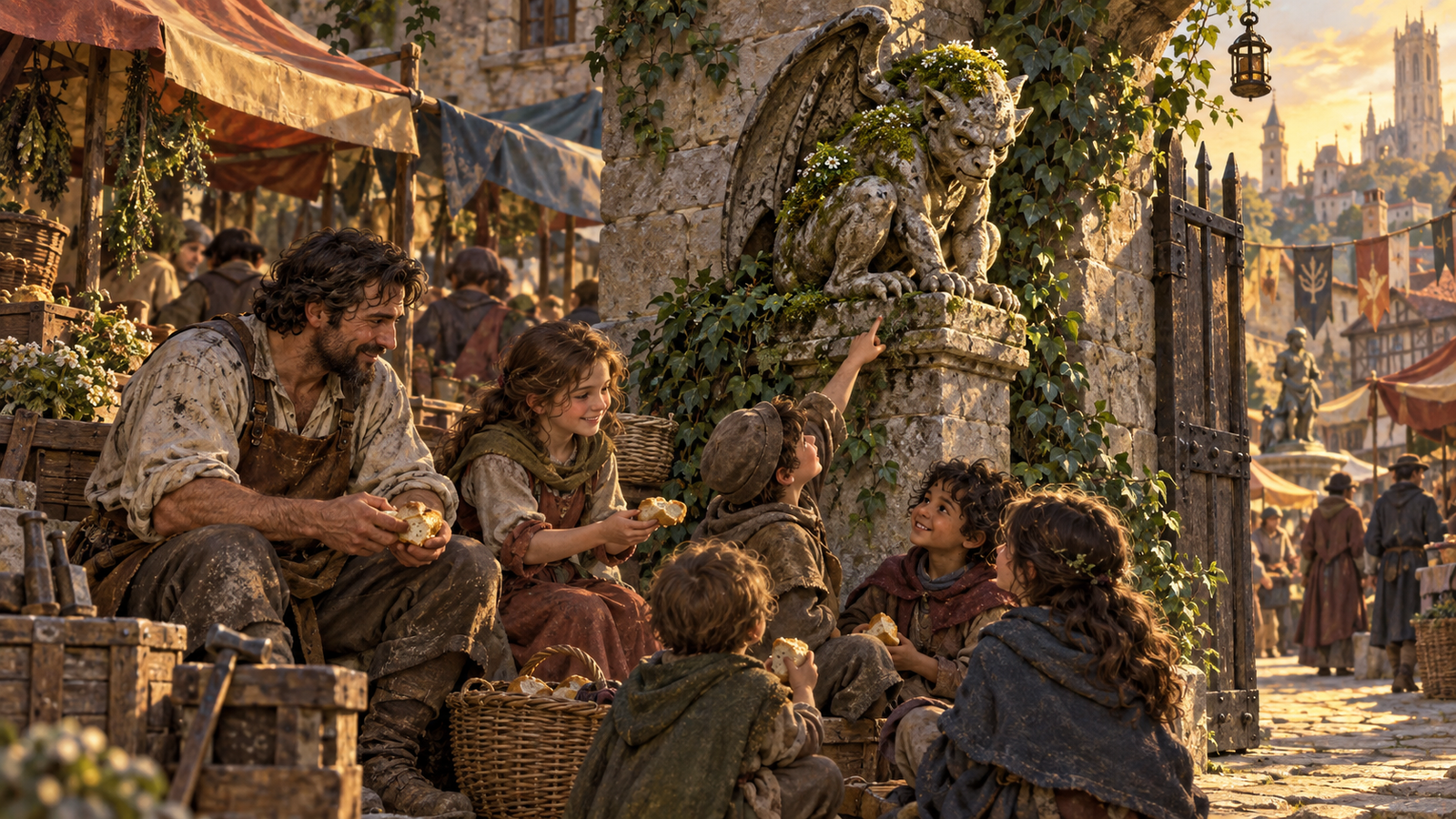
Mossgate Gargoyle: the small gate kept
Stone above the market door
Orin was asked to carve a guardian for the palace gate. The steward wanted a face that would make visitors feel small before they reached the steps: horns, fangs, a crown of stone, and wings spread wide enough to cast a shadow across the road. Orin listened, measured the arch, and said he would return with a design. Then he went to the market square, where his daughter Nadi was waiting for him beside the side gate.
The market gate was only tall enough for a cart and its driver. It opened toward a lane where sellers brought baskets before sunrise and children cut through on their way to lessons. Its lintel had a crack at the left corner. The neighborhood had asked the palace steward to repair it twice. Each time, the request was moved to another ledger. Orin saw the crack and the children beneath it. He saw how they hurried under the stone when a wagon came through, keeping close to the wall so the wheels would not catch their heels.
He carved the gargoyle for that gate instead. It was smaller than the palace wanted, with folded wings and a broad back curved like a roof. Its face looked fierce from the street, but Orin left the eyes round and slightly curious. He carved claws that could grip the stone and gave the creature a lowered head, as if it were watching the lane rather than judging the people who passed through it.
Orin had worked on statues before, but he had never made one for Nadi. Her mother had died when the girl was small, leaving Orin to raise her above a workshop that smelled of wet limestone. He did not talk about grief as if it were a lesson. When Nadi missed her mother, he sat beside her. When she asked whether a carved guardian could feel lonely, he said he did not know. He could make it look as if it were listening.
The market children began visiting the workshop while the stone was still rough. They asked whether the gargoyle could fly. Orin said no; its wings were carved into the body, and it was much too heavy. They asked whether it could bite thieves. Orin said it would never know which person was a thief. Nadi asked what it could do. Her father tapped the stone above the gate and answered, “It can stay where someone needs a watcher.”
When he installed it, the market families paid him in small shares: a sack of flour, a repaired kettle, a week of meals, two new hinges, and enough coin for the stone. Orin refused to put his name on a plaque. He wrote the names of the families in his work ledger instead. They had all paid what they could. The gargoyle belonged over the market gate, not to the mason who shaped it.
The children named it Mossgate because it watched a gate where moss already grew between the blocks. The name stuck. In its first winter, a green patch appeared across its shoulder. Nadi pointed it out. The children counted the patches each spring, as if each one proved stone could change. Orin explained that moss needed water, shade, and time. The children decided those were exactly the qualities a good guardian should provide.
Nadi and the spring count
Nadi was not afraid of the gargoyle. She had watched her father carve it, had seen its unfinished face before the eyes were cut, and knew where the seam ran along its back. She was afraid of the crack in the lintel. The gate was busy at dawn, and the wagons often scraped one side as they passed. Orin told the steward that the arch needed repair. The steward said the gargoyle made the entrance look sturdier. Orin answered that appearance was not repair.
He added two iron braces beneath the lintel. They did not cure the crack, but they reduced the strain while the families waited for the promised masonry crew. Orin showed Nadi how the braces carried weight. She learned to look for dust falling from a joint, water collecting where it should drain, and a new line spreading through old stone. It was not her job to inspect the gate. Orin taught her anyway, because the gate mattered to everyone who used it.
The children invented a spring ritual. On the first warm day, they would gather at the gate and count the new patches of moss on Mossgate’s back. Sometimes there were two. Sometimes five. One year, after a dry winter, there were none. The children were disappointed. Nadi brought a small cup of water and offered to pour it over the gargoyle. Orin stopped her. Moss could not be hurried, and too much water would wash the spores away. They left the stone alone.
By the next spring, two new patches had appeared. Nadi announced that the gargoyle had made up for the missed year. Orin said the stone had not been keeping score. The children argued that it had. They began keeping their own count in a small notebook, noting weather, rain, and which side of the gate received shade. It became a lesson in patience without anyone calling it one.
The market was a place where people passed without knowing one another. Nadi knew who sold pears, repaired shoes, and saved broken vegetables for soup. Mossgate watched them all. Its severe face discouraged careless drivers, yet the children spoke to it while waiting.
Nadi sometimes brought her lunch beneath the arch. She told the gargoyle what had happened at school: the teacher who mixed up her mother’s name with someone else’s, the girl who said a market child should not speak to a palace guard, the day she had passed an arithmetic test without asking Orin to check it. She did not expect a reply. The stone was a place where she could finish a thought without being interrupted by advice.
Orin noticed. He asked if she wanted him to make a smaller figure for the workshop, one she could keep at home. Nadi said no. She liked that Mossgate belonged to the market. Her father nodded. He had learned that protecting someone did not mean deciding what they should keep.
The living line
The market gate was not a royal threshold. It was a route to bread, cloth, medicine, and work. When a cart came through, people stepped aside; when a child was lost, a seller watched for the family. The cobbler spread grit on the slick lane. Everyone helped keep the passage open.
Mossgate’s stone did not move or tell a driver to slow down. The children stopped running under it when wagons came and learned to look up for dust. Drivers learned that its claws marked the arch’s narrowest point. The gargoyle did not make danger disappear; it gave people a point to notice together.
Orin continued asking for the lintel to be repaired. He brought the steward a sketch of the crack and a list of the carts that had scraped the brace. The steward said the palace would fund the repair after the summer procession. The procession came and went, but the repair did not. Orin was angry; he needed the steward’s approval to keep his workshop contract, so he chose his words carefully and kept a copy of each request.
Nadi asked why her father did not simply refuse the palace’s next statue. Orin said they needed the work. She wanted a clean choice between doing right and doing wrong. He told her most hard choices arrived with other people’s needs attached.
The neighborhood organized a repair day. Families brought mortar, tools, and food for the crew. The steward objected that the gate was city property. A baker replied that the gate carried city people every day. Orin agreed to supervise the work, but refused to let anyone pretend it was an official repair. They would stabilize the arch now and keep the request open until the city accepted responsibility.
While they worked, Nadi found a tiny root behind the gargoyle’s right foot. It had threaded into a seam and stopped at the stone. She asked Orin whether it might split the carving. He checked the joint and found the root was following the mortar line, not forcing a new crack. He left it there. The root grew slowly around the base, holding dust and moisture in place. The children called it the gargoyle’s green rope.
The gate passed between ordinary hands. A new lock was installed and the left brace replaced, though the steward’s crew still had not come. Mossgate remained above the opening as the living line learned to ask for help and provide it. No one person guarded the market; the stone held a place where the community could meet.
The roof that caught fire
The fire began in the dyer’s shop on a warm evening when the market was closing. A brazier had been left too close to a stack of oilcloth. By the time anyone saw the smoke, a flame had climbed the hanging fabric and reached the roof. The market bell rang. People came out of houses carrying water buckets, but the wind pushed sparks across the awnings.
Orin was at the workshop. Nadi was at the far end of the square with two younger children, trying to get them to the river stairs. The closest open route ran through the market gate. The other exit had been blocked by a cart delivering timber. The lane beneath Mossgate filled with people moving away from the smoke. Some were carrying parcels. One woman had a sleeping baby against her chest. An old man stopped in the middle of the arch to catch his breath.
Nadi did not shout that the gargoyle would save them. She shouted for people to keep moving, leave the baskets, and stay to the left of the brace. The children who had counted moss helped guide families through. The old man was carried by two sellers. The baby’s mother kept her head low beneath the smoke. The gate was narrow. It took time.
The roof above the dye shop collapsed. A beam struck the arch’s outer stone and cracked the lintel. The iron brace bent. Mossgate shifted in its perch. Orin reached the square and saw the people still beneath the gate. He called Nadi’s name. She answered from the far side, then turned back toward a boy who had dropped his shoe.
Orin wanted to run under the arch and carry her out. He knew the stone was failing. A market seller caught his arm and asked whether the brace could hold. Orin could not promise that. He looked at the crack, watched the dust, and told everyone to move in pairs. The gargoyle had no power to judge who deserved to pass. It could only keep the gate open long enough for them to choose.
The stone creature leaned forward. The iron brace took part of the load, and Mossgate’s broad back pressed into the lintel. The old carving cracked down one wing. Pieces of moss-covered stone fell into the lane, but the opening stayed wide enough for the last families to pass. Nadi reached the far side with the boy and his shoe. Orin followed after her.
The gate gave way as the final family cleared it. The lintel fell across the street, blocking the fire from spreading into the far market row. Mossgate shattered against the stones. Its face broke into three large pieces and many smaller fragments. The iron brace snapped. The green rope of roots pulled free, dragging moss and soil with it.
No one died in the arch. Several people were burned or bruised by the fire, and the dyer’s shop was lost. Nadi’s hands shook after she reached her father. Orin held her and did not tell her that the gargoyle had saved them as though it had made a decision like a person. He said the gate held. She replied that the gargoyle had held it. He had no reason to correct her.
Pieces in the ash
The morning after the fire, the market smelled of wet stone and smoke. The families formed a line to pass buckets, clear debris, and move the injured to the ward clinic. The gate lay broken across the lane. Orin wanted to begin lifting the pieces, but the steward arrived first with an order to remove them from city property. He said the fragments could be reused in a palace ornament once the square was rebuilt.
Nadi heard him call Mossgate “decorative stone.” She asked whether he knew how many people had passed through the gate the night before. He said the emergency was over. She asked whether the families had all been decorative too. The steward did not answer. Orin asked him to wait until the pieces were sorted and the market had agreed what to do with them. The steward said he could not promise that.
The children gathered the smaller fragments. They knew the shape of Mossgate’s paws and the chipped corner of one ear. They put the pieces in baskets and wrote the location where each had been found. The grown-ups carried the heavy sections. Nadi found the head beside the old brace. Its stone eyes were still open. She sat beside it until the market had finished clearing the lane.
At dusk, the first root appeared through a crack in the largest fragment. It was thin as thread and pale from being buried. By morning it had reached the moss at the edge. The children thought the gargoyle was growing back. Orin said stone did not grow the way flesh did, and roots did not mean the carving would become whole. Nadi said she knew. She could still be glad the root was alive.
That night, people who passed the ruined square heard a scrape behind them. A fragment shifted toward the gate whenever someone approached from the fire-damaged row. When a child crossed alone, the smaller stones rolled into a low line beside the opening. Nobody saw a complete gargoyle rise. The pieces simply turned as if they had remembered where they belonged.
The spirit had not left with the broken body. It was still watching the passage. The last thing Mossgate had done was hold the arch while people moved through it. The fire ended; the watch did not. In its memory, the market lane remained filled with people who needed a clear way out. It had no way to understand that the danger had passed and the living were rebuilding elsewhere.
Nadi returned the next evening with a jar of water for the roots. She did not pour it over the stone. She placed it in the shade nearby. The fragments did not move toward her. She set the head upright against the wall and told it the market had opened at the east entrance. The next morning, that piece had turned slightly toward the new route.
Orin understood then why the spirit remained. It was not anger at the fire or at the steward. It was not trying to punish the people who had let the gate fail. It was holding a place open because its final purpose had been a passage, and it had not yet seen another safe passage take its place. The roots entering its cracks did not trap it. The unfinished duty did.
A gate made somewhere else
The market reopened at the east entrance. The new route was longer, and the timber cart still had to be moved before dawn. A temporary footbridge crossed the alley where Mossgate had stood. Nadi helped paint arrows on the walls so that visitors could find it. Orin built a wooden rail for the steepest section. Families carried the old market bell to the new entrance and rang it when they were ready to open.
The steward wanted the gargoyle’s remains taken to the palace. The market committee asked to keep them. He said the carving had been paid for through the city contract. Orin showed him the ledger: the neighborhood had bought the stone and paid the labor in goods and coin; the contract covered only the iron brace. The steward asked for the original receipts. Nadi found them in the workshop chest, stained by flour and marked by the cobbler’s awl. The gargoyle had never belonged to the palace.
They chose not to rebuild the exact gate. The arch had been unsafe before the fire, and no one wanted a memorial to become a second hazard. Instead, the market built a lower stone opening with wider clearance and a timber canopy. The broken gargoyle fragments were placed along its sides at ground level, where children could see the moss and roots. The head faced the lane, not the palace road.
At first the spirit continued moving fragments into the center of the passage. People tripped over them. The children moved them aside and told Mossgate the new route was open. Nadi left the market bell ringing softly in the afternoon. The gargoyle’s face turned toward the sound. It did not follow the bell, but the roots near its base extended toward the new stones.
The family made a plan. Each evening, one person would walk the route from the old gate to the new entrance, carrying a lantern. The children would show the spirit where people now passed safely. They did this for a week. They did not expect a ghost to understand a schedule. They did it because repetition had helped the gargoyle learn the old market’s rhythms while it was alive.
On the seventh evening, Nadi walked the path alone. She started at the broken arch, passed the old lintel, followed the painted arrows, and stopped at the new gate. When she turned back, the largest fragment had not moved. Its face remained aimed toward the old passage. Nadi felt disappointed. Then she noticed that a small shard had rolled beside her foot, pointing toward the new route.
The spirit was learning that guarding could mean letting people leave one place and arrive somewhere else. The market committee agreed to keep the fragments on both sides of the route, rather than gather them into a single statue. Mossgate did not need a complete body to keep a watch. Its pieces could be placed where the market actually needed them.
The roots under the stone
The first full spring after the fire brought a thick green layer across the gargoyle’s back. The new gate cast enough shade for moss to grow on several fragments. The children counted each patch as before. They started from the largest piece and continued around the entry stones. The number changed whenever a fragment was moved or a root found new ground. Their notebook included the location of each patch, so nobody would mistake one stone for another.
Nadi had grown old enough to take work outside the market. She trained an apprentice mason named Pell and asked him to inspect the new lintel each month. He had a talent for measuring walls and a tendency to trust any structure that looked old. Nadi taught him to check the joints rather than the surface. She showed him the crack that had been ignored and explained why the repair requests mattered.
Orin’s hands weakened. He could still draw plans but no longer lift heavy stone. He sat near the new gate and watched the children count moss. He did not tell them they were wrong when they said Mossgate had returned. The fragments had returned to a useful place, even if the original carving could not be restored. He understood the word differently now.
The spirit appeared most clearly at the edge of the lantern light. It was not a whole stone creature. Its outline gathered from moss, dust, and the shadow beneath the canopy. It never spoke. When someone carried a heavy basket, it shifted to leave room. When a cart approached too quickly, the roots tightened against the stones. When the children walked through with chalk and notebooks, it stayed still.
The market learned not to depend on Mossgate for every safety. The gate still needed inspection. The road still needed a warning bell. Drivers still had to slow down. If a fire started, people had to move. The gargoyle could not replace a plan or keep a roof from burning. Its presence reminded the families that protection was made of many ordinary choices and that no single guardian could carry them all.
One autumn, the steward returned with a new request. He wanted to remove the fragments and build a palace arch from the stone. The market committee refused. The steward produced a contract naming Orin as the maker. Nadi produced the neighborhood ledger naming the families as contributors. The dispute went before a city clerk. He decided the fragments could stay because the city had never purchased them outright.
The steward left without the stone. He was not defeated by a monster. He had encountered neighbors who had kept their receipts. Mossgate’s fragments did not move. That night, the roots thickened around the largest piece and reached toward the new lintel. In the morning, a small patch of moss had appeared on a stone that had been bare since the fire.
Nadi put the change in the notebook. She wrote the date, the weather, and the names of the people who had attended the hearing. The guardian’s story had always belonged to the market. Recording that fact was part of guarding it.
The Ledger Crow gathers the fragments
The Ledger Crow came to the market when Nadi was old enough to have gray in her hair. It found her beneath the new canopy, checking the gate’s stonework with Pell. The Crow asked if it could hear what happened to Mossgate. Nadi said yes, but the market committee should be asked too. She did not want to speak as if the guardian were hers alone.
They brought out the work ledger, the children’s moss notebook, the repair requests, and the account of the fire. The Crow read the names of the families who had helped build the original carving. It read the names of those who cleared the route during the fire. It read the list of fragments and where they had been placed. The papers did not agree on every detail. Some said the lintel broke before the gargoyle shifted; others said the statue had moved first. No one could know the exact order.
The Crow wrote down the uncertainty. It recorded that the fire began in a dyer’s shop and that a roof fell near the market gate. It recorded that everyone made it through the arch before it collapsed. It recorded the injured and the lost goods without calling the destruction a victory. Mossgate had held the opening, but the market had paid for that time in homes and work.
The Crow asked Nadi what kept the spirit among the living. She said the gargoyle had been made to watch a passage, and its final act had been to hold that passage open while families escaped. It remained because it did not know the evacuation was complete. Even after the route moved, it stayed turned toward the old gate. The living had given it a new way to guard, but the spirit needed a record of that change.
The card would let the gargoyle appear where a player needed a defender. Nadi asked whether it would still protect the market. The Crow said the folio would carry the story, while the roots and stones remained there. The soul could answer calls in a match and still belong to the memory of its old home. A card was a path for the spirit’s presence, not a deed to the place it had guarded.
Mossgate’s printed rule was simple: Guard. It forced an opponent to confront the defender before attacking a more vulnerable target, as the small gate guardian had stood between the market lane and danger. The Crow would not add immunity or a promise that every ally behind it would survive. A guard could be damaged, removed, or bypassed by effects that did not follow ordinary attack rules. Its duty was meaningful because it changed the choice, not because it made harm impossible.
Nadi asked the Crow to include the spring moss count. The children’s notebook, now filled with drawings and weather notes, was added to the folio. She asked it to write that the market had built a new gate instead of trying to restore the old one. The spirit watched her place the notebook beside its largest fragment. The Crow left the page open until the roots stopped moving.
What the stone can promise
Mossgate Gargoyle costs 4 energy and has 2 attack / 6 health. Its exact effect is Guard. An opponent must attack a ready Guard creature before attacking your champion or a different creature through ordinary unit attacks. The gargoyle does not grant armor, heal allies, or prevent spells from targeting them. Its large health total helps it occupy that role, but it can still be removed.
Play Mossgate when you need to protect a valuable creature or make an opponent spend an attack on a defender first. If your champion is under pressure and the Gargoyle is ready, its Guard can change the order of attacks. If you have a creature whose effect matters next turn, placing a defender in front may buy time for that ability to matter. The opponent can still use a spell, a trap, or another legal effect to answer it, so do not treat the board as sealed.
The Gargoyle’s 2 attack means it is not a fast way to remove a large enemy. Its 6 health is what lets it remain in the path. Suppose you have a 2/3 support creature and the opponent has a 4/4 attacker. If the Gargoyle is ready, the opponent must deal with it before using an ordinary attack to target the support or your champion. The attacker will damage the Gargoyle, while the Gargoyle deals 2 back. That exchange may buy a turn, but it may not defeat the attacker. Consider what you will do with the time.
Guard only works while the creature is able to guard under the game’s readiness rules. If Mossgate has attacked and is no longer ready, do not assume it can intercept an attack before it readies again. You may choose to keep it back when the opponent has a dangerous turn coming. Likewise, if the opponent has a removal spell that does not require an attack, Guard may not protect the target you care about. Watch the opposing hand, open energy, and known effects.
The card can support a slower plan. You might use the time it buys to heal, draw, or play another creature. It can also make your opponent decide whether to spend removal on a defender or accept that their ordinary attacks must go through it. If the board already has a stronger Guard, adding Mossgate may provide redundancy, but it could also leave you short on ways to pressure the enemy. Build around the protection you need, not just the comfort of a high-health creature.
Its story is not a promise that stone never breaks. Mossgate shattered. It did not stop the fire, save the market’s goods, or restore the old gate. It did hold the arch long enough for every family to pass. In the game, Guard is similarly precise: it changes the opponent’s attack choice while it is ready. That is enough to matter, and not enough to make anyone invulnerable.
The gate that learned to move
Nadi kept the gargoyle’s fragments around the new entrance until she could no longer visit each morning. The children continued the moss count. Pell inspected the lintel. The market committee kept the repair requests and paid the masons when the city did not. Nothing about the work was grand. It was a set of tasks people remembered to do because the gate served them.
On the day the Crow carried away the card folio, the market opened as usual. A baker came through with warm loaves. Two apprentices argued about whose turn it was to sweep the lane. A cart slowed beneath the canopy. The roots lay quiet against the stones. Mossgate’s spirit remained near the old passage, but its face no longer pointed only toward the fire-damaged arch. It had turned toward the new route where people were walking safely.
Orin had once carved a fierce face because he thought children deserved a guardian as imposing as any king’s. Nadi learned that safety came more often from a repaired brace, a clear signal, a widened path, or someone who noticed a child had dropped a shoe. The gargoyle’s strength had not been its frightening expression. It had been the place it chose to hold.
The Crow recorded the name Mossgate Gargoyle, though the market had never agreed whether “Mossgate” belonged to the stone, the gate, or the whole square. Nadi liked that. The word held all three together. It described a guardian made by many hands, broken in a shared emergency, and remembered where the living still passed.
The card traveled into matches beyond the city. When it entered a field, it did not carry the full market, the fire, or the children’s notebook. It carried a soul that knew how to occupy the dangerous space between a threat and someone who needed more time. The Crow’s page let players call on that duty without pretending it had been simple or that the stone could keep every promise.
At spring, moss appeared across the back of the largest fragment. The children counted it aloud. They wrote down the date, checked the new gate’s brace, and went to school. The stone watched the route, but the living carried the rest of the work. The passage stayed open because both had learned to stand in their proper places.
At the table
Printed effect: Guard.
A creature built to hold the line
Use it when your champion or a valuable ally needs a defender on the field.
One move, shown
An opponent wants to reach your champion while this creature is ready.
Spend 4 energy to play Mossgate Gargoyle. Apply the printed effect exactly as written.
Play it before committing a fragile support creature. Guard changes which target the opponent must answer first.
The example explains a legal choice, not an additional card effect. Check the live game for current targeting and timing.
Chibi mode
This is the current game’s chibi rendering of Mossgate Gargoyle. The alternate art changes presentation, not the printed card rules.