Mourning Piper
3 energy · 2 attack / 4 health
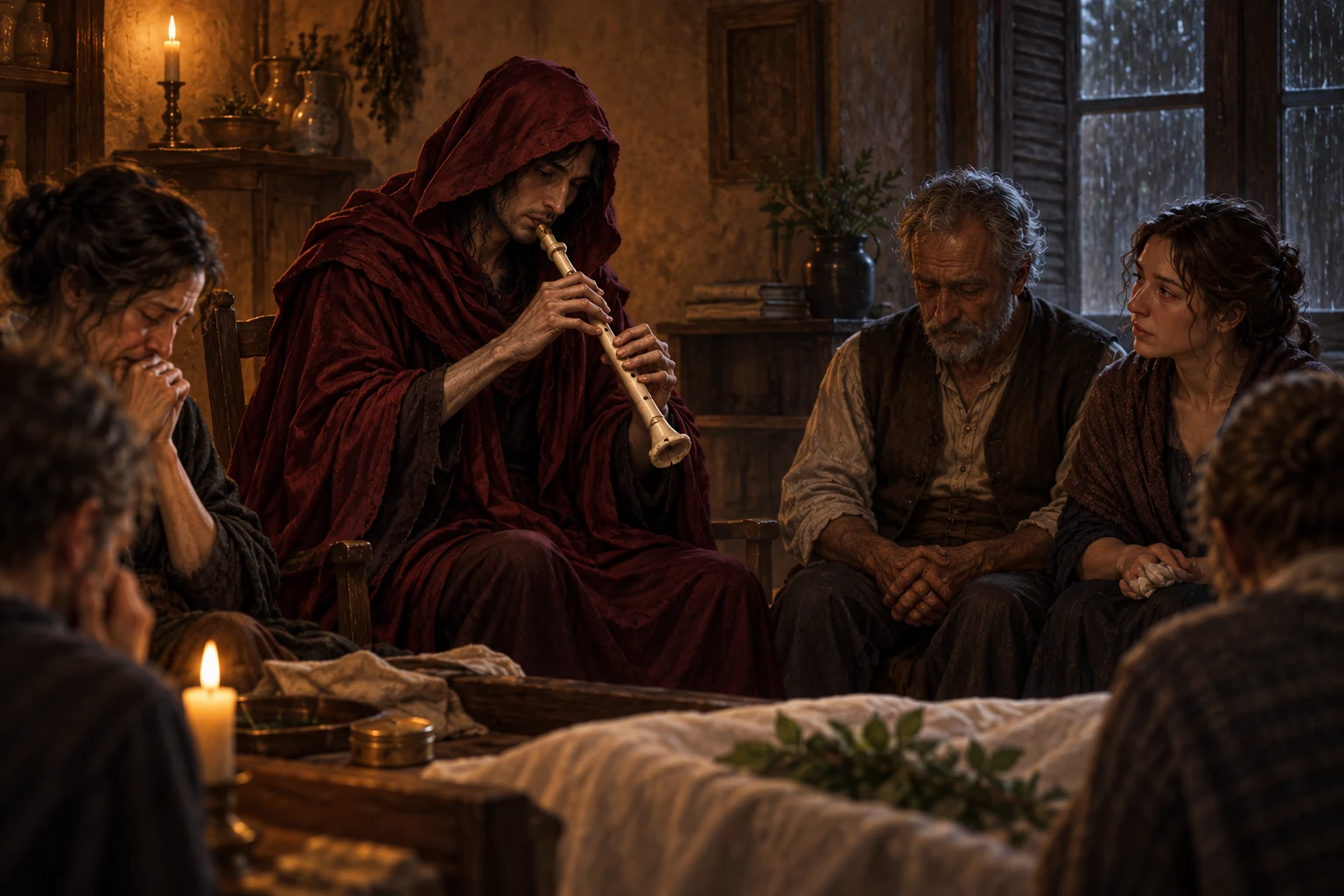
A Name Beneath the Last Note
The room above the repair stall
Tavian Sorn grew up in a narrow room over his mother's wind-instrument repair stall, where every cupboard door seemed to hum when the river wind came from the east. His mother, Rova, could hear a cracked reed before a customer reached the counter. His father, Halen, made wooden fittings and mended chairs for the wake rooms along the lower ward. Their younger daughter, Miri, could name every bird that nested under the eaves, while Tav could tell which one had returned by the shape of its pause. The family was not wealthy, but the stove worked, the door shut, and somebody was always expected home.
Rova taught Tav the difference between a broken instrument and one that was merely out of tune. She never let him force a peg when a little patience would do. Halen taught him how to sand the rough edge from a chair rung, because mourners leaned on furniture more heavily than they knew. Neither parent called these lessons music. To them, repair meant giving a thing enough room to be useful again. Tav grew up with that idea before he understood that people, too, could need room after something had ended.
He was a quiet child without being shy. He could spend an afternoon fitting cork into a cracked flute joint and then ask a customer a question that made them stop at the doorway. “Would you like it to sound like it did,” he once asked, “or like you need it to sound now?” Rova laughed at the careful phrasing. The customer did not. She came back a week later with a repaired instrument and told Tav that nobody had asked her what she wanted since her husband died. He remembered the difference between being helped and being decided for.
The night Halen did not come home
Halen died when a freight stair gave way beneath him at the lower quay. The fall was not a grand accident or a tale anyone had meant to tell. A wet board slipped from its bracket while he carried a box of repaired chair legs to the wake house. He was taken to a room above the ferry office, and Rova reached him before the night watch changed. Miri waited on the steps with a blanket. Tav stood beside her, counting footsteps in the corridor because no one could tell them how long the doctor would be.
Halen woke once before dawn. He asked whether the chairs had made it to the wake room, then told Tav not to tighten the pegs on the old flute too much. He did not know that this would be their last conversation, and Tav did not know what to ask. By the time Rova called the family closer, Halen had gone quiet. His hands still smelled faintly of cedar shavings. Miri leaned against her mother's side. Tav looked at the closed door behind them and felt the awful strangeness of a room that still contained all the objects but no longer the person who had used them.
The family could afford a small burial, not the paid procession Halen had once repaired chairs for. The clerk offered them the least expensive route: a cart at noon, one hired bell, and no street musicians. Rova signed because she wanted her husband laid to rest before the next rain. Tav watched the form turn his father's life into three boxes and a fee. Miri asked whether Halen would know that they had come. Rova told her, honestly, “We came. That is what we can promise.” Tav kept the paper because he could not think of another place to put his anger.
The first bone flute
In the days after the burial, Tav found a clean sheep bone among the offcuts a butcher had given Rova for glue and tool handles. He washed it, boiled it, and sanded it until the surface no longer caught on a cloth. His mother showed him how to drill the holes without splitting the narrow shaft. Halen had once saved a small brass ring from a broken chair fitting; Miri polished it and slipped it onto the end. The flute had no claim to being beautiful. It was simply a thing the three of them had made together when the paid bell could not stay long enough.
Tav tried to play a tune from the wake, but each attempt sounded too much like a performance. Miri was sitting on the floor with her knees against her chest. He stopped. Instead of forcing the melody, he blew one low note, waited until its edge disappeared, and left the silence intact. Miri's shoulders lowered. Rova, at the table, let out a breath she had been holding. Tav understood that the note had not fixed anything; it had made a small place in which nobody had to explain how hurt they were.
He carried the flute to the quay the next morning and played the same note beside the freight stair. The river answered with its ordinary slap against stone. A gull complained from the roof. He felt foolish for expecting something else, then less foolish when he noticed that a dockworker had stopped to listen. The man had worked with Halen and could not attend the burial because his shift had been docked. He stood beside Tav without speaking. They remained until the cold entered their fingers, then went to work. That was the first time Tav learned that quiet company could be a kind of music.
A wake without a procession
The first person outside his family to ask for the flute was an old neighbor named Selvi, whose brother had died in a rented room. The brother had no local papers, no savings, and no relatives able to pay the route fee. Selvi had gathered six people around a kitchen table. She asked Tav not to play a funeral song. She wanted something gentle enough that the children could finish their soup. He played two notes with a long space between them. Nobody marched. Nobody had to stand. A little boy ate, then cried into his sleeve when the bowl was empty.
Selvi tried to pay Tav with coins wrapped in a dish towel. He refused the coins, then reconsidered when he saw her face close. “Keep them for the room,” he said. She insisted on giving him a spool of thread instead, because it had been her brother's. Tav accepted it. Rova later told him that refusing every gift could make another person feel that their offering was shameful. He put the spool beside the flute case. It became the first object he kept from a wake, though not the last.
Word passed slowly, the way small useful things do. A tenant on Lantern Street called him after her uncle died. A baker asked if he could sit with the family after closing. A carter wanted no tune at all but asked Tav to stay while he folded his wife's coat. Tav began asking the same three questions: who should be remembered, what sound would feel welcome, and whether silence would be better. If a family chose silence, he did not play. No one had to earn his presence by accepting it.
Ossa's room
Ossa Venn kept a plain room behind a shuttered dye shop, where neighbors could sit after a death without renting a hall. She owned six mismatched chairs, a kettle that whistled too early, and a stack of clean cups that never matched. Ossa had once worked as a paid wake attendant, but she left when the company began charging families for every extra hour. She did not call the room charitable. She called it available. Tav met her when he arrived for a wake and found her waiting outside, asking whether the family had requested music or only a witness.
Ossa was older than Tav by a dozen years and more direct than anyone in his family. She told him that a melody could comfort one person and make another feel watched. Tav admitted he was afraid of getting it wrong. Ossa answered that he would get it wrong sometimes, and the important part was to stop when someone asked. She taught him to watch the room rather than his own hands: the person who shifted away, the child who leaned closer, the cup that stayed untouched. He learned to let his playing follow what people chose in the moment.
They became friends through the work and through what came after it. Ossa saved him a bowl of lentils when he arrived late. Tav mended the room's broken flute stand. They disagreed about whether a grieving family should keep every object left behind. Ossa believed a worn cup could be returned to the kitchen. Tav believed a cup someone had held might become important after the person was gone. Neither tried to win. Their friendship made space for a difference without turning it into a test of care.
One melody at a time
Tav never used one tune as a shortcut for another person's grief. He kept a small notebook, not of complete melodies but of shapes: a falling third for the baker who liked rain, two low notes for the dockworker who could not sit still, a breath with no pitch for the child who said the room felt crowded. The notebook did not include names unless the family wanted them written. It was not a ledger of who had died. It helped Tav remember what a living person had asked him to do, and it could be changed whenever they asked.
If he had met a mourner before, he still asked what they wanted this time. A woman named Hessa once asked him to play the same melody she had requested for her sister, then stopped him halfway through. The tune had been right last year; now it sounded like a door closing. Tav lowered the flute. Hessa asked for a cup of tea and told her story instead. He sat through the telling. The next week she asked him to play the old melody again, but slower. He never treated either choice as a contradiction.
He also made mistakes. At one wake he began too soon, while the family was still expecting a late arrival. The first note fell into the room like an interruption. Tav stopped immediately, apologized, and put the flute away. The family let him stay after he asked if they still wanted him there. He learned that an apology did not obligate the other person to comfort him. Later, when the youngest daughter asked for a note, he played it softly by the window, where she could listen or turn away.
Miri's second life
Miri grew into a careful girl who could see a missing line in a form before she could see a loose thread in her sleeve. She hated that their father's burial papers had reduced him to a fee and a route. As an adult, she took a job copying rent payments and notices for the ward office. She did not believe the office was fair, but she wanted to learn how it made its decisions. Tav worried that she would lose herself in its rules. Miri worried that he had mistaken refusal for freedom. They loved each other and did not always agree about what helped.
Once, Miri asked Tav to play at a small wake in her building. He recognized the family from her ledger. The deceased's name had been copied incorrectly, and Miri had spent three days trying to get it corrected. Tav asked whether she wanted music or wanted help with the paperwork. She said both, then sat beside him while he wrote the name exactly as the family had spoken it. She did not ask him to perform a tune. He remained at the table until the form and the tea were both finished.
There were years when Miri left before the wakes ended, and years when she returned to their mother's apartment carrying a stack of corrected records. Tav sometimes thought she had chosen the office over the people it overlooked. She sometimes thought he had chosen the symbolic comfort of a note over the practical work of changing a form. When they argued, they found their way back through ordinary things: the old brass ring on his flute, a loaf wrapped in paper, or the way their mother set a chair for both of them even when they arrived separately.
The book kept in a coat
Rova gave Tav a small weatherproof notebook after the first winter his flute developed a crack. She asked him to use it for names, but only names people wanted carried. He wrote the chosen name, a pronunciation, and one detail the mourner approved: “loved the pear tree,” “always took the last watch,” “could not bear boiled turnips.” He did not write the cause of death or what the family had whispered after the room emptied. Rova said memory could be generous without becoming a public record. Tav put the notebook in the inside pocket of his coat, next to the flute case.
At first, he copied names only at the family's request. Some did not want anything written. Others wanted the name spelled as it had been before a landlord or clerk had simplified it. One family asked him to include the person's chosen name and omit the one on their papers. Tav did so without debate. When the city forms offered no place for that choice, he did not pretend his notebook could replace the form. He could keep a name safe for the people who gave it to him. He could not make a private page into a public right.
The work changed him in small ways. He stopped assuming that a wake had one correct order. He noticed how often a family needed a chair more than a melody, how a child could be ready to laugh while the adults were still unable to look at the door, and how a person might want to tell the same story twice. Tav began carrying a folding stool and a spare cup. The flute remained his signature, but it was never the whole of what he brought.
A city asks for silence
The Stillness Order came after a crowded wake blocked the lower bridge during a night market. A cart turned sideways, a guard was injured, and the ward council issued a rule against public music after dusk. The announcement described noise as the cause, though the jam had begun when the bridge was narrowed for repairs. A paid procession could still apply for an exemption. Families using Ossa's room could not. Tav read the notice twice, then folded it carefully and put it in his notebook. He knew who would be asked to pay for quiet.
Miri said the order was written too broadly and should be challenged through the ward office. She offered to help file a petition. Tav agreed to bring names, but he would not give the office the private details families had entrusted to him. Miri thought the council would dismiss a petition without examples. Tav thought the people named in those examples should decide whether they wanted to be used. They set the argument aside and asked Ossa to speak with the families first. Most wanted to sign; several did not. The petition went forward with only the names people had chosen to share.
The council denied it. The Stillness Order stayed in force, and the bridge repairs continued through another season. Tav obeyed the public curfew. He no longer played outside the ward rooms or along the route home. Inside a private room, he asked the host whether any music was wanted and used only a soft note that could not carry to the street. If the family worried about a fine, he kept the flute closed. He hated how often care had to be measured against a rule, but he did not make the mourners bear the cost of his defiance.
What the rule counted
The order did not make the city quiet. Market bells still rang, carts still crossed the bridge, and the paid cemetery procession still received its permit. What disappeared were the small sounds from rented rooms and courtyards: an aunt humming to keep a child from watching the doorway, a neighbor tapping a cup to announce tea, Tav's two-note invitation. The rule counted volume more easily than it counted who had been left without a ceremony. Miri saw the same pattern in her forms. A missing name did not trouble the record until someone had enough standing to demand it be found.
Miri's work brought her more than a dozen correction requests that winter. She could not fix every line, but she learned which clerks would listen if a person came in with a witness. Tav helped the families rehearse what they wanted to say. He sat with them while Miri explained which papers mattered and which did not. They did not always succeed. They did learn to tell the difference between a failed form and a failed person. Tav began to understand that a gentle song could accompany a name, but it could not write the name into a register that refused to see it.
He and Miri argued again after one petition was rejected. Tav said the city had trained itself to hear only the voices that could afford a hall. Miri replied that a private list might preserve a truth but could not force a clerk to change an entry. Their mother poured tea between them and refused to let either turn disappointment into a verdict on the other. Miri stayed for supper. Tav walked her to the river stairs, and they parted with no resolution except that each would keep doing the work they could reach.
Esa Drell
Esa Drell washed linen for three households and slept in a small room above the closed dye shop. Ossa knew her as the person who returned lost buttons in a paper envelope. Tav knew her because she once asked him to repair a flute that belonged to her late brother. She did not like wakes. When her neighbor's wife died, she had stayed in the hallway and folded towels until somebody asked her to sit. Tav remembered that about her, not as a flaw but as the way she stayed close when direct comfort felt impossible.
Esa lived a long, unremarkable life by the standards of the city's official stories. She rose before dawn, washed work shirts, kept mint in a tin cup beside the window, and saved every length of good thread. When she could no longer climb the dye shop stairs, Ossa brought her a chair near the ground-floor stove. The two women shared the room in short visits. Esa asked for no special attention, but she liked when Ossa read the market notices aloud and stopped whenever the words became too small to see.
After Esa died in her sleep, Ossa wanted a wake in the room where they had shared tea. The city register had no current address for her. The landlord had sublet the room without filing the change, and the ward office listed Esa only as an unnamed lodger. Ossa knew her full name. Miri could not find an entry to correct. The burial clerk offered the same reduced route Halen had received, with no public notice and no procession. Ossa accepted the burial arrangement, but she would not let the room become another place where Esa's name had never been spoken.
The last permitted wake
Ossa asked Tav to play at Esa's wake, knowing the order forbade public music after dusk. The gathering would be indoors, the shutters closed, and the invited people would decide whether a note was worth the risk. Tav asked each person separately. Esa's old employer wanted a tune. The woman from the next room wanted the flute kept away. A younger washer asked if there could be a moment for her to tell the story of the missing buttons. They agreed to make room for all three choices: silence first, a story, then one quiet melody if the room still welcomed it.
Miri came with a copy of the rejected register request folded in her coat. She did not promise to fix it. She brought the name she had written at the top of a blank correction form: Esa Drell. Ossa asked whether the paper should be read aloud. Esa's neighbors said yes. Tav did not play until every person in the room had heard the name and had a chance to add how they knew her. There was no single speech. There were small details: the thread envelopes, the mint plant, a habit of leaving a dry towel over the stove for whoever came in wet.
Near midnight, Tav played a melody he had never used before. It began with a low note, paused long enough for the room to breathe, then rose only a little. He did not repeat it. Ossa asked him to write Esa's name on the outer sleeve of his notebook, not inside the private pages. She wanted a trace that could be shown to the council without revealing the other families. Tav agreed. Miri copied the name onto the correction form. The wake ended without a fine and without permission. Nobody mistook that small reprieve for justice.
A name for the case
When the last guest had left, Ossa returned the flute to Tav in its worn case. She had tied a strip of gray cloth around the latch so it would not rattle on his walk. Tav tucked the notebook beside it. The order made the streets feel wider and emptier at night; every sound seemed to travel farther than it should. Miri offered to walk with him, but the ward office had opened early and she needed to deliver the correction request. Tav told her to go home to their mother. He would follow after he took the river road.
Ossa stopped him at the door. “Write her name where it can be seen,” she said. Tav thought she meant the notebook sleeve. Ossa shook her head. The sleeve could be lost, copied, or shut away. She took a small pencil from the room's drawer and wrote **Esa Drell** across the plain wooden case, above the brass ring Miri had polished years earlier. The letters were uneven but legible. Tav felt the case change in his hands, though it weighed exactly the same. For the first time that night, the missing name had a place that did not depend on a clerk's permission.
He did not ask Ossa to rewrite it neatly. She had written it as she remembered it, and the tremble in the final letter belonged to the moment. Tav thanked her, closed the latch, and let the cloth keep it quiet. Outside the room, the first rain had begun. He could still hear the last note inside his breath, not as a melody but as the small space that had opened after it. The name was now carried by another person. That mattered. It did not erase the years when the city had failed to carry it.
Tav's way home
The river road was slick with rain. Tav walked slowly, keeping one hand on the flute case and the other against the wall when the paving dipped. The cold found the old ache in his lungs, a sickness left by too many winters playing in rooms with damp ceilings and no fire. He had felt it worsening for months and had promised Rova he would see a doctor after the next petition was filed. The petition was filed; the doctor visit was not. He did not fall because the order had banned him or because the city had sent someone after him. His body simply had less strength than the walk required.
At the river stairs he stopped to catch his breath. The street lamps made long pale smears on the water. A rat crossed the gutter carrying something soft in its mouth, then vanished beneath a plank. Tav sat on the low wall and tried to breathe through the tightness in his chest. He could have called for help, but the nearest lit window was several doors away and he thought the pain would pass. He took out the case. The letters Ossa had written were darkening as rain touched the wood. He pressed his thumb beside the name to keep the water from blurring it.
When Tav did not reach home, Miri went back to the room and found him below the stairs. Ossa arrived before the watch did. Rova came wrapped in a coat, with Tav's old notebook held against her chest. They found no final speech in his pockets. They found the flute, the gray latch cloth, and Esa's name written plainly on the case. Miri asked whether her brother had been alone. Ossa said he had walked out with the room's care still around him. Rova held the case but did not open it until morning.
The note beneath silence
Tav's burial was small. Miri asked the ward office to enter his name correctly, and the clerk did so because he had a family member with a registered address and witnesses. She hated that the same help had not been available for Esa. Rova set out two cups at home and could not bring herself to put the flute on its usual shelf. Ossa brought the case back to the wake room, where she placed it on the windowsill beside the tin cup of mint Esa had kept there. The rain stopped before noon, but a single note continued under the room's quiet.
At first Ossa thought the sound came from a cracked window. She shut it and heard the note again. It did not come from the flute's holes or the wood; it seemed to rest in the narrow seam between the case and its lid. When she opened it, the sound vanished. When she closed it, the note returned. Rain had softened the name already written on the case, so Ossa traced the letters again with her pencil. Rova recognized the shape of Tav's last melody, the low pitch and the space after it. She asked Miri to listen. Miri heard it too, then put a hand over the latch as if she could keep the note from being taken.
The spirit had not gone beyond the mortal world. The missing public record, Tav's promise to carry Esa's name, and his final breath over the flute case had joined around one unfinished act. The name was now written, but the correction had not been accepted and the neighbors had not yet been able to keep Esa in the city's memory. Tav remained tethered to the wooden case and to the uncompleted work of making her name visible. The note was not a ghostly performance he had chosen to repeat. It was the last breath of a promise caught beneath a closed lid, holding his spirit where the living could hear it but could not release it.
What a name can and cannot mend
Miri carried Esa's name back to the registry with Ossa beside her. This time they brought witnesses and the line from the flute case, copied onto a separate sheet. A clerk accepted the correction request, then warned them that the city might take weeks to review it. The entry would not restore Esa's lost wages or give her a procession after death. It would at least stop the official page from saying that no one had lived in the room above the dye shop. Miri signed as witness, not as owner of the story. Ossa kept the original pencil sheet.
The note changed as they worked. Whenever somebody spoke Esa's full name in the room, the seam went quiet for a few breaths. When the conversation moved away, it returned. Rova understood that the writing had not released Tav because the name itself was never the whole burden. The flute had held the last sound of his promise, and the promise was to help the living remember a person the record had erased. The spirit remained caught between the printed absence and the corrected line, unable to know whether the living would keep the name once the form left their hands.
Rova wanted to open the case and set the flute beside Tav's grave. Miri asked whether that would free him or only silence him. Ossa reminded them that no one knew. They did not force the latch. They agreed to keep Esa's name in the room and continue the correction until the registry answered. For three evenings, neighbors came and spoke one detail each. Nobody asked the spirit to play. They let the note remain, quiet and unfinished, while the people it had served made the next choice themselves.
The Ledger Crow arrives
On the fourth evening, the council accepted Esa's corrected name. Miri read the official page aloud in Ossa's room. The note beneath the case faded; no one claimed to know what lay beyond the mortal world, only that Tav's promise no longer had to repeat.
The Ledger Crow came after the neighbors left. It asked Rova whether the door was open, then explained that it could preserve Tav in the official folio before the tether gave way. The card would keep him in the mortal world, not release him. Rova asked whether it would make his music belong to whoever drew it. The Crow said it could record a soul without owning the life.
Miri opened the actual Mourning Piper card from the game. Its printed figure wore Tav's red hood and held a bone flute. The spirit crossed from the wooden case into that official frame. The two armor points on entry were the card's rule, not a power Tav had used alive. The Crow wrote Tav's name beside Esa's. The card held him; Rova carried the flute home, and the living kept the names moving.
At the table
Printed effect: Enter: gain 2 champion armor.
Bank up to two armor with a 2/4 body
Mourning Piper is a 3-energy 2/4 Hollow with Veil affinity. Enter grants 2 champion armor, capped at 5 total. Armor absorbs incoming champion damage before health; it does not heal, protect creatures, or change the Piper's 2 attack and 4 health.
One move, shown
Play it before expected damage to your champion when you have room under the five-armor cap. It is most efficient when both armor points can be gained and a 2/4 body is useful on the field.
Spend 3 energy to play Mourning Piper. Apply the printed effect exactly as written.
If your champion has 3 armor and 12 health, spend 3 energy to play Mourning Piper: armor rises to the cap of 5. A later 4-damage hit consumes 4 armor, leaving 1 armor and all 12 health; the Piper remains a 2/4. Starting at 4 armor grants only 1, and starting at 5 grants none. Playing it after a hit cannot undo damage already taken.
The example explains a legal choice, not an additional card effect. Check the live game for current targeting and timing.
Chibi mode
This is the current game’s chibi rendering of Mourning Piper. The alternate art changes presentation, not the printed card rules.