Aubergine Warden
4 energy · 2 attack / 6 health
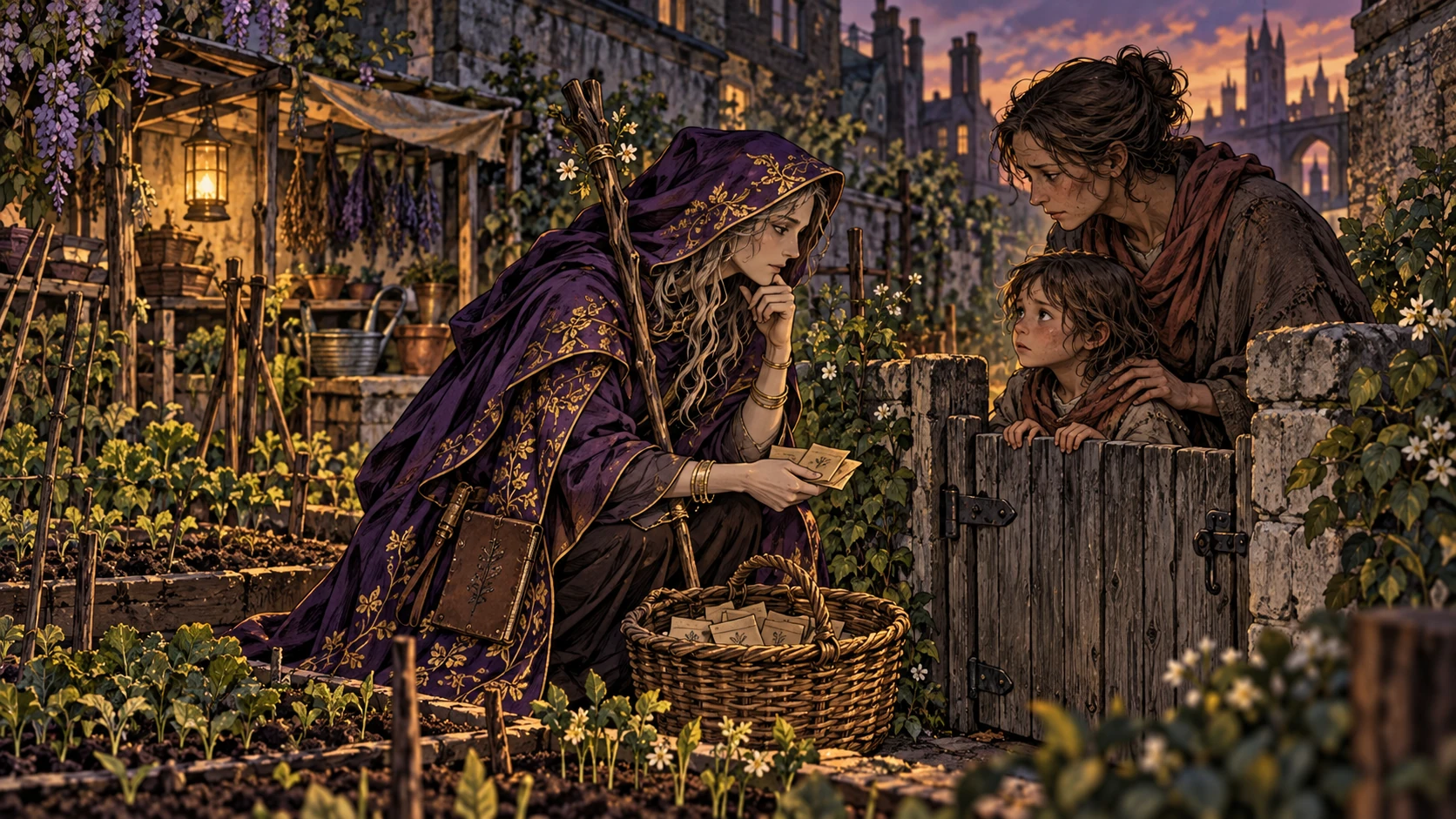
The Last Basket at the Open Gate
April twenty-seventh
The garden ledger records April 27 as Senda Daven’s birthday. Her mother, Anra, always said the date plainly and left the year blank. The family had been moving between rented rooms during that spring, and the clerk who kept births for the dye-house row had written only the day that Anra remembered. Senda never tried to repair the missing year with a guess. She kept the date because it was true as far as the people who loved her could make it true, and because she liked a calendar that admitted what it did not know.
April 27 falls under Taurus in the conventional Western zodiac, an Earth sign associated with patience, practical care, and attachment to what can be tended over time. Senda did not treat that sign as a prediction. She liked it as a fitting little note beside a birthday: she had always preferred a repair that lasted through weather to a promise that sounded grand for one afternoon. In the garden, she trusted slow roots, repeat visits, and clear terms. She was stubborn, but the people close to her learned that stubbornness often meant she had heard the cost of a decision before anyone else had counted it.
The official card would later call her Aubergine Warden. Neighbors first called her Senda, then “the seed woman,” and finally Warden after the common plot elected her to keep its keys and ledger. She wore an aubergine cloak cut from a discarded bolt at the old dye-house. Gold thread repaired one cuff; a narrow wooden staff helped her stand through long hours and mark the rows without stepping on seedlings. None of those objects made her a guardian by birth. They were things she chose, mended, and used to keep a place open.
The row by the dye house
Senda grew up in the poorer quarter where the old dye-house leaned toward the canal. Its outer wall was purple-black from generations of vats, and runoff had stained the stones long after the workers left. The row’s families learned to wash clothes in a side channel and to carry drinking water from a public pump uphill. A cart could pass through the lane only if neighbors moved their stools and crates. When a wagon was late, everyone knew before the official tally did; when a rent notice appeared, a whole row heard it read aloud through thin walls.
Anra Daven earned money repairing hems and washing cloth for households that could not afford new garments. She raised herbs in chipped cups on the window ledge, not because she believed every plant could cure sickness, but because a few leaves might calm a cough while someone found proper help. She taught Senda to ask what a person had already taken before offering a remedy. “Care can hurt when you guess,” she said. Senda remembered the lesson more clearly than any recipe. It would become the first rule in a different ledger.
The Daven room had one bed, one narrow table, and a window that opened only if someone lifted the frame. Senda slept beside the wall so Anra could reach the door. Her younger sister Avia slept across their folded coats and complained whenever Senda’s elbows crossed the blanket line. In the morning, they argued about who had used the last clean cup, then carried water together. Their closeness was not effortless. It was made from shared chores, small quarrels, and the habit of returning to the same table after both had cooled down.
Anra’s winter cups
When Anra’s lungs began to trouble her in the cold months, Senda turned the window ledge into a careful little nursery. She learned which herbs were safe to steep, which needed a healer’s advice, and which should never be given to children. Anra asked her to repeat the names and uses aloud. If Senda did not know, she had to say so. At first the admission embarrassed her. Later it became a kind of relief. She discovered that knowing the edge of her skill was more useful than pretending to have none.
Anra had kept a small envelope of seeds from a market stall, wrapped in cloth and marked with dates. They were not enough to feed a household. They were enough to begin something if the soil cooperated. Each spring, mother and daughters planted a few in broken cups. Most failed. One bitter green survived the first frost, and Avia named it “the captain” because it had outlasted everything else. Senda copied the planting date into a scrap book. Anra asked why. “So we know what happened,” Senda said, “not just what we hoped would happen.”
Anra died when Senda was still young. Her illness was not a curse, and no plant in the cups had been meant to save her. The family had found a doctor, borrowed money for medicine, and sat through every night they could. The treatment failed. In the week after the funeral, Senda took the seeds from the window and could not bring herself to open the packet. Avia found her at the table with the little book closed under both hands. She did not tell Senda to plant. She sat beside her until the two of them were ready to move.
Avia’s different answer
As they grew older, the sisters made different plans for their lives. Avia wanted wages she could count at the end of the week and a room with a door that locked. She found work stitching canvas covers for market carts and eventually moved in with a friend closer to the west road. Senda stayed near the dye-house row. She helped neighbors share small plots, but she did not claim to be born for it. She simply knew the names of the people who asked where food could grow and could not bear to watch the answer get lost between offices.
Avia loved her sister and still challenged her. She said Senda gave away seed before asking whether their own family had enough. Senda said Avia treated every shared thing like a danger. They could make each other furious in three sentences. Then Avia would bring an extra piece of bread to the garden, and Senda would mend the hem of Avia’s work coat without being asked. Their affection lived alongside disagreement; neither required the other to become easier to understand.
When Avia asked Senda to leave the row and find steadier work, Senda refused. She said the people needed one place where a poor harvest did not become a debt that could be collected at the door. Avia answered that people needed a sister who could be reached after dark. Senda had no clever reply. She promised to keep one night each week free and to send a note if the garden needed more than she could give. For a while they managed it. Later, each would remember that promise differently, and neither would be entirely wrong.
The bolt of aubergine cloth
The old dye-house had closed, but a storeroom remained full of cloth no buyer wanted. One bolt was stained an uneven deep purple, darker at the edge where dye had dried in a fold. Senda used it to make a cloak with a wide hood. The gold embroidery came from a spool Anra had kept for a wedding that never happened. Senda’s stitches wandered where her hands shook, and one cuff had to be resewn twice. Avia teased her that the garment looked like a curtain with a staff. Senda wore it anyway because it was warm, recognizable, and mended.
The wooden staff came later from a broken orchard stake. Senda cut it smooth, added a rounded grip, and used the lower end to point out bed rows during planting. The staff was not a weapon. When children leaned on it, she let them. When an adult mistook it for a badge of authority, she set it aside and spoke without it. She knew a symbol could help someone find her across a crowded market, but she did not believe clothing made her more entitled to be heard.
Neighbors began asking Senda to carry messages between the row and the relief office. She agreed only when she could bring the message back to its writer. A petition without a copy, she said, could become whatever the clerk claimed it had been. She kept duplicate notes in a cloth pocket sewn into the cloak. Avia joked that Senda would record the weather if it moved a seed packet. Senda answered that weather had moved more seed packets than most officials ever would.
The garden behind the vats
The plot lay behind the old dye-house where an empty yard met a drainage wall. The ground was sour near the canal and compacted beside the storeroom. Someone had once tried to plant there and left a line of broken stakes. Senda asked a mason to test the flood mark and a healer to inspect the soil before anyone ate from it. The first season was mostly clearing, measuring, and hauling safe earth in buckets. There were no heroic harvests. The first useful thing the plot produced was a place to work without paying a gate fee.
Senda did not choose every bed herself. The families who planned to use the garden mapped where they needed shade, where a child could reach the watering trough, and which paths had to remain wide for a cart. A retired potter built the first raised bed. Avia came on Sundays to stitch a canvas cover for the seed shelf, then left before Senda could turn the afternoon into another meeting. When the first green shoots appeared, the sisters stood at different ends of the row and smiled as if they had not spent the morning disagreeing about the fence.
The plot’s first harvest was small: onions, greens, beans, and a few aubergines that ripened unevenly. Senda insisted the children could keep the first purple one if they wanted. One boy carried it around for two days before his family cooked it. He brought back the seeds in a folded scrap of paper. Senda wrote his name only after asking him. The garden began to grow through returned seed, but also through the feeling that no one had to pretend they had not needed help.
A ledger that begins with dinner
Senda’s seed ledger did not begin with a balance. The first line asked whether the household had eaten that day. If not, the family could take seed without signing a promise. If they had eaten but had no spare seed of their own, the entry was marked “loan when able.” A return could come after the next harvest, or as a cutting, a repaired tool, help with watering, or nothing at all. Senda would not turn a living relationship into an interest-bearing account. The garden needed enough seed to continue, but it did not need every person to owe the same thing.
Some people thought this rule was naïve. A shopkeeper said it would empty the stores. Senda asked how many families had returned seed when no one watched. He named two; she named seventeen. She did not use the answer to embarrass him. She turned the ledger so he could see the dates and amounts. A ledger, she said, should let a person check her memory, including when her memory was wrong. The shopkeeper left without apologizing, but he later delivered a jar of dry beans and asked that it go to the people who had lost their allotment.
Avia read the early entries and asked why Senda had recorded the names of people who did not want to be named. Senda realized she had treated “record it so I can remember” as the same thing as “record it because they agreed.” She crossed out two names and replaced them with household marks the residents had chosen. It cost her a little pride to admit the mistake. Avia did not soften the correction. She did bring the next ledger, bound in thicker cloth so the pages would survive the rain.
The first basket on the shelf
The garden built a small covered shelf beside the gate. A basket of seed packets sat in the middle. Each packet had a note with the plant, the bed, and the season it had been collected. Some also carried a request: “leave two for the north steps” or “save enough for the children’s row.” No one could take the last packet without saying where it was going. Senda never stationed herself as guard. She asked the people who came through to learn how the shelf worked and correct her when she had written something down incorrectly.
On market days, families came from streets that had no growing space of their own. They brought tins, folded cloth, and empty jars, hoping to leave with something that could make a future meal possible. Senda did not measure need by how neatly someone explained it. A man who stammered received the same attention as a clerk who spoke in complete paragraphs. A mother who wanted only one packet got one. If someone asked for more than the garden could give, Senda showed the stock instead of making a promise she could not keep.
The shelf changed her relationship with Avia. Avia began to volunteer for the first morning hour, when Senda was most likely to give too much away because the day’s need was still abstract. They made a rule that either sister could ask for a pause. A pause did not mean no; it meant they would count what remained together. Avia’s steadiness let Senda continue giving without pretending that generosity had no limits. Senda’s listening helped Avia see that a boundary could protect a place without turning it into a private store.
The cutting that crossed wards
A seed packet from the dye-house garden traveled west to the abandoned tannery plot where Tira Vale was trying to grow useful plants in sour soil. The packet included a note about what had survived the drainage and what needed shade. Senda had not met Tira. She knew the gardener’s name from the shared seed shelf and the careful list of returned varieties, not from a private friendship. The note asked for nothing in exchange. Weeks later, a neighbor brought a rooted bramble cutting from Tira’s garden, wrapped in damp cloth and accompanied by a description of how far to keep it from a path.
Senda planted the bramble beside the dye-house gate and added the cutting’s source to the ledger. It caught quickly and made a thorny border that slowed carts without blocking the entrance. She wrote to the shared shelf that Tira’s cutting had rooted, and that the neighbors should trim it only where people needed room to pass. In time, later records called Tira Bramble Sister. The two gardens’ histories touched through seed and cutting, but the folios do not claim that their keepers met or shared a spirit.
Years later, Tira would carry a rooted bramble from her first garden to the cemetery arbor where Ilyse Venn tended names and cuttings. Senda’s seed ledger did not travel with that plant, and Senda was not at the cemetery. A living cutting could connect the work of two gardens without carrying the dead person who first planted it. Senda liked that distinction. She wanted memory to travel; she did not want a plant to become proof that one person owned every kindness it had passed through.
Master Olan’s lease
When the district was reassessed, the city sold the dye-house lot’s lease to Master Olan, a merchant who owned warehouses along the canal. He did not arrive as a villain. He arrived with stamped papers and a surveyor. He said the garden occupied land that could be rented for storage, and that the residents had no valid claim to keep using it. He offered to buy the seed stock at a price that would cover one year’s rent for Senda and Avia. It was more money than Senda had ever seen on one page.
Avia told her sister to take the offer seriously. She said a year of rent could buy safety and let the family move somewhere with a proper door. Senda asked if the residents would keep access to the garden. Olan said the new warehouse would have a locked yard, and that any seeds could be purchased through his company. Avia heard the answer and stopped advocating for the payment. The sisters still disagreed about risk, but the risk had become clear enough to count together.
Senda offered Olan the ledger and the terms under which the residents had built the plot. She showed the receipts for soil, the list of people who had contributed work, and the written permission from the previous leaseholder. Olan said the permission had expired. She asked him to give the families a harvest season to move the seedlings. He refused. She asked for a meeting with the district clerk. He said the papers were already final. Senda copied the refusal into the ledger so no one could later claim that the garden had left willingly.
A season of thin stores
Before the sale was enforced, rain failed for two months. The beans flowered and dropped. The aubergines stayed small. A late flood then spoiled the lower bed. Senda took the remaining seed packets and laid them on the table in rows, asking each family what they could replant and what they needed to eat now. Some asked her to save the rare seeds. Others needed something they could cook before the next market. She did not tell them that planting was always the wiser choice. A future harvest could not feed a child that night.
Avia returned to the garden with a loaf and a list of relatives who could store supplies. She had secured a room near her work and wanted Senda to come. Her sister did not refuse this time. They sat on the wall after the children had gone, and Senda admitted that she was afraid the garden had become the only place where she knew how to be useful. Avia told her she did not have to earn the right to be loved by keeping every gate open. Senda was quiet long enough that the lamps went out on the next street.
For several weeks, Senda visited Avia’s room after the garden closed. She learned where the spare key was kept and helped hem the canvas covers. They spoke less about the garden and more about small things: an aching wrist, the baker who kept burning the second tray, a child who had finally stopped fearing the stair. This ordinary time mattered. It gave Senda a life that was not only a public duty. When the district posted the lock date, she had a sister she could go to. The fact that she stayed would be a decision, not the only path she had ever been shown.
The last basket
The last basket held packets of beans, onion seed, and the few aubergine seeds that had survived the bad season. Senda had split them into smaller folds, each enough for a narrow row, not an entire household. She kept the basket on the table by the gate while the neighbors made a plan to move the beds. They could save some root stock and take the ledger. The new lock was scheduled for the following morning. Olan’s workers arrived a day early with a chain and a cart for the tools.
A crowd had gathered before Senda reached the gate. Some families had come for seed. Others had been told the plot was already closed and were afraid the remaining packets would be sold. The hired keeper stood beside the new lock and said he had orders not to admit anyone. Senda asked him to hold the chain while she counted the basket. He refused. She asked him to let the families take their own packets, with names checked against the ledger. He said the garden was no longer theirs.
Avia was at her sister’s side. She urged the crowd to wait while she found the district clerk. Senda wanted that too. She also saw the keeper winding the chain through the gate before the families had finished moving back. A child near the front began to cry because the packet for her grandmother’s beans was still inside. Senda reached for the latch and asked the neighbors to make a lane. She did not believe one person could hold a crowd forever. She believed that if she let the gate close in that moment, the people who had trusted her ledger would be turned away without even their own seed.
The gate she would not close
The first push came from behind, where no one could see the new chain. People stumbled into one another. Senda braced the gate with her shoulder and told those in front to pass through one at a time. Avia caught a child and pulled them toward the open path. The keeper let go of the chain when it began to bite his hand. The gate swung against its post, and the crowd surged toward the space that remained. Senda held the ledger to her chest with one arm and used the other to keep the wooden edge from slamming shut.
Anra’s old rule came back to her: ask what the person needs before guessing. Senda called for the families to tell her which seed packet they had come for. She heard answers, but the words collided with crying, boots, and the rattle of the loosened chain. Avia shouted Senda’s name. Senda turned enough to see her sister and made a small gesture toward the child Avia was leading out. “Take them first,” she said. It was not a noble speech. It was the next clear instruction she could give.
The gatepost shifted where the old drainage had softened the ground. The weight pressed Senda against the stone edge. She tried to move the ledger above the crowd so the packets could be counted after. Avia and two neighbors pulled at the gate, but its brace dropped across the narrow opening. Senda’s breath stopped beneath the crush before anyone could lift it. There was no last message to Avia, no final request about the garden. The last thing she saw was the small basket still inside the open line of the gate and the people she loved moving toward safer ground.
The ledger under the seedlings
The crowd cleared when the city watch arrived, but Senda was gone. Avia sat beside her until the neighbors were ready to move the body. She wanted to carry the ledger out with her. Its cover was cracked, the pages bent, and damp soil had darkened the ink. A clerk told Avia it was evidence in a property dispute. She answered that it was a record of people’s food and names, and that no one had permission to take it. The families wrapped it in canvas and left it on the garden table until a safe copy could be made.
Senda’s spirit did not rise because she had chosen to stay. In the moment the gatepost fell, the pressure of the wood, the last seed basket, and the open ledger had become one unfinished action: keep the route open long enough for the people to get through. Her breath had ended, but the movement that connected the gate to the seed bed did not. The damp pages held a trace of her final hand; the roots along the threshold had grown through the soil she had worked for years. The place returned her to the same narrow passage whenever the latch moved.
At first, the living saw only a violet blur near the gate after dusk. A packet would shift from one side of the table to another, though no one touched it. The old basket rocked when the air was still. Some neighbors said Senda was guarding the seeds. Avia did not like that explanation. Her sister had never wanted to be a guard. She had wanted the people to pass through and the garden to belong to them. What remained was not duty chosen from beyond death. It was a life caught at the point where a shared path had been forced closed.
What a ghost cannot harvest
The neighbors built a temporary table outside the chain and copied every seed entry they could still read. They carried viable packets to three other gardens and kept the original ledger in a dry box. Avia visited each site with the copy. She asked the new keepers to let families return seed only after they had eaten. The rule outlived the locked plot, though some changed its wording. Senda’s method traveled further than her shadow could. None of the living actions, even the careful ones, loosened the spirit from the gate and the roots.
When the city finally returned the lot to common use, the warehouse plan had failed. The land had flooded too often, and the merchants could not make the ground profitable. A public agreement gave the residents the right to reopen it. The new gate swung inward and outward. The repaired wall had a broad path. Avia planted the last viable aubergine seeds beside the ledger box. The crop grew, but Senda’s spirit still appeared when the latch caught or someone came too late for a packet. A fairer future did not change the way her death had happened.
Avia grew older. She took a room of her own and did not return to live in the garden. She came on market mornings, carrying bread and asking whether anyone had eaten. Her niece, Liri, took over the seed list, and the neighbors stopped referring to Senda as the “true keeper” as if no one living could do the work. They left the name Aubergine Warden on the entry board because children recognized the purple cloak in the old picture. The title remembered her practice; it did not ask the dead to continue managing the living.
The Crow asks before recording
The Ledger Crow arrived after the common agreement had been signed. He came with no claim on the land and did not ask Avia to unlock the ledger box. He stood outside the open gate until she invited him in. The spirit appeared near the bed where the aubergine seedlings grew. The Crow asked Avia what Senda had done when the gate first opened after the repairs. Avia said her sister had not crossed it. She had turned toward the seed shelf and tried to lift the basket. The Crow listened without calling that gesture proof of a wish.
He explained what the card could and could not do. The new card would let Senda’s spirit enter a game through a stable tether. It would not restore her body, remove the old bond, bring back the years she had lost, or make the garden’s death fair. It would give the spirit a named place and an action in the living world, while the original ledger, seed bed, and gate remained outside the card. He told Avia he could not promise Senda would stop returning to the garden. He would not record the ability to heal as a power to undo grief.
Avia asked whether accepting could make her sister forget the garden. The Crow said no. She asked whether the card would contain the people who had crowded the gate. He said only the spirit that chose the new tether would cross. Avia did not answer for Senda. She called the name she had used when they were girls and stepped back from the open folio. Senda approached the page on her own. The Crow held the card steady and waited until the spirit placed one hand against it. Then, and only then, he began the record.
One creature, two points of healing
When Senda crossed into the official Aubergine Warden card, only her spirit moved. The living garden remained common land. Avia kept the ledger copy; Liri kept the seed shelf; the old gate stayed openable from either side. The card was another tether, clearly offered and accepted, not a cure for the accident that had first trapped her. The Crow wrote April 27 beside Taurus and Earth because those were the date and sign the family had preserved. No year appeared. Senda’s life could not be reduced to a birthday, a cloak, or a single last choice.
The official card keeps the story’s care within exact rules: Aubergine Warden costs 4 energy, is a 2/6 Folk/Root, and on Enter heals one damaged friendly creature by up to 2. It cannot choose a champion or enemy. The card does not return a creature from the Well, remove a condition, or prevent later damage.
Its image shows Senda kneeling beside a young branch, hands open. The card gives one wounded ally a chance to stay; it cannot undo the wound or promise what happens next. If no friendly creature is damaged, Senda still enters without a heal target.
The seed that comes back
The first time Avia saw the card used, she stayed through the turn. A wounded ally received the two points it could use; its owner still had to choose whether to protect it, trade it, or let it act once more. “She knew the difference,” Avia said. Senda had never promised that care made loss impossible.
At the garden, the shelf keeps a space for seed that cannot yet be planted. Its note says to return packets only after a household has eaten. Sometimes the basket comes back full; sometimes the space waits until next season. Liri records either answer without accusation. She keeps the purple bolt behind glass because a child once asked where its gold thread came from, not because Senda was sacred.
April 27 returns each year, though no one knows which year began Senda’s life. Avia brings bread to the gate. The living keep the garden open by repairing a latch before it sticks, sweeping a cart-wide path, and dividing a packet between two families. The Crow records Senda’s card; the ward keeps the rest. A returned seed is not payment for the hand that gave it. It is room for someone else to begin.
At the table
Printed effect: Enter: heal a friendly creature by 2.
Restore a wounded creature while adding a 2/6 body
Aubergine Warden is a 4-energy 2/6 Folk/Root Unit. On Enter, choose one damaged friendly creature and remove up to 2 marked damage. It cannot target your champion, an enemy, a full-health creature, or a creature that has left the field. It does not raise maximum health, remove other effects, prevent later damage, or revive a card from the Well.
One move, shown
Use the heal when up to 2 restored health can help an ally survive an expected attack or make a trade worthwhile. If no friendly creature has damage marked, the Warden still enters as a 2/6 but has no legal heal target; do not spend 4 energy expecting it to heal your champion.
Spend 4 energy to play Aubergine Warden. Apply the printed effect exactly as written.
Your friendly 3/4 has 3 damage marked and 1 health remaining. Spend 4 energy to play Aubergine Warden and choose that creature: it removes 2 damage, leaving the ally at 3/4 with 1 damage still marked. The Warden enters as a 2/6. If the ally had only 1 damage, it would return to full health and the unused point is lost. If every friendly creature is undamaged, the Warden still enters but heals nothing.
The example explains a legal choice, not an additional card effect. Check the live game for current targeting and timing.
Chibi mode
This is the current game’s chibi rendering of Aubergine Warden. The alternate art changes presentation, not the printed card rules.