Orchard Crank
5 energy · 3 attack / 6 health
The Marks on the Handle
The day it first turned
Orchard Crank had no cradle, no first cry, and no year that anyone could write with confidence. Its beginning was an afternoon when a wooden body stood upright beside a half-built press and its new handle completed one full turn. The orchard workers marked September 16 in their ledger because that was the day the machine became useful. Much later, Mina called it a birthday. There was no reason to correct her. It had started that day, and the date stayed.
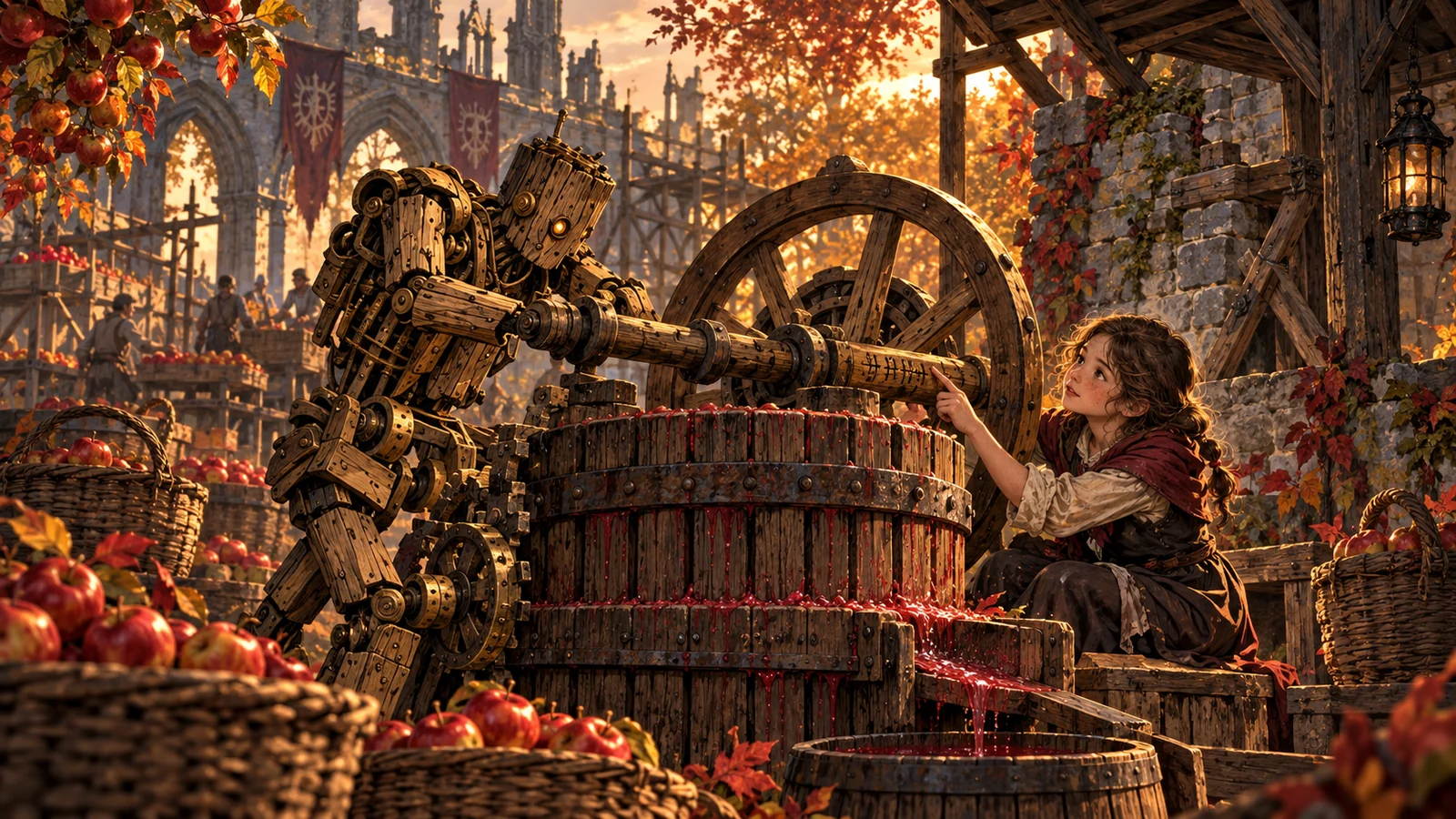
The first body was made of oak boards cut from a storehouse beam, a salvaged brass hub, two iron pins, and a broad wheel wrapped in leather so it would not bruise the press. Fara Senn shaped the shoulders and fitted the joints. She built it sturdy enough to help turn the apple screw, but simple enough that a neighbor could take it apart with a wrench and a wooden mallet. Nothing in the first design explained why it should later seem to listen.
Mina was nine then. Her father had died before she could remember his face, and she had grown used to adults speaking as if careful silence were the kindest answer. The mill was louder than the orchard and easier to understand. A wheel turned or it did not; a board held weight or split. She sat near the unfinished machine, sorting the washers by size, and asked her mother if it would know when she was there. Fara said it would know the sound of her shoes.
Ground left over from a wall
The orchard occupied ground that had once held a barracks. The barracks had been empty for years, its stonework cracked and its drill yard filled with weeds. A hard storm brought part of one wall down while planting crews worked nearby. A mule named Mallow braced a soil cart at the gap long enough for the workers to escape, and died when the rest of the structure fell. The orchard’s first families remembered her as a steady animal who chose her own pace.
Afterward, the crew built a proper buttress and refused to ask another animal to hold a failing wall. They planted fruit trees where the barracks yard had been, carrying soil in smaller loads and checking the old foundation each spring. Fara was not among the workers who had known Mallow. She arrived later to repair the hand press. Orchard Crank did not meet the mule, carry soil beside her, or inherit her spirit. The two lives touched only through a place changed by many hands.
People disagreed about whether the orchard was a memorial. Some said planting there made the fallen wall useful. Others said trees were not an apology and the old yard should have been left alone. The workers did not make the disagreement into a rule. They kept the repaired buttress visible, left a gap where carts could turn safely, and let each family decide what it thought while carrying fruit. The orchard became a place where grief and ordinary work had to share the same path.
Fara’s workbench
Fara had learned wheelwrighting from her aunt, who taught her to listen for the sound of a warped axle before she trusted a cart with a load. Her tools were few and kept in a cloth roll. She wrote down repairs in a narrow ledger, including the mistakes, because she had once spent three days repeating a failed fix someone had hidden from her. At the orchard she was hired to make the press work, not to build a person. That distinction mattered to her.
When the workers asked for a mechanism that could be used by people of different strength, Fara studied the press’s old screw and the slope of its platform. A tall crank forced the smallest workers to reach. A short crank made the strongest ones strain their backs. She designed a wide, low handle that accepted two hands at a time and a wooden automaton to turn it at a steady pace. If a joint wore loose, anyone could replace the pin without waiting for her return.
Mina spent the building days bringing her mother nails, holding a lamp, and sorting the things Fara said were too worn to use. She kept a bent brass washer anyway. When Fara noticed, Mina explained that it still fit the automaton’s left shoulder. Her mother let her keep it in the repair box, though she warned that a part which looked close was not always safe. Mina began to ask before she kept anything, and Fara began to ask before she threw anything away.
A machine no one owned
Fara refused to put a lock on the crank’s tool compartment. The orchard was organized by seasonal work, not a guild, and a locked cabinet would have made the person holding the key more important than the person holding the wrench. She drew the mechanism in the ledger and posted the diagrams beside the press. The workers added their own notes in the margins: which pin loosened in wet weather, how far to turn the brake, and where a hand could be caught if someone rushed.
Some neighbors wanted to pay Fara for a private machine that only their family could use. She declined. The press was built from shared timber and used by people who had planted the trees together. If one household claimed it, the other families would return to pressing fruit by hand or selling it before it spoiled. Fara had no speech about fairness ready. She only said the press would stay at the orchard, and if that made the contract too small, she would take another job.
The workers accepted the boundary because it matched what they had hoped the machine would be. They agreed to keep a common repair box, record borrowed tools, and give the first pressings to the people who had carried or sorted that week. Orchard Crank had no owner’s badge. It had a place in a shared routine, and that place was not the same as being property. The distinction would later become difficult when a merchant offered to buy the mechanism and take it away.
Mina names the turning
The first test was awkward. Fara pushed the handle through its range while Mina watched the gear mesh. The machine’s shoulders rocked unevenly; one leg scraped the platform; the apple screw moved a finger’s width and stopped. Fara loosened a pin and tried again. This time the wheel turned, but the press made a squeal so sharp that the nearby birds lifted from the branches. Mina laughed before she could stop herself. The machine rocked once more, as though the sound had surprised it too.
“Crank,” Mina said, tapping its wooden chest. Her mother told her that a tool did not need a name to do its work. Mina answered that names made it easier to ask someone to wait. She began saying, “Crank, hold there,” when Fara adjusted a pin. No one knew whether the automaton understood the words. It did hold there, because the brake was engaged. Mina thanked it anyway, and Fara did not make her feel foolish.
After the first harvest, Mina painted a small apple on the underside of one shoulder where rain could not reach it. Fara asked whether she wanted her initials beside the mark. Mina said no; the picture was enough. It became the only private ornament on a machine designed to be opened, inspected, and repaired. The painted fruit did not make it magical. It gave Mina a way to recognize the work she had helped finish when the whole assembly looked too much like a pile of parts.
The sound of an answer
At first the crank answered only through movement. When Mina tapped the left shoulder twice, its joint clicked in the same rhythm. Fara said the pin was loose. She tightened it, and the sound stopped. When Mina later tapped the press frame before starting, the automaton shifted its weight toward the handle. Fara checked the base and found a pebble under one foot. She removed it. The machine stood level. Every curious response had an ordinary explanation, which did not make the pattern less comforting.
The orchard workers started speaking to it because speaking made coordinated work easier. “Slow for the soft apples.” “Hold until the basket is clear.” “Stop, the screw is binding.” Crank did not have a voice. It had a groan in its shoulder joint, a soft knock from its right heel, and a wheel that gave different resistance when the press was loaded. Mina learned those signs as carefully as she learned her mother’s footsteps.
There was no day when a hidden spirit announced itself. Fara believed the machine was a well-made tool and Mina believed it knew when she was sad. The crew could not prove either account. What they could see was that Crank paused when someone said stop, even if another person kept urging it to continue. The pause might have been a brake, an adjustment, or an emerging choice. Mina preferred the last explanation and treated the machine with the same courtesy she wanted others to show her.
A household beside the orchard
Fara and Mina rented a narrow room above the tool shed during the harvest and returned to town during the quiet months. Rain tapped on the roof above their bed. Fara slept with one hand curled around the old wrist scar left by a slipped chisel. Mina kept the bent brass washer in a cloth pouch under her pillow, though she eventually admitted that she was afraid someone would throw it out while she was away. Her mother promised not to, then asked Mina to make the same promise about Fara’s old work gloves.
They did not speak about Mina’s father often. He had been a cart repairer who died during a winter road collapse, before the orchard existed. Fara remembered the care he took with other people’s wheels and the way he left a lamp burning for late travelers. Mina wondered whether a person could remain in a place because there was still something they meant to do. Fara answered honestly that she did not know, and that grief sometimes made unfinished work feel like a message even when it was only work.
Mina began collecting small things people left near the press: a dropped button, a ribbon end, a spoon with a cracked handle. She returned each one to its owner rather than making a private collection. The job gave her a reason to ask people their names. Some were shy; some were busy; a few were glad that someone had noticed. Crank stood nearby through those exchanges. It could not decide what the objects meant, but Mina thought it had become good at waiting while a person decided what to say.
The initials on the handle
Fara wanted the press to be maintained by the whole orchard. Each person who repaired a joint could scratch a small initial on the handle’s inner face, where it would not catch a sleeve. The marks were not proof of ownership or a public list of labor. They helped the next repairer remember who had adjusted a part and whether that person could be asked what they had changed. Mina added a tiny dot beside her mother’s first mark so she could find it in low light.
People added marks slowly. Some used a letter; some drew a shape because they could not read or did not want their name in a shared book. A worker asked for no mark at all, and Fara accepted that without recording the refusal. The handle filled with a small, uneven map of participation. Crank’s wooden hands held it during each press, so its palms rested over the marks while the screw turned. It was a practical arrangement, not a claim that every worker had given a piece of their soul.
Mina was the only person who thought the automaton could remember each mark. She would name the workers in order and brush the handle with a clean cloth. Fara told her that wood did not store names the way a mind did. Mina asked if her mother could prove that. Fara smiled and said no. She left the question open, the way she had learned to leave a tool diagram with enough room for someone else’s correction.
When the press had to wait
During a wet autumn, a shipment of apples arrived bruised and soft. The merchant who owned the carts wanted the press run faster so he could leave before dark. Fara checked the screw and said the load would pulp unevenly if they rushed. The merchant raised his voice and told Mina to move away from the handle. Crank held its weight against the brake. The wheel did not turn until the crew had checked the crates and removed the fruit that had begun to rot.
The merchant threatened to stop buying their cider. Mina wanted to answer him, but her voice caught. Fara did not tell her to be brave. She asked whether Mina wanted to stand beside her or wait in the shed. Mina chose to stay. Together they explained that the orchard would sell to another buyer before it allowed an unsafe press. The threat did not vanish, but the crew had time to arrange a smaller sale through families on the road.
Afterward, Mina asked if Crank had refused the merchant. Fara said the brake had been engaged and the crank had not been pulled. Mina pointed out that it could have moved when they released the brake. Fara had no answer she could defend. She checked the assembly again, found nothing wrong, and wrote the date in the ledger. That was their way of being fair to evidence: do not call a mystery solved just because one explanation feels better.
Mina learns a trade
Mina grew tall enough to reach the upper shelves and old enough to take paid work in town. She wanted to learn wood engraving, not wheelwrighting. Fara worried that the city workshop would underpay her, then admitted that worry was not a reason to choose Mina’s life for her. They agreed she would train for one year and return at the end of each harvest if she wished. Mina promised to write. She did not promise that she would stay.
Before she left, Mina sanded the apple mark beneath Crank’s shoulder and repainted it in red ochre. The color looked too bright beside the weathered oak. She liked that. She placed the bent washer in the repair box instead of carrying it away, then asked Fara to keep it there until she returned. Fara said it would still be in the box if it remained useful. Mina asked her to keep it even if it did not.
The first letters came every week, then every month. Mina described a master who corrected her grip without shaming her, a rented room with a window toward the river, and a friend who liked to draw small animals in the margins of invoices. She never wrote that she missed the orchard. Fara stopped asking whether she was coming home. When the press handle turned at the start of a harvest, the first few rotations sounded slower to Fara, though the mechanism tested true.
The offer to take it away
A merchant named Belden came to buy the press after the pear season. He offered enough coin to repair the orchard’s roof and pay the remaining wages. In exchange, Crank and the screw mechanism would be moved to his private cider house. He described the offer as practical. The orchard could keep the fruit trees and buy bottled juice from him later. Nobody doubted that the money could help. Nobody believed it would return the shared place the crew had built around the press.
Fara did not decide for the group. She placed Belden’s offer beside the repair ledger and asked each worker what they could not afford to lose. People named wages, roof boards, the weekly press day, or the ability to mend the machine without permission. Halen wanted to take the offer. Others worried that turning down a certain payment would hurt the same families the orchard meant to support. The debate continued into evening, without a villain to blame for the arithmetic.
The final vote rejected the sale but approved a smaller loan secured against next year’s harvest. Belden left disappointed, not cursed. Fara asked him to buy the first pear batch at a fair price, and he agreed. Crank remained in the orchard, not because everyone agreed it was a person, but because the community had decided the tool and its use were part of a shared life. The choice did not erase the cost of keeping it.
The water at the low road
The flood began with rain over the high fields and a blocked culvert near the old road. Water spread through the ditch and moved toward the orchard in sheets. Halen saw the channel rise and rang the brass handbell used to call workers from the lower rows. Fara was repairing a press pin. She put down the wrench and sent the nearest crew to move the crates uphill. The first danger was ordinary: wet ground, heavy loads, and people trying to do too much quickly.
Mina had returned that week to deliver a carved sign for the press shed. She and Fara disagreed about whether the cart road was still safe. Mina wanted to leave the lower orchard at once; Fara thought the supply cart could be moved before the water reached the turn. They were both trying to protect the same people. The argument ended when a wheel slipped and a cart rolled sideways toward the mill platform, carrying sacks and a worker who could not get clear.
The workers shouted for the brake. Rain swallowed half the words. Fara ran to the press. Mina pulled two people from the cart path while Halen led the others toward the higher orchard. The machine had been designed to turn fruit, not resist a flood. Its base started to shift. Fara could engage the brake and stop its wheel, but doing so would let the cart continue into the press frame. She looked at the cart, then at the people still crossing the low path.
A cart against the wheel
Fara called for everyone to get behind the stone buttress and for Mina to keep the path clear. The cart was wedged at an angle, one shaft pointing toward the mill and the other caught beneath a raised root. If the wheel slipped, the load would crush the doorway where the last worker was climbing out. There was no time to move the press safely or dismantle the crank. The machine was already connected to the wheel, and its wooden feet were planted on the wet platform.
Crank leaned into the handle. Fara had used its shoulders to carry pressure before, but never against a moving cart. The wheel jammed. A brass tooth snapped loose, and the left shoulder split where Mina’s washer had once been fitted. The cart stopped hard enough for the trapped worker to crawl clear. Mina reached the high path and shouted that all the orchard crew were out. Fara heard her. The automaton held the half-turn while the water kept pushing.
Fara tried to pull the handle free. It would not move. The current tore a board from the platform and lifted the rear brace. She told Mina to leave the mill and follow the crew. Mina started back toward her, then saw Fara point toward the safe path. They could not both reach the press before the water crossed the yard. Mina ran uphill, furious at the distance and grateful that her mother had ordered her to go.
The half-turn that held
With the path empty, Fara stepped toward the crank. The machine’s body was splitting, and the press wheel had bent out of line. She could have used the last of its leverage to push the cart another foot, but the worker was already free. The only task left was to keep the load from rolling back while the water drained away. The machine’s old brake was broken; the new one did not yet exist. The half-turn was the only thing holding.
The platform tilted. Fara tried the release pin and found it buried under a crate. She could not reach it without putting her hands beneath the frame. The rain ran into her sleeves. She called Crank by the name Mina had given it, then asked it to wait. She had spent years telling the machine to stop, slow, or hold. This time she did not know whether it could hear her. The handle remained fixed beneath its wooden palms.
The cart was no longer in danger of reaching the doorway, but the broken wheel kept the press under strain. Fara backed away as the frame shifted. A final brace snapped, and the machine’s torso hit the stone floor. Its body broke in three places. The wheel stopped. The cart stayed still long enough for the flood crew to secure it from above. Fara escaped with a badly bruised shoulder and a cut hand. Crank did not rise again.
When a tool becomes a loss
The orchard workers called it broken because that was what they could confirm. Its joints were split, its gear teeth scattered, and the press platform unsafe. Fara was alive, Mina was alive, and every worker had reached high ground. Those facts mattered more than a story about bravery. The crew still grieved the machine. Mina sat beside the remains and told it that she was angry it had made her watch from the path. She also said she knew why it had stayed.
Fara did not promise to rebuild the same body. The old wood had soaked up floodwater and the axle had bent. Reusing it before inspection could injure someone. The marked handle, however, could be dried and preserved. The crew gathered each piece, logged which parts could be safely repaired, and left the wheel where the water had stopped. Mina found the red apple mark under a splintered shoulder. She wrapped that piece in cloth and asked the others to keep it with the ledger.
That night, the mill shed gave a small, uneven knock. It came again at the hour when the press normally began its first turn. Fara thought a loose board was settling. Mina heard the rhythm from the house and woke her mother. Together they checked the shed, the broken gears, and the blocked culvert. No mechanism was moving. The sound ended after three turns, as if a hand had stopped just before the final quarter-circle.
The work after the flood
The flood left silt in the press room and damaged the lower orchard. The crew marked the waterline on the stone buttress and moved the platform uphill. Fara recovered slowly from her shoulder injury. Mina stayed through the first repairs, then asked if she could return to her engraving work. Fara said yes. Mina came back at harvest, and neither pretended the choice was a test of loyalty. Their relationship was not measured by how often Mina remained beside the press.
The workers built a proper brake before using the wheel again. They added a release lever above the wet floor, set a safe path around the platform, and created a written stop procedure. The new mechanism was tested with empty carts and then with modest loads. Halen kept the bell close. Fara refused to describe the improvements as a reward from the broken machine; they were changes the living owed one another after a dangerous failure.
They saved the old handle because its marks mattered to the people who had worked it. Each initial was recorded in the ledger before the wood was placed on a dry wall hook. The mark beneath Mina’s apple was still there. Some workers wanted to grind the handle into kindling, arguing that a dead tool should not take up space. Mina asked them to leave it for one season, until everyone could decide without the flood still in their ears.
The orchard turns without it
The new press was built by several neighbors using Fara’s diagrams. It did not look like Crank, and it did not carry the old red apple. The crew used a hand crank with a wider grip and a guarded gear. Mina carved a small sign for the shed, showing the route to the high ground and the mark where the water had reached. She would not carve an image of Crank into the sign. Its life, she said, did not need to become a warning label.
The first pressing after the flood was small. Fara engaged the brake, checked the platform, and asked the workers to keep the path clear. When the wheel reached the old half-turn point, the handle on the wall tapped once. Mina stopped turning. The new press held steady. The tap did not make the old machine return, but it reminded the crew to look at the brake before adding weight. They wrote that lesson into the procedure and credited the person who had found it.
The orchard resumed its ordinary work. Some families brought apples, others carried pears from a nearby grove, and children swept leaves from the stone path. Mina returned to the city between harvests. Fara still kept her ledger and slowly taught another repairer to read its notes. Crank’s old handle remained on the wall. The spirit did not control the new press, and it did not live inside every tool the crew used. Its attention stayed at the place where its own turning had stopped.
The Crow waits beside the brake
The Ledger Crow came after the repair crew had finished its safety checks, on a morning when the mill stood open and the marked handle had been returned to its hook. It did not appear in the flood, when panic might have made every offer sound like rescue. It landed beside the new brake, examined the old apple mark, and waited until the presence had gathered enough of itself to understand a question. Fara and Mina were both there, but the Crow addressed the spirit alone.
It explained why Crank remained. The spirit had stopped in the middle of a task that protected the people on the low path, with the cart still pressing against the wheel and the brake not yet built. The flood ended; the danger passed; the living rebuilt safely. None of that completed the instant held in the wood. Crank was not being rewarded for sacrifice, and it had not chosen to die. Its continued turning was a tether, not a duty imposed by the orchard.
The Crow described the official card without calling it a cure. The card could carry Crank into matches and give the ledger a stable account of the spirit. It would also create another bond to the mortal world. It would not restore the original body, make the press turn again, release the spirit, or let it become Fara’s property. Fara could tell the Crow what she hoped for, but she could not choose in Crank’s place.
A new turn, chosen
Mina sat on the step beside the shed and told Crank about her work in the city. She had carved a shop sign for a baker and was learning how to repair cracked wooden letters without hiding the line where they had been mended. She missed the orchard sometimes. She did not plan to move back. She wanted Crank to know that her leaving had not been a punishment or a failure of their friendship. It had been a life she had chosen while the machine remained where it was.
Fara told the spirit that she regretted building it for a job without knowing whether it wanted one. She could not undo the flood or recover the body. She said the orchard would keep the old handle as long as the people living there wished to, and that the new brake would not be named after Crank unless it wanted that. It was the first time she had spoken to the spirit as someone whose consent mattered, rather than as a useful mystery.
The Crow waited. Crank’s response was not a voice and not a sudden movement of the old mechanism. The marked handle gave one deliberate turn on its hook, then stopped. It was not the frozen half-circle of the flood. It was a new motion made after hearing the terms. The spirit chose the card, knowing it would carry the unfinished self forward in another form and would not set it free.
The card that holds the whole account
The official Orchard Crank card showed the wooden automaton at the apple mill, among the orchard’s red fruit and the wheel it had once turned. It did not show Mallow, the mule whose earlier work had changed the land, and it did not combine their spirits. The Crow placed the card beside the preserved handle and recorded the date the choice was made, not as a replacement for September 16, the day the machine first turned.
In game terms, Orchard Crank is a two-copy, 5-energy 3/6 Construct with Root affinity. Its printed Enter effect grants two champion armor, up to the game’s armor cap of five. Armor absorbs incoming champion damage before health is lost; it does not heal health or protect creatures. The effect is a card rule, not a literal historical event in which Crank raised a shield around Fara or Mina.
The Crow entered the account without claiming the mill, the orchard, or the work that remained there. Fara kept the repair ledger. Mina took her carving tools back to town. The old handle stayed on its hook until the workers chose where it belonged. Orchard Crank entered the mortal game as itself: the shared tool that had learned to wait, the broken machine whose half-turn held long enough for people to live, and the spirit that chose a new tether after the Crow told it the truth.
At the table
Printed effect: Enter: gain 2 champion armor.
Gain a champion buffer while adding a sturdy body
Orchard Crank is a two-copy 5-energy 3/6 Construct with Root affinity. Its Enter effect grants exactly 2 champion armor, up to the game's cap of 5. Armor absorbs incoming champion damage before health is lost; it is not healing, creature protection, Guard, Rush, or extra stats. If you have 4 armor, only 1 more can be gained; at 5, the armor portion adds nothing.
One move, shown
Play it before expected champion damage when the remaining armor and 3/6 body justify committing five energy. Check your current armor first. If you are already at the cap, decide whether the body alone improves the board; do not count the armor as protection for a friendly creature or as health restored.
Spend 5 energy to play Orchard Crank. Apply the printed effect exactly as written.
Your champion has 13 health and 2 armor. An enemy effect is expected to deal 3 damage to your champion, and you have a useful open creature slot. Spend 5 energy to play Orchard Crank: its Enter effect raises your armor to 4, and the 3/6 enters. If that effect later deals 3 champion damage, all 3 is absorbed by armor, leaving 1 armor and 13 health. At 4 starting armor, the Crank raises it only to 5; at 5, it stays 5. An effect that damages your creature is not absorbed by champion armor. The example illustrates armor only; Orchard Crank has no additional damage or defensive trigger.
The example explains a legal choice, not an additional card effect. Check the live game for current targeting and timing.
Chibi mode
This is the current game’s chibi rendering of Orchard Crank. The alternate art changes presentation, not the printed card rules.