The fruit that would not rot
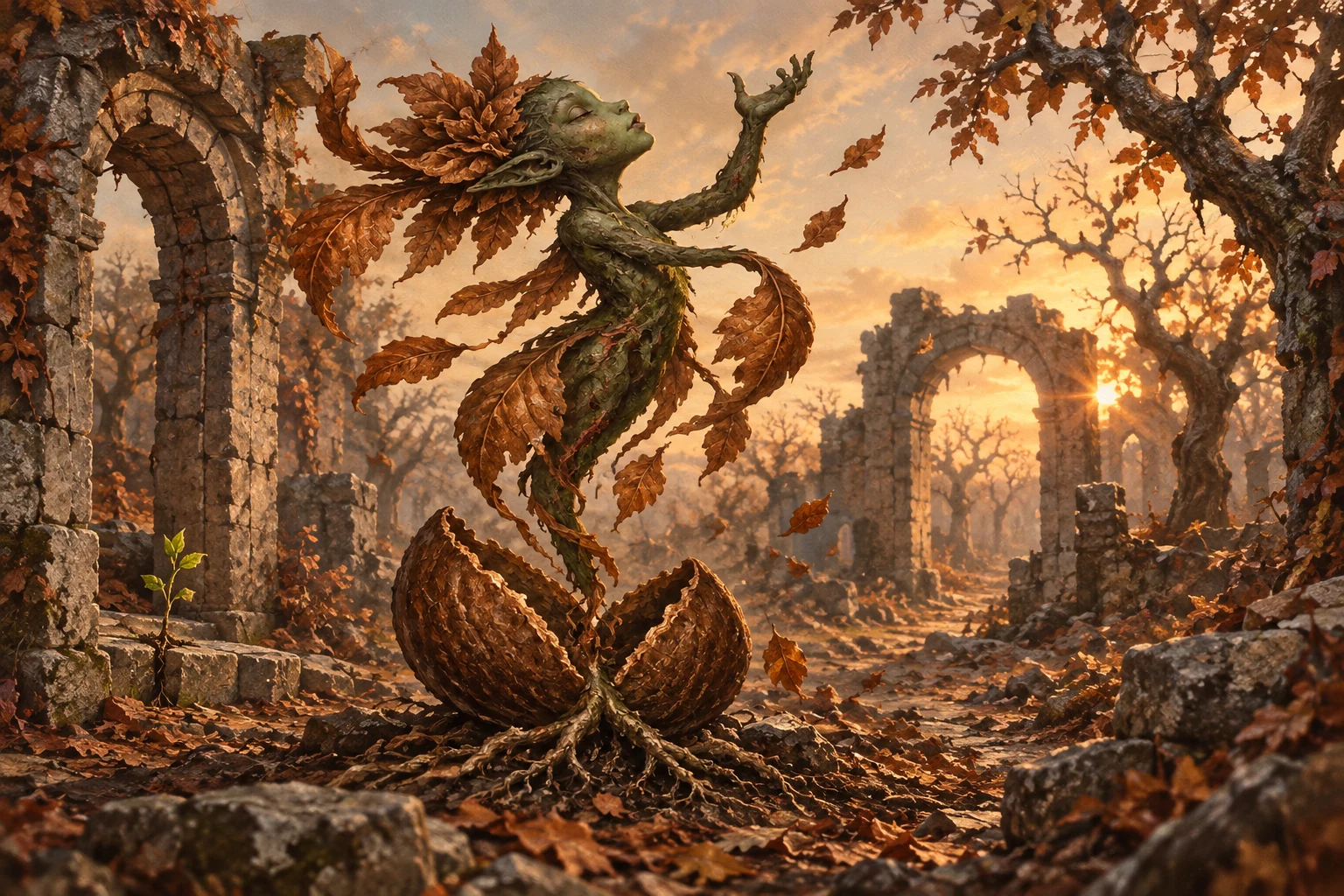
The fruit lay in the middle of a ruined doorway, round and copper-brown against the pale stones. The house behind it had lost its roof years earlier. Ivy covered one wall, and the threshold had split down the middle where rainwater froze each winter. People crossed the lane without noticing the fruit. It was too small to be a warning and too ordinary to be a treasure. Only the orchard keeper, Hesta, stopped when she saw that it had not softened after the late autumn rains.
Hesta lifted the fruit with both hands. It was warm inside, though the morning air was cold. The skin had no bruise or bite, and the stem remained green at its tip. She carried it to the orchard and set it on a shallow dish beneath the cider shed. Each day she checked it. It did not wrinkle, leak, or attract flies. After a week she brought it to Brann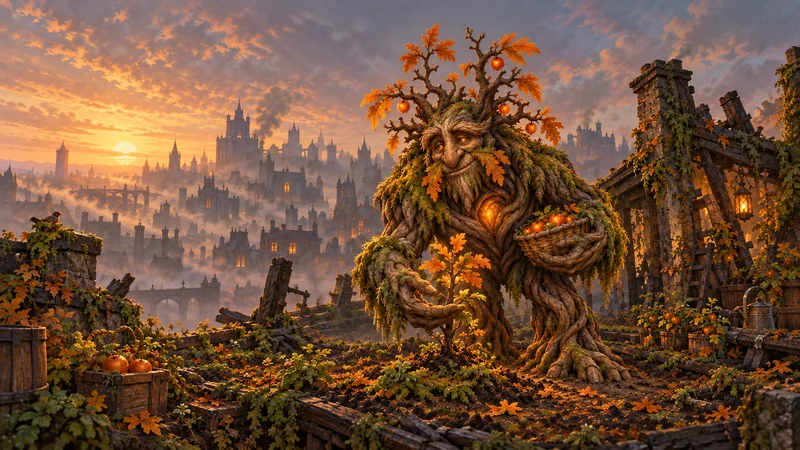 BrannFirst-generation championBrann tends fruit trees growing through the roofs of burned houses.Read this biography →, who had been helping the growers map the burned rows. He suggested that some fruits simply lasted longer than expected. Neither of them called it magic.
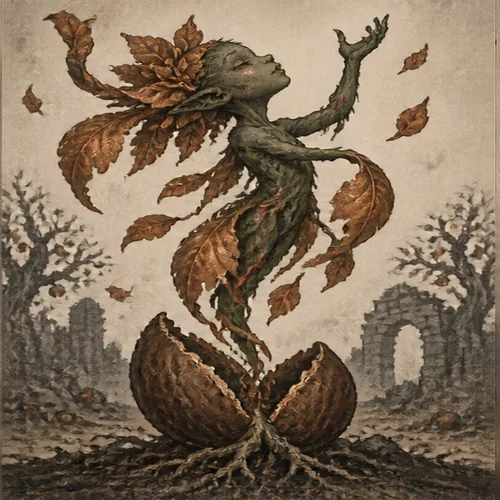
On the ninth morning, the shell opened along a seam. A tiny green figure lay curled among copper-colored seeds, her leaflike arms wrapped across her chest. She seemed to be sleeping. One seed rested against her cheek. Hesta did not touch her. She fetched a blanket and placed it around the dish, leaving the opening clear. The small figure’s breath stirred the seed husk. When she opened her eyes, the first thing she saw was the broken doorway through the shed window.
When Sere was strong enough to leave the dish, she returned to the doorway where the fruit had rested. She put both hands on the threshold and leaned forward, testing the air beyond it. The orchard was new to her, yet the broken stones seemed familiar. She traced the place where the fruit had touched the ground, then looked at Hesta. The old keeper did not tell her what the doorway meant. She offered her hand only when Sere turned back toward the shed.
A name for a small arrival
The figure was no bigger than Hesta’s hand. Her skin had the muted green of young bark, and dry copper leaves framed her head like a loose crown. She sat among the seeds and watched the room as if listening for something beneath the voices. Hesta offered water in a thimble. The nymph drank a little, then touched the rim and pushed it toward the seeds. Hesta understood that the other seeds mattered too. She placed them in a cup of damp soil beside the dish.
The growers asked what to call her. She could not speak the orchard language, but she repeated one sound when Hesta pointed to the seed cup: ‘Sere.’ The syllable might have been a name or a fragment of some older word. Hesta used it gently and waited to see whether the nymph would answer. The small figure turned her head. BrannBrannFirst-generation championBrann tends fruit trees growing through the roofs of burned houses.Read this biography → wrote ‘Sere, perhaps’ in the margin of his field notes. The question mark stayed there for years; no one forced certainty onto a creature who had just arrived.
Sere slept inside the open fruit for many nights. The fruit did not decay, even as the seeds began to root into the soil. Each morning she woke and moved one seed closer to the light. She did not ask for food. She liked the steam above warm tea and the sound of rain against the shed’s old roof. Hesta began setting a leaf beside the thimble, not as a meal but as a small marker that the day had begun. Sere learned to touch it before leaving the dish.
Learning what a door remembers
Sere’s first steps were unsteady. She could cross the orchard floor if the soil was damp, but dry stone made her pause. When Hesta carried her to the ruined house, the nymph went quiet. She looked at the threshold, then at the empty room beyond it. The house had once belonged to a family of potters. Their kiln was cold, the shelves broken, and the front door had been taken away for firewood. The doorway remained, open to wind and strangers.
Hesta asked Sere what she saw. The nymph placed her palm against the split stone. A thread of green appeared in the crack and stopped. She pulled her hand away. Hesta did not ask her to make the plant grow. She told Sere that the potters had left because the kiln could no longer be repaired and that the doorway did not mean they would return. The small figure listened. She did not try again that day.
The next morning, Sere returned alone with a copper seed. She set it beside the threshold, in soil where the door’s shadow fell. She did not force a root through the stone. The seed remained still. Hesta found it there at dusk and left it. By the end of the week, one pale shoot appeared. It was no larger than a stitch. Sere watched it without smiling. The doorway had not been restored, but a small living thing had found a place to begin.
The orchard circle
The growers of the burned orchard had formed a loose circle to share seed, tools, and work. They called the group Roots Through Ash. Sere was not made a member by anyone’s vote. She came to meetings and listened while people decided which trees to replant and which walls could safely stand. When she had a seed to offer, she placed it in the middle of the table. When she had nothing to add, she sat beneath the bench and let the conversation pass over her.
The circle debated whether the ruined potter’s house should be cleared. Some wanted the stones for a new shed. Others believed the old doorway ought to remain. Sere did not choose for them. She walked the threshold at dusk and returned with a seedpod split in two. One side had a pale root; the other was empty. She set the rooted half by the wall and the empty half in BrannBrannFirst-generation championBrann tends fruit trees growing through the roofs of burned houses.Read this biography →’s palm. He understood the gesture as a question: what could be kept, and what should be allowed to end?
They decided to leave the doorway and remove the unsafe back wall. The stones went to repair a drainage ditch. The threshold stayed open to the lane. Sere planted a small copperseed beside it, then marked the spot with a flat piece of slate so carts would not crush the shoot. The circle did not claim the plant or the nymph. They agreed to tell her before moving stones and to ask whether a seed needed a different place. In return, Sere showed them which cracks held enough earth for roots.
The growers made room for her in different ways. Hesta left the shallow dish on the shed shelf. BrannBrannFirst-generation championBrann tends fruit trees growing through the roofs of burned houses.Read this biography → kept the map tube low enough for Sere to reach. The children learned to walk around the seed plots rather than stepping over them. No one required her to attend every meeting or explain each choice. When a new member asked whether she was the circle’s gardener, Hesta said Sere had her own life and the circle had its own work. The distinction made their cooperation steadier. Sere could help without being turned into a service the group expected to receive.
A hobby of choosing
Sere developed a habit of visiting ruined doorways before planting. She would sit at the edge of the threshold and touch the stone, sometimes for a few breaths and sometimes for the entire afternoon. She seemed to notice whether the place had been abandoned gently or in a hurry. At a collapsed bakehouse, she planted no seed. The ovens had been dismantled, and the family had carried their tools away. At an old clinic, she planted two copperseeds near the entry because a healer still came by to check the weeds for medicinal leaves.
The work could make people impatient. A traveler wanted a path cleared before the next rain and asked Sere to cover the doorway with roots. She refused. BrannBrannFirst-generation championBrann tends fruit trees growing through the roofs of burned houses.Read this biography → explained that she chose where a seed belonged and that no one could order a ruined place to bloom. The traveler left annoyed. Later, the same person returned with a stool and sat near the threshold while Sere considered the stones. She placed one seed by the outer wall, where it would not block the way.
Choosing became Sere’s pastime as much as her work. She kept a small collection of seed husks in a woven pouch and sorted them by color, shape, and the sound they made when tapped together. Some were empty. She liked those too. Hesta asked why she saved a husk without a seed. Sere set it on the old potter’s threshold. It fit into a shallow mark in the stone. The empty shell could still show where something had once rested, even if nothing would grow there again.
Brann asks before he plants
BrannBrannFirst-generation championBrann tends fruit trees growing through the roofs of burned houses.Read this biography → traveled between the orchard and other districts, carrying news of which walls had fallen and which paths remained safe. He noticed Sere’s habit of sitting at doorways. Once, he came upon her beside an abandoned house where the threshold was still warm from afternoon sun. He had brought a handful of seeds from the orchard and nearly placed one in the crack. Sere raised her hand. BrannBrannFirst-generation championBrann tends fruit trees growing through the roofs of burned houses.Read this biography → stopped. She studied the doorway, then picked up a loose tile from the floor and moved it aside.
Under the tile was a small clay mark shaped like a child’s hand. The house had not been empty for as long as BrannBrannFirst-generation championBrann tends fruit trees growing through the roofs of burned houses.Read this biography → thought. A family had left in a hurry during the flood, and the mark showed where they had recorded their children’s heights. Sere returned the tile without covering the mark. BrannBrannFirst-generation championBrann tends fruit trees growing through the roofs of burned houses.Read this biography → put the seeds away. They found another place for them beyond the wall, where the roots would not split the clay record.
After that, BrannBrannFirst-generation championBrann tends fruit trees growing through the roofs of burned houses.Read this biography → asked before planting. He did not always understand Sere’s answer, but he learned to wait for it. Sometimes she chose a doorway; sometimes she carried the seed elsewhere. Their friendship did not depend on agreement. He could leave a seed in her care and trust that she might return it unplanted. She could point toward a safe route and know he would not turn the path into a permanent claim. They shared attention rather than ownership.
The sick keeper
Hesta grew ill during a winter when the orchard roads were closed by ice. The growers brought food to her house, but she had no strength to walk to the old shed. Sere stayed near the bed, placing one copperseed in a saucer beside the window. She did not try to heal Hesta with roots or leaves. The nymph sat on a folded cloth and listened to Hesta’s breathing. When it grew shallow, she touched the windowsill, and a small green shoot appeared in the crack.
The healer said Hesta needed rest and medicine. Sere could not replace either. She helped by carrying the thimble of water from the table and nudging the shutter closed when the wind pushed it open. Hesta thanked her as if these small tasks mattered. Sere lowered her head. She had spent so long choosing where something might grow that she had to learn the difference between a living person’s illness and a doorway’s neglect. A seed could wait. Hesta needed care from hands that could bring medicine.
Hesta recovered slowly and never returned to all her old duties. She taught a younger grower how to mark the orchard’s boundary stones. Sere brought the map to her bedside and set a copperseed beside each doorway that needed attention. Hesta crossed out two locations where the buildings had been safely dismantled. The nymph accepted the corrections. She did not treat every ending as a wound that needed to be undone. Some places were finished, and recognizing that fact was a form of tenderness.
After Hesta could sit in the sun again, she asked Sere to choose a place near the house for one more seed. The nymph walked the wall, touched three cracks, and finally set it in a pot beside the back step. Hesta asked why she had not planted it in the ground. Sere pointed toward the path where the roof runoff collected. The ground there flooded each spring. The pot could be moved if the water rose. Hesta smiled at the practical answer. A good beginning did not have to be permanent to be worth tending.
A garden that was not a home
A merchant offered to buy the ruined potter’s house and turn its courtyard into a private garden. He admired the young plants and promised to build a wall around them. Sere listened while he explained the plan. Then she moved every copperseed she had planted from the courtyard to the lane-side threshold. She did not destroy the garden. She chose a place where the neighbors could still pass and rest. The merchant said the plants would be safer behind his wall.
BrannBrannFirst-generation championBrann tends fruit trees growing through the roofs of burned houses.Read this biography → answered that safety without access might not be the kind of care Sere wanted. The merchant offered more money for the orchard circle’s land. Hesta declined. The old doorway was not valuable because a nymph had planted beside it. It was valuable because people used it as a landmark, left notes there, and remembered that the potters had once lived nearby. Sere’s seedlings could not speak for the former residents. The growers chose not to sell the threshold as if its history were an empty lot.
The merchant left, and the garden remained open. Sere kept one plant inside the courtyard and several outside the wall. She did not punish the place for the proposal. The little garden still needed sun. She watered it by carrying a thimble from the orchard well, one careful trip at a time. The act taught the children that a boundary could protect a plant or exclude a neighbor, depending on who had drawn it and whether anyone could cross. Sere never gave them a lecture. She kept the gate unlatched.
The fruit returns
Years later, the copperseed fruit appeared again in the potter’s doorway. The tree that grew from Sere’s first seed had produced a single round fruit, smooth and brown as old copper. It did not ripen on the branch. It fell at the threshold and remained there through autumn. Hesta had died the previous spring. BrannBrannFirst-generation championBrann tends fruit trees growing through the roofs of burned houses.Read this biography → was away on the roads, and the younger growers had never seen the first fruit. They asked Sere whether it should be taken to the shed.
Sere shook her head. She sat beside it as rain gathered in the stone channel. The fruit held its shape while other apples softened and split. A child wanted to carry it home. Sere let the child lift it, then waited until the child felt its warmth and returned it to the doorway. She did not know whether the fruit was a seed, a memory, or only a strange product of the tree. She knew it did not belong to her just because she had planted the first seed.
The fruit opened one morning with no one nearby. Inside lay several copperseeds and one empty husk. Sere collected the seeds and placed them in separate places around the orchard. She left the empty husk on the threshold. The fruit had not rotted, but its role had ended. The doorway did not need to keep the whole thing forever. Sere’s care included knowing when to leave something behind and when to let it become soil.
The doorways after the fire
A second fire swept through the lower orchard, this time in a dry summer. It moved faster than the growers could contain. Sere helped people find the lane through the stone walls while BrannBrannFirst-generation championBrann tends fruit trees growing through the roofs of burned houses.Read this biography → and the crew carried water from the reservoir. A roof fell near the cider shed. The old potter’s doorway survived, though one side split and a beam landed across the path. Sere’s seed patches dimmed under smoke. She refused to force roots through the burning soil.
When the fire was contained, several houses had lost their roofs. Families gathered in the orchard with what they had carried out. Sere walked among the damaged thresholds, stopping at each one to see what remained. She planted no seeds that week. The growers cleared rubble, found dry blankets, and recorded who needed a place to sleep. Sere waited until the people had decided what to repair. A doorway could be closed for safety, opened for shelter, or left untouched while a family mourned.
At the end of the week, one family asked Sere to plant a seed beside the door of their burned home. They were staying with relatives and did not know whether they would return. Sere placed one copperseed in a small pot instead of the ground. The family could take it with them. They carried the pot to the temporary shelter and set it by the bed. The choice let a living thing travel without pretending that the damaged home had already been rebuilt.
The growers wrote down what the families wanted before moving any stones. One household asked to keep a scorched doorframe because it showed the height of a child who had since grown up. Another asked for the last intact hinge to be returned to them. Sere waited through each conversation. She understood that a doorway carried memories she could not see in the soil. When the hinge was removed, she planted nothing in its shadow. The threshold remained open, but it was not hers to fill.
The last seedpod
The oldest copperseed tree stood beside the ruined potter’s threshold. Its roots had grown under the stones without breaking them. Each year it produced fewer fruits. Sere cared for the tree but did not try to force it to bear more. She collected the fallen leaves, cleared weeds from the path, and listened to the branches in the wind. The tree’s life was not a debt she could collect. When its last seedpod formed, she left it on the branch until it opened naturally.
A week of hard rain softened the threshold. Water ran through the old crack and pooled where the seedpod had fallen. The shell split, releasing one copperseed. Sere bent to pick it up. The stone shifted beneath her hand. A slab dropped from the ruined wall and pinned her against the doorway. She could not pull free. BrannBrannFirst-generation championBrann tends fruit trees growing through the roofs of burned houses.Read this biography → was far away, and the nearest growers were securing the river bank after another rise in the water.
Sere worked to move the slab, but the roots under the threshold were too weak to lift it. The seed rolled toward the drainage channel. She reached for it and stopped when pain made her arms shake. The doorway was not asking her to stay. The seed could be found later. She turned her face toward the lane and waited for someone to hear her. Rain kept falling. The roots held the water around her, but no one arrived before her small life began to fade.
The spirit caught in the husk
The growers found Sere after the rain eased. The slab was lifted and the nymph’s body carried to the orchard. The copperseed remained in the threshold’s drain, lodged inside the split husk of the last fruit. When BrannBrannFirst-generation championBrann tends fruit trees growing through the roofs of burned houses.Read this biography → returned, he placed the seed beside her and waited. Nothing moved. The people buried Sere beneath the oldest tree, leaving the husk and seed at the doorway where she had spent so much of her life deciding what should grow.
That night, the seed warmed. Its root had entered the split threshold and wound through the old copper marker set there to record the potters’ doorway. The husk held the curve of Sere’s last reach. Her departing spirit met the seed, the root, and the boundary mark at the exact place where her life ended. No one had planned a binding. The old fruit would not rot; the water had carried its seed into the crack; the marker kept the name of a home that had vanished. Together they accidentally caught her spirit in the mortal world.
The body remained buried beneath the tree. The people who had lived in the ruined house were long gone, and none of their spirits were drawn into the husk. The growers did not call the event a rebirth. When Sere appeared again, she was a spirit, able to move through the orchard but unable to depart from the mortal world. Her copper leaves stirred though the air was still. The seed stayed in the doorway, rooted through the mark, and the old fruit remained unrotted around it.
The doorway that cannot open out
Sere returned to the places she had tended. Some doorways had new roofs; some had been taken down safely; others remained open to weather. She did not plant at each one. A family had asked for the courtyard plants to be moved, so she shifted them to pots. At the old clinic, the herbs remained. She could walk past the ruined house, but the route beyond the orchard did not free her from the binding. The mortal world held her as surely as the root held the seed.
The growers kept the threshold clear. They did not use it to command Sere or demand that she protect their homes. BrannBrannFirst-generation championBrann tends fruit trees growing through the roofs of burned houses.Read this biography → left a small saucer of water near the old marker, though he knew a spirit might not need it. Sere touched the rim when she wished and left it alone when she did not. The gesture repeated the first kindness Hesta had shown her, but it did not reverse the binding. Care could make a place welcoming without changing the condition that kept someone there.
The Ledger Crow wrote down Sere’s life in the distinction she had taught the orchard: an empty doorway is not an invitation to invent who left; a seed is not proof that every loss will grow back. Her return did not mean that death had become a garden she could leave at will. The nymph remained a person with preferences, grief, and limits. She could choose where to sit and whether to plant. She could not choose to cross beyond the mortal world.
The orchard circle tried several ordinary ways to understand the tether. They moved the seed, loosened the root, and stored the copper marker in a dry box. Sere remained. They returned each piece to its place because taking them apart only damaged the record and did not change her condition. The Crow wrote that the binding was not a puzzle solved by finding the right gardener. It was an involuntary fact of her afterlife. The people around her could tend the ground and preserve the story, but they could not promise a way out.
The card keeps her name
When the Ledger Crow prepared Sere’s card, BrannBrannFirst-generation championBrann tends fruit trees growing through the roofs of burned houses.Read this biography → brought the split husk, the copperseed, and a rubbing of the doorway marker. He did not bring the family map as proof that the nymph belonged to the orchard circle. He brought it because it showed the places where she had chosen to plant. The Crow recorded her September 15 birthday as Virgo, a chosen calendar detail matching her patient, attentive nature; no written date from her living chronology survived.
The card held Sere’s one spirit in the official Mournhand design. The card’s actual printed effect remained modest: a 2-energy 1/3 that heals its champion by 1 on entry. The healing was a game rule, not a claim that Sere had cured Hesta or could undo the fire, flood, or binding. The husk and threshold remained in the orchard archive. They were part of the accidental catch, not extra souls inside the vessel.
The card did not release Sere from the mortal world. It gave the Crow a way to keep her history beside the names of the places she had tended, but the spirit remained bound. Her faction entry read Roots Through Ash, the orchard circle she had helped without being owned by it. Her hobby was choosing which ruined doorway deserved a seed first. The Crow left the last line open for a future note, because no one knew whether the old threshold would ever bloom again. A name could be kept without pretending the ending had been repaired.
 Coalblossom HartC28 · 5 energy · 2/6It walks only where ground remembers heat.Read this folio →
 Cinderroot BoarC25 · 3 energy · 3/5Coal seams glow beneath its brow as roots wake whenever it is wounded, tracing the route of families who never came home.Read this folio →
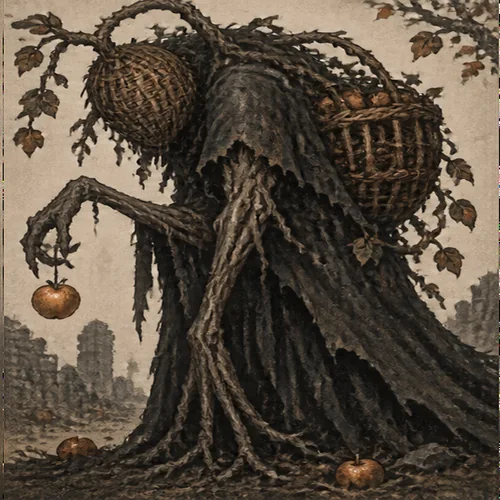 Orchard WretchC27 · 4 energy · 4/4Built from burned stakes and evacuation coats, it brings dark fruit to doorsteps and listens below the oldest tree for a name the roots will not return.Read this folio →