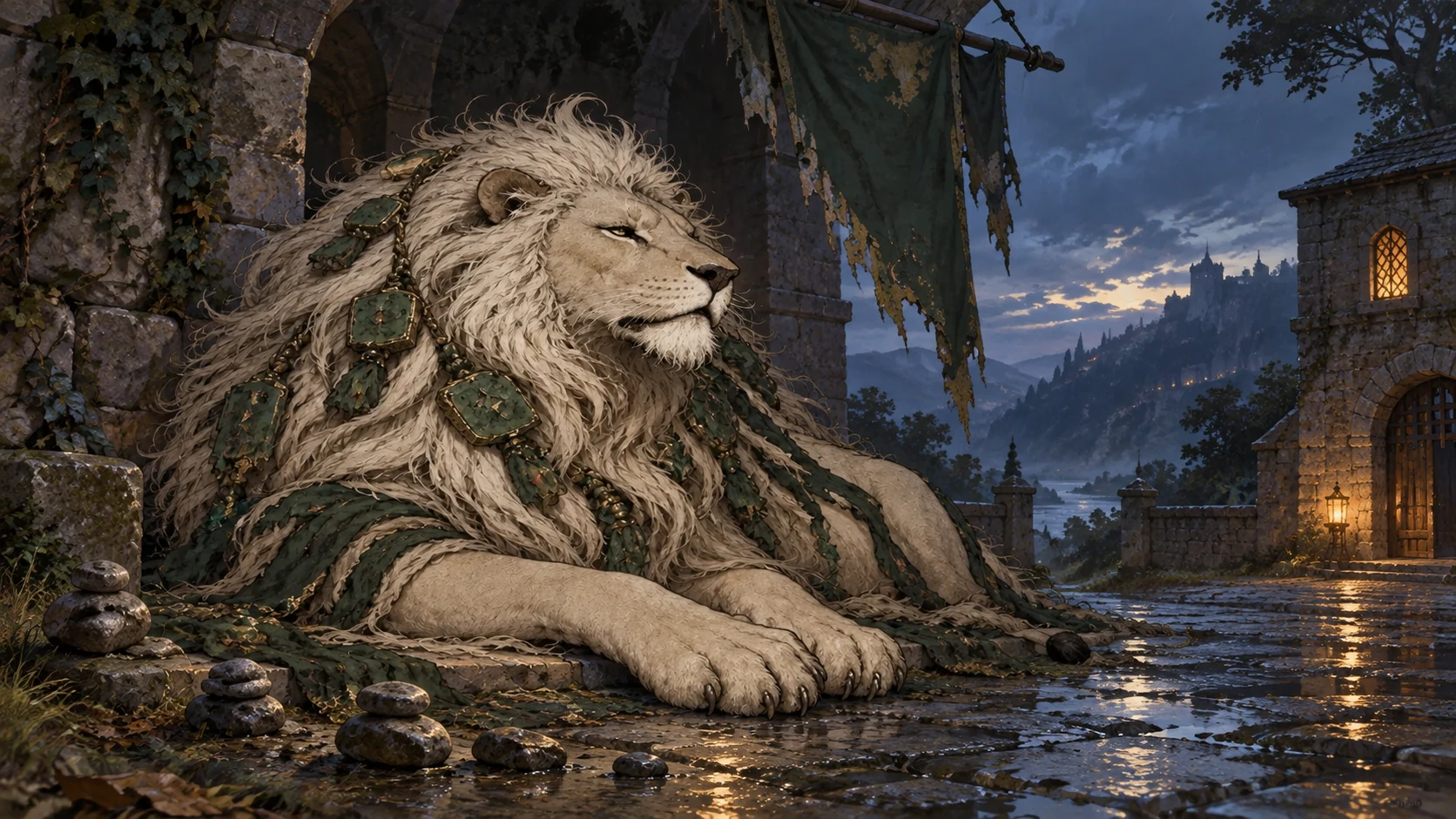
The date in the gate book
The gatekeeper entered August 14 in the little animal ledger because that was the morning the pale cub first opened both eyes. No one knew the exact hour of his birth. His mother had arrived at the hill station during a late-summer storm, found shelter beneath the timber arch, and delivered him in a bed of dry straw. She was gone by dawn. The keeper did not claim the date was a prophecy. He wrote it down so that, if the cub survived, someone would remember to mark the day with food and clean bedding.
The keeper's daughter, Nima, was small enough to sit inside an empty grain basket. She brought the cub a strip of green cloth from a coat her father had mended, then sat beside the straw and waited without reaching for him. He smelled the cloth, sneezed at its dust, and tucked his face against its folded edge. Nima decided this meant he liked it. Her father said the cub had only found something warm. She answered that warmth was a good beginning. The green strip became his first familiar thing, though no one called it a banner yet.
They called him Hearth because he slept near the gatehouse stove and because Nima said he made the cold room feel less empty. The name was used at home, not entered into any court roll. A visiting courier once asked whether the lion belonged to the crown. The keeper replied that the cub belonged to no one, though he depended on their care. Nima heard the difference. She repeated it later when an officer tried to take Hearth to the palace menagerie. The keeper was frightened enough to bow, but he did not let go of the lead.
A small room beside the road
Hearth's first world was narrower than the horizon Nima described to him. It held the gatehouse, the stone steps, a spring trough, the keeper's workbench, and a patch of grass that turned silver with frost. He learned the sound of his household: the keeper sharpening a chisel, Nima humming while she swept, the kettle lid trembling before it whistled. He would stretch out beneath the bench when the room grew loud. At night he followed the draft under the door with one paw, as if the road itself might slip inside while they slept.
The gatekeeper repaired tools and checked the old arch whenever stones shifted. Nima helped by carrying a wooden mallet she could barely lift. Hearth followed her from the workbench to the water trough, dragging the green cloth between his teeth. When she tripped, he pressed his broad head against her shoulder until she laughed. She grew careful about treating him as a toy. He was strong even when young, and his play could bruise. Their friendship developed through small agreements: she waited for his ears to turn toward her before touching his mane; he learned to set his paws down gently beside her.
Nima kept a cup on the sill for the first traveler who came after sunset. Sometimes it held broth, sometimes only water. Hearth learned that the cup meant someone had arrived tired, and he would lie near the door while the keeper asked their name and destination. He did not know maps or court ranks. He knew the difference between a visitor who wanted to pass and one who was afraid to continue. When frightened people spoke too sharply, he stayed still. Nima praised the patience, then reminded him that a growl could frighten someone who had done nothing wrong.
What the green strip meant
As Hearth grew, the keeper reinforced the outer pen and taught him to approach from the side rather than rush at the gate. Nima learned the calls that meant food, inspection, or danger. Neither considered these lessons a way to make him obedient to every passing officer. They were how a very large animal could live near a road without turning each encounter into a test of force. Hearth responded most reliably to Nima's quiet whistle. If she was absent, he watched the keeper's hands and waited for the latch to move before following.
The green cloth had been cut from the keeper's old work coat. Nima tied it once around Hearth's neck, but the knot caught in his mane and annoyed him. She apologized and moved it to a post beside his resting place. From then on she used the strip to signal that the gatehouse was open to travelers. When the cloth was tied there, the household would offer water and a place beside the stove. If the gate needed repair or the road had flooded, she moved it to the lower latch. It was never a royal emblem; it was a practical note from one household to the people approaching.
The court saw the strip and asked the keeper to register it as a mark of service. He refused to call it a standard. A clerk returned with a form saying every station on a crown road required an authorized sign. Nima, who could read only a few official words, asked whether a traveler could still drink if the sign were not approved. The clerk told her that was not the question. She kept looking at the cup on the sill. Hearth pushed his nose between them, and the clerk stepped back. No one was bitten. The clerk left with the form unsigned.
The first banner at the arch
A new governor came to the district after a bad harvest and sent an escort to inspect the road. The escort carried a clean green banner embroidered with the crown. Its captain saw Hearth beside the arch and assumed that the animal had already been assigned as a royal guard. The gatekeeper explained the household's arrangement. The captain listened politely, then said that the court would pay for the animal's feed and would expect the animal at the head of the next procession. The keeper did not accept the offer, but he had no authority to make the escort turn around.
Nima tied their old green strip to the gatehouse latch before the procession reached the hill. The royal banner flew above it. Hearth walked beside the carriage because Nima stayed close, and because the road was full of unfamiliar horses. He did not understand the words read aloud at the town entrance. He understood the people pressed against the wall, and the children who were lifted onto shoulders to see. When one boy slipped between two carts, Hearth lowered his head and blocked a wheel with his shoulder until the keeper pulled the child clear.
That evening, the captain praised the lion's discipline and told the governor that he could be trained to protect the banner. Nima answered that he had protected the boy. The captain said those were the same duty. Her father watched her face and placed a hand on her shoulder before she could answer. Later she told Hearth that people sometimes used a flag to make a promise sound larger than the person who had made it. Hearth rested his chin on her knee. She stroked the pale mane and said she would keep telling him which promises belonged to their household.
The gatehouse children
The hill road carried more than officials. Cart drivers stopped to mend wheels; a traveling teacher sheltered in the gatehouse with three pupils; families crossed on foot when the low bridge flooded. Nima began a habit of asking each child to choose a stone from the path and place it beside the spring trough. She called it a marker for the people who had passed through. Hearth nosed the stones into a crooked line, and each child corrected him. By the end of a season the line had become a small wall, low enough that no traveler had to step around it.
One pupil, Jori, came back every autumn to show Nima what he had learned. He was afraid of Hearth at first, so Nima never asked him to approach. They sat on opposite sides of the gate while the lion rested where Jori could see him. In time Jori began leaving drawings on the sill: a paw, a cup, the arch with a green mark on its post. Hearth watched the boy grow tall enough to carry his own pack. When Jori left for the last time, he touched two fingers to the gate instead of the lion. Hearth answered with a slow blink.
The household kept no list of who deserved welcome. The keeper let a traveler rest if the traveler did not threaten the room. Nima would ask Hearth to move aside when a frightened child wanted to pass. He learned to do so even when the child smelled of strange animals or carried a bright sword. The point was not that every visitor was harmless. It was that the gatekeeper, not the lion's fear, had to decide what the danger was. The discipline took work. He sometimes stood between the household and a stranger longer than necessary, then relaxed only after Nima tapped the water cup twice.
A duty without a choice
The first banner was replaced after the governor died. The new one bore a different arrangement of gold leaves but the same crown. Its captain inherited the road contract and the assumption that Hearth's place beside the arch had been granted forever. The keeper asked for the original agreement. The captain produced a copy with a seal that had never been shown to them. It described the animal as a permanent guard of the royal route. Nima recognized the gatehouse as the location and the signature as her father's, but she also knew the document did not say what he had been told he signed.
The keeper remembered that he had signed a repair receipt after a storm. The captain said that was a matter for the clerk, not the road. Nima looked at the seal and asked when Hearth had chosen the crown. The captain's face hardened. He ordered the lion moved to the procession ground until the papers could be reviewed. Hearth rose when the chain came free. He could have lunged at the captain, but Nima's whistle reached him first. She walked with him beside the carriage. The captain counted this as compliance; Nima counted it as keeping him safe until she understood the order.
The new banner stayed above the arch for only a few months. A tax dispute became a march, the march became a riot, and the cloth was torn down and burned in the square. Hearth was not sent into the crowd. He remained at the gatehouse while the keeper and Nima carried water to people who had been hurt. The banner's captain later reported that the lion had failed to protect the royal standard. Nima objected that the standard had not been there when the danger came. The keeper told her that a record could make absence look like a choice if no one wrote the rest.
Nima leaves the road
Nima grew into a skilled healer. She learned to stitch a torn palm without closing dirt inside it and to keep a fever patient awake long enough to drink. The nearest town had a clinic, but the hill road remained part of her work; people still arrived with cuts, falls, and stories they were not ready to tell. Hearth walked with her when she traveled nearby. She carried his water bowl, and he learned the pace of her injured patients. If someone stopped to catch their breath, he stopped too. No one needed to command him to hold the road open.
When Nima accepted a place at the town clinic, the keeper celebrated with a stew pot large enough for the neighbors. She was glad to go and sorry to leave. Hearth pressed against her shoulder while she packed the green cloth, then let her tie it around the gate post one last time. She returned on the first day of each month for several years. Their meetings became ordinary: she showed him a new bandage technique, he turned his head away from her medicine smell, and her father pretended not to notice that they had kept the same farewell each time.
The keeper began to tire. He had spent too many winters lifting stones and too many nights checking the arch after a storm. Nima urged him to move to town, where the stairs were shorter and she could watch his cough. He said the gatehouse still needed someone. She replied that being needed was not a reason to let his body break. They argued without anger, but neither changed the other's mind. Hearth stayed between them, one paw beside the step. Nima left the green cloth with her father and asked him to call if the road became more important than his health again.
The arch becomes a court symbol
The crown's clerks eventually ordered the gatehouse repaired and placed a carved lion above the arch. A stoneworker made the face calm, with the mouth closed and the paws extended toward the road. The court wanted a symbol of watchfulness. The keeper recognized the shape of Hearth's resting pose and asked the mason to leave the paws unbound. The mason did. When the stone was set, Hearth sniffed its base and sat beside it. Travelers began to leave smooth stones beneath the carving, because it looked as if the lion were waiting for them.
The officials tied a new banner beneath the carving. The banner named a ruler whose family had not visited the gate in generations. Its colors faded under rain, and another standard replaced it when the succession changed. Hearth watched each change from the same patch of road. He did not know the rulers by their faces; he learned them from the banners and the commands carried by their attendants. Some orders protected the crossing. Others closed it to people who had not paid a toll. Hearth did not understand the treasury, but he understood when a child was kept on the wrong side of a barrier.
The keeper's body finally failed on a spring morning. Nima reached the gate before the neighbors had finished carrying the old man inside. She sat with Hearth in the small room, his mane pressed against her skirt, while the kettle cooled without being poured. When they buried her father, she placed the bent chisel beside his name and tied the green strip to the handle. Hearth lowered his head. It was the first time Nima had seen him choose not to follow her when she rose. She stayed another night, then returned to the clinic with the knowledge that the road had become his whole home.
The name he would not guard
A ruler whose face appeared on the new banner ordered the road closed during a dispute over land. The gate captain read the instruction aloud to the travelers already waiting. The barrier came down, separating an exhausted family from a shelter beyond the arch. Hearth recognized their youngest child from the month before; she had left one of the smooth stones beneath the carved lion. He stood beside the barrier but did not attack it. He watched the captain, then the family, then the blank space under the banner where no name had been written for the people on the road.
Nima arrived from the town with a medical satchel before nightfall. The family needed to reach the clinic. The captain said the order came from the ruler and could not be changed by a healer. Nima asked whether the ruler had seen the sick child. He said no. She asked whether he would carry the child back down the wet road if the fever worsened. He did not answer. Hearth remained beside the gate, huge and steady, but it was Nima's question that made the captain look at the people rather than at the banner.
The captain lifted the barrier after the family agreed to leave their cart until morning. No one called it rebellion. The order was revised later by another clerk and nobody admitted that the first instruction had been wrong. Hearth watched the banner sag in the rain. Nima told him that some people served a ruler's name because they had been taught that a name and a promise were the same thing. She touched the stone lion's paw and then Hearth's. He had never been asked to guard the cloth itself. The cloth had simply kept trying to stand between him and the road.
The people who returned
Years passed in the way a road measures them: a familiar cart came less often, a child returned with a different stride, a stone was moved to make room for another. Jori became a teacher and brought his own pupils to the gatehouse. Nima remained in town, but still returned to check the old arch. Hearth's mane whitened until it matched the winter mist. He did not seem to weaken as quickly as an ordinary lion might. People said the road had lent him its years. The keeper's ledger still held August 14, though no one could tell which page should mark the birthday now.
Nima brought a small cake each late summer, with no candles because the gatehouse draft always blew them out. She set it on the sill and told Hearth what had happened at the clinic. He listened while she talked about patients who recovered, patients who left without saying goodbye, and the one young healer who insisted on naming every poultice after a bird. She never asked the lion to answer. When she finished, she leaned her forehead against his and rested there until her shoulders stopped carrying the day's weight.
Nima eventually grew old enough that the stairs hurt her knees. She began leaving the clinic to a younger healer, first for a day, then for whole weeks. Hearth walked more slowly beside her. On the last trip they made together, she did not bring the green cloth. She had repaired it too many times, and only a few threads remained. She tied the fragment beneath the stone lion's paw and told Hearth it could stay there. He sniffed it, then stood with his body between her and the empty road. She smiled. The protection had always gone both ways.
The quiet bargain of the road
The town grew around the crossing, and the old gate became a place people used even when they could have chosen an easier street. They left stones under the carving for travelers who had not arrived. Hearth nudged the stones into a line whenever he passed. No one made a public rule about the custom. It was simply understood that a person leaving a stone would return for it, or someone else would move it out of the rain. The habit outlasted the council that had first tried to tax it.
Hearth learned a private pattern from the road. A traveler who looked back twice might be deciding whether to ask for help. A person who did not set down a pack was unlikely to stay long. Children often reached for his mane, but he lowered his shoulder only when their guardian gave permission. Sometimes he was hungry and impatient. Sometimes the spring froze and the household had to carry water uphill. No vow made him gentle at every moment. Nima had taught him to pause, not to become harmless or perfect. He still had to choose where to put his strength.
A clerk eventually came to inspect the old gate's documents. Beneath the stone base, he found a lead plate installed by a forgotten court. It held the same seal as the false service contract and a line requiring the guardian to remain at the crossing until the road had been declared safe by the crown. The clerk could not find an end date or an accountable ruler. He told the council the plate was historical, not actionable. Hearth's paw rested beside it. The clerk marked the inspection complete and left without realizing that the old language had never been released.
The order to close the arch
The final winter began with a thaw and ended with rain that did not stop. The river rose past the low bridge, and the hill road became the only dry route to the upper wards. A messenger brought an order to close the gate because the old arch had cracked. The council wanted to protect its remaining banners and sealed records in the building beyond it. The people waiting on the road needed the same shelter. Hearth stood under the carved stone, listening to the two groups argue about who had the right to pass.
Among the travelers was a family carrying a child in a blanket. The child's face was red with fever, and the mother knew Nima's old hand signals from the clinic. She used the sign for water. Hearth remembered the cup on the sill, the nights Nima had left broth for strangers, the green mark at the latch. The gate captain held the order up and said the route was unsafe. The mother did not ask him to risk his life. She asked whether he would let them wait in the rain until the child stopped breathing.
The captain lowered his eyes. He was not cruel; he was afraid of losing his post and the shelter that came with it. Hearth understood that fear could make a person hold a door shut without wishing anyone harm. He did not blame the captain. He moved toward the barrier and placed his shoulder against the gate. The captain shouted that the arch could fall. Hearth looked once at the carved lion above him. The old stones had heard rulers promise protection for generations, but none of those rulers stood in the rain now.
The last crossing
The gate opened just far enough for the family to pass. Hearth kept his shoulder against it while the mother carried the child through and the father followed with their bundle. Then another traveler came, an old woman who had lost her walking stick in the flood. Someone reached back to help her. Hearth held the gate longer than the captain believed possible. He was not trying to defeat the storm or prove that his strength could save everyone. He was giving each person the few seconds the crossing required.
A crack traveled through the arch. The captain yelled for Hearth to move, but the lion could not leave the gate without letting it drop onto the last traveler. The carved stones shifted. The old woman crossed. The family reached the upper path. The gatekeeper's descendant pulled the captain clear. Hearth felt the weight descend across his back and ribs. The sound was smaller than the roar that followed. For an instant he smelled the gatehouse stove and the green cloth, and the rain became the tap of water in Nima's old tin cup.
He died beneath the arch he had guarded for most of his life. The captain and the travelers lifted the fallen stone as soon as they could, but no living breath returned. They found no crown on him and no royal collar, only the worn impression where Nima's cloth had once rested. The people who crossed that night made a cairn of smooth stones beside the road. The captain wrote that the lion had disobeyed an order, then added that every traveler survived. He left the final line blank because he did not know how to record a choice that had saved the very people the order put at risk.
A spirit under the empty standard
The gate was rebuilt, but its old arch could not be restored. The council kept the carved lion and placed it at the new crossing. A strip of green thread remained beneath one paw, where Nima had tied it years earlier. The court's lead plate was set into the new foundation because the builders thought it was a historical seal. Its words still required a guardian to remain until the crown declared the road safe. No crown had accepted responsibility for the order, and no official considered himself empowered to end it. A small clerical oversight became the exact hinge on which Hearth's afterlife turned.
Hearth's spirit rose from the fallen stone but could not travel beyond the reach of the old seal. When the road opened, he found himself beside the new carving, pale mane dim in the dawn, green cloth marks hanging like the memory of a banner. He tried the road at first light. The world thinned at the boundary marker, and he was pulled back to the arch. He tried again after rain, after the next council changed the toll, and after the cloth above the gate was removed. Each time he returned to the same threshold, not by choice but because the lead plate still named a duty no one had ended.
He did not become a host for the people who had died in the flood. They had crossed alive; the stones beneath his paws held no other spirits. Hearth remembered the family, the old woman, and the keeper's descendant as separate people who had gone on with their lives. The spirit that remained was his alone. At times he forgot details of Nima's face, then recovered them when the green thread stirred. He kept the distinction because a guardian could become possessive if he mistook memory for ownership. He wanted to protect the road without making the travelers belong to him.
The Page and the Lion
Long after the gatehouse had become a court passage, a paper herald began appearing at the far end of the route. The Procession Page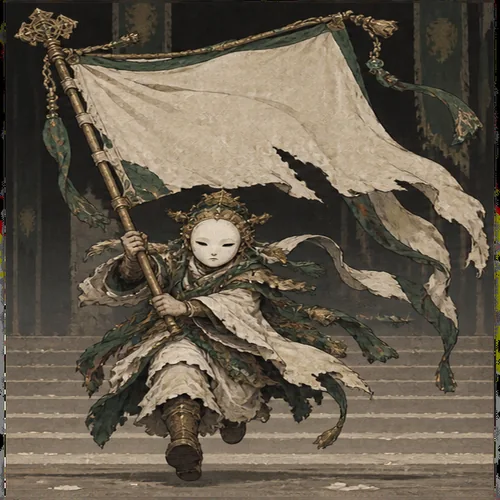 Procession PageC39 · 1 energy · 1/2The smallest herald carries a list of names too heavy for its paper arms, adding one final mark to debts already bleeding.Read this folio → carried lists of debts and names the officials preferred not to read. Hearth watched it arrive, announce the obligations, and leave again without asking the Lion to kneel beneath any standard. They were not one spirit and had never shared a body. The Page kept the order of the record; Hearth kept the road open long enough for someone to hear it. Their differences became familiar, and their silence learned how to hold a conversation.
The Page once asked whether guarding a gate made Hearth part of the court. The Lion remembered the stone, the plate, and Nima's cloth, but he could not speak in human words. He lowered his head toward the empty arch. The Page understood that a place could hold a promise without owning the person bound to it. It wrote the debt into its list. Hearth remembered that the banner had never been the one he chose to guard. The two spirits remained separate, but the Page's records helped later visitors understand that the Lion's loyalty had been taken for granted, not freely given.
When travelers left stones at the new crossing, Hearth nudged them into the same crooked line as before. The Page noticed that he never moved the smallest ones, which children had placed near the center. It asked why, without expecting an answer. Hearth watched the road. The Page left a blank space beside the entry, not as proof that the Lion had spoken, but as room for a detail it could not know. Their friendship was built from that restraint: the Page did not assign words to the Lion, and the Lion did not demand that the Page turn every memory into a verdict.
A Crown Ledger and an open door
Much later, the courthouse opened an inquiry into the orders that had kept the passage under royal authority. The old plate was brought into the hearing room. Iona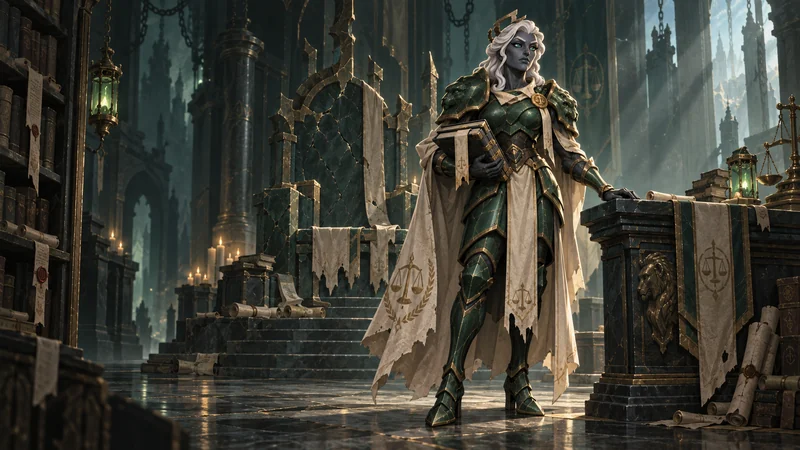 IonaFirst-generation championIona catalogs the promises every ruler abandoned.Read this biography → recognized the shape of its seal from records she had inherited and asked who had been allowed to cancel the duty. The answer was no one. The Lion remained outside the chamber, in the same place it had been for generations. Kael
 KaelFirst-generation championKael kept the foundry gates open when the city ordered its workers sealed inside.Read this biography → noticed the stone figure and the pale spirit resting beneath the torn standard. He said there was no king and no banner, yet the Lion still guarded the steps.
IonaIonaFirst-generation championIona catalogs the promises every ruler abandoned.Read this biography → admitted that the court had treated a missing end date as a permanent obligation. She did not say she had caused Hearth's death or original binding. She had not. She could only answer for what her office was doing now. KaelKaelFirst-generation championKael kept the foundry gates open when the city ordered its workers sealed inside.Read this biography → asked whether the Lion could be given a duty it might choose and a door it might leave. IonaIonaFirst-generation championIona catalogs the promises every ruler abandoned.Read this biography → had no legal formula that made a spirit free by declaration. She ordered the inquiry to remain open and let the Lion decide whether it would cross the threshold with them.
Hearth could not read the Crown Ledger the way a clerk could. The trial's preparation revealed only the owner's next steps; it did not expose the opponent's hidden hand. He needed no secret knowledge to understand the invitation. The people in the courtroom had stopped calling his obedience proof of consent. For the first time, the gate stood open without a royal banner above it, and no one blocked the path to make him choose. He turned toward the room and moved of his own will. The old stone stayed behind; the spirit passed the open door.
The card at the open door
The Ledger Crow gave the Lion's spirit the official Bannerless Lion card form. The card contained Hearth alone, not Nima, the travelers, the captain, or the people whose stones remained beneath the arch. Its painted image showed the pale-maned guardian and the green remnants of the standards he had outlived. It used Mournhand's real printed card design, with the same three-energy cost and three attack, four health shown in the game. When the trial ended, IonaIonaFirst-generation championIona catalogs the promises every ruler abandoned.Read this biography → gave the card to the player without claiming ownership. The transfer gave Hearth a portable form for play; it did not erase the old lead seal or send him beyond the mortal world.
The Lion's printed text is Open slot. He has no natural triggered effect. In the game, a player can build his role by choosing an attachment in the saved loadout, then judge the cost and benefit at the table. For example, if Bannerless Lion is a 3/4 and attacks a 2/3 defender, combat resolves simultaneously: the defender is destroyed and the Lion survives at 2 health. That trade comes from his printed body and the normal combat rules, not from an invented ability.
