Mire Crown Stag
4 energy · 3 attack / 5 health
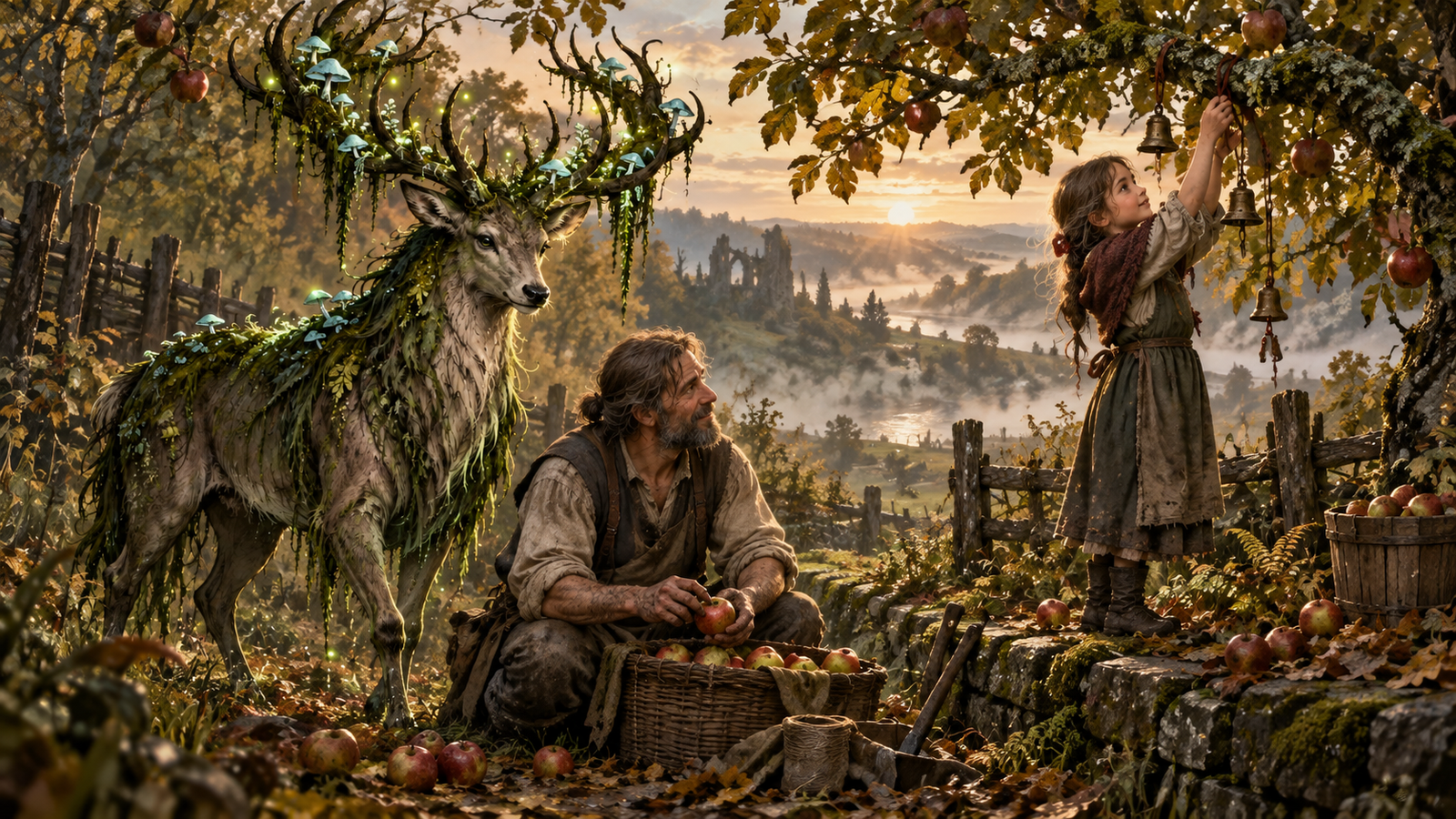
Mire Crown Stag: the bells beneath the water
The orchard above the floodplain
Before the orchard became a mire, its paths rose just above the river’s spring reach. They were narrow, packed by wheelbarrows and hoofprints, and shaded by apple trees that leaned toward one another as if trading secrets. Iven Vale kept the place for the town council, though he had never thought of himself as its owner. He pruned branches, repaired the low fence, and left windfall fruit beneath the trees for anyone who arrived hungry. His wife, Sera, had planted the oldest row before she died. Iven continued to tend it because the work gave his hands somewhere to go on mornings when the house was too quiet.
The stag came from the western wood as a yearling, thin enough that the ribs showed under its coat. It did not bolt when Iven saw it. It stood between two apple trees and watched him cut a dead limb. He lowered the saw and waited until the animal had chosen its distance. The next day it returned. By the end of the week it was eating windfall apples from the ground while Iven worked on the opposite side of the path. He never tried to feed it by hand. He believed a gift should not become a debt merely because someone accepted it.
Iven’s niece, Neri, lived with him after her mother took a position in the city infirmary. She was seven, impatient with silence, and convinced that the stag was lonely because it had no name. Iven explained that animals did not need human names to know one another. Neri answered that people did. She began calling it Bell because its ears turned whenever the small pruning bells rang in the trees. The name stuck in her own mouth, though the stag did not react differently when she used it. At least, that was what Iven said. He still looked toward the orchard whenever Neri called.
One autumn the river rose high enough to cover the lowest path. Iven tied soft bells to the branches above each place where water had reached the roots. The metal was light, chosen so it would not startle the birds. When the bells rang in the wind, Bell learned which lanes stayed dry and which ended in mud. It began to walk the raised paths at dawn, pausing where a bell moved too sharply or where a footstep had softened the earth. Iven noticed the pattern and adjusted the markers. Neither of them knew that the orchard was teaching the other how to listen.
What the bells were for
The bells were not decorations. Iven had learned the river by losing things to it. Years before Bell arrived, a sudden flood had taken Sera’s lower garden and half the toolshed. She had survived that flood, but the cold that followed weakened her lungs. Iven kept the small bells because sound could warn someone before water reached their ankles. The orchard had no wall strong enough to hold the river back. It could only give people time to choose a higher path.
After Sera died, Iven planted a new line of dwarf apples near the orchard’s eastern edge. He wanted Neri to grow up with fruit trees that were hers to climb, not only rows that reminded him of his wife. Neri named each tree after a person she liked. The names changed every few weeks. One tree was “Aunt Sera,” then “the doctor who lets me keep the bandage scissors,” then “Bell’s secret tree.” Iven let the labels stay until the weather took them. He found comfort in the fact that the orchard could hold a name temporarily without demanding it last forever.
Bell learned Neri’s habits. It waited beyond the fence when she came home from school, not close enough to frighten the other children. It followed her along the dry paths when Iven sent her to collect fallen branches. She would talk about her lessons, the city, and the idea that she might one day study medicine. Bell listened with its head turned slightly, the same posture it used when a bell sounded from another side of the orchard. It did not understand the words. It knew when Neri’s voice was bright and when she was trying not to cry.
One day, Neri fell on a low stone and cut her knee. Iven reached her first, but Bell had been nearer. The stag stamped at the wet ground, then moved between her and a patch of black mud where the path had begun to give way. Iven carried her home. She cried more from embarrassment than pain. The cut was small, but a physician cleaned it and warned that river mud could make a wound dangerous. Neri stopped laughing. For a week afterward she tied a little bell to the gate so Bell could hear when she came outside. Iven said the animal did not need it. He did not remove it.
A path for the injured
In the years that followed, the orchard became a place where people came to recover. Neri, now old enough to help in the infirmary, brought neighbors who needed fresh air after fever or a quiet path after grief. Iven did not ask them to explain their troubles. He showed them where the roots made a natural seat and which trees still held late fruit. Bell kept its distance, but it remembered each person’s pace. Those who moved slowly found the stag standing at the next bend, waiting until they had caught up.
When a traveler cut a hand on a broken basket, Bell did not let anyone approach until the wound had been washed. Iven first thought the stag was afraid of the blood. Then he noticed that it approached only after Neri wrapped the hand. It had learned, through no lesson anyone could point to, that a hurt person needed care before they needed company. The stag was not gentle because it had never known danger. It was careful because it had seen how quickly a small injury could become a larger one when people pretended it did not matter.
Iven began to keep a second map beside the flood markers. He marked the paths that held after rain, the trees that offered shade at midday, and the places where an injured person could rest without being seen from the main road. Bell often stood near the marked bends. The stag’s antlers brushed low branches, carrying bits of moss and leaf. When the first mushrooms appeared on its crown, Neri tried to pick them off. Iven stopped her. Some were harmless, he said; others needed to remain where they had grown. Bell shook its head, and a pale cap fell into the basket at Neri’s feet. She laughed until the stag stepped away.
The orchard’s caretaker was not a healer, and Bell was not a guard trained for battle. They made small choices around pain: slow the cart, leave the gate unlatched, do not send a feverish child across the road alone. Iven taught Neri that the bells were useful only if someone listened after hearing them. Neri sometimes argued that the town should build a wall, drain the lower land, and move the orchard uphill. Iven agreed that the path could be improved. He also said a wall could fail and a dry path could still lead someone into danger. The map was not a promise that nobody would be hurt. It was a promise that they would try to notice.
The town’s tidy map
The council surveyors arrived in spring with red stakes and a plan to straighten the river road. The orchard sat across a proposed service lane that would shorten the route to the furnace district. The surveyors measured tree rows, fence posts, and the well. They did not record the footpaths that crossed the property or the places where the water changed direction. When Iven showed them the old flood markers, one clerk wrote “unverified local observations” in the margin. The council wanted a map that could be built from. It had little use for a map that asked people to remember.
Neri argued at the public meeting. She was sixteen by then, and her voice shook when the clerk called the orchard “low-value land.” She listed the names of families who used its paths, the sick neighbors who rested beneath the east trees, and the bells that had warned the ward during Sera’s flood. The chair thanked her for her concern and said the town would compensate Iven for the lost acreage. Nobody had asked what the orchard meant to her. She left before the meeting ended, ashamed of the tremor in her voice and angry that no one had heard the words inside it.
Iven tried to negotiate a smaller lane and a raised footpath around the orchard. He offered to move the fence himself and plant new trees where the road would pass. The contractor refused because the project had already been costed. The clerk said residents could use the road once it was complete. Iven replied that a road designed for wagons did not replace a path used by someone walking beside an injured neighbor. The clerk wrote that down as sentiment. The surveyors drove the red stakes into the earth.
Bell reacted to the stakes before Iven did. It began circling the eastern row at dusk, stopping where the ground gave a hollow sound. The river had shifted beneath the surface. A hidden channel ran toward the orchard, blocked by a wall of old silt. Iven reported the hollow ground to the council. They sent an inspector who tested the path on a dry afternoon and found it firm. Neri wanted to remove the stakes and place them on the road. Iven asked her not to risk a fine. They marked the dangerous ground with yellow cloth instead. Bell watched from the trees as if it understood that warnings could be ignored by people who had never needed them.
The calf by the old fence
The flood came in early summer, after three days of rain upriver. The first water covered the lowest orchard path, then slipped through the unmarked channel beneath the eastern row. Iven rang the bells himself. Neri went to the high road to warn the neighboring families. Bell moved along the fence, guiding frightened animals away from the black water. It was not a panicked flight. The stag crossed each path once, then returned to the points where a person might mistake shallow water for solid ground.
At the eastern fence, a young calf had become tangled in a fallen branch. The animal belonged to a milk seller who had tied it beneath the oldest apple tree to shelter it from the rain. Iven heard its cries and went back. He had time to reach the raised path. He could have cut the branch and returned with help. Instead he climbed down into water already carrying broken limbs. Bell followed. The stag lowered its head and pushed at the timber while Iven worked the rope free. The current loosened the bank beneath them.
Neri found the calf on the higher path and dragged the rope clear. She shouted for Iven. The stag heard her and turned toward the sound. The movement freed the branch enough for the calf to scramble up. Iven was pinned against the fence. Bell stepped into the current, placing its shoulder beneath the beam. It held the wood long enough for Iven to slip free, but the water had already pulled a section of fence across the path. Iven struck the stones and could not stand. Neri and the neighbors reached him from above.
Bell stayed in the flooded row. Its antlers caught a loop of the warning cord. It wrenched free, but one tine broke against the fence. The stag pushed toward Iven until the last stretch of ground collapsed between them. Neri called its name, the name she had made as a child, and Bell tried to cross. The current dragged it sideways into the orchard’s drowned roots. The neighbors saved Iven and the calf. They could not reach the stag before dusk. Its body was not found when the water fell.
Iven survived the flood with a fever and a broken leg. He asked first for the calf, then for Neri, then for Bell. Neri answered each question. When she told him the stag had not come back, he turned his face toward the wall. He did not ask her to say it had died. She could not. In the weeks that followed, they walked the safe upper path together. Iven rang the bells at every marker. At the eastern fence, he stopped before the missing section and listened for a hoofbeat that never came.
The orchard after the water
The river did not return to its old channel. It left the eastern half of the orchard saturated, then receded far enough to make the ground look safe again. The council called the flood an exceptional event. The contractor resumed work. Iven was still healing, and Neri had begun training full-time at the infirmary. They had less time to argue than the council had to rebuild. The orchard was divided by a roadbed and a drainage trench. Several trees died. The rest grew at strange angles, their roots searching for a lower water line.
Every dawn, Iven walked the new edge with a cane. Neri marked the trees that could still bear fruit. She wanted to save them all, though the work made her hands ache. Iven told her to choose the trees most likely to survive. She heard this as a request to choose which memories mattered. They argued. He told her the orchard was not her mother. Neri answered that he had spent years treating it as if it were. He had no reply that would not sound like a defense, so he sat beside the broken fence until she came back.
They repaired what they could. A few residents helped on weekends. The calf grew into a nervous milk cow and returned each year to the upper grass, never approaching the drowned side. Neri brought it apples from the surviving trees. The cow remembered the flood in its own way, shying from the old fence and pressing close to the person holding the basket. Iven never blamed it for being frightened. He watched it from a distance and left a dry path back to the hill.
Bell began to appear after the water settled. At first the witnesses disagreed about what they had seen: antlers between trees, a reflection in a puddle, a dark shape where the moon made the branches look pale. Then the mushrooms returned. They grew along the places where the stag had walked, most densely beside the missing fence. Some glowed faintly after rain. Neri thought the mycelium had spread through the drowned roots. Iven did not tell her she was wrong. When they heard a bell ring with no wind, he held his cane still and listened.
The stag’s spirit had not chosen to remain as a ghost. It had been reaching for Iven when the path broke. The orchard’s web of roots, bells, and remembered routes held that unfinished movement in the mud. It could travel a little farther each season, but never beyond the boundary where the bells had once marked safe ground. When Iven crossed the road to the infirmary, the stag followed until the last tree and then stopped. Neri would sometimes find it waiting beside the upper fence, watching for the old caretaker to return.
A life measured in small recoveries
Neri became a physician because the infirmary needed people who knew how to listen before reaching for a remedy. She did not become a physician to finish her father’s work or to redeem the flood. She wanted to understand why a shallow cut could turn dangerous and why people hid injuries until they could no longer hide them. At the infirmary she learned to ask, “When did it begin?” and “What changed?” She kept the questions plain. Patients trusted them more than promises that everything would be fine.
When Iven’s leg healed, it did not become what it had been. He walked with a cane and could not work the lower orchard. He and Neri began to visit the surviving paths in different ways. He would pause at the old bell markers and tell her what each sound had meant. She would tell him what she had learned at the infirmary about joints, fever, and fear. Their conversations did not erase the argument about the orchard. Some evenings they agreed about what to do; other evenings they left the question open until the next visit.
The stag became a familiar presence to the patients who could walk. It never approached the infirmary door. Instead it appeared across the road where the old orchard began, its antlers threaded with moss and small pale fungi. The patients called it a guardian. Neri asked them not to feed it. She did not want the name to become a duty it had not accepted. A child recovering from a broken ankle drew the stag with a crown of mushrooms. The picture showed it carrying a basket of apples. Neri placed it on the ward wall. She did not tell the child the animal was a spirit trapped in a few acres of marsh.
Iven grew older. He stopped walking all the way to the eastern fence and began leaving a basket of windfall fruit at the start of the safe path. The stag did not eat from it when he watched. The next morning the basket would be empty, or turned on its side, or filled with a leaf and a single apple seed. Neri said a bird might be taking the fruit. Iven answered that birds had never returned seeds in baskets. Neither of them insisted on certainty. It was enough to keep making the small offering.
When Iven died in his sleep, Neri was at the infirmary. She had visited the previous night and left before dawn, promising to return with a new bell for the orchard. The promise was ordinary; she made similar promises every week. At the funeral, she regretted every ordinary sentence she had not said. She returned to the orchard after the mourners left and found the stag standing beside the old marker. It lowered its antlers until the broken tine rested near the basket. Neri sat in the grass and told it that Iven had died. The stag stayed until sunset. For the first time, she understood that the spirit was not waiting for her father’s return. It was keeping a place where his name could still be spoken.
The bell pulled from the mud
The town eventually declared the drowned orchard unsafe. The road was moved again after a drainage wall failed, but nobody restored the paths. Neri protested at the council meeting and was told there was no budget to maintain land that no longer produced fruit. She asked what counted as production: apples, medicine, a dry path, a place where people could grieve without being hurried. The chair said those things belonged in different departments. The orchard did not fit on a budget sheet, and so it was left to sink.
Neri continued to visit. She brought new bells and tied them higher in the branches as the water rose. Each one rang less often than the last. The stag moved through the mire without leaving prints. Its body was not living flesh, but the shape of the animal remained. The fungi on its antlers glowed softly at night. It would walk beside Neri until she reached the old fence, then turn back toward the tree where Iven had fallen. She did not ask it to come farther. There were boundaries that love could not persuade into disappearing.
One autumn storm tore a bell from the oldest branch and carried it into the mire. Neri heard it ring underwater, a muffled sound that seemed to come from beneath the path. She returned with a long hook and a rope. The mud was too deep for her to step safely, so she tied the rope to a root and lowered the hook. It caught the bell after several attempts. When she pulled, the branch above her split and dropped a curtain of water. The stag rushed forward, placing its body between her and the falling limb. Its crown struck the tree. Fungi scattered through the rain like tiny lamps.
The bell came up in Neri’s hand. It had been Iven’s first marker, the one he had tied after Sera’s flood. The metal was green with age, but the cord still held a faded knot. The stag stared at it. Neri understood then that the bell had become the last piece of the route that connected the living orchard to the drowned one. She could take it away and close a chapter of her father’s work. She could leave it and let the mire keep calling the stag back. She chose neither immediately. She sat on the dry bank with the bell between them and told the stag everything she remembered about Iven, including the arguments.
The spirit listened. When Neri spoke of his kindness, the stag’s light softened. When she admitted she had been angry that he returned to the flood, the light did not dim. When she said she was angry still, the stag stepped close enough for its muzzle to touch her shoulder. Neri cried. She had imagined that remembrance required a clean story. Instead, the orchard held a father who had been generous and stubborn, a daughter who loved him and argued with him, and a stag who had chosen a dangerous path for reasons no one could fully settle.
The Crow offers a different path
The Ledger Crow arrived before winter. It had been following reports of a light in the mire, and it carried a folio whose pages stayed dry in the rain. Neri mistrusted the Crow at first. She had seen officials turn names into evidence for whatever they already wanted to do. The Crow did not ask her to sign anything. It asked whether she would tell the stag’s story from the beginning, including what she did not know. Neri said she could tell what she had seen, but she would not decide what the spirit wanted.
The Crow accepted this boundary. It laid three objects on the bank: the recovered bell, a blank record, and a card-shaped sheet of dark paper. It explained that the Mournhand binding could give the stag a body beyond the orchard’s old routes. The binding could also make its spirit available to players who summoned the card. Neri asked whether it would be forced to fight. The Crow told her that the card’s printed rule would shape its use in a match, but the spirit’s consent had to be recorded separately. It could choose whether to answer a call. The card would not make the violence of a battle disappear, nor could the Crow promise that the spirit would be free of every tether.
The stag approached the bell and touched it with the broken tine. It did not ring. The Crow asked it to choose between remaining bound to the drowned ground or being recorded in a card that could travel. Neri did not translate the options as if she knew what the stag understood. She simply placed the bell on the blank record and stepped away. The stag moved to the card. Its antlers crossed the page without tearing it. The spirit’s light settled into the ink, where the Crow recorded its name as Mire Crown Stag and preserved Iven, Sera, Neri, the orchard, and the flood as part of the life that had shaped it.
The binding did not return Iven. It did not repair the drowned orchard or absolve the council that had ignored the warnings. It changed the place where the stag could wait. Its spirit remained in the mortal world, held by a promise to protect people already in danger and by the familiar human names that had become part of its memory. When the card was complete, Neri heard one clear note from the old bell. The sound traveled beyond the flooded trees. She did not mistake it for her father’s voice. She let it be the stag’s answer.
The living edge of the mire
In a match, the Mire Crown Stag gains two attack while attacking a damaged creature. The rule is specific: the stag is more dangerous when it can see that a target has already been hurt. It does not gain that strength while defending, and it does not make the first wound. A player can use another card to damage an opposing creature, then send the stag into that wounded target. The sequence turns attention into timing: first identify the opening, then commit the attacker. If the target is still unhurt, the bonus does not apply.
That effect echoes the stag’s life without rewriting it. Bell had learned that pain should be noticed before a person was asked to keep walking. Its fierceness was not an appetite for suffering. It was a response to danger that had already crossed the line. In the orchard, the stag waited near the wounded and the lost. At the table, the player must decide whether to act after an enemy has been weakened or spend the stag’s attack elsewhere. A careless attack wastes the advantage. A patient one can end the threat that has already injured an ally.
The folio links Mire Crown Stag to Coalblossom Hart, who tends the surviving edge of the same ruined orchard. The hart’s story begins where Bell’s ends: among roots that still produce something living after the water. The Crow records them separately because grief does not make two creatures one. Their paths meet at the orchard boundary, where a line of mushrooms grows beside new leaves. The stag guards the damaged path. The hart tends what can still grow.
Neri kept the recovered bell in the infirmary garden. She tied it to a low branch, where patients could reach it without climbing. Its note was soft and slightly uneven. Some people rang it to ask for help; others rang it when they had made it through a difficult morning. Years later, children who had never met Iven learned that the sound marked a path to a shaded seat and a basket of apples. They did not know the full story, and Neri did not force it on them. When they asked about the antlered shadow beyond the fence, she told them the stag had once stayed when someone was hurt. It still did.
 Coalblossom HartIt walks only where ground remembers heat.
At the table
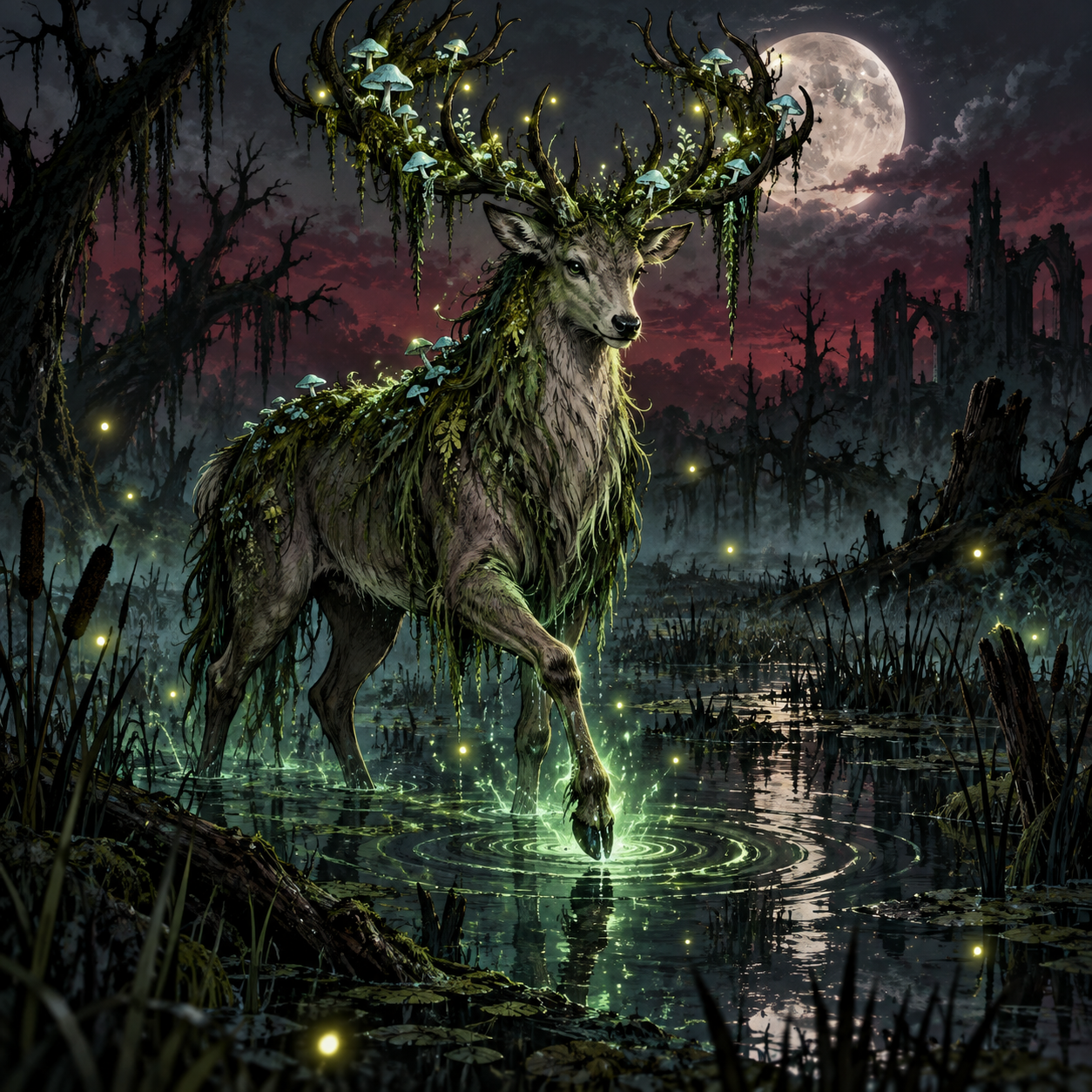
Printed effect: Gain +2 attack while attacking a damaged creature.
Set up the damaged-target attack
The Stag gains two attack only while it attacks an already damaged creature. Its 3 attack becomes 5 for that qualifying combat; the bonus does not apply while defending.
One move, shown
An enemy creature has taken damage and remains on the field for your attack.
Spend 4 energy to play Mire Crown Stag. Apply the printed effect exactly as written.
Damage the target first, then attack it with the Stag. Against a healthy creature, it stays at its printed 3 attack, so choose another line or prepare the wound first.
The example explains a legal choice, not an additional card effect. Check the live game for current targeting and timing.

Chibi mode
This is the current game’s chibi rendering of Mire Crown Stag. The alternate art changes presentation, not the printed card rules.