Wispwing Crane
3 energy · 2 attack / 3 health
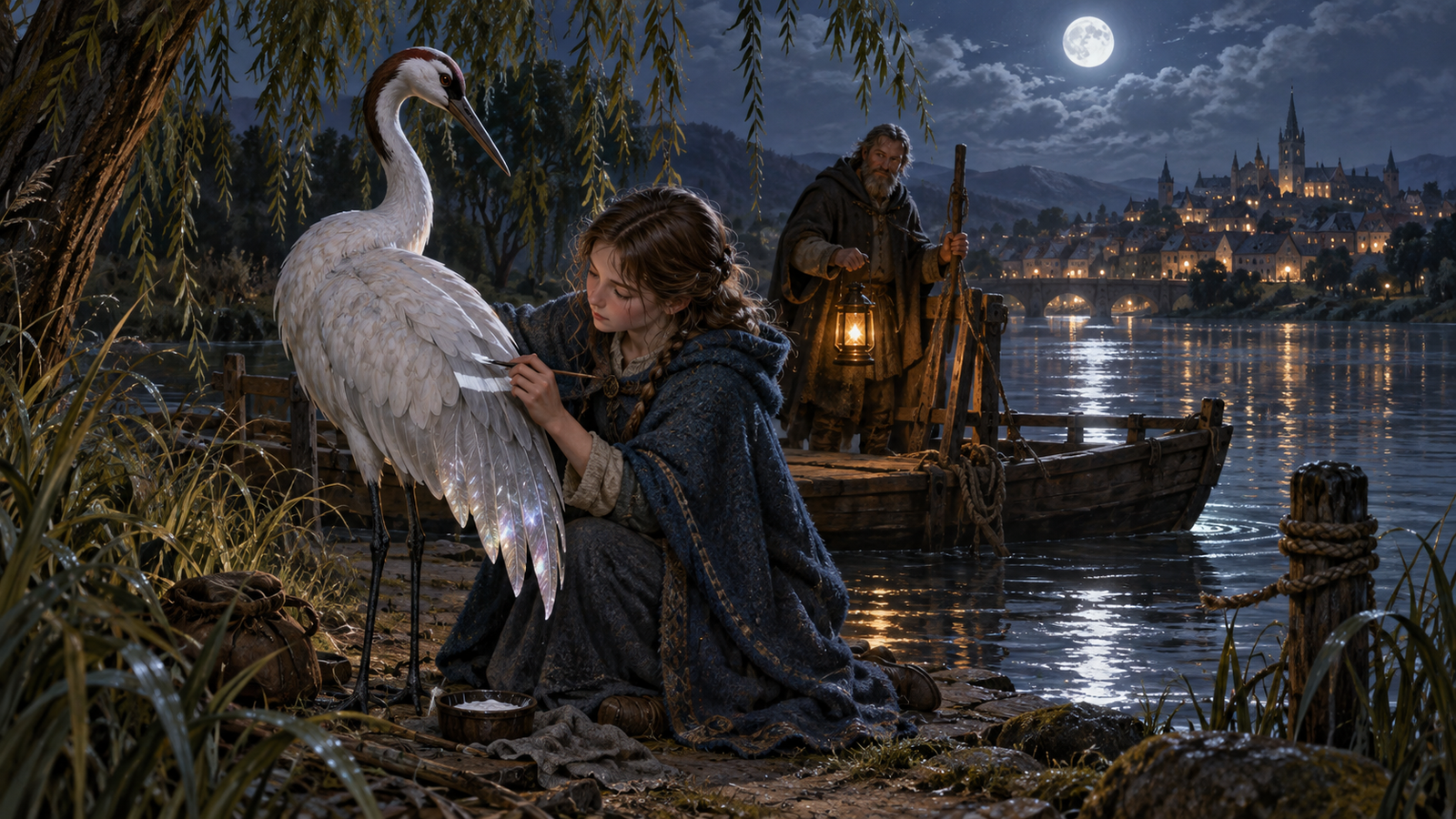
Wispwing Crane: the bank that answered
A mark on the white wing
The crane arrived at the ferry crossing each spring, but no one could say when it had first decided the place belonged on its route. It was a tall white bird with a dark line at the edge of each wing and a patient way of standing among the reeds. It did not nest beside the busiest landing. It chose the quiet stretch where the current slowed before turning around the willow island.
Torren, the ferryman, noticed it because it watched people rather than fish. A family came down the hill with a sleeping child, and the crane waited until they had crossed. A pair of traders argued over the fare, and the bird stepped away from the rope as if it had heard every word. When a storm made the river rise, the crane moved to higher ground long before the water reached the ferry posts.
Torren’s daughter, Edda, was ten when she first carried a lantern on the crossing. Her mother had died the winter before, and the ferryman had brought his grief to work with him. He was good at reading current and poor at knowing what to say at supper. Edda learned to tie the mooring knot, trim the lantern wick, and tell a traveler when the crossing was too dangerous. She did not want to replace her mother. She wanted to help her father finish a day without losing the boat.
The crane began following the ferry. It would walk along the bank as Torren pushed off, then fly low beside the boat until the far landing came into view. It never tried to perch on the passengers. It kept a little distance, white wings moving above the black water. Edda began to look for it whenever the river was difficult to read. If the bird turned inland, she checked for a wind shift. If it stayed near the current, she watched the reeds for a hidden snag.
She was not sure the crane understood the work. Torren said it was following insects or the warmer air above the water. Edda said those explanations could be true and still leave room for the bird to choose them. Her father replied that people often mistook an animal’s habit for a promise. Edda accepted the warning. She did not ask the crane to carry anything it had not already chosen to carry.
One dusk, after a storm had thrown branches against the ferry posts, Edda found a small line of white mud on the bird’s wing. It looked like the river had painted a mark there. She asked Torren whether it could help them tell this crane from the others that sometimes crossed the marsh. Torren said they should not mark a wild bird without reason. Edda agreed. She watched for another week. The crane returned to the same bank each evening and waited near the lantern.
When Edda asked again, Torren handed her a pot of harmless chalk pigment used to mark ropes before repairs. She put a short white stroke near the edge of the crane’s folded wing, careful not to touch the feathers beneath. The bird held still. She stopped at once when it shifted away. The mark was small enough to fade in a season. It gave the family a way to recognize the same visitor without pretending it belonged to them.
The crane came back the following year with most of the mark worn away. Edda knew it anyway. She had expected to be relieved. Instead she was glad, the way she was glad when a familiar traveler returned with the same scuffed boots. She painted a shorter line where the first had been. The crane watched her hand, then turned toward the water. Torren said it had tolerated the ritual. Edda said that was not the same as loving it. Both were right.
A ferry is a promise with limits
Torren kept a small book of crossings. It listed the day’s passengers, the weather, and any repair needed before the boat went out again. He did not record every conversation. He recorded enough to remember whose medicine had been delivered, which family had paid later, and who would need a second trip before the shops closed. He believed a ferry was a promise with limits: he would carry people across when the river allowed it, and he would say no when the water made the promise unsafe.
Edda sometimes hated those refusals. A traveler would arrive with a tired child or a parcel of food, and Torren would say the crossing had closed. The crane might be standing on the far bank, visible beneath the moon. Edda would argue that it had crossed. Her father would answer that a bird did not have to keep a lantern lit, guide a boat by hand, or bring every passenger home. The crane’s flight was not evidence that the ferry was safe.
She understood the distinction after a fog night when the boat nearly struck an old bridge piling. The crane had disappeared into the gray. Torren turned back using the sound of the water against the hull and a rope tied to the landing post. No one was hurt. The passengers were angry about the delay, then embarrassed when they saw how close the boat had come to the timber. Edda stopped arguing with the river after that, though she still argued with her father about how early he closed the crossing.
The crane did not make the route safe. It made the route feel less lonely. On quiet evenings, it walked the reeds while Edda checked the oarlocks. On crowded evenings, it waited farther back. If a passenger was frightened, Edda pointed toward the white shape and asked them to look at its feet. The crane never hurried. The river continued moving around it. Watching that stillness gave people something to do with their fear.
Edda’s friend Iven lived on the opposite bank. He was learning to repair boats and had a habit of asking for passage just after Torren had tied up for the night. Edda would take the small skiff to fetch him. Torren did not forbid it, but he made her wear a second lantern and tell him the route. She accused him of treating her like a passenger when she knew the river better than some grown men. He said knowing the river did not make her immune to it.
The crane watched their practice runs. It followed the skiff from the bank, then landed near the place where Iven was waiting. Edda wondered whether it recognized her or only the lantern. She decided it did not matter. When she returned, she carried the oar back to its hook, the lantern back to its peg, and the small book to her father. The work was ordinary. The crane’s company made it easier to keep doing.
When the river froze at the edges, the crane left. Edda’s first winter without it felt longer than the first winter without her mother, though she knew the comparison was unfair. The bird had not promised to stay. Still, she looked at the quiet bank each evening. Torren let her. He did not tell her that spring always came. He showed her how to repair a cracked lantern glass and waited until she asked for help.
The painted feather
The white mark faded by the third spring. Edda had grown taller and could row the ferry without her father on board. Torren gave her more responsibility but did not call her the ferryman. She could refuse a crossing, set the fee, and close the route if she saw danger. She could also change her mind when new information arrived. Torren said that was what judgment looked like: not never being wrong, but being willing to notice.
One morning, the crane returned with a long feather caught in the reeds. It could not reach the feather without putting its body into the mud. Edda stepped closer, but the bird backed away. She stopped. After a while, the crane lowered its head and used its beak to pull the feather free. It carried the plume to the bank and left it beside the lantern. Edda understood that the bird had brought it deliberately, though she could not know why.
She kept the feather in the ferry book. It became their signal that the crane had returned for the season. The bird’s mark was no longer needed. Edda could recognize the dark edge of its wing and the small notch near the shoulder. When the chalk line vanished, she did not repaint it. The feather did not make the crane a pet or give the family a claim. It was a thing it had left behind, and Edda treated that gift carefully.
Torren grew older. His hands stiffened in cold weather, and his shoulder began to hurt after a long crossing. Edda took more of the evening routes. Their roles changed without a ceremony. He still sat beside the stove and checked her notes. She still came to him when the river did something she could not explain. The crane continued to follow the boat from bank to bank, sometimes flying ahead, sometimes vanishing until the far landing.
The bird did not rescue people every day. Most days, it simply stood in the shallows or hunted in the reeds. Edda liked those days. They made the crane part of the river rather than a tool that appeared only when someone was in danger. When it brought its wings close to its body and tucked one leg beneath itself, she knew the night was calm. When it walked upstream, she watched the current. Neither sign replaced judgment. They were one more detail in a crossing full of details.
The ferry book accumulated more feather marks. Edda wrote down each year the crane returned. She added notes about the color of the water, the first frost, and how long the chalk mark remained. Some pages were practical: the lower rope frayed; the south post shifted; the crane’s favorite bank flooded in spring. Other pages were personal. She wrote that her mother used to hum while trimming the lantern wick. She wrote that Torren had begun asking her to read the passenger list aloud, because his eyesight was changing.
Edda did not know whether the crane heard the humming. It often stayed nearby while the lantern was trimmed. Sometimes she sang the tune from memory. The bird would lower its head and wait. She did not take the stillness as proof that it recognized her mother’s song. She accepted that the quiet was enough.
When Torren finally retired from regular crossings, the ward held a small supper at the landing. He sat in the boat and let Edda row it once across and back. The crane flew beside them. At the far bank, Torren touched the old ferry post and said he would miss the sound of the water against the hull. Edda said she would miss having someone to blame when a crossing was late. He laughed. The crane folded its wings, and they went home together.
The passenger who did not arrive
The night the ferry vanished began with ordinary weather. The river was high from two days of rain but within the marked safe line. Edda checked the lower post and found the mooring rope sound. Her father had retired, though he still watched the crossing from the house. The crane had returned that spring with the white mark nearly gone. Its feather rested in the ferry book beside a new entry: “First crossing of the thaw.”
The last passenger was a cooper’s apprentice named Senn. He had been working across the river and wanted to get home before his sister’s birthday supper ended. Edda knew him from earlier trips. He carried a parcel wrapped in oilcloth and apologized for arriving late. She asked whether he had eaten. He said he would when he got home. The crane stood near the lower reeds, neck tucked into its feathers.
Edda checked the lantern and the oar. The current had shifted toward the island, but the ferry could still cross if they kept upstream of the old post. She told Senn to sit low and hold the rail. He did. She pushed off. The crane took flight, following the boat close to the water.
Halfway across, the fog came down. It was not thick at first. It softened the far lights and erased the bank behind them. Edda called a course. Senn answered that he could see the lantern. The crane flew ahead, then turned toward the shallows. Edda followed the sign, but the current had changed faster than she expected. A submerged branch caught the ferry’s side. The rope tore loose from the small anchor, and the boat swung toward the central channel.
Edda dropped the oar into the water and caught it again with the rope. The ferry scraped a stone. Senn’s parcel fell. He reached for it as the boat tipped. Edda shouted for him to stay low. The crane circled once, white wings cutting through the mist. She could not see the landing. She could not see Torren’s house. She could hear the river and the ferry’s boards shifting beneath her feet.
The current carried them toward the old bridge pilings. Edda pushed the oar against one and spun the bow toward the reed bank. The ferry jolted. Senn lost his hold and went into the water. Edda grabbed the trailing rope, but the current pulled it through her hands. The crane folded its wings and dove after him.
Edda reached the shallows alone. The ferry grounded against reeds, its lantern still lit. She called for Senn. No answer came. She called for the crane. The fog swallowed her voice. Torren heard the horn from the house and led the river watch to the lower bank. They searched until dawn. They found the oilcloth parcel tangled in the ferry rope. They found two white feathers near the central piling. They did not find Senn or the crane.
Edda had made the crossing as safely as she knew how. That did not keep her from replaying it. She had followed the current, called warnings, and reached the bank. She had also been the person in the boat. It took years for her to accept that responsibility and guilt were not the same thing. She had been responsible for her decisions. She was not responsible for every force the river had hidden from her.
The return to the wrong bank
The search ended when the river watch could no longer justify keeping people away from their work. Senn’s sister came to the landing each evening for a month. Edda sat with her when she could. Torren brought food. Neither knew what to say. The crane’s absence had its own shape. Edda looked for the white wing each dusk and found only foam, reeds, or moonlight on the water.
She kept the ferry open when the conditions allowed it. She also closed it sooner during fog. Some passengers complained that she was afraid. She did not deny it. A fear that had learned the shape of a real danger could be useful if it did not make every choice for her. She wrote the new closing rule in the book and asked another ferryman to review it. The route changed because the river had changed, and because the loss had taught her what she had not known before.
At the place where the crane had dived, the current made a circle around the old piling. A white shape appeared there on certain nights. It moved toward the wrong bank whenever someone called out from the water. It never crossed to the landing where Edda waited. Torren said it was likely foam. Edda said perhaps. Neither of them wanted to turn a hope into a report.
The first year, Edda thought the shape was the crane returning. The second year, she wondered whether it was Senn. The third year, she stopped assigning a name to it. She could not prove what remained in the water. She could only say that the river carried something pale across the channel when a voice called from the wrong bank.
The ferry book stayed open beside the lantern. Edda recorded each search, each false sighting, and every passenger who crossed safely after the accident. She wrote the dates when the fog descended. She noted where the water had hidden the branch. The record was painful, but it helped future ferrymen make better decisions. It also made sure Senn had not vanished into an anonymous story about a dangerous river.
Torren worried that Edda had made the book into a place where grief could not end. She told him that writing down a name did not mean she expected the person to return. She was learning the difference between remembering and waiting. Torren understood. He began to visit the landing less often, though he still woke when the ferry horn sounded in the night.
On the fourth anniversary, Edda found the old painted feather among the reeds. It was the plume the crane had left years before, darkened by water but still white along one edge. The current had carried it to a bank where it could not have rested during an ordinary season. She took it to the house and dried it beside the stove. Torren did not tell her what it meant. He asked whether she wanted to put it back in the ferry book. She said yes.
A promise that could be returned
Years passed. Edda trained another ferryman, Luan, to read the current at the lower bend. She showed him the safe line, the submerged branches, and the places where a lantern reflection could be mistaken for a landing light. She told him about Senn and the crane. She did not make the story into a test of courage. The lesson was to watch the water, listen to warnings, and turn back when the route stopped being safe.
Luan asked whether the crane had truly gone after Senn. Edda said she had seen it dive. She could not say what happened afterward. He asked if the bird was a ghost. She said she did not know that either. Luan looked disappointed. Edda told him uncertainty was not a failure of the story. It was the part that remained honest.
Torren died many years after the crossing. He had lived long enough to see the north landing rebuilt and a second warning light installed on the island. Edda placed the ferry book beside him at the wake, open to the entry from the night of the fog. His friends told stories about the crossings he had made and the ones he had refused. They understood that turning people back was part of keeping them alive.
After Torren’s funeral, Edda returned to the river. The pale shape appeared below the old bridge, moving across the current. It was no longer a small white blur. For one breath, she saw the crane as she remembered it: long legs beneath a folded body, dark wing edges and the old chalk mark nearly erased. It did not come to the bank. It turned toward the far landing and vanished among the reeds.
Edda did not call it back. She held the feather in one hand and the ferry book in the other. She had once believed that if the crane returned, it would mean Senn had been found. The sight did not give her that answer. It gave her the bird, and the old crossing, and the knowledge that the river had carried a memory without making it evidence of anything else.
The next spring, a traveler arrived at dusk after the crossing had closed. He carried a small girl with a high fever and asked whether Edda could take them across to the ward physician. The current was low, but a thick fog sat over the island. Edda told him no. She gave him a lantern and sent Luan to guide them by the upper road. The traveler was angry. He was also frightened. Edda did not confuse his anger with proof that the crossing was safe.
From the water, the crane gave a single call. Edda looked toward the reeds. The white shape moved upstream, away from the fog. Luan followed the safer road. The child reached the ward before midnight. No miracle had occurred. A route had been chosen carefully, and the living had done what they could.
Edda placed the feather back inside the ferry book. She wrote the child’s name only after asking permission. She recorded the road they used and the time they arrived. Beside the note, she drew the small white mark she and the crane had once shared. The bird had returned without being summoned. She had returned the promise by making room for a different path.
The crane the Crow could not call home
The Ledger Crow came to the crossing when Edda had grown old enough to teach rather than row. It carried an empty folio and asked to hear the story from the people who had lived beside the water. Edda gave it the ferry book. Luan described the current and the changed safe line. Senn’s sister, now gray-haired, told the Crow how she had waited for the boat that did not arrive. No one said the same thing in precisely the same way.
The Crow wrote down the disagreement. It noted that Edda had seen the crane dive; that the searchers found feathers but not a body; that a pale shape returned at the bend; and that none of these facts proved Senn’s fate. It recorded Torren’s rule that the ferry should close when the crossing became unsafe. It recorded Edda’s guilt and the work she did to keep the next boat from repeating the same route. It did not make her regret the crane’s only living memory.
At dusk, the white shape crossed the river. It circled the ferry lantern, then flew toward the reeds where the old piling stood. The Crow asked whether the bird wished to be remembered by name. Edda said its name in their family had never been more than “the crane.” Senn’s sister called it the white-wing. Luan called it the wisp because he had never seen it clearly enough to decide if it was alive. The Crow wrote all three in the margin.
The crane’s spirit had remained in the mortal world because its final flight had no landing. It had left the far bank to help someone in the current and never surfaced. The rescue became the last thing it knew how to do. Every call from the wrong bank drew it back into the river. Even after the ferry changed and the search ended, the bird could not tell whether a cry meant a passenger still needed help or only the echo of the night it vanished.
The Crow did not promise to bring the crane home. It asked whether the bird wanted to travel in a card, where other people might call it into their matches. The spirit circled once and landed on the open folio. Edda placed the old painted feather beside it. The Crow wrote the bond as a way for the crane to answer a call without being left alone in the current. The card was a record of a soul, not a claim that the bird had saved Senn or that every crossing could be made safely.
The crane’s name settled on the page as Wispwing. It entered the folio with its white mark, the ferry light, and the route it had followed. The Crow wrote its effect exactly: Rush. It can attack on the turn it is played after the opening turn. That speed reflected the bird’s quick response, but the rule belonged to the game. The story did not add a second attack, a rescue, or an escape from damage.
Edda asked if the card could ever reach the opposite shore. The Crow said the page could travel farther than the river, but it could not tell her where the spirit would rest. She understood. The point had never been to force the crane to return. It was to let its story be answered without pretending the loss had been solved.
A first flight in the hand
Wispwing Crane costs 3 energy and has 2 attack / 3 health. Its exact effect is Rush: it can attack on the turn played after the opening turn. The timing clause matters. During the opening turn, Rush does not let it attack immediately. On later turns, if you deploy it and the game’s normal attack rules allow the attack, it can act that turn instead of waiting.
This makes Wispwing useful when a new target appears and you need pressure now. If an enemy creature has low health and is a legal attack target, the Crane may attack immediately after it enters on a later turn. If you need to respond to a threat before it attacks again, the same timing can matter. Its 2 attack and 3 health are still modest; a ready attack is not automatically a favorable trade. Check the opposing creature’s attack, health, and any active effects before sending the Crane in.
For example, suppose your opponent has a 2/2 creature that threatens a valuable ally next turn. On a later turn, you can spend 3 energy to play Wispwing and attack that target immediately. If the target is removed, you have changed the next board state without waiting. If the enemy has 3 or more attack and the Crane would be lost for little value, it may be better to deploy it for a later turn or choose a different answer.
Rush also gives you flexibility when the opponent leaves an opening. You can play the Crane and use its attack to pressure a champion or trade with a creature if that is legal and worthwhile. Do not confuse Rush with Guard: Wispwing does not automatically intercept attacks. It does not heal, draw, or alter the river. It simply arrives able to attack sooner after the opening turn.
The card can pair well with effects that make a target vulnerable before combat, but the effect must actually resolve first and the target must remain legal. It can also pressure an opponent who expects you to spend the turn developing a slow board. The risk is that a 2/3 body may not survive the response. If you use it only for immediate damage, compare that damage with what you could achieve by preserving the creature. Timing is the Crane’s advantage; its stats do not promise durability.
The crossing taught Edda that movement and arrival are different. Wispwing can move at once. It cannot guarantee the destination is safe. In play, that means use the immediate attack when it changes a decision, protects another plan, or reaches a target before the opponent can respond. If the board is empty of useful targets, deploying it may still build your field, but the Rush portion will wait unused. Let the card’s exact rule, not the dramatic image of a bird over water, decide what is possible.
What the water keeps
Edda visited the river until she could no longer walk to the lower bank without help. Luan brought the ferry book to her house each spring. They read the entries together and corrected the notes when the current changed. The painted feather remained pressed between the page about the fog and the page where the child reached the ward by the upper road.
Some years the river ran low enough to show the old piling. Some years it disappeared under brown water. The pale shape crossed whenever someone called from the wrong side, but not every voice belonged to a passenger. A fisherman once shouted for his dog. A child called to a friend on the island. A watchman called for help after slipping on the bank. The crane answered all of them with the same swift turn.
The ward learned to keep more than one signal. The lanterns marked the safe path. The chimes carried over the market. The ferry book held the names and the hours. The crane remained part of the crossing, but no one asked it to be the only answer. Edda had seen how a single promise could become a trap when no one else shared the work.
When the Crow returned years later, it brought the card’s record back for the family to read. Senn’s sister held the page and asked whether the crane remembered the night. The Crow said the spirit was still tied to it, but memory was not the same as a full account. The bird might remember the call, the water, and the pull of the current. It might not remember the face beneath the surface. No one could know what an animal’s spirit understood after death.
Edda asked the Crow to add one more line: “The river does not owe the living an explanation.” It was not a statement that people should stop searching or stop mourning. It was a warning against turning uncertainty into blame. Senn’s absence mattered. The crane’s spirit mattered. Their stories could be held without forcing either to prove a meaning.
The Crow added the line in the margin. Wispwing moved across the ink and left no mark. Its white wing caught the light from the window. Then it turned toward the sound of a lantern being lit outside. The crossing was open, but the tide was changing. Luan checked the rope before taking the boat out.
Wispwing followed the ferry from bank to bank. At the far shore it landed among the reeds and waited until the last passenger stepped onto dry ground. The spirit was still part of the mortal river. The folio did not close the water around it or declare the missing found. It gave the crane a name people could call, and a route that did not end at the place where it had disappeared.
At the table
Printed effect: Rush. Can attack on the turn played after the opening turn.
Tempo after the opening turn
Rush lets this creature attack on the turn played after the opening turn.
One move, shown
The enemy left a vulnerable target that cannot wait through another full turn.
Spend 3 energy to play Wispwing Crane. Apply the printed effect exactly as written.
Deploy this creature after the opening turn and use its immediate attack if a legal target is available.
The example explains a legal choice, not an additional card effect. Check the live game for current targeting and timing.
Chibi mode
This is the current game’s chibi rendering of Wispwing Crane. The alternate art changes presentation, not the printed card rules.