Brass Owlet
2 energy · 1 attack / 3 health
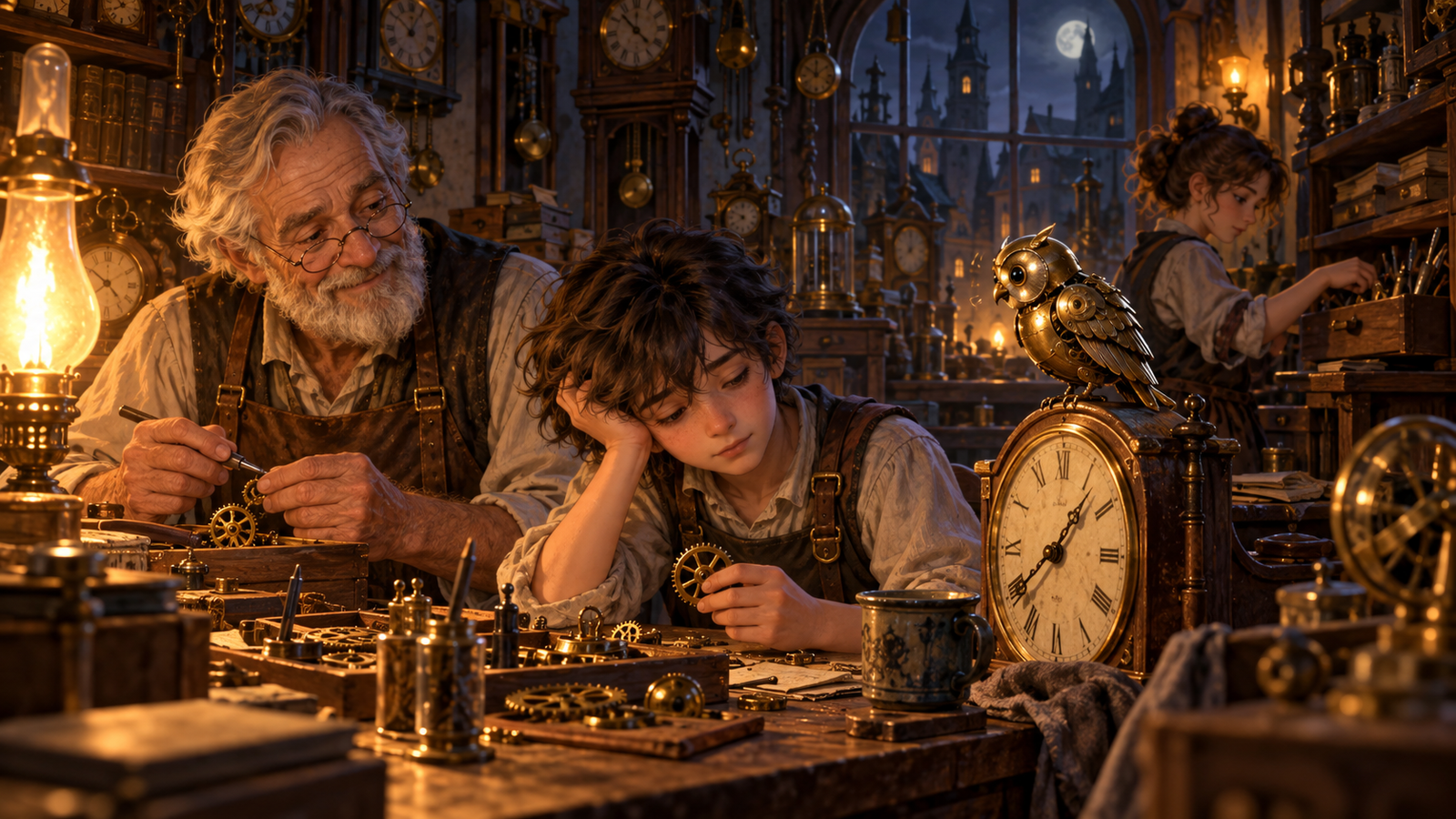
The Hour It Kept
A clockmaker’s second workshop
Master Ansel had built clocks for harvests, ferry landings, and people who needed one dependable sound in a difficult house. He had also built the Orchard Clockbeetle from a thimble and mismatched gears. The beetle tended the orchard mechanisms and learned the family’s rhythms. The Brass Owlet came later, in Ansel’s smaller repair shop nearer the market, where apprentices worked beneath a ceiling crowded with pendulums. Ansel kept the two workshops because customers brought him more clocks than one pair of hands could mend.
The second shop opened before sunrise. Apprentices swept filings from the floor, sorted screws by thread, and wound the clocks Ansel had repaired the day before. They were not children, though some were barely grown. Most had families who depended on the wages. They stayed late to earn another coin or to prove they could be trusted with the fine work. Ansel was proud of their care. He was less proud of how often he accepted it without asking what the extra hour cost them.
One of the apprentices, Lio, had a younger sister named Peri. Their father had lost the use of his left hand after an accident at the mill, so Lio sent most of his pay home. He learned quickly and hid his tiredness behind exact measurements. When Ansel asked him to stay, Lio said yes before looking at the window. He was afraid that refusing might cost him the position. Ansel mistook that fear for ambition because it sounded like the kind of answer he had once given his own master.
Lio was not the only one with a reason to stay. Sava sent money to her aunt, who rented a room near the south gate. Venn, the youngest apprentice, was saving for a set of tools he could call his own. Each had made a different bargain with the clock: one more hour for a safer household, a better reference, a little independence. Ansel knew the sums they earned but rarely asked what they gave up to earn them. He had been taught that a workshop was a family, and family was supposed to endure. He had not asked who benefited most when the word “family” meant unpaid time.
Ansel had apprenticed under a master who never dismissed anyone before the last order was finished. He remembered falling asleep on a stool while the old man measured a brass wheel. The lesson he kept was precision. The lesson he forgot was that he had hated being too tired to go home. When he opened his own shop, he promised himself he would be kinder. For years, he thought kindness meant praise and patience while a job was under way. He did not understand that sometimes it meant ending the job, accepting a delay, and paying the cost himself.
After a week of late repairs, Ansel assembled a tiny brass owl from spare gears and the shell of a broken alarm clock. It was meant to tick at dawn and wake the apprentices before the first bell. He fitted two small glass eyes, a turning head, and a spring that gave one bright chirp at the appointed hour. Its feet were made to perch on a clock frame. The owl had no voice beyond the alarm, and no function beyond timekeeping. Ansel thought that was enough.
The hour after the lamps
The first morning, the owl chirped just before dawn. Lio laughed and said it sounded like a bird that had swallowed a clock. The other apprentices polished its little eyes with the corners of their aprons. They had no spare money for a gift, so they left it a clean patch of brass on the workbench and called it Keeper. Ansel said its proper name was the Brass Owlet. Keeper stayed.
At night the shop was different. The pendulums overlapped like rain. The lamp smoke gathered beneath the rafters. A tired worker could mistake the hour by half a day because every clock had a different voice. Lio worked closest to the deep gear press, where the mechanism turned with enough force to take a finger. Ansel had installed a wooden guard, but it had warped in the damp. He kept meaning to replace it after the next urgent job.
The owl began turning its head toward whoever remained at the bench after the lamps were supposed to be lowered. It was not programmed to do this. Ansel told himself the heat made the spring shift. Lio said the little bird watched the clockmaker whenever he forgot to eat. Another apprentice, Sava, said it chirped softly when someone’s shoulders began to sag. Ansel checked its gears and found no fault. He tightened one screw, tested the alarm, and returned to his work.
The apprentices began treating the owl’s midnight chirp as permission to leave. Lio would finish one last task, then put on his coat. Sava would cover the tools. Ansel sometimes stayed after them, alone with the clocks. At home, he had the orchard ledgers to finish, a leaking gutter to mend, and a letter from his daughter Mara he had not yet answered. He could have gone home earlier. He kept choosing one more repair because every unfinished job seemed to belong to someone who needed it.
On the first night Lio left before the last minute, he walked home slowly, expecting Ansel to call him back. Nobody did. He stopped at the mill gate and looked at the dark window above his family’s rooms. Peri was meant to be asleep, but he saw her shadow pass the curtain. He had carried a warm loaf home in his coat and set it on the table. Their father was still awake, mending a strap one-handed. Lio realized he had not been home early enough for supper in weeks. The owl’s chirp had not made him less responsible. It had made room for him to be responsible as a brother and son, too.
A sound that asked a question
Lio found the first movement of the owl’s head amusing. He would wave at it on the way out. Then one night it chirped while Sava was still holding a hot gear. She had worked through supper and was trying to finish a watch promised to a widow before the morning market. The owl’s eyes turned toward her, and its little alarm rang. Sava put the gear down. She did not say she was tired. She said, “It’s right. I can finish this when my hands stop shaking.”
Ansel heard the exchange from the back room. He had spent decades making clocks that told people what time it was, but he had not noticed how often a worker used a deadline to ignore their own body. He offered to finish the watch. Sava refused, saying she could do it in the morning. Ansel asked if she was sure. She nodded. He let her go. It was a small decision, but he remembered it because no machine had made him take it.
The widow returned the next day and apologized for asking Sava to rush. Sava showed her the repaired watch and explained why it had taken one extra morning. The widow said she had not known the apprentice stayed after the lamps. She had assumed the shop closed when the market bell rang. Ansel realized the customers had never demanded the late hours; he had imposed them on himself and passed the pressure down to the people with less power to refuse. He adjusted the order book to include realistic delivery dates. A few customers chose another repairer. The shop earned less that month. Nobody fell asleep at the dangerous bench.
The closing routine also changed the way the apprentices spoke to each other. They began asking, “Are you leaving with us?” instead of “Can you finish this?” Lio was the first to say no when a late job could wait. Sava left her half-completed watch under a cloth without apologizing. Ansel sometimes felt the old urge to call them back. When he did, he looked at the owl before speaking. Its head turned toward him, and he heard how his own request might sound to someone who needed the work. He began to say “tomorrow” more often.
After that, the owl’s night chirps became part of the workshop’s closing routine. The apprentices packed their tools, checked the stove, and left together when the hour came. Ansel started asking who needed to leave before he assigned another task. Some evenings he sent everyone home and stayed alone. Other evenings he admitted the repair could wait until morning. He did not become wise all at once. He forgot, apologized, and tried again.
Peri came to the shop one afternoon to bring Lio a wrapped meal. The owl turned its head toward the girl, then chirped. Peri was not working, and it was nowhere near the alarm hour. Lio said it must be greeting her. Peri asked whether the owl knew the way home. Ansel said it knew the hour. Peri said that was not quite the same thing. The remark stayed with him longer than any of his apprentices’ jokes.
A loose tooth in the gear train
The gear press had been making a dry click for several days. Ansel heard it, marked the casing for repair, and kept using the machine to finish a batch of wheel teeth before a market deadline. He had ordered a replacement pin, but the courier was delayed. A warped wooden guard left a narrow opening near the lower gear. Lio knew the press was unsafe. He also knew Ansel was worried about the contract and had begun working late again.
Lio told himself he would be careful. He measured the piece twice, clamped it, and reached to clear a curl of brass from the teeth. The press slipped. The loose pin let one wheel jump forward, and the wooden guard tore free. The sound was smaller than the danger. Lio froze, unable to pull his hand away in time.
The Brass Owlet moved. Its tiny body shot from the clock frame and struck Lio’s wrist, knocking his hand sideways. The gear teeth caught the owl instead. Brass folded against brass. The press jammed, and the workbench shuddered. Lio fell backward, his hand unhurt but shaking. The owl lay beneath the gear, one glass eye cracked and its small head still turned toward him.
Ansel pulled the power lever and freed the broken mechanism. He checked Lio’s hand, then checked it again. Sava brought a blanket. Peri, who had waited by the front window, ran to find the millwright who knew how to repair the press. The owl did not move. Ansel lifted it with both hands. Its spring had stopped. For once, the clocks did not fill the silence.
Lio sat on the floor until his hands stopped shaking. He was angry at himself for reaching toward the gear and angry at Ansel for keeping a faulty press in use. He was grateful to the owl and ashamed that it had needed to save him. All of those feelings fit in the same body. Ansel did not ask him to forgive the shop or declare that everything had happened for a reason. He put the damaged guard on the bench between them and said he would take responsibility for the machine. Lio nodded, but he did not say the apology was enough.
The repair that could not be made
Ansel wanted to rebuild the owl. He set its parts on a white cloth and looked for each gear, pin, and feather-shaped plate. The left eye was cracked through the glass. The spring had been flattened. Its brass body could be soldered, but the tiny frame that held its head had split. He tried to repair it once, then stopped when he realized he was trying to make the accident disappear by restoring the machine.
Lio had not been injured, but he could not stop seeing the moment the owl moved. He visited the shop the next day and apologized for reaching near the guard. Ansel told him the machine should not have been used without its cover. Lio said he had known that. They were both right. Neither fact made the other less responsible. Ansel paid Lio for the day he missed and ordered the replacement guard before reopening the press.
Peri asked to keep one of the owl’s glass eyes. Ansel said the pieces were too sharp. She said she did not want to play with it; she wanted to remember the bird that had looked at people when they forgot themselves. He gave her the intact eye after smoothing its edge and placing it in a small brass setting. Peri wore it on a cord beneath her collar, where it rested against her shirt and warmed slowly.
The apprentices left the other parts on the workbench. No one could agree whether the owl had truly chosen to move or whether a damaged spring had released at the exact wrong moment. Lio believed it had saved him. Ansel believed the broken press had been his responsibility. Sava said the owl had made a choice whether or not anyone could prove how. The shop kept all three accounts in its ledger, because a clean explanation would have been easier and less honest.
The alarm at the same hour
The owl’s alarm sounded that night. Its parts were on the workbench, its spring broken, and its clock frame empty. Still, at the hour when it usually reminded the apprentices to leave, one clear chirp rang through the shop. Ansel thought the sound had come from a wall clock. He checked every dial. They all showed a different minute, and none had an alarm set.
The next night, the chirp returned. Sava had come back to collect a scarf. She heard it from the street and stopped. Ansel was inside, alone, with his hand on the door latch. He did not open the shop. The sound came again, softer, from the empty clock frame. Sava called his name. Ansel answered. They stood on opposite sides of the door and listened until the sound faded.
For months the alarm returned at the same hour. If someone remained in the shop, it chirped until they closed the lamp and left. If the shop was empty, it sounded once and went quiet. The owl had become a spirit held in its last task. It did not understand that Lio had gone home safely, that the press had been repaired, or that the apprentices could now leave without being told. It continued to warn them because the final thing it had felt was a body in danger beside a turning gear.
The repeated sound changed what the shop could bear to keep. Ansel stopped hanging unfinished work on the wall near the owl’s frame. Sava asked that they not wind the old dawn mechanism again. Lio would not take a shift alone after dark. These were not rituals meant to summon the spirit. They were ordinary boundaries that made the workshop safer for the living. The owl still chirped at the old hour, but no one stayed to test whether it would sound again. They heard it once, acknowledged it, and closed the door together.
Ansel tried to leave a note beside the frame: “The press is fixed. Lio is safe.” The paper remained blank where he had written the words. He tried again in the ledger and wrote the whole account, including his own decision to delay the guard replacement. When he read the entry aloud, the owl’s head turned toward the door. The spirit was not asking him to absolve himself. It was still listening for the moment when its warning would be heard and the people would leave. Ansel realized that the spirit had no way to know whether that had happened unless he changed what he did.
Ansel kept the workshop open too late after the accident. He wanted to hear the chirp again, and he told himself he was trying to understand the mechanism. In truth, he was waiting for the owl to tell him he had not failed Lio. The alarm did not answer that question. It repeated the hour. Ansel began to see that making the owl into a judge would be another way of asking it to work for him.
The orchard clock remembers
Ansel visited his other workshop, the orchard repair room, where the Clockbeetle still kept the spring mechanisms moving. He told the family what had happened to the Brass Owlet. Mara listened while he described the press and the repaired guard. Nella asked if the owl had been a person. Ansel said he did not know. Oren asked whether it had wanted to keep watching the shop. Ansel could not answer that either.
The Clockbeetle chimed beneath the old harvest dial. It had learned to guard the orchard paths and the family’s small routines. It did not claim to know what another spirit felt. Ansel sat beside it and finally opened Mara’s letter. She had asked him to visit for supper months earlier. He apologized for not answering. Mara said the invitation still stood, but she did not want him to come only because he felt guilty. She wanted him to come because he wanted to be there.
That night, Ansel closed the city shop at the agreed hour. He left the repair unfinished, told Lio the replacement guard was ready, and walked home with the lantern unlit. The owl’s chirp followed him as far as the door. He did not turn back to check the frame. The next evening he went to Mara’s for supper. He arrived late, but he had called ahead. They ate the barley cakes too dark at the edges, and Peri showed him the glass eye on its cord.
Ansel did not sell the orchard workshop. The Clockbeetle remained there, guarding the clocks and the family’s path. When he did travel between the two shops, he carried no pieces of the owl. He had learned that connection did not require combining two lives into one. The Orchard Clockbeetle belonged to the spring clocks and the road the family chose to leave. The Brass Owlet belonged to the night shop, Lio’s saved hand, and the hour when Ansel finally stopped working.
A maker listens at closing
The Ledger Crow came to the city shop on an evening when the alarm sounded early. He had heard of a brass bird that chirped from an empty clock frame. Ansel did not show him the broken pieces first. He told him about Lio, the bent gear, and the repair guard he should have replaced sooner. He told him that he had praised apprentices for staying late and called it trust, when he had been relying on their fear of losing their place.
The Crow asked whether the owl had ever belonged to the shop. Ansel said he had made its body, but he had not made the way it watched. The apprentices had polished its eyes. Peri had carried one eye home. Lio had heard its warning. Ansel could not decide which of those things belonged to the owl and which had been given to it by the people around it. The Crow wrote the question down without forcing an answer.
Ansel had spent a lifetime believing that a maker’s responsibility ended when an object worked as designed. The owl made that belief feel small. It had been meant to sound at dawn, but its attention had grown around the people who stayed too late. He could not claim that he had intended that care, and he would not claim that he owned the spirit because he had soldered the gears. The apprentices had treated the owl as a companion before he understood what it was becoming. He asked the Crow to record their names as witnesses and let them correct anything that made the bird sound like his invention alone.
Lio told the Crow that he had not asked the owl to save him. He had been careless, and he had wanted to finish the work. He also said that the sound at closing had helped him go home when he did not trust himself to leave. Sava said the owl had never forced them out; it had made leaving feel permitted. Peri said its eye still warmed against her chest. The Crow wrote each account in a separate line. The Owlet’s life was not a single lesson delivered to the shop. It was the sum of what different people had heard in the same small chirp.
They came back the next evening, before the hour. The shop was closed. The guard was fixed, the press was safe, and no apprentice was inside. Ansel sat on the step with the old clock frame beside him. Lio and Sava waited in the doorway of the neighboring bakery. Peri came with her mother. When the hour arrived, the chirp sounded from the empty frame. It was no louder than the snap of a small twig.
The spirit appeared above the clockmaker’s palm: a tiny brass owl, 1/3 the size of a household cat, with glass eyes and a head that turned toward each person present. Ansel told it the press was repaired. Lio said he was safe. Sava said they had all gone home. Peri showed the eye on her cord. The owl listened, then looked toward the open street. It did not chirp again.
The silence did not mean the owl had forgotten its alarm. It meant it had heard what the people had said. For the first time, its last warning no longer had to repeat in an empty room. Lio could remember the danger without being made to relive it every night. Ansel could remember his responsibility without asking the Owlet to absolve him. Peri could keep the glass eye as a reminder of a creature who had noticed people, not as proof that she owed it a life of service.
The Crow explained that the card could carry the owl beyond the shop and let it answer within the rules of the game. It would not owe Ansel an alarm or require Lio to return to the workshop. The spirit could stay, refuse, or wait. It approached the blank vessel only after the people had finished speaking. Ansel did not touch it. Peri set the glass eye on the step between them, and the owl hopped forward. The Crow recorded its name as Brass Owlet, though the shop would remember it as Keeper.
One layer of protection
In play, Brass Owlet costs 2 energy and enters as a 1/3 Construct. Its exact effect is: “Enter: gain 1 champion armor.” The armor belongs to your champion, not to the Owlet or another creature. It absorbs incoming champion damage before health is lost and cannot rise above the game’s cap of 5. The effect does not heal health, protect a unit, or reduce damage to a creature.
Its small body and single armor make it a modest defensive play. If your champion has fewer than 5 armor and you expect an attack, playing it before that attack gives you one more point of protection while placing a creature on the field. If your armor is already at 5, the armor cannot increase; you may still value the 1/3 body, but the entry effect adds no protection. Timing matters: armor gained after damage is dealt cannot retroactively absorb that damage.
For example, suppose you have 2 armor and 12 health, with 2 energy available. You play Brass Owlet before the opponent’s next attack. Your armor becomes 3. If the next attack deals 4 champion damage, 3 is absorbed by armor and 1 reaches health, leaving you at 11 health and 0 armor. The Owlet stays on the board as a 1/3. If you had already been at 5 armor, playing it would not grant a sixth point. If the attack had already resolved before you played it, the new armor could only protect against later damage.
The Owlet’s story carries the same restraint. It can offer one point of protection at the moment it enters, but it cannot stand between every worker and every danger. Its alarm was a warning, not a replacement for a safe guard or a fair schedule. In a deck, use it when a low-cost body and a timely armor point fit your plan. Do not treat the single armor as a heal or as a guarantee that your champion can survive the next exchange. One careful hour can help. The rest of the work still belongs to the people at the bench.
At the table
Printed effect: Enter: gain 1 champion armor.
Add one armor before a hit
On entry, gain 1 champion armor up to the cap of 5. Armor absorbs incoming champion damage before health, but it does not heal or protect creatures.
One move, shown
Your champion has fewer than 5 armor and you expect incoming champion damage after the Owlet enters.
Spend 2 energy to play Brass Owlet. Apply the printed effect exactly as written.
At 2 energy, play Brass Owlet before a 4-damage champion attack while you have 2 armor and 12 health. Armor rises to 3; the hit removes those 3 armor and deals 1 to health, leaving you at 11 health. The Owlet stays as a 1/3. If you were already at 5 armor, the effect cannot add a sixth point; if the hit already happened, the new armor cannot undo it.
The example explains a legal choice, not an additional card effect. Check the live game for current targeting and timing.
Chibi mode
This is the current game’s chibi rendering of Brass Owlet. The alternate art changes presentation, not the printed card rules.