Crescent Jackal
3 energy · 3 attack / 2 health
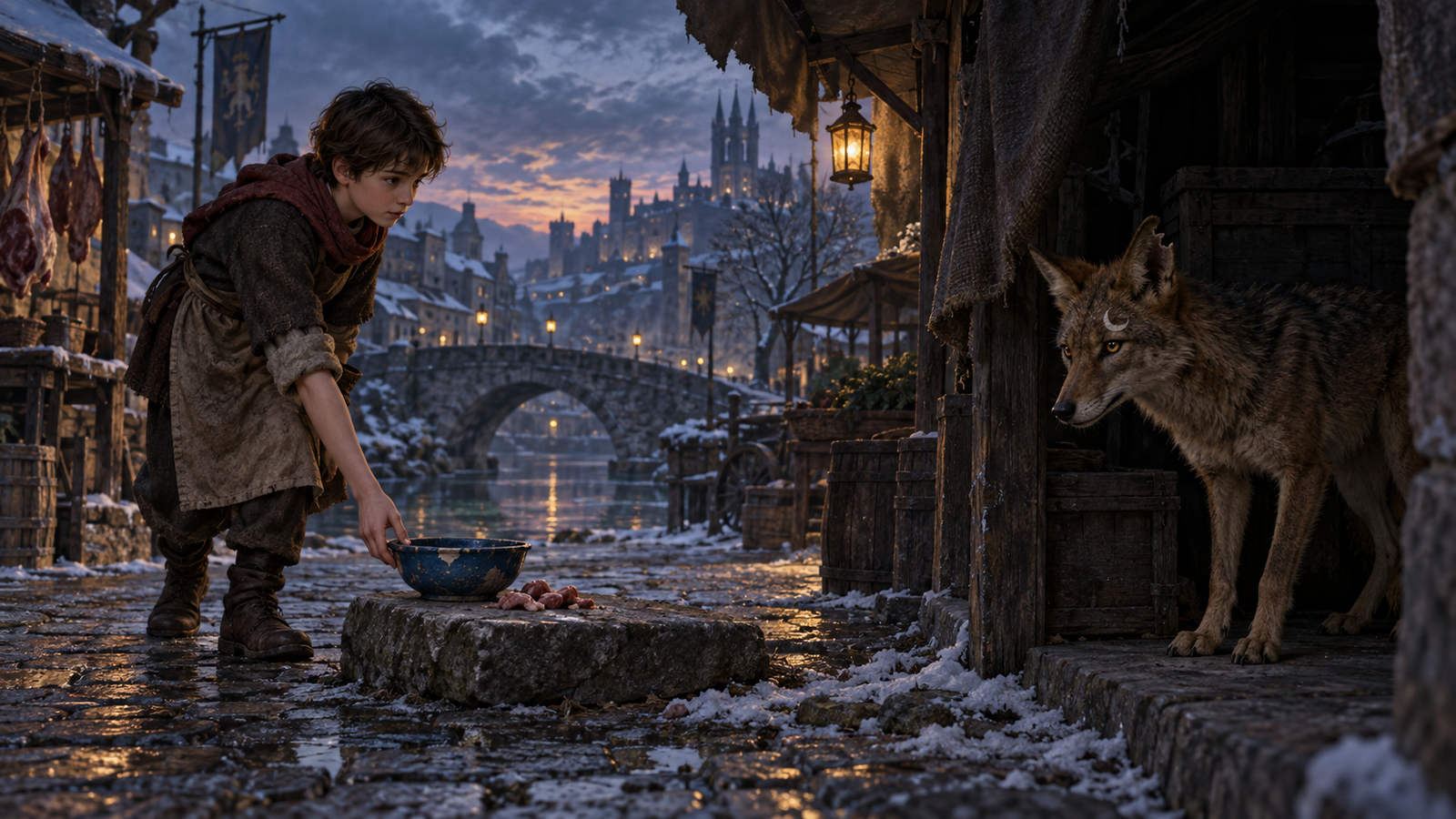
The Road He Kept
The market at the bend
Before anyone called him a Crescent Jackal, he lived at the eastern edge of a market that was built around a turn in the road. The road came down from the hills, crossed a narrow stone bridge, and curved between the butcher stalls before heading toward the river wards. Travelers arrived there tired, hungry, and unsure whether to trust the city. They looked for a sign, a lantern, or a face that seemed to know which way was safe. The jackal watched them from the shadow beneath a shuttered awning.
The boy who first fed him was named Eren. He was the butcher’s youngest son, old enough to carry a pail and too young to lift the whole carcass without help. He saved the smallest scraps from the chopping block: a strip of gristle, a piece of skin, a bone with almost no meat left. His father said those bits were waste. Eren said they were still food. He put them on the same flat stone each evening and walked away rather than waiting to see whether the animal would come.
At first the jackal only took the food after the shutters closed. He was lean, with one pale mark that curved over his brow like a sliver of a moon. His coat was dusty brown in daylight and almost black beneath the market’s blue evening lamps. His left ear had an old notch. No one knew whether it came from a trap, a fight, or a careless winter. He did not limp. He did not let anyone touch him.
When he settled, he folded his front paws beneath himself and kept his nose pointed toward the nearest exit. The market cats learned to cross behind him, never between him and the lane. He startled at the slap of a dropped pan, but the next evening he returned to the same patch of shade. Eren noticed those details because he had started watching for the jackal, not because they revealed a secret code. Sometimes a frightened creature returned because its own habits mattered more than fear. The boy began to understand that remaining nearby could be a choice made again and again, not a promise made once.
Eren learned his boundaries by paying attention. The jackal would take meat if the boy set it down and stepped back. He would not take it from a hand. He would stay near a doorway if the path behind him remained open. If another dog came close, he moved away rather than fighting. Eren did not decide that this meant the animal trusted him. He decided only that the jackal had reasons for choosing distance, and those reasons were his to keep.
The boy began leaving water beside the scraps. He used a chipped blue bowl that had belonged to his mother, who had died when he was small. His sister Dara said the bowl was too good for a stray. Eren answered that it was too good to sit empty. She carried it back inside each morning, washed it, and put it out again at dusk. The jackal never came while they watched. Still, the bowl was empty by dawn.
A bowl left at the threshold
Eren’s mother had called the market bend a good place to hear people before they entered the city. She had sold broth from a little cart there, and had known which travelers needed directions, which needed a meal, and which needed to be left alone. After she died, his father took the cart apart and used its boards to repair the butcher stall. Eren kept the blue bowl because it was the only thing that still carried her daily work. He did not tell Dara this. She already knew.
The jackal’s arrival did not heal the family’s grief. It gave their evenings a small repeated task. Eren cut the scraps. Dara filled the bowl. Their father checked the shutters and pretended not to notice. In the beginning, the animal came only when everyone had gone indoors. Later, he appeared while the two children carried water from the pump. He stayed far enough away to leave if they moved toward him. The children learned not to turn his presence into a claim: no collar, no leash, no story that he belonged to them.
They began calling him Nisk. Dara chose the name after hearing the short breath he made when he smelled the meat. Eren asked whether it was really a name if the jackal had not agreed to it. Dara said the animal could leave if he disliked it. Nisk never came when called, but the children used the name between themselves. They did not use it to summon him. It became a way to speak of the particular animal at their threshold without saying “the stray” as if he could be replaced by any other.
Their father, Harl, disliked the arrangement. He had watched a fox take a chicken and a dog bite a delivery boy. He said a wild animal near the food stalls would bring trouble. Eren asked him to move the water bowl if the jackal was a danger. Harl moved it to a more sheltered place. He did not admit that the scraps would still be there. When the winter was especially severe, he cut a larger piece from the meat he had bought for his own stew. He told Dara to use it before Eren could see.
Nisk had rules of his own. He would not enter the stall, though the door was open on several warm nights. He avoided the butcher’s knives and did not take food if Eren was arguing with his father. Once, when Harl dropped a heavy hook and swore, Nisk left the awning for three days. Eren understood that fear could remain even when no one meant to frighten you. The boy learned to make his steps audible before he came around the corner. He learned that gentleness was not a key that unlocked every door.
When spring came, Dara began helping a map seller who set up beside the bridge. She liked his work: the careful symbols, the blank spaces, the small corrections made when a flood moved a path. She brought home scraps of paper and drew the market as she wished it could be. She put the butcher stall, the broth cart’s old place, and the water pump on the map. She also drew the shaded awning where Nisk waited. Eren told her not to mark a wild animal’s den as a public landmark. Dara rubbed out the exact spot and drew the awning instead.
The road beyond the bridge
When Eren turned sixteen, the hill road brought a master butcher looking for an apprentice. Harl had wanted his son to inherit the stall, but the boy had never been sure he wanted to spend his whole life behind the same counter. He liked learning how each cut could feed a different household. He liked knowing the regular customers and the way a careful hand could use what others called scraps. Still, the stall was the only work he knew, and his father’s knees hurt more every winter.
The master butcher, Sora Venn, had a shop in the river district. She made smoked sausage, cured meat, and food for the caravan kitchens. She offered Eren room in the loft and a proper apprenticeship. He would have to leave the market bend before dawn in three days. Harl said he should take it. Dara said she would miss having someone to blame when the blue bowl was chipped again. Eren laughed, then waited until she went outside before admitting he was afraid to leave his father with too much work.
Harl said the shop would manage. He had never been good at telling his children he needed them. Instead, he showed Eren which customers could wait a day, which delivery routes flooded in spring, and which knife required a new handle. He did not mention the scraps or the bowl. Eren asked if he could keep setting them out. Harl looked at him for a moment, then said the animal had managed before their family noticed him. That was not permission, exactly. It was an acknowledgment that Nisk was not a possession being handed over.
On his last evening, Eren carried the bowl to the awning. He placed the familiar scraps on the stone and sat down on the opposite side of the lane. Nisk watched from the shadow. The boy told him about the river shop, the room above it, and the work he hoped to learn. He did not ask the jackal to follow. He did not ask him to stay. He said that the route would take him past the bridge on market days, though he did not know how often he could come back.
The next morning, Eren left before the lamps went out. Nisk was not at the bend. Eren felt an ache that embarrassed him because no promise had been made and no goodbye expected. He crossed the bridge carrying his knife roll and a map Dara had folded into his coat. The city grew quiet behind him. At the far end, he turned once. He saw the pale moon mark of Nisk’s brow in the dark beneath the awning, then the animal lowered his head as if he had simply been watching the road.
Dara’s replies included small drawings. One showed Harl asleep beside the closed stall with a cleaver still in his hand. Another showed the blue bowl filled with rainwater. In the corner, she drew Nisk looking toward the hill road. Eren kept that one folded inside the map. He could not tell whether it was only Dara’s imagination or whether the jackal really had begun watching for him. Either way, the paper made the distance feel less like a door shutting and more like a route that might still be walked.
Waiting without a leash
Days passed. Then a week. Harl kept the bowl on the sill and filled it when the air turned hot. Dara did not speak of Eren every evening. She had her map lessons, her chores, and a stubborn desire to learn the names of all the streets. Nisk did not need to hear the boy’s name to know the pattern had changed. The steps he recognized were gone from the lane. The butcher’s shop still smelled familiar, but the voice that used to set the scraps down had moved beyond the hills.
The animal began to trace Eren’s route. At first he crossed the bridge only to the first lit corner, where the lane split toward the river shops. He stopped there, ears raised, then returned to the awning. Another night he followed a fish cart further down the road. He learned the smell of Sora’s smokehouse and the scrape of Eren’s knife on the wooden block. He did not enter the shop. He waited at the side passage where the workers left water for the horses.
Eren saw him on a rainy afternoon. He was carrying a basket back from the river market when a dark shape slipped between two carts. He called “Nisk” once and stopped. The jackal did not come closer. Eren set down a piece of meat on the stone edge of the road, then stepped aside. The animal took it after a long pause. The boy felt a rush of joy, then noticed Nisk’s ribs beneath his coat and the new scar along one shoulder. He wanted to ask where the scar came from. Nisk wanted no interview. They shared the food and let the silence be enough.
After that, Nisk sometimes followed Eren’s route by moonlight. He did not trail him closely. He waited at locked gates, sat near the street where the boy lived, and watched until the lamps were extinguished. When Eren left for work, the jackal was usually gone. The distance was not a trick. It was the condition under which the animal was willing to remain near the person he had chosen.
Sora found pawprints beside the smokehouse and asked whether Eren had brought a dog to the city. He said it was a wild jackal from the market and that it had never agreed to belong to him. Sora approved of the distinction. She told him that keeping food outside was his choice, while deciding where Nisk could go was not. They set a shallow water dish by the service door. If the animal came, he could drink. If he did not, the workers would still have water for the cart horses.
Nisk returned one morning at the bend. His coat was rough, the scar had healed, and he carried a length of twine around one foreleg. Eren did not reach for him. He sat beside the flat stone and waited until the jackal let him cut the twine with his knife. Then the animal backed away. They began again at the edge of the market, with the same water bowl and no promise that either would stay forever.
The crescent road’s living map
Dara grew into her mapmaking work. She copied the city’s routes for travelers and drew the places that official surveyors overlooked: a spring behind the dye works, a dry stair below the bridge, a courtyard whose owner let stranded families sleep during floods. Eren helped her test the paths when he visited. Nisk’s tracks often gave them the first clue that a lane had become unsafe. He avoided one alley after a retaining wall cracked and would not cross a wooden footbridge that looked sound to both humans.
The family did not call these choices magic. Nisk had sharp senses and a body trained by hard seasons. Eren had learned to observe him without turning every movement into a message. If the jackal ran from a street, they checked for a dog, a cart, a smell of smoke, or a person shouting. Sometimes there was no danger. Sometimes an animal simply preferred another route. Dara put that lesson on her maps: a safe road was not a road that every traveler must take; it was a road a traveler could choose with enough information.
The crescent market acquired more lights as the city expanded. New shutters covered the old awning, but Harl kept the stone where Nisk had first eaten. The butcher’s shop changed hands twice. Eren’s apprenticeship became a partnership with Sora. Dara printed maps that included the river ward and the hill gates. The three of them met on the same evening each month to eat together. Nisk was never expected to attend. Sometimes he sat under the outer wall while they talked. Sometimes he followed the moonlit road elsewhere.
When Harl’s hands began to tremble, Eren worried he was losing the family’s livelihood. Sora offered to help repair the butcher stall, but Harl refused to let her manage it. Dara said he did not have to choose between his pride and the shop. She drew a new counter with lower shelves so his aching back would not have to reach overhead. Eren took over the early deliveries. Their father accepted both arrangements only after he had complained about them for a week.
Nisk watched this negotiation from the bend. The jackal knew what it meant to keep a place without owning it. He had stayed near the market because it was familiar, because the people who lived there had not tried to cage him, and because the road brought others who needed water or warning. His presence became part of the neighborhood’s memory. A child who had never met Eren’s mother still knew the blue bowl was for a thirsty traveler or animal. A new map seller marked the bend with a crescent symbol after Dara explained its history.
In later years, Eren took a younger apprentice, Mara, who wanted to use every scrap of meat and every minute of smokehouse heat. He told her about his mother’s broth cart and the bowl beneath the awning. He did not tell the tale as if kindness had purchased Nisk’s loyalty. He said a hungry animal had accepted food at the times and distance it could bear. Mara asked if the jackal had ever been grateful. Eren said he did not know. He did know the animal kept coming back when it wanted to.
At the end of one long day, Eren crossed the bridge and found the crescent path lit by moonlight. Nisk stood at the bend, older now, muzzle graying along the edges. The jackal did not approach. Eren put down a small piece of meat and sat with his back against the stone. The moon rose over the city’s roofs. Neither needed the other to explain why the road mattered.
The night the gate was left open
The raid began during a market festival, when the roads were crowded and the watch bells were competing with musicians. The attackers came through a disused service gate to the east, expecting the city’s wardens to be watching the river entrance. Their first aim was not to take the market. They wanted to close the bridge behind them and control who could leave. In the confusion, a cart overturned near the crescent bend, blocking the easiest route toward the lit streets.
Eren was in the butcher shop, helping Sora pack the late delivery. Dara had gone to the map office to return a surveyor’s case. Harl was closing the old stall. The first shout came from the bridge. Then the lamps went out in a row, and the market’s familiar corners turned into shapes that moved without warning. Eren grabbed the service key and ran for the side gate, the one used by workers who needed to move meat carts around the crowd.
Nisk heard the change before the people did. He had been resting beyond the wall where the hill track joined the city road. When the first cart fell, he ran toward the market, not because he had been summoned but because every route he knew was suddenly full of panic. He moved between legs and wheels, avoiding hands that reached for him. Near the side gate, a child was crying beneath a collapsed basket. Nisk barked once, the first time Eren could remember hearing him make that sound. A nearby porter followed it and pulled the child free.
The side gate had jammed halfway open. A fallen beam pinned one hinge. If Eren could clear the latch, people from the inner market could reach the safer uphill street. The crowd pushed toward it, but the narrow opening made a crush more likely. Eren and two porters tried to lift the beam. Someone shouted that attackers were entering from the bridge. The jackal slipped through the gap and disappeared into the alley on the other side.
Eren called his name. Nisk did not return. The boy put his shoulder against the gate and lifted while the porters pulled at the beam. The wood shifted a finger’s width, then stopped. From the far side came the scrape of metal. Nisk reappeared, carrying a curved blade in his jaws. It was a crescent-shaped knife from the fallen cart, its edge nicked and its handle wrapped in blue cord. He dropped it at Eren’s feet and turned toward the street beyond the gate.
The jackal charged the first attacker who reached the alley. He could not overpower a grown fighter. He darted in, struck at the man’s calf, and vanished beneath a cart before the blade came down. It gave Eren time to get the hinge moving. Another attacker entered. Nisk turned again. The animal’s speed was not a victory; it was a handful of seconds. Every time he ran toward the opening, the crowd gained room to move. Eren saw Dara’s map symbol painted on the service gate and understood that the route she had recorded was becoming real beneath his feet.
The porters freed the beam. The gate swung wide enough for the children and older market workers to pass. Eren called for Nisk to come through. The jackal looked toward him, then back at the last people trapped beyond the cart. He ran between them and the attacker, his pale brow catching the flame of a dropped lantern. The crescent knife lay in the road where Eren had left it. The market’s doors stood open at last, but the animal stayed on the wrong side of the threshold.
What the teeth could not hold
The crowd reached the uphill street. Eren helped the last porter lift a woman over the broken curb, then turned back for Nisk. The gate was open, the cart burning at one wheel, and the crescent blade still on the ground. He called again. For one breath he heard paws striking stone beyond the smoke. Then the street filled with the clatter of boots and the animal’s steps stopped.
Eren found Nisk behind the overturned cart after the attackers had been driven toward the outer road. The jackal had held the narrow passage until the last group crossed. A deep wound lay beneath his ribs. Eren pressed his coat against it, but he had no bandage large enough and no healer could reach them through the blocked lanes. Nisk did not try to bite him. He rested his head on the boy’s knee, the same distance he had always chosen, now shortened by the need of the moment.
Harl arrived with the old blue bowl. He had taken it from the stall before the roofs caught. Dara came from the uphill route with a small crowd behind her. She put her map under Eren’s hand so the paper would not blow away. The lines had blurred in the smoke. At the mark for the crescent bend, she had drawn three possible exits and the side gate. One of the exits was now blocked. Another had carried the children to safety. The map had not predicted what would happen. It had given people a place to look when the street became difficult to read.
Nisk watched Eren’s face. The boy whispered that the gate was open and the people had gone through. He wanted to tell the jackal that he had done enough. He wanted the words to mean something that could keep the animal alive. Nisk’s breathing slowed. The blue bowl tipped against the stone. A little water ran through the dust and darkened the crescent knife’s wrapped handle. The jackal let out one quiet breath and did not take another.
Eren did not call him brave. He did not make the dead animal responsible for the choices of the people who had attacked the market or failed to secure the gate. He sat beside him until Dara touched his shoulder. The surviving workers began carrying water and covering the wounded. The gate stayed open through the night so no one would have to wait for permission to escape. When dawn came, Harl placed the blue bowl at the path’s entrance, filled with clean water. He left the jackal’s body where Eren and Dara could decide what to do.
They buried Nisk beyond the bridge where he used to wait when the city felt too close. Eren and Dara did not put a public name on the grave. They marked it with a small crescent cut into a piece of wood and turned the notch toward the road, so the family could find it without turning the resting place into a sign for strangers. Eren set the crescent blade beside the mark. He had found it in the dust, its handle still wrapped in blue cord. The knife had belonged to the fallen cart, but now it carried the last image of Nisk running toward the open gate.
Eren returned to Sora’s shop, though he could no longer cross the bridge without looking for the familiar shape beneath the awning. He kept making food from useful scraps. Dara kept drawing routes with alternate ways out. Neither claimed that these acts brought the jackal back. They were the work the animal’s absence made visible: a person needed more than one road, a gate should open before a crowd panicked, and kindness could be offered without turning it into a debt.
The blade at the crescent marker
For several nights after the burial, the knife moved. It did not travel far. The crescent blade shifted from one side of the wooden marker to the other, always with its point toward the road. Eren thought someone was tampering with the grave. He and Dara took turns watching from the bridge. On the third night, the knife lifted a finger’s width from the earth. A gray shape ran around the marker, too quick for the lamplight to hold.
The spirit did not return as a living animal. It could not drink from the blue bowl or leave pawprints in the mud. It came back as a streak of pale fur and a pressure in the air that made the road seem suddenly crowded. The crescent blade had been near Nisk when he died, and the unfinished act of holding the gate open clung to it. When a traveler approached the bridge after dark, the spirit ran ahead and waited at each locked entrance. It did not force doors open. It showed where the route bent and where a person could turn away.
Eren’s grief made him want the animal to speak. He wanted a sign that Nisk had recognized him, that the years at the market had mattered, that the choice to stay beyond the gate had not been made in vain. The spirit gave him none of these answers. It was not an apology, a promise, or a ghost that could be comforted into changing its mind. It remained because the final charge had not ended in its own understanding: people were still shut in by a gate, and the road was still waiting to be found.
The Crow arrived with a folio and a warning. A binding would not resurrect Nisk’s body or give Eren ownership over the spirit. It would keep the jackal in the mortal world in a form that could still answer when the gate or road called. Eren asked if Nisk could choose to leave. The Crow said the spirit’s assent mattered, but its old impulse might pull it back to danger. Dara asked whether binding it would make the market safer or only make the family feel less alone. The Crow did not pretend to know.
They made space for the choice. The blade stayed on the road between the grave and the city, not at Eren’s feet. No one called Nisk. The Crow opened its folio and waited. The jackal circled once, then stopped beside the blue bowl. Eren set down water and stepped back, leaving the path to the bridge clear. Nisk looked toward the market, then toward the road beyond it. He lowered his head to the open page. The choice was small, but no one forced it.
The Crow bound the spirit to the folio and wrote the terms in a hand that left room for corrections. Nisk would answer the call to move swiftly when the road required it, but the binding would not make him a guard at anyone’s command. Eren signed as witness. Dara recorded which travelers could see the marker and which details should remain private. The name Nisk appeared in the margin, not as a title granted by the city, but as the sound the siblings had used among themselves.
When the page settled, the jackal stood at the edge of the road with the crescent blade’s pale gleam at his brow. He took one step toward the gate, then looked back. Eren did not ask him to stay. The Crow closed the folio around the spirit’s choice, and the road remained open behind him.
The road after the binding
Eren returned to the market and helped his father replace the awning. The blue bowl stayed on the sill, though no one expected Nisk to come and drink from it. Dara’s maps added a small crescent beside the repaired side gate. She wrote that the entrance had two hinges now and that the hill road was the safer exit when the bridge was blocked. The note did not mention a ghost. Travelers needed directions they could use, not a legend they had to believe.
The Crescent Jackal became known in the game by the blade it had carried and the road it had kept open. Its spirit still runs ahead of danger, quick enough to act on a later turn, but the old story warns that speed alone cannot make an attack safe. A Guard may still stand in the way. A ready creature can still trade its life for a few seconds. Eren’s memory of Nisk is not a command to charge; it is a question about what the opening is for and who needs room to pass through it.
When Dara’s daughter began learning the map trade, she asked why the crescent mark faced outward from the gate. Dara told her that the jackal used to wait at the edge of the road, where someone could still turn around. The child asked whether the spirit belonged to their family. Dara said the animal had chosen to remain near a road, not to become a family’s property. They left the bowl by the threshold and let the next traveler decide whether to drink.
Eren kept one piece of blue cord from the knife’s handle. It was frayed, darkened by the water that had run across it on the night Nisk died. He tied it to the underside of Dara’s original map, where the mark for the side gate could not be seen from the street. When he taught apprentices to set aside what a kitchen would otherwise throw away, he told them the bowl’s story without turning it into a lesson about virtue. The scraps had mattered because a hungry animal could accept them. The care had mattered because it asked for no obedience in return.
At the table
Printed effect: Rush. Can attack on the turn played after the opening turn.
Spend three energy for a same-turn attack
Crescent Jackal is a 3/2 with Rush, so after the opening round it can make an ordinary attack on the turn it is played. Rush removes the normal wait to attack; it does not bypass Guards, change legal targets, or prevent return damage. Its two health makes a trade into a 2-attack creature lethal to the Jackal.
One move, shown
There is a small enemy creature you can remove now, and the Jackal can survive its return damage. Check Guard restrictions and attack values before spending 3 energy.
Spend 3 energy to play Crescent Jackal. Apply the printed effect exactly as written.
On round 2, spend 3 energy to play Crescent Jackal. If an unguarded 1/1 blocks your plan, attack it immediately: the 3 attack removes it and the Jackal survives at 1 health after taking 1 back. Into a 2/2, both creatures deal lethal damage and are removed. On the opening round, the Jackal cannot attack immediately; against a Guard it must follow the normal legal-target rules. Rush creates tempo, not a safe or guaranteed hit.
The example explains a legal choice, not an additional card effect. Check the live game for current targeting and timing.
Chibi mode
This is the current game’s chibi rendering of Crescent Jackal. The alternate art changes presentation, not the printed card rules.