Gutter Sphinx
5 energy · 4 attack / 5 health
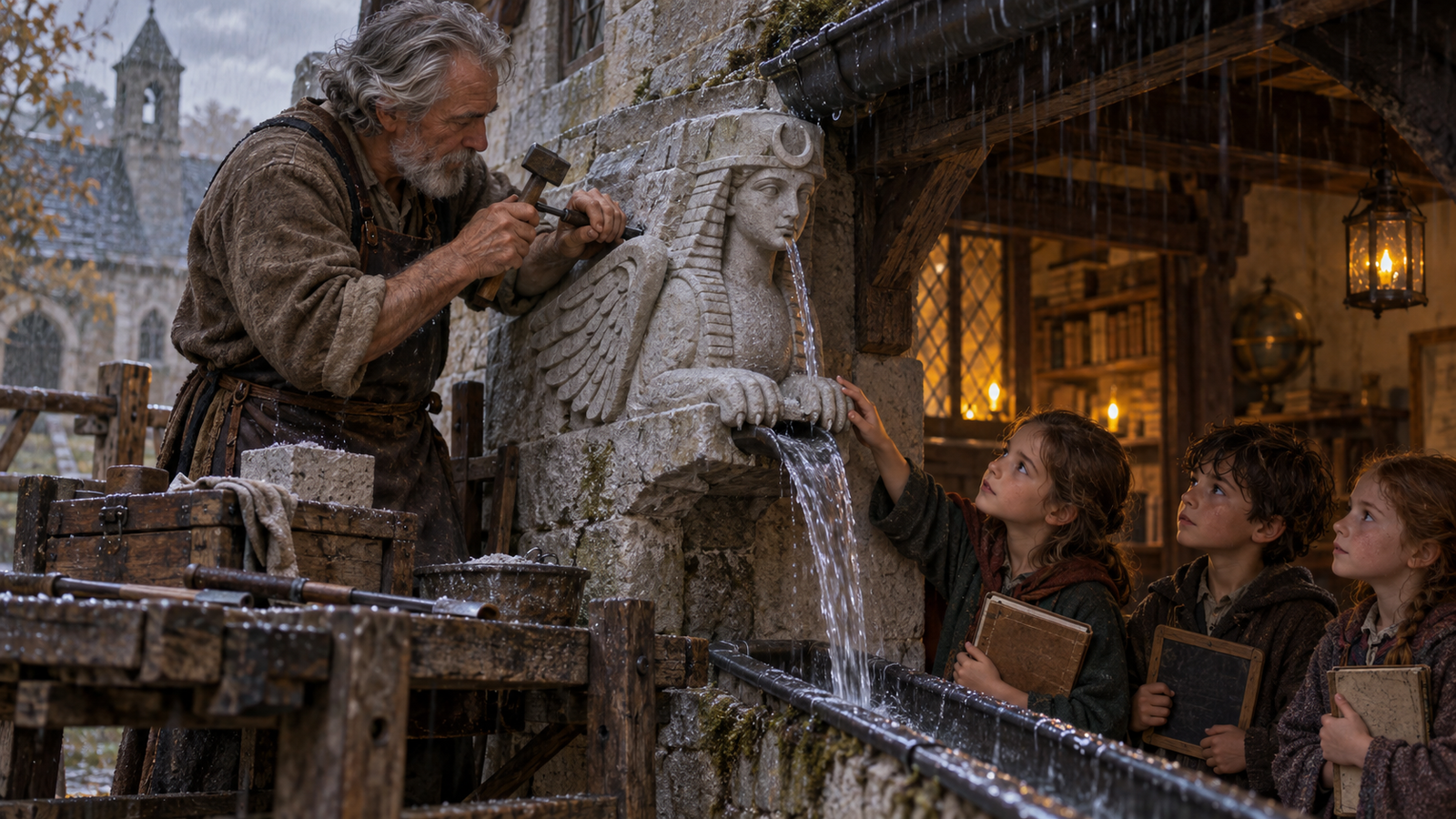
The Question Under the Eaves
The school where rain came inside
The old school stood in the lowest lane of Slate Row, where the roofs leaned toward one another and the gutters carried more leaves than water. When it rained hard, a thin stream ran down the back wall and fell into the room where the youngest children learned their letters. The teacher set a bowl beneath the leak. The children moved their stools around it. By midday, someone always forgot and set a book in the wet ring.
The school had no money for a new roof. It had one hearth, a cracked slate board, and a shelf of copybooks passed down until the pages were nearly transparent. The children came anyway. Some lived above workshops where there was no quiet place to study. Some were sent because their families needed them out of the way while the adults worked. Others arrived before dawn simply because the school was warm.
Master Eren Vey was a stonemason who repaired steps, lintels, and public wells. He had studied letters as a boy, but the foreman who hired him thought a mason needed only numbers. Eren learned to read by tracing carved names on headstones and asking the stonecutters what the unfamiliar marks meant. He could not repair the school roof alone, but he could carve a gutter spout to keep water from running down its wall. The head teacher offered him two meals and a place at the stove in exchange for the work.
Eren chose a block of pale gray stone and shaped it into a sphinx with a long face, folded paws, and wings tucked close to its sides. The old stone books showed sphinxes with crowns and fierce teeth. Eren gave this one a patient brow and a small crescent above each eye, like a moon reflected in a puddle. He cut a channel through its body so rain would leave by the mouth rather than spill over the wall. The children watched him work between lessons.
One girl, Mara, could recite any poem she heard but lost her place when a page was crowded. A boy named Pell stuttered when called on but asked questions that made the teacher set down her chalk. Another child, Iven, could read quickly and believed this made his first answer correct. Eren listened to them argue about what a sphinx should ask. Mara wanted a riddle with one right answer. Pell wanted a question that took the whole afternoon. Iven said a question was useless if the teacher already knew the answer.
Eren told them a careful question was not a trap. It was a way to find out what a person meant before trusting what they said. He had seen a foreman call a cracked step safe because he did not want to pay for a repair. He had seen a neighbor refuse a loan because she feared the borrower would be ashamed to repay it late. The words were simple; the reasons were not. The children began meeting beneath the sphinx’s gutter after lessons to practice riddles while rain ran down its face.
The stone figure had no name at first. The children called it Gutter Sphinx because the teacher said “the gutter” and Eren said “the sphinx” whenever they argued about the channel. The name stayed. In the afternoons, they sat under its lip to keep the rain off their pages. They brought questions about arithmetic, family, work, and all the things grown people said were settled. The stone did not answer, but it held the sound of their voices in its hollow body.
The mason who learned to ask
Eren had not planned to become part of the school. He accepted the roof repair because it included a meal, then stayed because the teacher asked him to fix a loose desk. The children were not easy company. They interrupted one another, argued about whose turn it was, and sometimes laughed when Pell stumbled over a word. Eren had to learn when to correct them and when to ask why the laughter had started. The wrong response could make a child stop trying for a week.
The teacher, Mistress Hesta, had worked in the school for thirty years. She could quiet a room with one look, but the city’s education office had stopped sending ink and paper. She kept attendance in a ledger, not because every absence needed punishment, but because she wanted to know which children had gone to work. She asked Eren to carve a small shelf under the sphinx so the books could dry above the puddles. He made the shelf strong enough to hold the whole class’s copybooks.
The school’s youngest pupil was Anet, whose mother repaired nets along the canal. Anet could not read the letters her mother left on the counter, so she had been carrying them to Mara and asking her to sound them out. Mara showed her a trick: point to each word with a blunt nail, then read the sentence again without pointing. Eren saw that she had learned the trick from the copybooks, not the teacher. He asked her where she had found it. She said she had found it by getting tired of losing her place.
Eren began to bring small stone offcuts for the children to practice lettering. He showed them how to make a line deep enough to remain after rain, and how to brush away dust without widening a mark. The children carved their initials on stones they could carry home. He warned them not to mark the school wall without asking. When Iven asked whether that meant rules mattered more than learning, Eren asked who had to repair the wall after the letters were cut. Iven thought about it, then offered to help carry the loose stones.
After work, Eren returned to a single room over his workshop. His partner, Leva, kept the household accounts and was better at making decisions than he was. She could see when he brought home only half a wage because he had repaired a neighbor’s step for free. She did not tell him to stop helping people. She asked him to tell her before he promised away their winter coal. They argued over this often, then worked out a mark in the ledger: a small dot beside work Eren had chosen to do without pay. Leva could budget around kindness if she knew it was coming.
She visited the school once and saw the sphinx above the gutter. Leva asked why he had made the creature’s mouth open. Eren said the rain needed somewhere to go. She asked what it would say if it could speak. He thought of the children arguing under the eaves and said it would ask them what they had not yet checked. Leva smiled and said that sounded like the school, not the stone.
In the spring, a city surveyor came to inspect the building. He said the roof could last another year if they sealed the beams with a preservation charm. The school had been promised a grant for the spell, but the money did not arrive. Eren found a mason who offered to cast it cheaply, though the man had not studied roof structures. Mistress Hesta said they should wait for the city’s repair crew. The children began to worry the school would close before summer.
Questions beneath the stone mouth
The children made the sphinx part of their lessons. Mistress Hesta gave them one question each week that did not have a single answer. What makes a promise fair? When is a secret kind? Why do people say “everyone” when they mean only the people they know? The children wrote their answers on scraps and tucked them into a clay jar beneath the shelf. The jar was not a test. It was a place to leave a thought that might change by next week.
Mara wrote that a promise was fair when the person who made it could say what it cost. Pell wrote that a secret was kind when it protected someone who had asked for privacy, but cruel if it kept them from getting help. Iven said “everyone” was what people said when they wanted a small group to sound important. The teacher read each answer without names. The children asked which one was right. She said she was still thinking.
One storm afternoon, a boy from the upper ward came in soaked and angry. His father had told him he was too slow to learn and should stop wasting the family’s money on school. The teacher gave him a towel. Iven asked whether the boy had actually failed his lessons. The boy did not answer. Mara asked if he was afraid to return home. He looked at the floor. Pell asked if anyone could walk with him. Three children volunteered before the teacher could speak.
Eren understood that a question could be a kind of shelter. It could give someone time to say what had happened without forcing them to tell the whole story. He also understood that not every person wanted questions. Sometimes a bowl of soup, an empty chair, or a silent walk was more respectful. He told the children that asking was not automatically kind; listening to the answer was part of the same act.
When the sphinx’s gutter worked, the children cheered. The first rain came through its carved channel and dropped into a barrel beneath the wall. The room stayed dry. The children had a place to keep the water for wiping slate boards. Eren had carved a shallow line beneath the mouth where the water ran. The line resembled a smile in wet weather and a frown when the stone dried.
The school began to use the sphinx as a meeting place. A child who had arrived late could wait beneath the eaves without entering a room full of watching faces. A parent who wanted to ask Mistress Hesta about a lesson could speak to her outside. The children left chalk questions on the step, then rubbed them out before the next day. The stone was not an oracle. It made a small amount of space where a person could pause before choosing what to say.
Eren carved no inscription into the sphinx. The city had asked him to put its seal on the school wall in exchange for the grant. He said the stone was the school’s work, not a monument to the office that had not sent its promised money. The surveyor called him ungrateful. Eren asked whether a seal could keep rain from the books. The surveyor said no, then left without answering the question the children had written beneath the gutter: “What does a roof promise?”
The roof that was meant to last
The repair grant finally arrived at the end of summer. It was less than the city had promised, but enough to buy timber and a preservation charm. The charm was meant to keep the roof beams from rotting while the school waited for a full replacement. The caster, a careful young woman named Odel, explained that it would slow water damage but could not strengthen wood that had already split. Eren asked her to inspect every beam before she began. The clerk said the inspection would cost another day’s labor.
Mistress Hesta wanted the school open before autumn. Many families depended on its hours; children could not stay home when their parents worked. She worried that delaying the charm would leave them with no roof at all. Eren wanted the damaged beams replaced first. Odel said the spell could hold a sound structure, not rescue a failing one. Each person was making a reasonable choice with incomplete information, which did not mean every choice was equally safe.
They tested the back beams and found one soft with rot. The office would not pay for another day’s inspection, so Eren offered to replace that beam from his own stock. Leva objected when she saw the cost in their ledger. He explained that the school would close if the work waited. She asked why he had not told her before making the offer. He had no good answer. They argued over the coal money, then agreed he could use the timber if he took a paid repair from the surveyor the following week.
The preservation charm was placed across the roof. Odel warned that it needed a month to settle and that nobody should add another ward until it had finished. The city clerk promised not to send another caster. A week later, a different office arrived with a seal meant to make the school walls resist a storm. The second spell pressed against the first. Odel asked them to stop. The clerk said the order had already been paid and the seal could not be returned.
Eren wrote both charms into Mistress Hesta’s ledger. He noted the date, the caster’s warning, and the office that had approved the work. The clerk said no one needed a record of a routine improvement. Eren asked why, if the work was routine, the office was afraid to have its name beside it. The clerk left the page open on the desk. The teacher copied it by hand so there would be a record outside the school.
The children sensed the adults’ anxiety. Iven asked whether the new spell meant the roof was safe. Eren said it was meant to preserve the beams, but nobody could promise the roof would never fail. Mara asked what they should do if the room began to shake. Mistress Hesta practiced the exit route with them. Pell asked who would make sure the younger children got out. The class chose partners and repeated the plan until each person knew where to go.
The sphinx’s gutter kept working. Eren checked the channel every evening, clearing leaves from the mouth. He left the school with the question still carved beneath its eaves: “What does a roof promise?” The children had written answers in their clay jar, but none of them claimed the building could protect them from every storm. The promise, Eren thought, had to include what the people below would do when the structure could not hold.
The classroom after the children left
The school survived autumn. The first rains passed, and the roof held. Families began trusting the building again. The city cited the successful charm in a circular, though it did not mention Odel’s warning or Eren’s replacement beam. Mistress Hesta read the circular aloud and asked the children what it left out. They named the inspection, the split timber, the second spell, and the fact that the storm had been mild. The class wrote their own account in the ledger.
Mara became a copyist and later worked in the Hall of Records. Pell learned to repair instruments and kept a notebook of questions musicians asked when a string sounded wrong. Iven left school to help his family’s business, then returned on evenings to teach arithmetic. Anet learned to read the letters her mother left on the counter. The children went different ways, but the lessons under the gutter followed them: ask what an answer is based on, notice who pays if it is wrong, and leave room for a person to say they do not know.
As the class grew older, the school’s roof needed another repair. Eren wanted to replace the whole span. The city proposed a cheaper patch. Mistress Hesta asked the former pupils to help. They came with timber, nails, and a careful plan. Odel inspected the beam. They waited until the old preservation charm had been released before adding anything new. No one wanted to repeat the first repair just because a clerk had already signed a form.
The children left small gifts beneath the sphinx. Mara tucked in a page with a question she had not solved. Pell left a broken reed and a note about the sound it made. Iven left a slate with the answer to a problem he had once gotten wrong. Anet brought a letter she had written to her mother and read it aloud before taking it home. The sphinx held no collection of possessions. It held traces of people practicing how to understand one another.
When Mistress Hesta retired, the city considered closing the school. The attendance had fallen because many families moved beyond the outer wall. The school’s heating cost was high, and the office said the remaining children could be transferred to a distant building. Mara came back from the Hall and asked for a public meeting. Pell brought the old attendance ledger. Iven found families who would testify. Anet read a letter about how learning to read had helped her keep her mother’s fishing stall open.
Eren stood beneath the sphinx and explained that the gutter spout had saved the books, but the school had been saved by people who noticed the roof was failing and asked what a spell could actually do. The city did not promise to keep the building open forever. It approved another year and agreed to let the neighborhood use one room for evening lessons. The decision was limited, but it was written down and signed.
Eren grew older. His partner Leva took over the accounts for the repair crew. She could now read the mason marks he had once traced on headstones. They kept the little dot in the ledger for unpaid work, but they discussed each one before the promise was made. When Eren’s hands began to stiffen, he gave the chisel he had used for the sphinx to Mara. He told her the stone did not need a perfect answer. It needed a path for water and a question worth returning to.
The storm under the preservation spell
The school’s last storm arrived after a dry summer. The old beams had held for years, but the preservation charm had been patched by two offices and renewed without Odel’s inspection. The city said the roof was safe because it had passed its review. Mara asked to see the review. The clerk showed her a single line with a seal and no name beside it. She asked what had been checked. He told her the ward itself had been checked, not the beam.
Former pupils came to clear the classrooms before the next weather front. They moved copybooks, slates, and the clay jar to the lower hall. Eren was nearly seventy and could not climb the ladder. He stayed on the ground, directing the crew by tapping the wall where a beam should be. Leva told him not to go inside if the roof began to groan. He promised, then crossed his fingers in the old way he had used as a boy when a promise felt too large.
The storm arrived at dusk. Rain ran down the gutter and through the sphinx’s channel. For an hour, the stone mouth carried the water cleanly into the barrel. Then the second ward began to hum. The preservation charm had trapped moisture inside a beam the office had never inspected. The wet wood expanded against the sealing spell. The roof gave a sound like a cart wheel cracking.
Mistress Hesta’s old exit plan still lived in the school. The children’s former partners moved the youngest pupils into the lower hall. Mara and Pell carried the ledger. Iven ran to fetch Odel from her home. Eren heard that a box of notebooks remained in the back room. They belonged to children who had moved away, and their families had asked that the writing be returned rather than discarded. Eren knew the roof could fail. He also knew the room where the box sat.
Leva caught his sleeve. She asked what he was doing. Eren said he had to bring the notebooks out. She said there were other records of the children’s work. He asked whether those pages included the letters Anet had written to her mother and the questions Mara had kept private. Leva could not promise they did. She did not tell him to go. She asked him to look at her and say what the risk was.
Eren said the beam was failing, the ward was holding it in a shape it could not keep, and the back room was beneath the worst span. He said he could reach the box if he moved quickly, but the roof might come down before he returned. Leva asked if the children were already out. Mara answered from the door that everyone had reached the lower hall. Eren looked at her, then at the sphinx above the gutter. He asked whether the school had kept its promise. No one answered for it.
He went inside. He found the notebooks under a table, wrapped them in the teacher’s old cloth, and turned toward the exit. The stone above the back room cracked. The sphinx’s gutter broke away from the wall and struck the floor, but its channel continued to drain the rain. Eren pushed the wrapped books through the doorway to Pell. The roof fell behind him. The fallen beam trapped his leg and crushed the steps before Leva could reach him.
The crew pulled Eren free after the storm passed. He had died beneath the roof he had tried to keep safe. The notebooks were wet at the edges but readable. The official report said the preservation spell had functioned as intended and the collapse was caused by an unusual storm. Odel refused to sign it. Mara copied the report, added the inspection history, and placed both accounts in the Hall. The school closed. The gutter sphinx remained attached to one broken length of wall, its mouth still carrying rain into the barrel.
The question the stone kept
After the collapse, the city removed the school’s remaining rooms. It kept the lower hall as a storage space and moved the sphinx’s broken gutter to the salvage yard. The stone was too heavy to lift easily, so the workers left it beneath a canvas tarp. Whenever it rained, water found the channel and came through the open mouth. The yard keeper heard a whisper beneath the splash: “What does a roof promise?”
At first he thought a child had hidden nearby. He checked the wall, the cart shed, and the path along the canal. No one was there. The question returned during the next rain. It came from the sphinx, but not in Eren’s voice. The stone had heard years of children answering one another, and it held the unfinished sound of the school’s last night. It had watched the roof fail after the city declared it safe. It had carried the rain and the question past the moment its maker died.
The former pupils returned to the salvage yard one by one. Iven stood beside the broken wall and said the roof promised protection only if someone kept checking the beams. Pell said a promise should tell you what happens when it fails. Mara said the city had used “safe” as a way to avoid naming the people who made the decision. The sphinx listened. Its mouth kept asking the same question, not because it could not hear them, but because no one had yet answered as the person who had been left beneath the roof.
Anet came last. She had become a teacher in the river ward. She brought a copy of the letter she had once read aloud at the school, the one she had written to her mother. She did not want the city to display it. She wanted the Crow to know the sphinx’s story without taking the words from her family’s hands. She asked Mara to record only that a letter existed and that its writer had chosen to keep it private.
The city tried to repair the stone. A mason filled the crack beneath the sphinx’s jaw. The rain ran through the channel, and the question returned. They moved it indoors. The question returned. They covered the mouth with cloth, and the sound came through the gutter. It was not a haunting that could be stopped by restoring the object. The spirit had become caught in the work’s failure and the unclosed question of what people owed to those who trusted the building.
Mara refused to answer for Anet. Pell refused to tell the sphinx that Eren’s death had been worthwhile. Iven said the children had survived, but survival did not make the report true. They had learned to ask questions, but the city kept giving answers with no name attached. The old school’s notebook, preserved from the collapse, contained their first attempts at deciding who could be trusted. The pages were damp, smudged, and written in several hands.
The Crow arrived when Anet returned, years after the last lesson. It opened a blank folio beside the broken gutter and asked whose answer should be recorded. Anet said she would speak for the lesson she had learned, not for every child. She asked if the sphinx could remain without becoming a public monument. The Crow said binding would hold the spirit, not claim the children’s notebooks or letters. Anet looked at the stone and asked the old question once more.
An answer that leaves room
Anet said a roof could promise that people had tried to keep one another dry, but it could not promise what no one was willing to inspect. She said that when a building failed, the record should name the choices that led to it, even when those choices were ordinary and made by people who believed they were helping. She did not call Eren’s death a sacrifice. She called it a loss the city could have prevented.
The sphinx’s mouth fell quiet. Rain still passed through the channel, but the question no longer repeated itself without end. The Crow offered the spirit a choice: remain in the mortal world bound to a folio, or leave the broken gutter and the school’s unfinished record behind. The stone did not become a person. The spirit that had gathered from Eren’s carving, the children’s voices, and the last night could choose for itself.
It chose to remain. The Crow wrote that the notebooks belonged to their writers and that the city’s report did not erase the inspection warnings. Anet signed only for her own memory. Mara kept the private letter private. Pell added the names of those who had helped carry the children out. The folio held the Sphinx’s question, not the children’s whole lives.
In time, the broken gutter was placed above a public doorway at the Hall of Records. The city repaired the stone but left one seam visible, so visitors could see where the channel had cracked. The Gutter Sphinx watched the entrance and asked no one to trust a seal without reading what it covered. The Crow recorded that it had once stood over a school, and that children had learned to question the answers adults gave them.
Years later, Mossgate Gargoyle came to the Hall’s threshold. It too had watched a public doorway and learned how people confused a guardian with a guarantee. The Gutter Sphinx did not tell it what to do. They traded questions about the buildings that had failed around them and left room for one another’s different answers.
At the table
Printed effect: Gain +2 attack while attacking a creature with magic.
Challenge a creature carrying magic
Gutter Sphinx is a 4/5. It gains +2 attack only while it attacks a creature that currently has magic attached. The bonus applies during that combat only; it does not remove the magic, increase health, help while defending, or apply when attacking a champion or an unenchanted creature.
One move, shown
An enemy creature with magic attached is a good attack target, and the Sphinx can survive the target's return damage. Check the target's current magic and attack before committing five energy.
Spend 5 energy to play Gutter Sphinx. Apply the printed effect exactly as written.
Attack an unguarded 3/5 creature that has a non-stat magic effect: the Sphinx attacks with 6, removes it, and survives at 2 health after taking 3 back. If that same creature has 5 attack, the Sphinx is removed by return damage. A Guard still controls legal targets; attacking a creature without magic uses only the Sphinx's printed 4 attack. The bonus does not persist after combat.
The example explains a legal choice, not an additional card effect. Check the live game for current targeting and timing.
Chibi mode
This is the current game’s chibi rendering of Gutter Sphinx. The alternate art changes presentation, not the printed card rules.