Hearthglass Bear
6 energy · 4 attack / 8 health
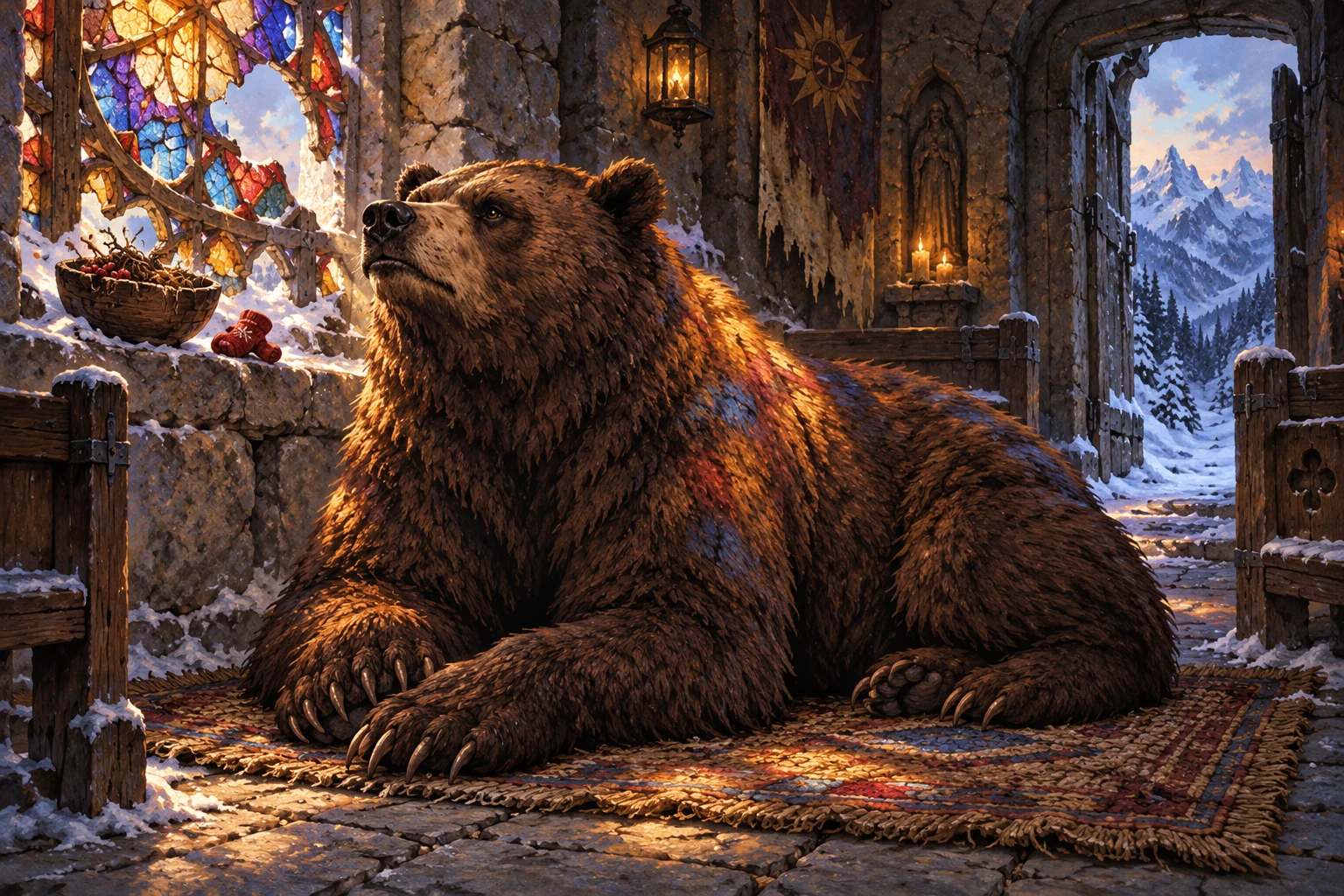
The Door Left Open
The cub beneath the blue ridge
The cub’s first world was a den pressed into a blue ridge above the chapel valley. Snow narrowed the entrance each winter, and pine roots combed the ceiling. Its mother knew the hush before a drift broke loose, the scrape of a fox under snow, and the distant wheel-rattle of carts. The cub learned these things beside her, warm against her ribs, before it knew that people gave names to places.
It was one of two cubs. Its sister had a white crescent on her shoulder that vanished each spring beneath new fur, and a habit of stealing the dry side of the den. They wrestled until their paws filled with snow, then leaned against their mother while she licked the frost from their faces.
When the cub first followed its mother beyond the ridge, the valley opened in layers: spruce, roof, smoke, and a pale tower with colored squares where its windows had broken. The cub watched the light shift over the snow. Its mother waited until the cub turned away on its own. A bright place could be seen without being entered, and a living thing had the right to choose its distance.
What the snow taught
The cub’s mother did not make a pet of fear. She taught it to turn sideways when a path felt too narrow, to climb before a stream crusted over, and to leave a carcass when the smell of iron meant a trap. Hunger could be endured for another hour; a leg caught in wire could not. The cub learned to watch first and move only after the world had revealed enough of itself.
Its sister was bolder. She slipped down the ridge to sniff at a cart track and once returned with a strip of blue cloth caught in her fur. The cub stayed back, studying the smell of people, oil, and damp wool. It followed later because its sister had come home safely. They learned that courage was not the absence of caution; sometimes it was returning to see whether someone else had made it back.
Spring softened the valley. Water ran in the roadside ditches and brought small fish into the shallows. The cub and its sister waited while their mother drank. A chapel bell rang at noon. At first the sound made both cubs crouch. Their mother listened until the echo ended, then went on drinking. The bell did not chase them. The cub filed away a warning that was not always a danger.
A separate path
The sister eventually followed a herd of deer over the western saddle. The cub went as far as the last line of pines, then stopped. Its sister looked back once. The cub held its place. They had shared a den, but not every road. Their mother remained beside the younger bear until the sister’s tracks disappeared beneath new snow.
It slept in the empty hollow its sister had used and woke expecting to find her shoulder against its own. The hollow stayed empty. The bear learned that missing someone could be a fact of the landscape, like a fallen tree: not a punishment, not a reason to pretend the path was clear.
As the cub grew, it returned to the den carrying the scents of low meadows, frozen creeks, and the old chapel. No collar, call, or hand followed it. The bear’s first idea of care was quiet: stay near enough to answer, far enough away to leave another creature free.
The first thaw without her
One spring, the mother did not wake from her long sleep. The bear nudged her shoulder, waited, and nudged again. Meltwater ticked from the ridge. The bear pressed its forehead against her flank until the cold reached through its fur, then backed away. Nothing in the den had changed except the breath that was missing.
Over the next days it moved through places its mother had shown it, pausing at the stream bend and the cedar stump where she had scraped her back. Those landmarks did not answer. They held the map of how she had taught it to survive: where to drink, where to turn aside, and how to wait rather than force an opening.
Some mornings it lay at the den’s edge, where it could see the valley. The chapel windows caught sunlight even when the hill remained in shade. The colors travelled across snow and vanished. It remembered its mother by leaving when it was ready.
The chapel below the ridge
The chapel had once been a waystation for people crossing the ridge. By the time the bear came to know it, the roof had been patched with mismatched slate and the north window was broken into a dozen uneven gaps. Its caretaker, Edda Vale, kept a stove lit and the outer door unlatched. In thaw, travelers could sleep on the benches. In winter, she piled blankets near the hearth and left a bowl of scraps on the far side of the threshold.
The bear found the bowl before it found Edda. It waited beyond the stone steps until the smell of people faded, then approached and took what it needed. Edda never stood in the doorway to watch it eat. The next evening, a little food appeared in the same place. The bear understood the pattern: food was offered, not used as a rope.
Edda did not bolt the door against the bear, and she did not call it closer. The bear knew her by the rhythm of her work: broom across stone, kettle set down, the bell pulled once at dusk. Her presence became another sound that did not require the bear to flee. It was a boundary that could be approached, declined, and found again.
Sella and the red mitten
Sella Vale was eight the winter she first saw the bear from the chapel loft. She had come to live with Edda after her father’s death on the ridge road. Her mother, Anik, worked in the lower village and visited when weather allowed. Sella spoke little during her first month at the chapel.
One morning Sella dropped a red mitten from the loft window. It landed beside the food bowl. She was not allowed outside alone, so she watched as the wind pushed it toward the steps. The bear appeared after dusk. It sniffed the mitten, carried it by the cuff, and placed it just inside the doorway before taking the food.
Sella found the mitten at dawn. She wanted to run outside and thank the bear, but Edda asked what the bear had chosen. Sella looked at the doorway and said, “It left.” Edda agreed. Sella began leaving a slice of apple beside the bowl on certain evenings. The bear took it when it wished. Their friendship grew through gifts that could be refused.
Learning each other’s weather
Sella started to recognize the bear’s habits before she could distinguish its tracks from every other animal’s. It preferred the shadow side of the chapel steps. It never entered while the bell rope moved. When it heard a cart, it waited in the trees until the wheels passed. Sella sketched those observations on scraps of paper, a collection of patient questions rather than commands.
The bear learned Sella’s sounds too. Her boots scraped differently when she was tired. The loft window clicked twice when she was about to leave an apple, once when she had forgotten it. If she cried, Edda sat beside her. The bear watched from the trees, ears turned toward the chapel. Sella began to understand that comfort did not always mean touching.
At the end of a warm autumn, Sella drew a small sun on cloth and tied it to the bowl’s handle. Edda worried the ribbon might catch on a branch, so Sella removed it. The bear carried the bowl once in its teeth, then dropped it when the cloth shifted. The next day, Sella painted the sun on a flat stone beside the steps. The bear could pass it without wearing it.
A name with room inside it
The other children who stayed at the chapel called the bear the window animal. They saw its dark shape moving beneath the broken colored glass and believed its fur changed color. Sella objected that the bear had no obligation to answer to a name. She also wanted something to say when she told Edda where it had gone. After several tries, she chose “Hearth,” because the bear often sat where the light from the chapel’s old rose window reached the snow.
The name was not a command. Sella used it when she spoke to Edda, not when the bear was close. The bear did not turn at the sound. Sometimes Sella said “Hearth” softly to an empty place after it left. The word gave her somewhere to set her affection without pretending the bear belonged to her.
Edda let the name remain, with one correction: “It is what we call the story we share. It isn’t a tag on the bear.” Sella understood the difference. When travelers asked whether the animal was friendly, she answered that it chose its own distance. When they asked whether they could feed it, she said the chapel bowl was not an invitation to approach. Hearth had made a place in their lives by being allowed to stay wild.
The chapel is for whoever arrives
The chapel’s open door was a disagreement Edda had kept with the village council for years. A few residents argued that an unlatched entrance invited theft and strangers. Edda answered that a shelter requiring proof of deserving warmth was only a room with better manners. She kept a ledger of blankets and lamp oil, but no column for whether a traveler had earned them.
One autumn, an injured courier arrived after dark with no letter of passage or coin. Edda let him sit by the stove. The bear listened beneath the trees. The courier noticed its shape and raised a metal poker. Edda asked him to set it down. The bear turned away and left. No one chased it or put the courier on trial.
Sella later asked whether Edda had been afraid. Edda said yes, but fear did not decide who was allowed to be safe. The bear had taught them something similar without explaining it: a boundary could be held without becoming a threat. Edda kept the door unlatched, and the bear kept the right to leave. In the years before the storm, these choices seemed small. They were the shape of the chapel’s promise.
The cracked rose window
The chapel’s north rose window had been broken before Edda took over. Its center panel, a piece of amber glass with a red border, had survived in the frame. Around it, blue, green, and rose fragments were clouded by years of smoke. In the afternoon, the remaining panes threw warm shapes across the stone floor. Sella called them “sun patches.” The bear sometimes settled beneath them after the bowl had been emptied.
When the wind shifted, a loose pane clicked in its lead frame. Edda had asked the council for repair money. The council sent nails and a note saying the chapel would be closed if the roof failed again. Edda saved the nails for the door and used leftover copper strips to steady the glass. She was not trying to make a monument. She wanted the window to stop shedding shards where children sat.
Hearth’s coat caught reflected color when it crossed the threshold. To Sella, it looked as if little windows had opened across the bear’s shoulders. She never said the bear was made of glass. She knew that fur stayed fur, and light only borrowed a surface. But she kept the image in her mind: the same animal could carry pieces of the chapel’s colors without being changed into something the chapel owned.
The road begins to empty
By the next winter, the ridge road was quieter. A landslide had closed the upper pass, and families from three hamlets were told to travel toward the southern town. Some left in carts; others walked with bundles tied to their backs. Edda kept the chapel ready for anyone delayed by weather. Sella packed dry socks, a loaf of black bread, and the last two blankets into the hall cupboard.
Among the people who came down the road was Anik, Sella’s mother. She had been working in the lower village and had been unable to climb to the chapel for weeks. When she arrived, Sella ran across the room and buried her face against her coat. They had written letters through the courier, but each one had ended with a promise that the road would reopen. The hug was warmer than the paper. Edda watched them without asking Sella to choose which home mattered more.
Anik stayed for two nights and helped Edda mend the blankets. She was a practical person, suspicious of stories that made animals into signs. Yet she did not mind the bowl by the door. When Sella explained that Hearth had returned the mitten, Anik looked at the wear on the cuff and said the bear must have carried it carefully. She understood that wonder did not have to deny the ordinary. Sometimes it began with a simple act done gently.
Preparing for a winter that would not pass
The chapel’s pantry filled slowly. People left grain, dried mushrooms, and jars of berries in return for a place to rest on the road. Edda recorded each gift, though she insisted nobody owed an equal amount. Sella marked the shelves with colored strips so children could find food without asking. Anik taught her to mend a torn sleeve with a stitch that could be removed later. The chapel became a shared place, repaired by people who might never meet.
The bear visited less often as the snow deepened. It had found a sheltered ravine where wind deposited fallen branches, and a ridge hollow where it could sleep without hearing the chapel bell. Sella missed its dark outline, but she did not take the empty bowl as a bad sign. She continued to leave food and checked the steps for prints in the morning. Sometimes the bear returned. Sometimes it did not. The choice remained its own.
Edda asked the council again to replace the north door before the next hard storm. They sent a carpenter named Oren with wood, hinge pins, and instructions to fit a locking bar. Oren thought the bar was sensible: people could protect the chapel’s supplies by closing it after sunset. Edda asked him to wait before installing it. She wanted to see how the door sat in the frame, and whether it could be shut without making the entrance impossible to open from outside.
The first warning
The storm announced itself in the animals before it appeared in the sky. Birds disappeared from the lower trees. Deer crossed the road in a tight group and did not stop at the salt lick. Hearth came to the chapel at midday, earlier than usual, its coat wet with fine snow. It paced the edge of the clearing, then looked toward the ridge and back at the open door. Edda read the weather in its posture, not as prophecy but as evidence.
She sent Oren to the village with a warning and asked Anik to bring the people still waiting on the road down from the pass. Sella wanted to go too. Edda told her that a child could help best by carrying blankets and keeping the hearth lit. Sella accepted the task, though her eyes kept returning to the trees. When the bear vanished, she did not call after it. She knew it might be finding shelter or following a route humans could not use.
By dusk, the wind had covered the road’s footprints. Oren came back with one family: a mother named Mara, her father Len, and a baby called Pella bundled against Mara’s chest. Two more travelers were still above the bend. Anik went back out with a lantern and a rope. Edda barred none of the doors. Sella set a kettle on the stove and counted the dry blankets twice, then again when the first shutters began to shake.
Snow against the threshold
The storm broke over the chapel after dark. Snow pressed into the broken north window and streamed across the floor. Oren wedged a bench beneath the frame, but the wind lifted it and slammed it down. Edda and Anik moved the travelers away from the glass. Mara held Pella under a blanket; Len braced the inner door with his shoulder. The chapel’s unlatched entrance began to pull open with each gust.
Hearth reached the steps when the door’s lower hinge tore away. The bear did not charge blindly into the hall. It planted its paws outside the threshold, lowered its head against the wind, and pushed the door back into its frame. Edda saw the familiar broad shape through the snow. The bear’s back filled the opening; the storm curled around it instead of rushing into the room.
Oren shouted that the animal would crush the door or be crushed by it. Edda told him to hold the broken hinge, not to drive the bear away. Anik and Len took his place at the beam, and the travelers moved toward the safer side room. Sella heard the glass tremble overhead. She had seen Hearth leave dozens of times; never before had it chosen to stay against a force that wanted every living thing to scatter.
The hours that followed
The storm lasted longer than any of them expected. The bear’s shoulders took the pressure each time the wind struck the door. The old frame splintered, and Oren tried to thread a rope through the hinge side. Edda directed him from inside, one instruction at a time. Anik and Len held the beam while Mara kept the baby warm. Sella carried water and blankets between rooms, counting each person by name so nobody disappeared in the noise.
Hearth could have turned away. The clearing behind it held trees, and the ravine offered shelter. No human could order the bear to remain, and none tried. It stayed because the chapel beyond its body was full of breathing people, including the child who had once dropped a mitten and never demanded a thank-you. The bear did not know their names as humans did. It knew their smells, the small quick breath of the baby, and the sound of Sella’s boots moving safely inside.
Near midnight, the inner brace cracked. Len caught one end before it fell, and Oren slipped on the wet stone. Edda called him back. She understood that one more person outside the safe room would not make the door stronger. Through the gap, she saw Hearth shift its weight and press its flank against the frame. Snow piled to its knees. The door held for another gust, and then another. Each pause let the people inside move farther from the broken window.
The last passage through
At the height of the storm, Anik noticed the two travelers she had gone to meet were missing from the room. She thought she had seen them arrive, but the last gust had blurred every movement. Sella counted again and found one blanket unused. Edda opened the side passage that led to the old sacristy. Len and Oren crawled beneath the fallen bench and found the travelers pinned between the wall and a fallen shelf, alive but unable to stand.
The chapel’s remaining door began to buckle. Hearth leaned harder into it. The bear’s breath steamed in the broken frame, and each exhale turned to frost along the wood. Sella held the red mitten in her fist. She wanted to run to the bear, but remembered the old rule: care is not permission to cross a boundary. Instead she placed the mitten on the inner sill where the bear could see its color through the crack.
When Len and Oren brought the travelers into the side room, Anik counted the whole group. No one was missing. Edda called through the storm that they were safe. The bear heard the human voices change; the panic had thinned. It made one low sound, not a roar and not a word, and stepped back from the doorway. The damaged frame lurched outward. The bear turned its shoulder into the gap once more, giving the last person time to clear the passage.
The morning after
The wind weakened before sunrise. No one opened the door until the snow stopped moving across the steps. Edda and Oren worked together to lift the broken frame inward. Hearth lay beside the chapel wall, partly covered by drifted snow. Its body was still. There was no wound a person could fix, and no last command from the bear. The great animal had spent the strength that belonged to its own life and had not come back from the cold.
Sella stood behind Anik. She did not approach the bear until Edda asked if she wished to. Then she placed the red mitten near its forepaw, not on its fur. The mitten looked impossibly small beside the bear. Sella said Hearth had left it once, and she was leaving it now. Anik kept an arm around her without telling her that the bear had gone somewhere better. Nobody could know that.
The people the bear had sheltered survived. The two travelers were bruised and exhausted; Mara and baby Pella slept through the morning. Oren inspected the entrance and found the door could not be repaired with a single hinge. Edda asked him to begin again after everyone had eaten. She wanted the new door to protect people from weather without making a shelter into a locked room. The bear’s body was carried to a quiet place beneath the ridge, where the snow would not cover the path forever.
The colors after the body
That evening, the north window caught the last winter sun. Its colored light reached across the chapel floor and touched the place where Hearth had stood. Sella saw the shape of a bear on the wall, though nothing had moved outside. She blinked, and the shape vanished. Edda did not call it a spirit. She did not tell Sella it was only a trick of the glass. They sat together until the window turned dark.
At midnight, the chapel bell sounded once, though no one pulled its rope. Edda found a small trail of frost leading from the threshold to the broken pane. Each shard was cold on one side and faintly warm on the other. Near the center, a curved reflection moved against the candlelight like the outline of an ear. The bear’s spirit had not followed the usual passage away from the living. It had remained inside the colored glass.
Edda understood the first part of the tether: Hearth had died holding the broken door, and its last breath had crossed the same pane that had watched the bear choose the chapel for years. The glass had taken the exact outline of that final act. It was not a reward, nor a decision by the bear to become a guardian forever. It was an involuntary catch, like a paw caught in wire. The living could see the spirit. They could not call it free.
Three nights in the window
The first night, Sella sat on the floor beneath the window and spoke about ordinary things. She told the reflected bear that Anik had arrived safely, that baby Pella was warm, and that Oren had burned the porridge. She did not ask Hearth to answer. The reflected ear shifted once when the chapel door moved in the wind. Sella stayed until her mother carried her to bed.
On the second night, the colors seemed brighter. The bear’s shape passed from shard to shard without crossing the dark gaps between them. Edda tried to lift one pane out of its lead frame, but the spirit’s outline tightened until the entire window rang. She stopped. Forcing the glass risked breaking the only place where Hearth could still be found. Sella asked whether that meant the bear was trapped. Edda said yes, and that loving something did not make a locked door open.
The third night brought a thawing wind. The warm side of each shard clouded, then cleared. Hearth’s outline appeared at the broken entrance on the glass, shoulder against a door no longer there. It was repeating the final act that had ended its life. The pane held it in the mortal world because the chapel’s open threshold, its surviving light, and the remembered pressure of the bear’s body met in one fragment. The spirit had not chosen to remain; the fragment would not let it pass.
A doorway made for returning
Oren returned at first light with fir boards and an iron hinge. He had brought a locking bar, as the council instructed. Edda asked him to set it down. They designed a door that could close against snow but be opened from outside by any person who needed shelter. A hook kept it from slamming in the wind, and a low latch could be lifted by a child. Edda refused to install a bolt that could turn the chapel’s welcome into a test.
The glass pane could not stay in the damaged window. Oren built a high transom into the replacement door, a protected frame above the opening. They fitted the amber center shard with its red border in the middle and surrounded it with smaller blue and rose pieces. The pane would travel with the door, but the threshold beneath it would remain openable. The glass would not be bricked into a wall, and the passage would not be closed forever.
As the repaired door swung for the first time, the spirit’s reflection moved into the transom and settled in the color that had held it. Hearth appeared whole for a moment: not a living body, not a memory and not a free ghost, but a bear-shaped presence behind glass. Edda kept the doorway open while the travelers passed in and out. Sella left the red mitten on the sill. They had rebuilt a place for strangers. They had not yet found a way to release the bear.
The final page of the life
For several weeks the chapel remained busy. The survivors helped repair the roof, Anik carried supplies from the village, and Sella learned to read the marks on Oren’s carpentry plans. The transom held its color even at night. Sometimes a paw-shape appeared in its amber center; sometimes there was only ordinary glass. The bear did not cross the room or follow the people. Its spirit stayed attached to the pane and to the entrance where its final breath had caught.
The council tried once more to close the chapel. Anik spoke at the meeting about the travelers who had survived the storm. Oren showed the new door’s open latch and how it could be secured against weather without trapping anyone outside. Edda brought the old broken bar, still unused. They did not tell the council that the spirit lived in the glass. They asked for the chapel to remain what it had been: a room whose threshold could be crossed both ways.
The request was granted for one year. No one promised what would happen after that. Sella visited the doorway each evening and touched the wood below the transom, never the pane. She had learned that a presence could stay near without being summoned. Hearth’s life had ended, its spirit remained caught in the mortal world, and the living still had choices to make about the door. The Ledger Crow arrived before the pane could lose its hold or be broken by another winter.
The Ledger Crow takes the card
The Crow came at the first dusk after the repaired entrance reopened. It wore no church badge and claimed no authority over the chapel. Edda recognized the satchel and the long ledger. The Crow had recorded other souls held by unfinished places, but it did not call Hearth’s tether a blessing. It asked who had given permission to enter. Edda answered that the door was open; the Crow could come inside, but the spirit was not theirs to trade.
The Crow examined the transom without touching it. The bear’s outline moved from amber to blue and back, unable to cross the dark lead between the panes. The pane had preserved the spirit and kept it in the world. The Crow explained only what it could do: copy the spirit into an official card before the glass failed, so no one could break the fragment and call the resulting disappearance freedom. The card would contain Hearth. It would not release the bear or erase the chapel’s story.
Edda and Sella watched from the threshold. The Crow opened the actual Hearthglass Bear card, and the colored outline passed from the transom into its printed frame. A broad bear appeared beneath a mosaic of amber, blue, and rose glass. The art was a record of the trapped spirit, not a suit Hearth had worn in life. The Crow closed the card after the transfer. The chapel remained open, the pane still colored the door, and the bear’s spirit remained in the mortal world—now held by the card rather than the fragment. No one called that an ending.
At the table
Printed effect: Guard.
Use its 4/8 body as your Guard anchor
Hearthglass Bear is a one-copy, 6-energy 4/8 Beast with Wisp affinity and the printed Guard trait. While it is your only Guard, enemy creature attacks must target it instead of your non-Guard creatures. If you have multiple Guards, the attacker may choose among the legal Guards. If you have no Guard, enemy creatures remain legal targets; a direct creature attack on your champion is unavailable while any enemy creature is on the field. Guard restricts attack targets: it does not prevent damage, block spells, heal, or add armor.
One move, shown
Spend 6 energy when keeping an important non-Guard creature on the field is worth committing most of a turn to a high-health defender. Its 8 health can absorb an attack, but check the attacker’s strength and keep a plan for removal effects, which Guard does not stop.
Spend 6 energy to play Hearthglass Bear. Apply the printed effect exactly as written.
Your opponent has a ready 3/3 and a non-Guard 2/2; Hearthglass Bear is your only Guard. If the opponent attacks a creature, that attack must target the Bear rather than your 2/2. The Bear deals 4, removes the 3/3, takes 3 damage, and remains with 5 health. If you also control another Guard, the attacker chooses between the two Guards instead. The opponent can still target the Bear with a spell. The 2/2 on the opponent’s field already prevents a direct creature attack on your champion; Guard’s additional job is to make the Bear the required target for creature attacks while it is your only Guard.
The example explains a legal choice, not an additional card effect. Check the live game for current targeting and timing.
Chibi mode
This is the current game’s chibi rendering of Hearthglass Bear. The alternate art changes presentation, not the printed card rules.