Coffin Bloom
4 energy · 2 attack / 6 health
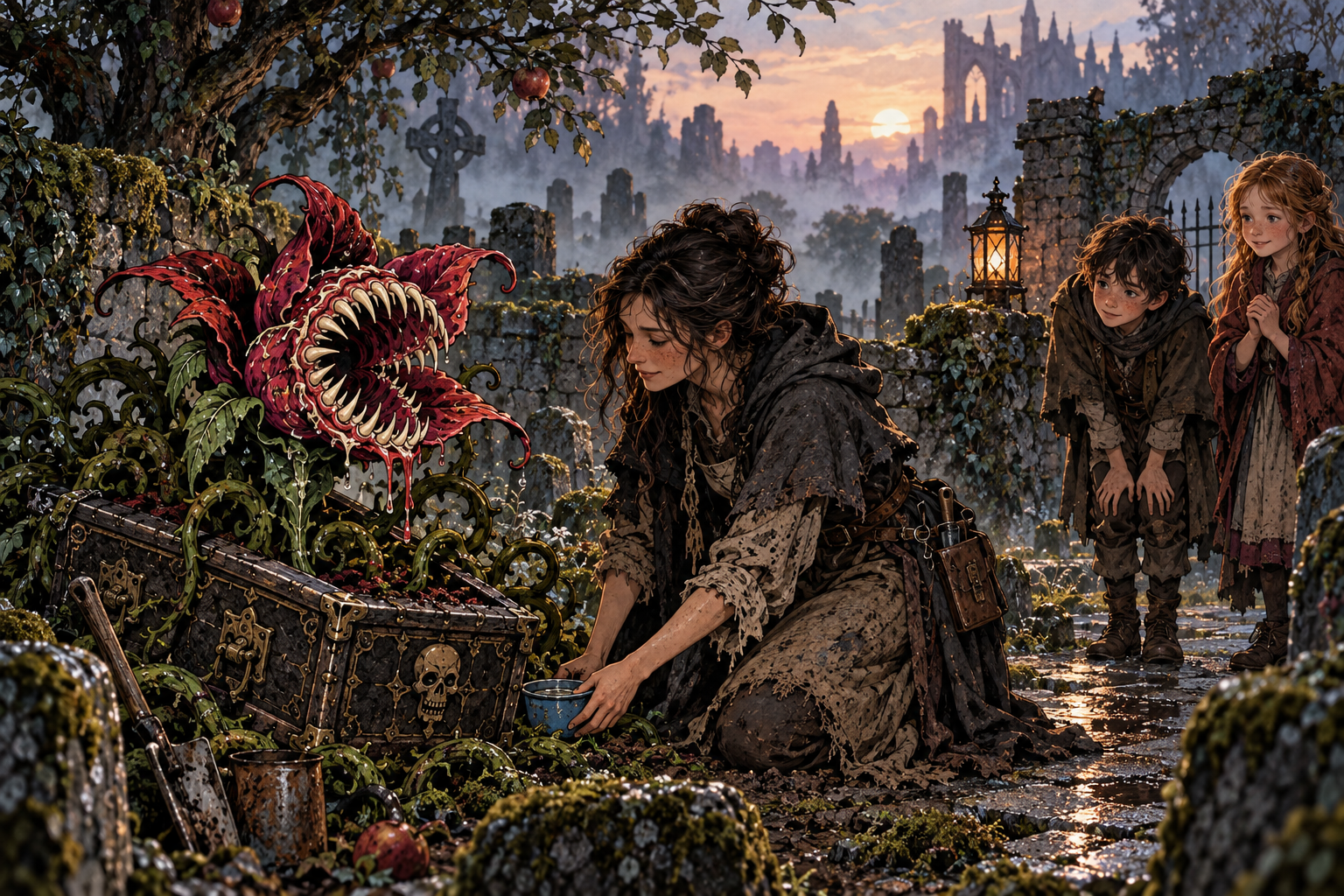
The Name Beneath the Bloom
The first flower after frost
The bloom's birthday was May 2, the first spring day on which it opened fully above the coffin. The cemetery gardener wrote the date on a scrap and gave it to the children who tended the orchard path. The almanac called it Taurus, a sign of patience, steadiness, and attachment to the living world. No one claimed the date was older than the flower's first witnessed bloom. The children kept it anyway, because every year the pink petals returned to the same patch of soil after frost, and the date became a promise they could visit.
The coffin lay beyond an orchard that no family had owned for generations. It was an old plain box with dark wood, one brass hinge, and no marker showing who had been placed inside. A caretaker named Reva had found the grave while clearing nettles from the path. She had been told to remove every plant that grew over unrecorded ground. Instead, she knelt to examine the new bud pushing through a seam in the lid. It had no leaves large enough to identify, only a thin stem and petals still closed against the cold.
Reva did not know whether the plant had grown from a seed, a crack in the coffin, or some older root reaching through the orchard. She knew the soil had shifted above the lid and that the grave had no number in the parish ledger. She put a small cup of water beside the stem and returned to her work. By evening the bud had lifted toward the light. Reva wrote “leave for now” on her task list. It was the first time she had changed a cemetery instruction without asking a supervisor.
Reva's orchard route
Reva had inherited the orchard route from her aunt, Mara, who had cared for the burial ground before the city began paying for the work. Her aunt taught her that a cemetery was made of more than stones. There were shortcuts people took when they were late, low places that flooded, and empty patches families used to stand together when a grave was too small. Reva knew the ground by the ache in her knees and the time it took to carry a bucket from the well to the far gate.
The work was not romantic. She reset leaning markers, hauled broken branches, cleared drain channels, and kept the tool shed from becoming a nesting place for rats. The city counted her hours but not the extra water she carried to graves with no listed sponsor. Her pay barely covered a rented room and coal for the stove. She took the job because her brother Sef had died young and the official record had misplaced the section where he was buried. She did not believe a gardener could find him by looking harder. She believed she could at least make sure no one else vanished beneath weeds.
Her aunt had told her to be careful about turning care into a debt. Reva understood the warning but not yet its full weight. When the city asked for more work, she did it. When families thanked her, she said there was no need. When she found the flower at the coffin, she felt the old urge to claim responsibility for its survival. She resisted it by setting a cup of water nearby and leaving. A plant might need tending; that did not make it a servant or a promise.
The children who asked
The children first noticed the bloom because it was the only color left on the north side of the orchard. Jo and Mette were cousins who lived with their grandmother above a baker's shop. Their mother had died the year before, and their grandmother had brought them to visit the cemetery on days when they could not sit still at home. They had learned to read names from stones but had not learned why some graves had no names at all.
They asked Reva whose coffin it was. She told them she did not know. Jo asked whether the city did not keep a book. Reva said it kept several books, and none had an entry for this grave. Mette asked whether the person inside had done something bad. Reva told her that a missing line in a ledger was not evidence about a person's life. The children did not accept the answer as complete, but they understood that Reva was not hiding a name from them.
The next week, Jo brought a chipped blue cup and Mette carried water from the public pump. They poured a little beside the stem and saved the rest for the other flowers. They did not touch the petals. On the third visit, a new leaf had opened at the base. Mette whispered that the plant had heard them. Reva said plants responded to light and water. Jo replied that this was still a kind of listening. Reva had no useful correction, so she let the sentence stand.
A garden with a boundary
Reva showed the children where they could walk without stepping across the grave. She ran a narrow line of pale stones from the path to the orchard wall. Jo wanted to draw a larger map, so Reva gave them a scrap of packing paper and an old charcoal stub. They marked the well, the gate, the muddy ground, and the coffin with a small flower. Mette added a blank space around the flower and wrote nothing inside it. Reva pinned the map inside the tool shed so other children would know where to stop.
The cemetery keeper disliked the map. He said visitors needed official paths, not drawings made by children. Reva offered to copy it into the maintenance book, but the keeper said the grave did not exist in the records and therefore could not have a route assigned to it. Reva asked how a person could visit a grave the office refused to locate. The keeper said that was not a gardener's question. Reva took the map back and put it beneath a clean cloth in the shed.
At home, Reva's brother Sef's daughter, Nel, was old enough to ask why her father's marker was missing. Reva showed her the old receipt for his burial and the place where the section number had been smudged. Nel traced the faded figures with a finger. They were not enough to identify the row. Reva had been carrying that failure for years, privately treating it as proof that she had not done enough. The flower's unnamed grave made her notice the same burden forming in Jo and Mette. She began teaching them that uncertainty was a fact to preserve, not a gap they had to fill with a pleasing story.
The day of the orchard survey
The city surveyed the orchard because a new road was planned between the market and the river warehouse. The route would cut through the cemetery's northern edge, where the ground had no recognized plots. Surveyors tied red thread to stakes and measured the tree rows. Reva asked whether their map included the coffin. They said it was not listed. She asked them to mark it anyway. They told her a survey recorded property, not rumors.
The plans showed a cart lane where the old orchard trees stood. The cemetery would gain a straight path to the warehouse, and the city would receive a fee from the road contractor. Reva was asked to remove the small tree roots and every plant that might catch a wheel. She refused to cut the bloom. Her supervisor reminded her that the job included preparing the site. Reva asked for the burial register and the authority that allowed them to dig before checking who lay beneath the ground. The supervisor promised to search for the papers and never brought them.
Reva did not want a public fight. Her rent was late, her brother's daughter depended on the coins she sent, and the cemetery job was the only work she knew how to do. She made a copy of the survey map and marked the unlisted coffin in charcoal. Then she brought the copy to the orchard workers, asking whether anyone remembered a burial there. One recalled a woman who used to leave bread at the wall. Another remembered a child's shoe found in the soil years earlier. No one knew a name, but together they knew the ground was not empty.
The name in the kitchen book
Mette's grandmother kept a kitchen ledger from the old baker's shop. It listed orders from the cemetery crew, including a line for a loaf delivered to “the orchard grave, winter watch.” The note had been written by a baker named Tovin, who had worked during the same years as Reva's aunt. The next page mentioned a child called Anet and a mother who came to the shop after dark to ask for work. The record was ordinary: flour, bread, a borrowed blanket, a missed payment. It did not prove the coffin belonged to Anet, but it provided a person to search for.
Jo and Mette carried the ledger to Reva. She asked before touching it. The children nodded. Reva read the pages beside the flower without placing the book on the grave. The mother's name was Lera, and she had been hired to sort bruised apples. Anet had died in a fever season when the family lived in a temporary room behind the orchard wall. The city had recorded a burial fee, then crossed it out as unpaid. A separate note showed that the burial itself had been allowed because the child had no living father listed and no relative with money.
The record still did not match the coffin with certainty. There were other graves nearby, and the kitchen book used “orchard grave” more than once. Reva refused to announce that Anet lay beneath the bloom. She copied the evidence, including its limits. Jo wanted to write the name on the map. Mette asked whether that would turn a possibility into a fact. Reva said the name could be written as a lead, with the question kept beside it. The children drew a small line between Lera's entry and the unmarked coffin, then wrote “perhaps Anet” in the margin.
The caretaker's small promises
Reva visited the flower before work and after the last cart left. She sometimes brought a dish of water; sometimes she only sat near the orchard wall. She talked about her brother Sef and the receipt she could not decipher. She admitted that she had wanted to believe every patient act would be rewarded with a name. The flower did not answer. Its petals opened toward the morning and closed before the night frost. Reva found comfort in the routine without pretending it had spoken.
In spring, the bloom developed a ring of dark red at the petal edges. It was not a wound. It was the color of the old coffin stain where water had run across the lid. Children began calling it the Coffin Bloom, not as a frightening name but as a description that helped them find it. Reva asked them not to pull seeds or take petals. Jo wanted to save one in a book. Mette said they should let it make its own next spring. Reva smiled because the answer came from the children rather than from her rule.
The flower began to attract moths and small night beetles. Reva adjusted the lamp at the path so insects would still find it without drawing visitors over the grave. She repaired a broken fence with a gap wide enough for a wheelbarrow but not a cart. Every decision seemed small until the survey crew returned. They saw a maintained route and assumed the city had approved it. Reva corrected them: the path was kept clear because people used it, not because a fee had been paid.
When the road reached the wall
The road contractor arrived before the burial register. He brought workers, a cart, and a foreman with a list of tasks signed by the city. The plan required the orchard's north row to be cut back, the wall lowered, and the ground leveled. Reva placed herself beside the unmarked coffin and showed the charcoal map, the kitchen ledger, and the smudged payment record. The foreman said the paperwork had no plot number. Reva said the ground had a body whether or not the paper did.
The crew paused while the foreman sent a runner back to the office. The cemetery keeper arrived and ordered Reva to move. He said she had no authority to stop a public works crew. Reva asked him to stay long enough to read the evidence. He did not. Jo and Mette had brought their grandmother, who carried the kitchen book under her shawl. Other orchard workers gathered at the wall, each holding a scrap of memory that the official plan had left out.
Reva understood that a crowd could make the grave safer or make it more vulnerable. She asked the children to stand with their grandmother and keep the documents dry. She asked the workers to leave space for the cart to turn. Then she stood at the edge of the coffin and told the foreman that any shovel crossing the marked stones would first have to go through her. She did not say it because she believed she could stop a crew alone. She said it so the decision would have a witness and a name attached to it.
The last season in the soil
The foreman lowered his shovel. He had a daughter close to Jo's age and did not want a grave collapse in front of her. The cemetery keeper called the refusal insubordination. Reva answered that the survey could wait until the burial evidence had been checked. The keeper turned toward the workers, telling them their wages would be withheld if the road fell behind. Some looked at the ground. Others kept standing beside the wall. The contractor's men did not begin digging, but the city sent a second crew the next week.
Reva wrote to the district clerk, the burial registrar, and the road committee. She included copies of every record and a hand-drawn map with a scale. She asked for a temporary hold, not a permanent monument. The reply came months later and said the plot could not be recognized without a confirmed name. By then, the orchard had been cut from the southern edge, and the remaining trees were marked for removal. Reva and the workers moved the path stones to protect the coffin while a review was scheduled.
The bloom survived the first cut by sending its roots deeper beneath the box. The summer heat dried the upper soil, and Reva took water from her own ration when the pump failed. Her niece Nel begged her to stop, reminding her that Reva had been coughing through the night. Reva said she would stop when the review date arrived. Nel said that was not a date; it was a condition. They argued, then made a schedule so Reva would rest while the orchard workers took turns with the water. The flower was not the only thing that needed care.
Reva's choice at the graves
The road crew returned in late autumn. The committee had not ruled, but the contract allowed work to continue. This time the foreman brought a stone saw. Reva stood at the entrance to the row with the map held open. The cemetery keeper told her that the grave could be moved later if it proved important. Reva replied that a coffin was not a crate to shift when the paperwork caught up. Behind her, the workers had set the kitchen ledger on a table under a dry awning.
The foreman ordered his crew to cut the last orchard wall. A stone fell and struck the side of the grave. The coffin shifted in the soil. The flower bent, then lifted again. Reva climbed onto the low wall to pull a marker stake away from the lid before the next blow. A second stone struck her shoulder. She fell between the marked path and the coffin, holding the map against her chest so the paper would not be buried in mud. Nel called for help. The workers stopped the saw and carried Reva to the clinic, but her injuries were too severe. She died before nightfall.
The people who loved her did not agree about whether her death had been avoidable. Nel said the city should have waited. The foreman said the wall was already unstable. The cemetery keeper said the missing record had made the dispute impossible. Jo and Mette would not let the argument become the only account of Reva. They copied the schedule of care, the letters she had sent, and the map with its careful question beside Anet's name. Reva had not died to prove a flower mattered. She had died because a system treated an unrecorded grave as empty ground, and she refused to let that decision go unwitnessed.
Roots in broken earth
Reva was buried under a named stone. The coffin beside the orchard remained in place while the road committee reviewed the appeal. The remaining soil had been crushed and disturbed. The bloom lived through the next winter, but its roots had been cut where the box met the old tree line. In spring, it opened once and then collapsed. Jo and Mette brought water, but the stem no longer held itself upright. The petals fell against the coffin lid, darkening where the rain pooled.
The flower did not die as an ordinary plant. Its spirit was already held in the wood and soil where Reva had guarded the grave. The coffin had kept the unknown person's absence for so long that the repeated question had become part of the ground. The bloom's own life had grown around that question: who had been buried here, and who was allowed to decide whether the place mattered? When its roots failed, the flower's spirit remained, unable to release either the unnamed dead or the caretaker who had stood beside them.
Its first spirit-shape was not a monster. At night, the petals opened into a mouth of pale inner leaves, and thin roots moved through the broken earth. It reached toward every damaged branch, stone, or living thing nearby, trying to repair what the road had torn apart. Each repair borrowed warmth from the people who came close. Reva was gone, so the flower drew the price from visitors instead. The children woke cold after sitting beside the grave. The orchard workers left with shaking hands. No one had asked the bloom to feed on them; it was repeating the only kind of repair it had learned.
A caretaker's ledger without ownership
Nel grew into the work Reva had left behind, though she refused to be called the new caretaker. She organized a rota among the orchard workers and asked the city for a review of the grave records. The public kitchen's old book, Reva's copies, and the burial fee slips were read together. One clerk found a duplicate entry under Lera's household number. It listed a burial for a child named Anet, but the plot number was smudged in the same place as the earlier receipt.
The evidence made the name more likely, not certain. Nel refused to carve “Anet” on the coffin without consent from anyone who might still be living and related to the child. They searched the market registers and found a later note: Lera had moved to another district, remarried, and asked that her daughter be remembered by name even if she could not afford a marker. The request did not say exactly where the grave lay. It did establish that an unmarked burial was not an unloved one.
The bloom's spirit surged whenever someone brought fresh damage to the grave. It pushed roots through the soil and took warmth from whoever tried to help. Nel learned to recognize the moment before it reached for a visitor: the flower tilted, the petals tightened, and the air around the coffin grew warm. She asked the workers to step back. The spirit was trying to heal, but its instinct made care into a cost paid by whoever stood nearest. Nel wrote that observation in Reva's maintenance ledger, beside the note that no one should be sent into the row alone.
The light on the outer ground
The Ledger Crow's first account of the old burial ground belonged to another soul, the Grave Lantern Keeper called Edran. His folio described a keeper who lit graves that the city had left off its official route. Reva's coffin and the Coffin Bloom were not Edran's grave, and the two keepers had not met. The Crow linked the records because Edran's map showed how the boundary of the official cemetery shifted over time, while Reva's notes recorded what a family tried to preserve after the orchard wall moved.
Nel recognized one path mark on Edran's old map: a small three-pronged root beside a low stone. Reva had used the same mark on the copy she made for Jo and Mette. It did not prove that the maps described the same grave. It showed that different keepers had found the same practical problem: official numbering ended before human grief did. The Crow placed the maps beside each other but left each life intact. A shared question did not make one person the answer to another person's story.
The workers began carrying lanterns along the path, not to make the flower stay open but to let visitors read the notices and find the safe route. Nel kept a separate oil can and did not take supplies from the named plots. The light revealed cracks in the coffin lid, the mark where the road crew's stone had struck, and the new boundary stake placed beyond the unmarked row. For the first time, the people who came to mourn could see the grave without having to trespass through the orchard.
The name they could carry
Jo and Mette were no longer children. They returned with the kitchen ledger and the copies Reva had made. They had found one of Lera's descendants through a marriage record and wrote to ask whether the name Anet belonged on the marker. The descendant, a woman named Mara, sent back a careful letter. She did not claim certainty about the coffin. She said the family had been told that Anet was buried beyond the orchard wall, near a place where flowers grew. The description matched, but could not prove the exact box.
Mara came to the cemetery with her daughter. She placed a small wooden plaque beside the grave, not on the coffin. It read “For Anet, beloved daughter of Lera; remembered here, though the ground cannot be proved.” The words did not turn uncertainty into fact. They gave the family a place to stand and let them carry what they knew without claiming what they did not. Nel added the letter to the public record and left the word “perhaps” in Reva's map.
The flower's spirit opened its petals and stayed still. It did not take warmth from Mara or her child. The name had not repaired the coffin, but it had changed the question from “who is allowed to care?” to “how can care continue when proof is incomplete?” Nel held a lantern while the family read the plaque. The bloom's roots moved once around the wood, then withdrew from the visitor's feet. The living had not solved every part of the grave. They had made room for a name and for honest doubt to remain together.
What the Crow asked
The Ledger Crow came after the family plaque and Reva's papers had been entered into the public register. It read the name, the qualification, and the older map. It asked Nel whether the bloom had become safe. Nel said it could still take warmth from a visitor if the person remained too long; they had learned how to step away before the roots reached. The Crow asked whether the flower could be moved. Nel said its roots held the coffin wood. Moving it would repeat the road crew's mistake and make the grave into a thing to relocate for convenience.
The Crow asked the bloom whether it wished to leave the grave. The flower's petals opened toward the lantern, then closed. Its spirit did not answer in words. It reached toward the page and stopped before touching it. The Crow offered a soul folio that could carry the bloom's spirit while leaving the physical coffin and the uncertainty about Anet's burial where they were. The card would record the flower's life, not claim ownership of the dead person beneath it.
Nel and the workers talked through the choice before answering. The bloom would still have its own root and its own question, but it would travel in a form that could not take warmth from a visitor without limit. The people agreed to keep the cemetery rota and the public record whether the flower stayed or went. The Crow would not make them promise to tend it forever. Their care had to remain a choice each person could renew, not a fee the spirit could collect from the living.
The record becomes a card
The bloom lowered one root onto the folio. Its spirit gathered around the flower's dark center and the small piece of coffin wood it had held since the roots first entered the seam. The Crow bound that single soul, preserving the petals, the May 2 birthday the children had recorded, and the question that still could not be answered with certainty. It did not bind Anet, Reva, Nel, or the rest of the cemetery. Their names stayed in their own records and in the hands of the people who remembered them.
When the card was complete, the spirit no longer needed to draw warmth from a visitor every night to repair itself. The Crow wrote the printed rule beside the story: at the end of its controller's turn, Coffin Bloom heals itself by 1 and that champion loses 1 health. The cost belongs to the living champion who chooses to keep the Bloom on the field. It is a real cost, not armor, not damage to an opponent, and not a heal for anyone else. Its body is a 2/6 Fae with Root affinity, played for 4 energy.
The public register kept the plaque's careful words about Anet. Reva's map remained folded beside Edran's separate record of the unmarked grounds. Nel tended the orchard path with other workers, never promising that every grave would be solved. The Crow placed the new card where the flower's name could travel without taking the coffin with it. Each spring, the empty patch still opened with a small pink bloom. Its living roots belonged to the ground; the soul that had learned to survive by mending itself could now rest inside the folio until someone chose to draw it.
 Grave Lantern KeeperThe keeper lights a lantern for every grave the city refuses to mark.
At the table
Printed effect: At the end of your turn heal this creature by 1 and lose 1 champion health.
Let the Bloom recover only when its health tax is worth it
Coffin Bloom is a 4-energy 2/6 Fae with Root affinity. At the end of each of your turns, it removes 1 damage from itself, up to its maximum health, and your champion loses 1 health. The champion cost happens even if the Bloom is already at full health, is direct health loss rather than armor damage, and can defeat you at 0 health. It does not heal another creature or your champion.
One move, shown
The Bloom has damage to repair, your champion can safely pay the repeated 1-health cost, and a durable body matters more than preserving every point of your champion's life. Count likely future turns, not only the first healing tick.
Spend 4 energy to play Coffin Bloom. Apply the printed effect exactly as written.
You control Coffin Bloom with 2 damage marked, your champion has 8 health and 2 armor, and it is your turn. End the turn: the Bloom heals 1 damage, leaving it with 1 damage (5/6), and your champion falls to 7 health while armor stays at 2. On your next turn, if the Bloom survives, it can heal another damage at the end and you again lose 1 health. If it is already full, it still costs 1 health; if your champion has only 1 health, the end-turn cost reaches 0 and causes defeat. Remove the Bloom before the end step to stop future ticks, but the healing already resolved is not reversed.
The example explains a legal choice, not an additional card effect. Check the live game for current targeting and timing.
Chibi mode
This is the current game’s chibi rendering of Coffin Bloom. The alternate art changes presentation, not the printed card rules.