Gutterglass Gecko
1 energy · 1 attack / 2 health
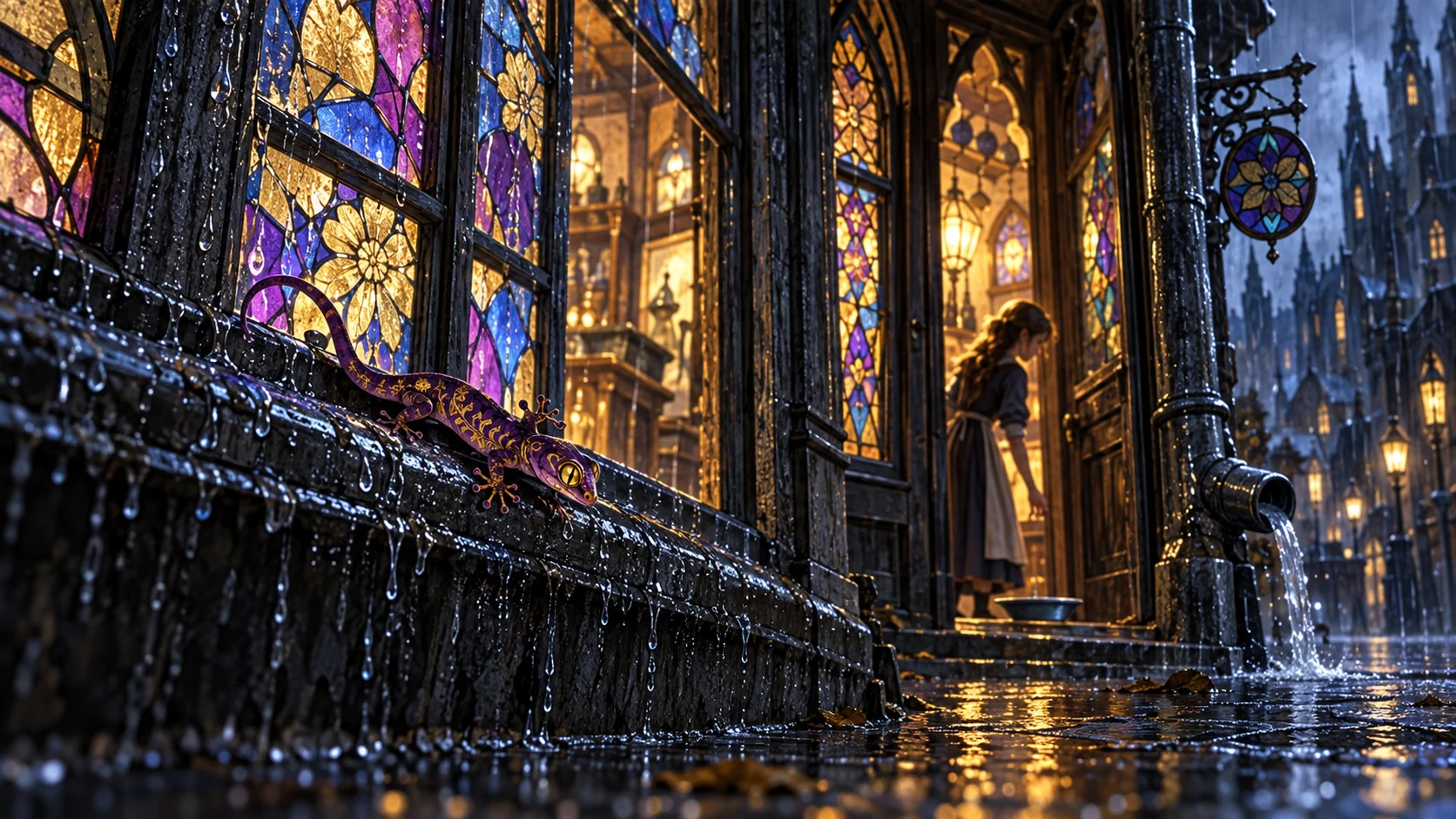
The Run Between the Panes
The First Warm Wall
No one in the glass quarter knew the gecko’s first day. It emerged from a crack behind the kiln after the last frost, small enough to disappear beneath a brick lip, with a violet back that caught blue in the morning and plum in the shade. The Crow later assigned May 29 as its birthday, with no year preserved. Gemini and Air suit the quick turn of its attention: it watched several routes at once and chose among them in a breath.
The young gecko did not begin with a name or a purpose. It began with warmth. The kiln wall held the night’s heat long after the fire went dark; tiny insects gathered at the seams, and the gecko learned that patience could be as useful as speed. It would wait with its throat moving softly, then spring, grip the rough brick, and return to the same safe ledge. Each meal taught its body a little more of the building.
Its territory was not a room but a chain of edges. A drain lip became a bridge. The underside of a sill became a roof. The thin seam between two panes became a road with a blue sky beneath its feet. It learned where mortar crumbled and where glass held firm. When the kiln workers crossed the courtyard, the gecko flattened itself into a shadow; when they left, it came out again and resumed its small, exact map.
The quarter changed around the gecko. A bakery began using the alley, then a cooper moved a barrel rack beneath the wall, and canal masons replaced three paving stones. Each change made its old routes less reliable. Glass-foot learned to test a ledge with one forefoot before trusting it, to take a longer path when a familiar corner smelled of fresh lime, and to retreat when the stones carried a cart’s weight. Its quickness was useful because it had first learned caution.
The Shop Behind the Street
The shop belonged to Veyra Doss, a glazier who repaired windows for the market and cut ordinary panes for the new homes rising along the canal. The storefront opened onto a narrow lane. Behind it, scraps of glass stood in wooden racks, each edge wrapped in cloth. The gutter above the back door caught rain and crumbs of putty. No one planned it as a habitat, but the gecko found a dry corner there and stayed.
Veyra worked with care because a bad cut could injure a customer years after the repair. She marked each pane with chalk, set the glass on padded trestles, and kept a basin of water near the sharpening stone. Her daughter, Ena, swept the floor and collected the cleanest offcuts for the window mosaics she hoped to make. The gecko watched them from the beam. Their hands moved slowly around glass, and that steadiness made the shop feel safer than the street.
Veyra had inherited the shop from her partner, Ena’s father, and still used his system of labeling each offcut by color and thickness. She disagreed with his habit of keeping every scrap; she believed a workshop should make room for new work. But she kept the smoothing stone he had worn flat, and when Ena asked why, Veyra said it remembered the pressure his hands had taught it. Glass-foot never knew the story. It knew only that some tools stayed in one place because someone could not yet move them.
The first time Ena noticed it, she was searching for a missing blue bead. A speck moved upside down along the window frame, paused where the sun struck, and vanished behind a strip of lead. Ena set down her broom rather than reach. She returned the next morning with a scrap of paper and drew a crooked outline of the little visitor. The gecko could not read the drawing, but it learned the sound of her careful footsteps.
Ena was nine, old enough to be trusted with a broom and young enough to believe that every empty space might be the beginning of a picture. Her mother Veyra rarely spoke of Ena’s father, who had died before the gecko came to the shop, but kept his smoothing stone at the bench. Ena’s drawings were a way to ask about things without insisting on an answer. Glass-foot became one more small subject she could observe without trying to own.
A Name That Did Not Claim
Ena called it Glass-foot. She chose the name because the gecko crossed the window without slipping, not because it belonged to her. If it appeared, she watched. If it disappeared, she kept working. She never trapped it in a jar or tried to carry it outside. That distinction mattered. The gecko could leave the gutter whenever it pleased, and its trust began in the fact that nobody closed the route behind it.
At first, Glass-foot only came down after the shop had emptied. Ena began leaving a shallow dish of water on the sill during hot weeks, far enough from the edge that it would not spill. She put it there and walked away. The gecko learned that the dish did not move toward it. It learned that thirst could be answered without a hand closing around its body, and that a large creature could offer something useful without demanding a performance in return.
The arrangement became part of the shop’s day. Ena set out water, swept the offcuts, then glanced toward the sill without expecting a show. Veyra kept the sharpest pieces covered and asked before moving the little dish. When a customer complained that a lizard lived near the window, Veyra explained that it ate the insects gathering there and caused no harm. She did not pretend it was tame. She only asked that the shop’s quiet neighbor be left alone.
The Map of Safe Edges
Glass-foot’s map grew by repetition. From the gutter it could descend behind the painted sign, cross a beam, and reach the old drain. The route avoided the open courtyard where cats sometimes waited. It also passed beneath a row of panes that caught the late sun. The gecko did not understand the glass as a human craft. It understood temperature, vibration, friction, and the difference between a surface that held and one that trembled.
It learned the shop’s working sounds. A soft tap meant Veyra was testing a fitted pane. A scrape meant Ena was clearing the trestle. A sharp, bright knock meant everyone should move away. Glass-foot would stop at the first vibration and flatten against the nearest rough surface. The habit saved it from several falling scraps. It was not bravery that kept it alive, but the ability to notice danger before the people carrying it did.
In the evenings, the gecko hunted moths attracted to the work lamp. It did not attack the lantern or the people near it. It waited at the frame where insects circled, then made a quick dash across the warm wood. Ena sometimes watched from the doorway, counting the little pauses as if they were part of a dance. She drew the route on another scrap, but this time she included the drain, the beam, and the sheltered ledge.
Veyra noticed that the gecko used the same route every night and began setting the lamp behind a small shade. She did so for the work: bright light on the cutting bench, softer light near the window. The change also left a calm strip where Glass-foot could hunt. Veyra did not announce the accommodation, and Ena did not call it a promise. Care between a person and a wild creature often took the form of noticing what made a shared place safer.
Summer Without a Cage
The summer the canal ran low, the shop grew hot enough that the putty softened in its tins. The shallow dish dried before noon. Ena filled it again each morning, then moved it into shade when the sun reached the sill. Glass-foot came only when the room was empty. Its body needed moisture, and the shop’s roofline held more heat than the wet stones beside the canal. The new dish made the difference between a safe visit and a dangerous search.
Ena’s care stayed practical. She asked Veyra which plants could sit in the window without attracting more insects, and Veyra showed her how to keep the basin clean. They set a small stone beside it so a tiny visitor could climb out if it fell in. The gecko never fell, but the stone remained. A kindness that expects no proof does not become wasted just because it is rarely needed.
Glass-foot learned Ena’s absence too. When she left to help at the market, the dish stayed where it was, but the shop sounded different. The gecko did not mistake routine for ownership. It came and went according to thirst, temperature, and the changing hour. Still, when the familiar footsteps returned, it sometimes appeared on the same blue-edged pane. Ena took that small return as the only answer she needed.
On market mornings Ena left a mark beside the dish with chalk: one line when she had filled it, a second if she had checked the stone and washed the bowl. This was partly practical, because Veyra might work before she returned, and partly a way to make care visible without making it theatrical. The gecko could not know the system, but the habit shaped the people around it. They learned to maintain its route even when no one was watching.
The Child at the Drain
One afternoon, a child named Toma slipped through the half-open back gate while following a dropped wooden wheel. He was small enough to fit beneath the loading platform, where a narrow drain passed under the wall. Veyra and Ena heard his voice but could not see him. The street outside was crowded with carts, and the drain’s mouth had collected leaves and paper. Toma had crawled farther in, frightened and unable to turn around.
Glass-foot knew the drain from the inside. It had used the dry upper seam to travel between the shop and the canal wall. The gecko was on the outer sill when the first calls began. Veyra lifted the platform boards. Ena brought a lamp. Neither could make the cramped channel wide enough for an adult hand, and the child’s answering voice was growing weaker beneath the street noise.
The gecko did not understand the danger as a story about rescue. It recognized a familiar opening blocked by unfamiliar movement. It darted down the wall and entered the drain by the narrow seam it had used for years. Its small feet found the dry ridge. Its body passed where a hand could not. On the other side, Toma saw the violet shape move toward the grate and began calling again.
Toma was the wheelwright’s son, visiting the lane with his aunt while his father repaired a cart. He had spent the morning rolling a wooden wheel along the curb and naming each turn a different road. When it slipped beneath the loading platform, he followed without thinking about how far the drain narrowed. The adults had called his name before he understood that he was stuck. Glass-foot did not know the child’s name; it recognized the small, frightened voice coming from a passage it used every night.
The Pane That Fell
The sound of Toma’s voice brought people to the gate. Veyra called for a pry bar. Ena ran to fetch the market keeper. Above them, a pane loosened where the timber frame had swollen in the heat. The fastening had been repaired twice, but the old sash had finally split. No one in the yard saw the hairline crack as it spread across the glass.
Glass-foot reached the drain’s far opening and found Toma pressed against the wall. The gecko could not pull him, speak to him, or tell him which way to crawl. It could only make the route visible. It climbed onto the one clear section of the pane set into the drain’s maintenance cover, then ran toward the courtyard light. Toma followed the movement with his eyes and shifted closer to the opening.
The pane fell before Veyra could reach the platform. It struck the loading board and broke, scattering fragments across the passage. The largest piece tipped against the drain’s outer edge and sealed the route Glass-foot had just crossed. The gecko moved back toward the gap as Ena lifted the board. It had given the child a direction; now it had to find another way through a wall that had changed in one terrible instant.
The Last Crossing
Toma pushed his hand toward the clear opening. Veyra called for him to keep his palm flat. Ena held the lamp low, searching for a second channel around the fallen pane. Glass-foot found a hairline space beneath the sharp edge. It could fit where the child’s hand could not. Its feet gripped a strip of damp mortar and carried it toward the street side, with the wall’s vibration shuddering through every step.
Outside, the market keeper used the pry bar to raise the heavy fragment. The glass shifted rather than lifted. It wedged against the old drain lip, leaving a gap just large enough for a small body. Glass-foot turned sideways and squeezed into the opening. The edge caught the skin along its flank. It felt pressure, heat, and the frantic movement on both sides, then reached the outer channel and ran toward the light.
The gecko crossed the final stretch and vanished beneath the low grate. Toma saw it, crawled after it, and reached the courtyard where Ena pulled him clear. The family gathered around the child. Veyra checked his hands and knees, and the market keeper wrapped the glass fragments before anyone stepped near them. Nobody saw Glass-foot return under the platform. The gecko’s injured body had stopped beneath the pane that had blocked its way home.
A Life Small Enough to Miss
Ena searched for Glass-foot that evening. She checked the sill, the beam, and the water dish. The gecko did not appear. She told herself it had gone to another warm wall, as it had sometimes done before. Veyra said the broken pane might have frightened it. Neither wanted to imagine the narrow place beneath the loading board where the dust had not been swept.
The next morning, Veyra found the gecko while clearing the pieces. It lay beneath the edge of the pane, too still to respond to warmth. The wound was not visible in the dark space, and she did not make Ena look. They carried the little body outside in a folded cloth and buried it by the canal stones, where the wall received morning sun. Ena placed the paper drawing beside the earth, then took it back before the rain came.
Ena cried for the creature she had not been allowed to hold, and for the small routine that would no longer answer her footsteps. Veyra did not promise that another gecko would return. She helped Ena fold the drawing at its edges and put it in the tool box, beside the smoothing stone. Neither keepsake pretended to be the animal. They were a record of attention: one made by a person who had lived in the shop, the other by a child who had let a wild visitor remain wild.
The shop did not become silent in the way a person’s absence makes a home silent. Work continued, orders arrived, and glass had to be measured. But the sill stayed empty. Ena refilled the shallow dish for several weeks, then stopped when no one came. She kept the drawing in her tool box, not as proof of ownership, but as a record of a visitor who had chosen the same safe place again and again.
The Seam That Would Not Close
Glass-foot did not wake inside its body. Its first awareness was the same route under the shop: a warm ledge, a drain, the blue reflection of the window. It tried to return to the familiar crack and found that distance no longer worked as distance should. It could move along the course, but never arrive at the place where the living gecko had rested. The spirit had been held by the last crossing it could not finish.
The gecko’s tether was not the glass itself. It was the narrow route between the child’s trapped voice and the people waiting outside. The broken pane had made that route a question with no answer. Glass-foot kept running from the drain mouth to the blocked seam, then back again, because the final movement that had saved Toma had also ended beneath the fallen glass. It could not understand that the child was safe.
The spirit remained in the mortal world without choosing to stay. It did not haunt the family or punish the shop. It could not push the pane aside, climb into Ena’s hand, or make the paper drawing move. Its awareness stayed attached to one remembered task: find the opening, reach the other side, and make the route visible. Every attempt ended at the same sealed edge, so the same small run began again.
A House Learns to Listen
Veyra rebuilt the window frame with a wider sill and a safer latch. The new pane fit squarely, but she refused to seal the maintenance grate beneath it. Instead, she made the opening large enough to inspect and added a hinged guard that could be lifted without breaking glass. Her repairs took longer than the customer expected. She explained that a hidden space should be reachable before someone got trapped in it.
Ena kept a clean channel under the platform. She removed leaves and loose paper each week, then checked the grate before closing the shop. The shallow dish stayed in shade during the hottest months. She never called for the gecko or expected it to return. The care was meant for whatever small life might use the route later, though her hands still paused near the old blue pane.
The repairs changed the building, but not the spirit’s loop. The newly opened access grate gave the living a safe way through. Glass-foot still ran the old line, reaching the point where the fallen fragment had stopped it in its last breath. The grate opened for Veyra’s hand; it did not open the invisible passage that held the gecko. A practical repair could protect future visitors and still fail to release the one who had died there.
The Crow on the Roofline
The Ledger Crow had watched the glass quarter from the rain gutter across the lane. It knew the stone figure above the market roof as Gutter Sphinx, a separate presence whose perch overlooked the same street. The Sphinx’s old vigil and Glass-foot’s small route crossed in place, not in origin or fate. The gecko had never shared a life, a body, or a binding with that guardian.
When the new grate was finished, the Crow descended to the courtyard. Its feathers held the dusk like ink, and its ledger made no sound when it opened. Glass-foot paused on the pane, then ran past it. The Crow did not reach out. It followed the path with its gaze and waited until the gecko returned to the sealed seam once more.
The Crow had recorded many unfinished crossings: a ferry that never arrived, a door that remained barred, a warning that reached the wrong person too late. It did not call each spirit a hero. A small life did not need a grand title to matter. It asked only whether the gecko knew the child had escaped. Glass-foot could not answer in words, but its body softened when the Crow traced the route from drain to safe courtyard.
What the Drawing Could Say
Ena’s drawing still showed the gecko upside down on the pane. The lines were uneven, and one foot had too many toes. Veyra kept it inside the tool box beside the measurements for the rebuilt frame. The Crow understood that the paper was not a spell and did not contain the animal. It was a memory made by a person who had learned to leave water without asking for anything back.
The Crow explained that the child was alive, the family had carried him home, and the route had been repaired for those who came later. The spirit listened through movement: a pause at the drain, a turn at the opening, a return to the final seam. It could not forgive a person or choose a new home in the human sense. Its attention was built around paths, so the explanation had to be shown as a path.
When the Crow spoke of a card, it did not promise that the gecko would become alive again. It described a new tether, one that would let the spirit move when called and rest when not summoned, while keeping the unfinished rescue inside its own memory. The card could not erase the first binding or turn death into a trick. Glass-foot would remain a gecko, with the same history and limits.
The Choice at the Open Grate
The Crow left room for refusal. It placed the offer beside the open maintenance grate, then waited beyond the courtyard. Glass-foot could keep repeating the blocked route or accept a different connection. The spirit moved to the grate, stopped, and looked back toward the shop’s window. It remembered the child’s voice, Ena’s water dish, and the safe path that had not existed when it needed one.
Glass-foot chose the new tether by crossing the space between the old seam and the Crow’s open ledger. That movement did not undo its death or return it to the warm body beneath the glass. It did not belong to Ena, Veyra, the Crow, or the market keeper. It was the gecko’s first meaningful decision after the trap: continue as itself, but let the old passage lead somewhere beyond the drain.
The binding took place in the Crow’s record, not in the water dish or the drawing. No human sealed the gecko away. No one traded it for a favor. The spirit’s crossing gave it a portable home because the route of its death could not be repaired for the dead. The open grate remained open for the living, and Glass-foot entered the card as a separate soul.
The Card in the Ledger
The Crow carried the new folio to a table where the game’s rules could name what the soul did in play. The printed card kept the official Mournhand design: black field, thornwork, astronomical teal lines, and the red skeletal-hand seal. It showed the violet gecko, not an imagined human rescuer, and carried no alternate frame. Its small portrait did not replace the full life recorded behind it.
Gutterglass Gecko costs 1 energy and has 1 attack and 2 health. It is Beast and Veil. Its printed ability is Rush: after the opening turn, it can attack on the same turn it is played. It has no additional entry damage, healing, shield, or hidden effect. The fast crossing in its story explains the timing; the rule text determines the match.
The card’s body is fragile. A one-attack strike can defeat an opposing 1-health creature, while ordinary combat still returns damage to the gecko. Against a 2-attack Guard, its 1 attack will not defeat the defender, and the Guard can kill it in retaliation. Its low cost can create an early choice or use spare energy, but speed is not safety and a fast play is not automatically a good trade.
One Quick Crossing
Suppose the opening turn has passed and the opponent has a 1/1 creature without Guard. Playing Gutterglass Gecko for 1 energy makes it eligible to attack that turn. If it attacks the 1/1, both creatures deal their printed attack during combat: the opponent’s creature takes 1 and is defeated, while the gecko takes 1 and remains at 1 health. This is a useful exchange only if removing that creature matters more than preserving the gecko.
If the opponent instead has a 2/2 Guard, attacking it is a poor use of the small body. The gecko deals only 1, so the Guard survives with 1 health; the Guard retaliates for 2, defeating the gecko. Rush grants the opportunity to attack immediately after the opening turn. It does not raise attack, ignore Guard, cancel retaliation, or let the gecko attack twice.
A player can also keep the gecko on the field rather than trade it at once. A later enchantment or champion power might change its attack or protection, but those effects must be checked on their own cards and paid for normally. Nothing in Gutterglass Gecko’s text provides that help. Its cleanest use is often a low-cost threat that pressures a vulnerable lane or removes a fragile creature before the opponent can use it again.
The Other Side of the Window
Gutter Sphinx watched the same street from above, a stone sentinel with a separate story and its own rules. The Crow placed their folios near each other because their lives occupied the same quarter, not because one created or commanded the other. The Sphinx could see the narrow lane; Glass-foot knew the seam beneath the window. Neither possessed the other’s memory.
The gecko still carries the heat of a wall after sundown and the sharp chill of rain on glass. Its record includes the water dish, the child’s voice, the last run under the pane, and the repair that helped those who remained. These details matter more than an invented prophecy. Glass-foot’s life was small in scale, but it changed the direction of one frightened child and taught a careful glazier to make access visible.
In a hand, the card may appear for one brief crossing. It can attack quickly when the match has moved beyond its opening turn, then it may be defeated by a larger creature or protected by a later choice. The Crow does not call that temporary service a second life. It is the gecko’s remembered motion given a place at the table, with its limits intact and the route finally open in both directions.
At the table
Printed effect: Rush. Can attack on the turn played after the opening turn.
Spend one energy for a same-turn attack after the opening turn
Gutterglass Gecko is a two-copy, 1-energy 1/2 Beast with Veil affinity. Its only printed effect is Rush: after the opening turn, it can attack during the turn it is played. It has no Enter damage, stat bonus, Guard, shield, or second attack. Ordinary combat damage and retaliation still apply.
One move, shown
Use the low-cost body to pressure a vulnerable creature or finish a 1-health target when the match has passed its opening turn. Check the target’s health and attack before committing: the Gecko has only 1 attack and 2 health, so a larger defender can defeat it in retaliation. Rush gives timing, not safety or damage.
Spend 1 energy to play Gutterglass Gecko. Apply the printed effect exactly as written.
After the opening turn, the opponent has a 1/1 non-Guard. Spend 1 energy to play Gutterglass Gecko, then attack that creature: it takes 1 and is defeated; the Gecko takes 1 retaliation and survives at 1 health. If the target is a 2/2 Guard, it survives with 1 health and deals 2 retaliation, defeating the Gecko. During the opening turn the Gecko cannot use Rush to attack immediately. It does not attack twice or deal damage just by entering.
The example explains a legal choice, not an additional card effect. Check the live game for current targeting and timing.
Chibi mode
This is the current game’s chibi rendering of Gutterglass Gecko. The alternate art changes presentation, not the printed card rules.