Moth-Wheel Porter
3 energy · 2 attack / 4 health

Moth-Wheel Porter: the lamp that kept returning
A narrow street and a patient hand
Sela Venn learned to make things in rooms that other people had already decided were too small. Her first workbench had once been a kitchen table. Her first vise was a clamp her mother used for mending chair legs. When she was twelve, she drew a cart that could carry coal through the alleys behind the east market, but the cartmaker who saw the sketch laughed and told her to draw something with wheels wide enough for a respectable road. Sela kept the drawing. The lanes she knew were not respectable roads, and people living in them still needed bread, medicine, and a way to get home after dark.
Her father, Pell, had repaired clockwork shutters until a fever took his breath. He left her a tin of screws sorted by size, a small hammer with a cracked ash handle, and a rule he had followed without ever calling it a rule: if a thing could be repaired, do not make its owner feel foolish for breaking it. Sela remembered the neighbors who came to his bench with bent hinges and apologies. He accepted both the hinge and the apology, then gave them back the hinge without the apology. She wanted her own shop to feel that way. She wanted people to bring in a ruined object and leave believing they could still use it.
The room she rented was behind a cobbler’s shop on Bellwether Lane. Its door stuck in wet weather, the window looked onto a wall, and the ceiling sloped low enough to bruise a tall person’s head. But Bellwether connected the medicine market to the riverside tenements through a chain of passages no delivery cart could enter. In winter, those passages became slick with soot and ice. In summer, they filled with washing lines and the smell of onions. Children used them as shortcuts. Couriers avoided them. Sela began to wonder whether the city’s idea of a useful street was simply a street wide enough for the city’s largest vehicle.
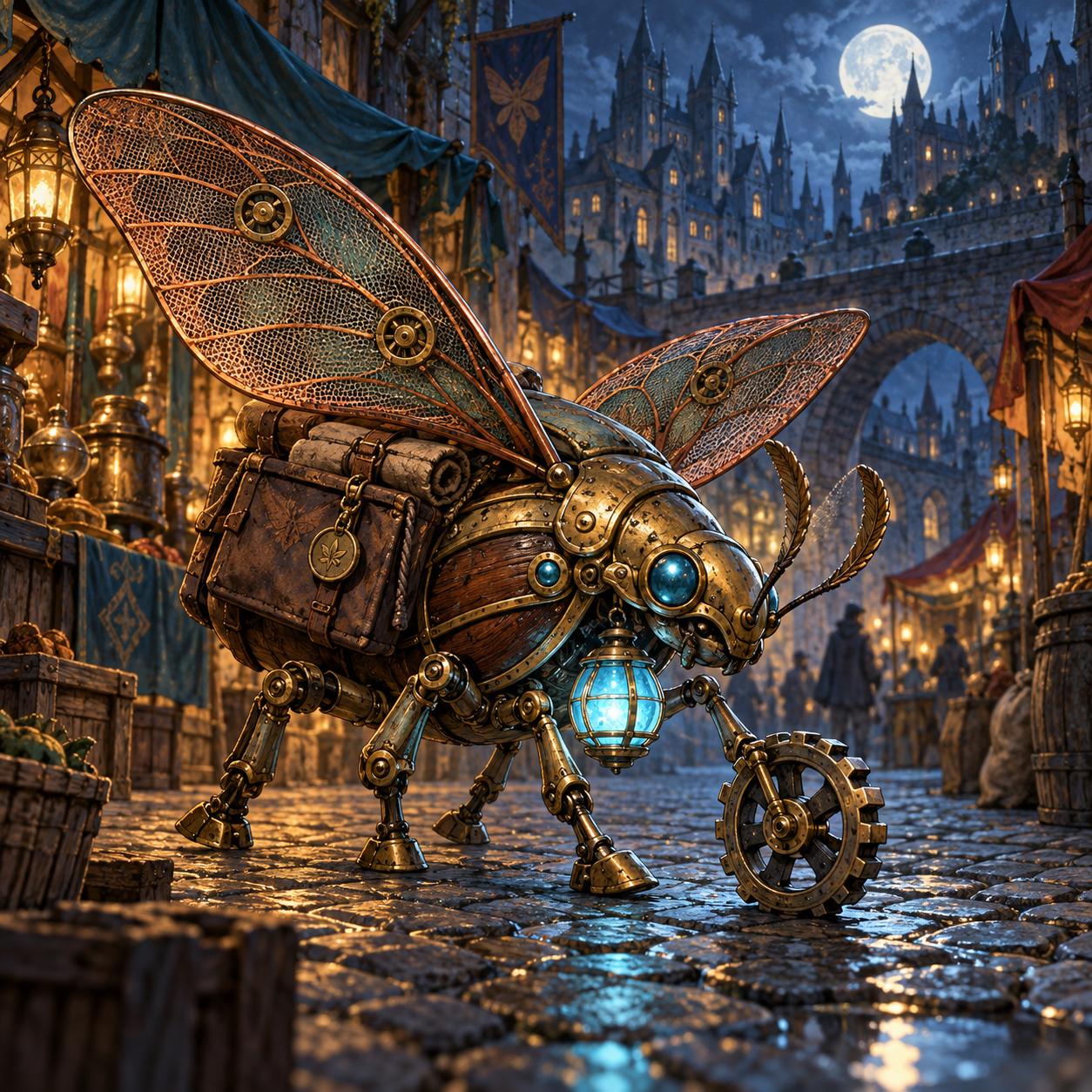
For years she repaired ordinary things: a kettle that leaked, a hand-cranked fan, a toy horse with one wooden leg, the latch on a widow’s medicine cupboard. When she had spare brass she designed a small carrier with two rear wheels and a low tray. It tipped at every threshold. She narrowed it, then narrowed it again. One wheel became a turning gear set beneath the front of the frame. A folded pair of metal wings helped the carrier balance when it leaned around corners. Sela did not know yet that the object would become a friend. She only knew that someone in Bellwether was always waiting for a parcel.
The list above the workbench
The first person to ask Sela for a delivery was a retired midwife named Ilyen, whose hands had begun to shake. She had been walking a bottle of fever syrup to the south rooms each evening, and the stairs had grown difficult. Sela tried to build a simpler carrier. It made the turn by the bakery and became wedged between two baskets of turnips. The second version reached the south rooms but spilled the bottle on the last step. Ilyen wiped the syrup from the floor, put a cup of tea in Sela’s hand, and said the third attempt was bound to have a better story.
Sela started a list on the wall. Each line had a name, a doorway, and a note about how to approach it. “Mrs. Orlo—knock once, wait; her hearing is good, her knees are not.” “Jeren and Lis—leave the parcel in the blue tin if their father is on night shift.” “South rooms—keep the bottle upright.” These were not routes in the cartmaker’s sense. They were a map of the small courtesies that made a delivery arrive safely. Sela tested the carrier against every threshold and patched its tray with a strip of leather when she saw how bottles slid on wet cobbles.
Children gathered at the shop window to watch. One boy, Tavi, asked whether the carrier could fly. Sela showed him the folded bronze wings and said they were not for flying; they kept the machine steady when its wheel had to climb a broken curb. Tavi was disappointed for half a minute. Then he held a paper pinwheel in front of the wings and watched the air move it when the carrier turned. He announced that it could fly a little, if it wanted to. Sela wrote the sentence on the wall list, beneath the address of a woman who had no one to carry her coal.
The carrier was not alive. Sela repeated this when people asked. It followed a spring, a small flywheel, and a set of keys she had cut herself. If the wheel turned, the gears carried a load. If the tension ran down, the machine stopped. She built a blue-glass lamp into its front so people could see it in fog and so it could see a doorway after sunset. Tavi called the lamp its heart. Sela said a lamp was not a heart, but she stopped correcting him. At night, when the workbench was quiet, the blue glow made the little brass face look as though it were listening.
A name for the route
The first delivery the carrier completed by itself was not medicine. It was a folded note from Ilyen to a young mother in the south rooms, explaining how to cool a child’s fever without frightening him. Sela had wound the drive, placed the paper under the leather strap, and stood at the end of the lane where the route turned. The machine went three paces, stopped at a crack in the stones, and adjusted its small front wheel. Then it continued. It did not hurry. Its wings trembled each time the wheel crossed a seam. At the south door it lowered the tray and blinked its lamp twice.
The mother opened the door. She took the note, read it, and smiled in relief. The porter turned around without being asked. Sela had fitted a simple return spring, but the machine’s careful turn looked like a decision. She followed at a distance, unable to decide whether she was proud of the gears or worried by the thought that the moment meant more than she had built. That evening, she added a brass bell to the handle so a person could hear it coming. Tavi said it needed a name that sounded like its work. The name he chose was “Moth-Wheel,” for the wings and the wheel. Sela wrote “porter” after it on the shop ledger.
It began carrying more than parcels. On the way back from an errand, it returned a lost mitten to a child who had dropped it in the market. It waited outside the school arch while a limping teacher searched her bag for the key. It carried a warm loaf from the bakery to a room where an old man lived alone. Sela had not programmed those stops. She traced the wheel tracks and found that each detour led to a person on the wall list. The little machine had been taught a route, but the route had been made of people, and somehow the two had become difficult to separate.
One evening, Tavi did not come to the shop window. He had been sent to stay with an aunt in the hill district, and his mother had forgotten to tell Sela when he would return. The porter made its usual delivery, then remained at the end of Bellwether Lane. Its lamp shone toward the dark school arch. Sela went to it and said Tavi was away. The machine’s wings drew close against its body. It turned toward the shop. Sela did not believe it understood the words. Still, she felt the silence after them as if she had given an answer to a person who had asked.
The things a list could not carry
Sela began to keep two records: one for parts and one for deliveries. The parts book was orderly. It listed springs, rivets, gear teeth, lamp oil, and the cost of repairing the front wheel after it struck a loose paving stone. The delivery list grew untidy. Names were crossed out when a family moved, underlined when a parcel had to be handed to a particular person, and circled when nobody had answered. It was the second list she trusted. A parcel could be replaced. A missed visit could make someone think they had been forgotten.
At the edge of the ward lived a boy named Ren who could not always leave his room. His mother had a cough that left her exhausted, and his older brother worked nights at the river cranes. Ren made paper birds and hung them in the window. Sela sent him a bundle of brass scraps and a pair of dull blue lenses left over from a lantern repair. The porter brought them. On its next visit, Ren had made a paper moth to match the machine. He tied it to the parcel strap with thread, and Sela let it stay there even though the paper softened in the rain.
Ren asked Sela to teach him how the wheel worked. She brought a small gear and showed him how a tooth passed force to the next tooth. He understood the drawing better than she expected. He asked whether a machine could choose to do something it had not been told. Sela gave the honest answer: it could follow a path that its maker had not imagined, but she could not prove that this was the same thing as choosing. Ren considered this, then asked whether people could choose things they did not understand either. Sela said that seemed likely. He laughed, and she went home thinking that the question had been for her.
When Ren’s medicine ran low, his mother sent the porter back with an empty bottle and a note asking for another. Sela had already closed the shop. The next morning she found the bottle on her bench, the paper moth attached to it, and a faint blue mark where the lamp had rested. She had no memory of winding the machine after hours. She checked the return spring and found no fault. The route ledger showed a delivery, written in her hand though she could not remember making the entry. The porter had carried the bottle back to her shop and waited until she woke.
The blue lamp in the blackout
The ward lost its street lamps during a late-autumn storm. Rain flooded the lower steps, wind snapped a wire above the market, and the district went dark just before the evening deliveries. Sela barred the shop door and lit two oil lamps. The Moth-Wheel Porter stood beside the workbench with its blue lamp still bright. Every few minutes the gears clicked as the frame cooled. She considered keeping it inside. Then she read the wall list and saw the names of people waiting for medicine, bread, or a message that might tell them someone was coming.
She loaded the tray with sealed bottles and tied a strip of yellow cloth around the lamp handle. It was a signal she had used during tests: if the cloth showed, the porter was on a medical run and should be given room. She wound the drive until the ratchet held and opened the door. The machine moved into the rain. Sela followed for the first three turns, then watched the light disappear around the bakery. She stood there listening. The bell sounded once near the south rooms. Twice near the school arch. Once at Ren’s window. The blue glow crossed the alley like a small promise she had made with gears and brass.
It returned soaked but upright. The paper moth on its strap had dissolved into a pulp of blue fibers. Sela dried the machine piece by piece and kept the scraps in a jar. The next morning Ren’s brother came to say the medicine had arrived before the fever worsened. He did not mention a machine. He thanked Sela for not forgetting them. She answered that she had not gone herself. He looked at the blue lamp on the bench and said, “Someone did.” Neither of them had a word for what that meant, so they let the sentence stand as it was.
After that night, the porter’s routes became harder to explain. It sometimes left the shop before Sela wound its drive. Its lamp brightened when a name on the list was in trouble. Once, it returned from the hill district with a child’s wet glove tucked in the tray, though no delivery had been scheduled there. Sela examined every gear and spring. She found no hidden mechanism, no second key, no trick. She feared she had made a fault that would put a person at risk. She also feared that repairing the fault might erase something she had not made and could not replace.
The door that would not open
The blackout came back in winter, this time with a fire in the old furnace hall. The city had sent repair crews to reroute the lamps, but they had locked the east workshop while stores of lamp oil were counted. Sela had entered through the side door to retrieve a box of emergency wicks. A beam fell across the inner latch after the first blast of heat. The workers outside could not lift it. Smoke covered the high windows, and the iron door would not turn. Someone ran to fetch the fire brigade. Someone else shouted for Sela to climb the shelves. She tried, slipped, and struck her shoulder. She was alive, afraid, and behind a door that had decided her name did not matter.
The Moth-Wheel Porter had been carrying a parcel of bandages along Bellwether when it saw the smoke. It had no route to the furnace hall. The machine stopped at the corner and turned its lamp toward the sound of the alarm. The ratchet in its wheel had almost run down. It could have returned to Sela’s shop to be rewound. Instead it crossed the market, passed the crowd, and reached the locked door. The machine pushed its front wheel against the lower seam. The wheel slipped. It backed away, gathered what motion its little drive could spare, and struck again.
Each attempt bent a tooth in the drive. The bronze wings shook against the stone wall. The blue lamp kept shining through smoke and rain. Sela heard the bell from the other side and called the porter by the name Tavi had given it. She told it to go, to find help, to stop hurting itself against the door. She knew it could not understand the words, yet she kept speaking because silence felt like agreeing that she was alone. The porter continued until the front wheel cracked and the drive stopped turning. It had not opened the door. It had made enough noise for the workers to hear where she was.
The door was lifted minutes later. Sela was carried out coughing, with one arm around the box of wicks she had gone back for. The machine lay beside the threshold, its lamp dim but unbroken. She survived. The porter’s gears did not. She knelt on the wet stones and put both hands around its frame, apologizing for the door, for the fire, for every route that had asked it to carry more than its body could manage. The blue lamp shone once against her sleeve. Then it went dark.
The promise without a mechanism
Sela kept the broken porter on her bench. She told herself she was waiting for enough brass to replace the damaged wheel. Then she told herself she was waiting for a specialist. The truth was that she could not bear to take it apart. The paper moth’s last fibers remained caught beneath a brass clasp. The yellow route cloth had burned at one edge. Sela laid both beside the frame and wrote each part number in the repair book, but she left the lines for the porter’s name blank. Every time she tried to write, she remembered Ren asking if a machine could choose, and she could not decide what answer the book deserved.
Ren visited after the fire. He had recovered and was able to walk farther, though he still carried a bottle in his pocket. He stood beside the bench and touched neither the machine nor the lamp. “It came because you were inside,” he said. Sela told him the porter had followed an alarm and a familiar road. Ren asked how the machine knew which door mattered. Sela explained the route, the lamp, the bell. He listened and asked the same question in a different shape: if the route had been only gears, why had it turned away from the shop when its drive was nearly empty?
Sela had no proof. She had only the empty drive, the ruined wheel, and the memory of hearing its bell through smoke. She told Ren that being cared for did not make a thing human. He agreed. He said it made the care real anyway. Those words stayed with her. For a time, she imagined that she would build another porter and teach it the old routes. She could make it more durable, give it a stronger wheel, protect the lamp. But if she copied every part and none of the choices that had grown around them, would it be the same companion or merely the same shape?
She did not build a replacement. Instead she repaired the old machine slowly, keeping the cracked wheel in a tin and fitting a new axle without erasing the scratches. The body could carry a parcel again, but the old drive would never move by itself. She wound it for small journeys and let it rest afterward. When the lamp lit, she spoke to it as she always had: where the parcel was going, who was waiting, and whether it could manage the steps. She stopped saying “it is only a machine” when the shop was empty.
A lamp taken from the street
Years passed. Sela’s hair silvered at the temples. Ren grew into an apprentice at the riverside clinic, where he used the porter to carry clean cloth and medicine between wards. He had never asked Sela to forgive herself for the furnace door. She had never asked him to say the porter had saved her. They both understood the rescue had not worked as intended. The machine had failed to open the door and succeeded in making the people outside look in the right place. That was not the same as victory. It was also not nothing.
When Sela died, the shop’s new owner cleared the shelves to make room for a proper cart repair business. The porter was set outside with a crate of unwanted metal. A dealer bought the blue lamp, believing its glass was worth more than the bent housing. He carried it through the ward in a sack. The porter, still without a working drive, remained on the stones. By morning it had moved several feet. Its wheel track ended at the dealer’s cart, where a single blue-glass shard had fallen. The dealer found the machine beside the sack and dropped it at the salvage yard, annoyed that it had followed him.
The porter followed the lamp again. It traveled by short movements: a turn when the rain loosened the frame, a roll when a cart bumped the pile, a slow push from a street’s downward slope. Sometimes it stayed still for weeks. It did not know whether the light was Sela’s, Ren’s, or its own. It knew only that people still waited in doorways and that the lamp belonged with the routes. The last piece of the old paper moth had vanished from its strap. The empty place remained.
It carried nothing now. Its tray was bent. Its bell did not sound. Yet people who noticed it in the salvage yard began leaving objects beside it: a child’s mitten, a wrapped heel of bread, a bottle with a cork still in place. Nobody knew whether the little machine could deliver them. They left them because its lamp had once meant that someone was coming. Each object made the porter’s silent list longer. Each name it had carried became a weight the gears could not measure.
What the Crow bound
The Ledger Crow found the porter at the edge of the old market, beneath a rain gutter that had not been repaired since Sela’s shop closed. The Crow did not pick it up at once. It sat on the stone post and read the brass plate, the cracked wheel, and the pale groove where the blue lamp had been mounted. From a folio it read the delivery names Sela had written: Ren, Ilyen, the south rooms, the school arch. It did not mistake the list for the porter’s whole life. The list was only what could be written down by someone who had held a pencil.
The Crow asked what the machine was still trying to do. The porter could not answer in words. Its wheel shifted toward the alley that led to the south rooms. It stopped where the lane split: one path returned to the shop; the other led toward the clinic where Ren now worked. The light that remained inside its frame was faint, but it turned toward the waiting place rather than the place it had been built. The Crow saw that the promise had outlived the mechanism. It had not been “deliver the parcel,” because there was no parcel. It was “do not leave someone waiting alone.”
The Crow offered the spirit a home inside a card, where a broken wheel would not be forced to turn until it failed. The porter hesitated. Its route had always belonged to the streets. A card could keep the promise but might close the road. The Crow told it the truth: the card would hold its story, not replace its choice. It would still be called to help. It could refuse a call. The promise would not become an order. Sela had built the porter to carry what mattered, not to be owned by every hand that found it.
When the binding settled, the blue lamp returned—not as glass, but as a small steady light above a brass wheel. The Crow wrote “Moth-Wheel Porter” at the top of the folio and left space below for names it had not yet met. Somewhere across the ward, Ren paused in the clinic doorway and felt certain that a familiar bell had sounded, though the street was quiet. The porter’s spirit remained in the mortal world, held by the people it had loved and by the unfinished route that still led toward someone in need.
 Coppercap PorterThe porter was built to carry things no larger than a lunchbox.
At the table
Printed effect: Enter: gain 1 champion armor.
Bank a point of champion armor
On entry, the Porter adds one armor to your champion while also placing a 2/4 body on the field. Armor is capped at five.
One move, shown
Your champion may face incoming damage, and your armor is below its five-point cap.
Spend 3 energy to play Moth-Wheel Porter. Apply the printed effect exactly as written.
Play the Porter before the expected damage so the new armor can absorb pressure. If you are already at five armor, the armor portion is wasted.
The example explains a legal choice, not an additional card effect. Check the live game for current targeting and timing.

Chibi mode
This is the current game’s chibi rendering of Moth-Wheel Porter. The alternate art changes presentation, not the printed card rules.