
Built for the small load
Tamsin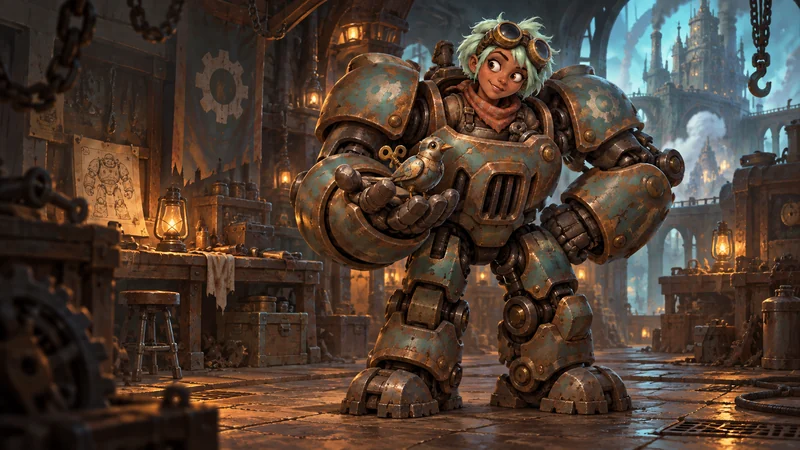 TamsinFirst-generation championTamsin was the smallest apprentice in a workshop that built enormous machines.Read this biography →’s workshop did not build the Coppercap Porter. It arrived years earlier in the back room of a repair shop, assembled by a craftswoman named Enna who had more patience than money. She wanted a helper that could carry nails, thread, lamp wicks, and folded notes between the shops without asking a child to cross the crowded market alone. The first body was made from blue-painted scrap tin, hinge joints, and a pair of watchful glass eyes. A dented copper pot became its cap because it fit the head and kept rain from the gears.
Enna tested it with a wooden box the size of a lunch pail. She loaded it with six nails, a spool of thread, and a small apple. The Porter managed the weight, though its left knee clicked at every step. When Enna tried a larger crate, it stopped at the doorway. She shortened its handles, changed its route, and taught it to ask for help with a bell instead of forcing its way through. The design was not a failed version of a stronger machine. It was a promise that the small errands deserved a worker of their own.
Its scarf came later. Enna cut a strip from a flour sack and wrapped it around the neck joint to keep grit from entering the gears. The cloth was cream once; soot and rain gave it the color of old paper. A child from the next shop tied the loose end into a knot, then drew a tiny blue door on one corner. The Porter kept the scarf even after Enna offered a clean replacement. No one knew whether it understood the picture. It touched that corner before each delivery, as if checking that the door was still there.
The name in the rain
The little machine had no name during its first month. Enna called it ‘porter’ when she needed to distinguish it from the kettle, the press, and the other tools that could move under their own power. Children called it Blue, Tin-Toes, and Pothead. It responded to none of those words consistently. Its attention turned most reliably when someone rang the brass handbell fastened to the cart. Enna decided a bell was enough. Names, she said, should belong to people who wanted to use them.
One wet afternoon, a grocer’s daughter named Iri slipped in the lane and dropped a basket of pears. The Porter stopped its cart, placed the lunchbox-sized delivery under an awning, and returned to gather each pear. It pushed them toward Iri one at a time so they would not roll back into the gutter. The last pear had a dark bruise. Iri called it ‘Coppercap’ when she thanked the helper for guarding it from the rain. The name fit the pot better than any of the others, and the Porter turned toward her voice.
Iri began greeting it by that name. Enna watched to see whether the machine would keep responding after the child went home. It did. The Porter learned the sound in several voices, then the rhythm of it shouted across a market, whispered from a doorway, or spoken with relief when someone saw the cart arrive. It had not been given a human name or a family name. Coppercap was an invitation, offered by the first person who noticed that its work could be kind. It accepted the name through repetition, not through a ceremony.
Twelve small trips
Coppercap preferred twelve small trips to asking a larger worker to make one large one. Enna noticed the pattern before anyone else. It carried a single hinge pin to the cooper, returned with a note, took a needle to the seamstress, and brought a clean rag back to the repair shop. Each errand fit inside its little cart. The routes seemed inefficient until the people along them began leaving small things to be carried: a key to an elderly neighbor, a medicine spoon, a paper pattern someone was afraid to lose.
The trips gave the Porter a map made from people instead of streets. It knew which stoop had a loose board, which baker kept a bowl of water outside, and which door should only be knocked on after the second bell. It learned that a closed curtain did not always mean no one was home. Sometimes a note could be slid under the door; sometimes the right choice was to turn back. Enna put no new command in its wind-up key. It had watched the people who trusted it and learned to treat their thresholds carefully.
Coppercap carried no load larger than a lunchbox, but it often made several trips for the same person. It delivered one copper washer, waited while the mechanic tried it, and returned with the wrong size. It took the corrected piece back. The mechanic apologized for the extra work. Coppercap rang its bell once and leaned against the shop wall while he found the right washer. Its small scale made the errand slower, but it also made refusal visible. When the cart could not manage a thing, it stopped. That pause became part of what people trusted.
The lunchbox rule
Enna kept a painted wooden lunchbox beside the workbench. It was the Porter’s measuring box, a reminder that its carrying capacity was a boundary rather than a challenge. The first apprentice to ignore the rule piled a sack of coal onto the cart. Coppercap moved three steps, its knees buckled, and the sack slid off. No one was hurt, but the apprentice laughed at the little machine for being weak. Enna asked him to carry the sack himself, then asked Coppercap to carry the lunchbox that held his tools.
The apprentice understood after the third stair. Coppercap moved at its usual pace beside him. It did not gloat or take the heavier burden. At the top, the boy opened the box and found the screws he needed to repair a window latch. He thanked the Porter. Later, he added a small brass plate to the cart’s side with a line scratched into it: ‘Small loads still arrive.’ Coppercap traced the letters with one blue finger. It did not need to carry more to prove that it had carried enough.
From then on, workers used the lunchbox as a practical guide. If a delivery did not fit, they divided it or found a second carrier. Coppercap did not have to strain to earn its place. Enna kept the original wooden box after its handle cracked, and Iri repaired the handle with two copper tacks. It became a common object passed between the shops: someone would load it, Coppercap would carry it, and the next person would return it. The box accumulated marks of use without belonging fully to anyone, just as the route belonged to everyone who depended on it.
The cream scarf
The scarf protected Coppercap’s neck joint, but it also held the route notes. Enna stitched a narrow pocket into one end for folded slips too small to stay on the cart. A note might say ‘two lamp wicks, back stair’ or ‘ask before entering.’ Coppercap could not read every word, so it learned the shapes of familiar marks and the sounds people used to explain them. The scarf became damp when it rained and stiff when soot dried in the weave. Enna mended it instead of replacing it, adding a patch each time the fabric thinned.
Iri drew a blue door on a second patch when the first faded. This one had a crooked knob and a small square of yellow light in the window. Coppercap would touch the door before leaving for a delivery, then touch the bell on its cart. Iri said the drawing looked like the home she hoped to have when she was grown. Coppercap did not know what a home was, but it learned that the picture made her stand straighter. It carried the patch through summer heat, winter rain, and a long season when Iri stopped coming to the market.
When Iri returned, she was taller and had a baby brother bundled against her shoulder. She had been away caring for their sick mother. Coppercap waited while she put a small parcel into the cart. The scarf’s blue door had frayed at one corner; Iri stitched it with dark thread and did not remove the old marks. She told the Porter that their mother was better and the baby had a name. Coppercap rang the bell, then carried the parcel to the new home. It had not known where Iri went. It had known only to keep the route open for her return.
The first copper plate
The first protective plate came from an old kettle. It had split along the bottom and could not hold water, but one side remained smooth enough to polish. Enna cut it into a small panel and fastened it to the cart where a stone might otherwise strike the Porter’s frame. Coppercap objected to the extra weight by stopping at the first stair. Enna removed one of the cart’s handles, shifted the axle, and tried again. The Porter made it to the top without dragging its knee.
The repair taught Enna that protection had a cost. A plate could save the frame from a blow and make every trip harder. She marked each panel with a shallow line so they could count the repairs. The workers began dropping scrap pieces into a tin by the door. Most were too warped to use, but Coppercap would carry the tin to the bench when it grew full. Enna sorted the pieces and chose only those that could protect without making the cart too heavy.
Coppercap stood nearby while she worked. It held no opinion about beauty, but it seemed to notice when a plate caught the light. Enna polished the rough edges so they would not snag the scarf. Coppercap tested each new plate by placing a hand against it, then walking the familiar loop past the market and back. The armor was not an invitation to load more onto it. It was a promise that the Porter could keep making the small trips without every careless bump becoming a broken joint.
The Porter at the workshop
By the time TamsinTamsinFirst-generation championTamsin was the smallest apprentice in a workshop that built enormous machines.Read this biography → first saw Coppercap, the little helper had already worked the lanes for years. TamsinTamsinFirst-generation championTamsin was the smallest apprentice in a workshop that built enormous machines.Read this biography → was still a child in a workshop built around machinery too large for her reach. She met the Porter when it arrived with a box of short bolts and found her sitting beneath a drafting table, trying to make a hinge fit a cabinet twice her size. Coppercap set down the box and waited. TamsinTamsinFirst-generation championTamsin was the smallest apprentice in a workshop that built enormous machines.Read this biography → asked whether it could carry the hinge back to Enna for a longer pin.
The Porter made the trip. It came back with three pins, each a different length, because Enna had guessed that TamsinTamsinFirst-generation championTamsin was the smallest apprentice in a workshop that built enormous machines.Read this biography → might need options. TamsinTamsinFirst-generation championTamsin was the smallest apprentice in a workshop that built enormous machines.Read this biography → tested all three and kept the smallest. She returned the other two in the lunchbox. Coppercap carried them away without complaint. From then on, the workshop became one stop on its route. TamsinTamsinFirst-generation championTamsin was the smallest apprentice in a workshop that built enormous machines.Read this biography → learned the bell’s meaning: one ring meant the cart was here; two quick rings meant the load needed attention; a pause and another ring meant the Porter had reached a boundary.
TamsinTamsinFirst-generation championTamsin was the smallest apprentice in a workshop that built enormous machines.Read this biography → did not build Coppercap, and she did not claim it as a servant. She offered a clean place to rest, oil for the joints, and copper offcuts for Enna’s repair tin. Coppercap chose when to stop. It chose when to take a delivery. The two kept a working friendship shaped by small acts: TamsinTamsinFirst-generation championTamsin was the smallest apprentice in a workshop that built enormous machines.Read this biography → adjusted a crooked wheel; Coppercap brought a brace to hold her work while she tightened the bolt. She was one of many people on its route, not the source of its life or the owner of its spirit.
Armor for the unnoticed
When a winter fever passed through the lane, Coppercap carried small comforts instead of tools. It brought broth in a sealed jar, folded cloths, and notes from people who did not know whether a sick neighbor wanted visitors. The cart could not carry a person, and it could not cure anyone. It could deliver one warm meal before it cooled. It could wait outside a door until a hand appeared. That scale of help mattered because it asked no one to pretend that every problem had a grand solution.
After the fever, Enna began making flat copper plates from damaged cookware. She fixed them to the Porter’s shoulders and forearms, where they caught the edges of carts and shutters. TamsinTamsinFirst-generation championTamsin was the smallest apprentice in a workshop that built enormous machines.Read this biography → helped polish one plate until she could see her small face in it. Coppercap did not become stronger in the way people meant when they praised strength. It remained a one-load helper. The armor let it keep working after bumps that would have dented the blue body beneath the paint.
The Porter carried spare plates to people who needed them. A child used one to patch a cracked lunch tin. A cobbler put another under a stool leg. A lamplighter shaped a third into a shield for a flame on a windy street. Coppercap did not decide who deserved protection. Its route carried what people asked it to carry, one small piece at a time. If the plate was too large, it left it with another worker. Protection traveled through the lane as a practical material, not a miracle the Porter could hand out without cost.
When Enna could not work
Enna’s hands began to stiffen in cold weather. She hid the pain for as long as she could, because the repair shop paid by the finished object and the rent did not wait. Coppercap noticed that she dropped small screws more often. It started placing a shallow tray closer to her elbow. She told it that the tray was in the wrong place, then moved it herself. The Porter learned that help was not always welcomed at the first offer. It learned to leave the tray within reach and wait.
When Enna finally stopped working, she did not vanish from the route. She sat by the window and wrote instructions for the people who took over the bench. Coppercap brought each page to the next shop. Her notes explained how to repair a wheel without forcing the axle, how to choose a copper plate that did not make a joint stiff, and how to tell when the Porter had rung for a real problem. She was proud of the machine, but she did not write that it belonged to her. She wrote that it knew its own limits.
Enna died many seasons later, after a long illness. Coppercap carried the last folded note from her bedside to the workshop. The paper contained no secret command and no final message naming an heir. It listed the day’s repairs, then ended with the words ‘leave the small box by the door.’ The workers did. The Porter touched the cream scarf, rang its bell once, and made its regular route. For years afterward, it delivered a fresh lunchbox of tools to the bench on the anniversary of her death. No one called the gesture a summons. It was the route it had learned with her.
The market lane changes
The old market lane changed when a stone bridge was rebuilt. Stalls moved, a new wall divided the square, and the route Coppercap had followed for years ended at a locked gate. The Porter waited before it, bell silent. A porter from the other side called that deliveries could be left at the gate. Coppercap did not cross. It carried the parcel back to the sender and waited for a safer instruction. The delay frustrated people who wanted the route to remain as it had been, but no one could accuse it of risking a small life to save a few minutes.
TamsinTamsinFirst-generation championTamsin was the smallest apprentice in a workshop that built enormous machines.Read this biography → walked the new route with it. She had grown into a mechanic by then, but still moved carefully through spaces where other people hurried. They found a service stair and a covered passage that kept the rain off the cart. TamsinTamsinFirst-generation championTamsin was the smallest apprentice in a workshop that built enormous machines.Read this biography → marked the new map in chalk. Coppercap tested each turn, listening for the scrape of the wheel and watching the doorways. At the end of the route, it rang twice, because the box had shifted. TamsinTamsinFirst-generation championTamsin was the smallest apprentice in a workshop that built enormous machines.Read this biography → helped it settle the load before they returned.
The changed lane taught Coppercap that memory could not replace attention. A route remembered from yesterday might not be safe today. It began stopping at the bridge even after the gate reopened, checking the path before each crossing. Some deliveries took longer. A few customers chose another messenger. The Porter accepted the smaller list without trying to carry more than its joints allowed. It did not measure its worth by the number of parcels. It measured a trip by whether the person waiting at the end could receive it.
The cart wheel that wobbled
A hard frost split one wheel along the grain. The cart still moved, but each turn sent a jolt up Coppercap’s left arm. TamsinTamsinFirst-generation championTamsin was the smallest apprentice in a workshop that built enormous machines.Read this biography → offered to replace the wheel before the next run. The Porter rang twice and pointed the cart toward the upper lane, where a child was waiting for a medicine spoon. TamsinTamsinFirst-generation championTamsin was the smallest apprentice in a workshop that built enormous machines.Read this biography → asked whether it could make the trip. Coppercap tested the wheel, moved a few inches, and stopped. The sound of its bell was not defiance. It was the signal the workers had agreed meant the load or route needed attention.
They divided the deliveries. TamsinTamsinFirst-generation championTamsin was the smallest apprentice in a workshop that built enormous machines.Read this biography → carried the medicine spoon on foot while Coppercap brought the small parcel of clean cloth to the next doorway. They met again by the repair shop. The wheel was replaced, and Coppercap made the short loop home. It had not failed by asking for help. The pause kept a cracked wheel from breaking under a heavier burden. TamsinTamsinFirst-generation championTamsin was the smallest apprentice in a workshop that built enormous machines.Read this biography → wrote the repair in the route ledger, not to shame the machine but to remember that its work required maintenance and rest.
The repaired wheel was made from a different wood, pale against the older dark spokes. Coppercap rolled it back and forth beneath the bench until the sound matched the other wheel. Enna’s notes showed how to fit the axle without pinching the joint. TamsinTamsinFirst-generation championTamsin was the smallest apprentice in a workshop that built enormous machines.Read this biography → followed them carefully. At the end, she placed the tool tray in Enna’s old spot by the window. The shop was full of absence, but its instructions still helped someone care for the helper who had once carried them.
The night of the falling sign
The storm that ended Coppercap’s living days began with a market sign swinging loose above the bridge. The wind drove rain through the narrow lane and pushed loose boards from the stalls. Coppercap had been sent with a lunchbox-sized packet of brass fasteners for the workshop. It was the last trip of the evening. The covered passage was flooded, so it chose the longer lane by the old repair shop. The cart’s smaller load shifted in the gusts, and the cream scarf snapped against its shoulder.
At the bridge, the sign came free. It struck the stone rail and split into two pieces. One half fell toward a group sheltering beneath the market awning. Coppercap rang its bell, then shoved the cart across the lane until its copper plates met the falling board. The plate bent. The cart tipped. Coppercap kept its hands against the sign long enough for the people beneath it to escape into the covered passage. No one had ordered it to stand there. Its route had brought it to the place where the load became larger than it could carry.
TamsinTamsinFirst-generation championTamsin was the smallest apprentice in a workshop that built enormous machines.Read this biography → arrived after the worst of the wind had passed. Coppercap was pinned beneath the broken sign, its left wheel splintered, one arm still braced against the board. TamsinTamsinFirst-generation championTamsin was the smallest apprentice in a workshop that built enormous machines.Read this biography → lifted the timber with help from two market workers. The Porter’s blue shell was cracked, and the emberlike glint in its glass eyes had dimmed. The brass fasteners remained in the lunchbox, untouched. TamsinTamsinFirst-generation championTamsin was the smallest apprentice in a workshop that built enormous machines.Read this biography → set them beside the cart and told Coppercap the people had made it inside. Its bell gave one small ring. Then its joints became still.
The rivet at the threshold
They carried Coppercap back to Enna’s old shop. TamsinTamsinFirst-generation championTamsin was the smallest apprentice in a workshop that built enormous machines.Read this biography → laid it on the repair bench, but the workshop could not restore the small life inside it. The blue body had served for decades; the joints were worn smooth, and the cart was bent beyond repair. They removed the bent copper plate from its shoulder. Beneath it, the old safety rivet had worked loose and lodged in the scarf’s tiny pocket. A strip of route paper clung to the rivet, bearing the chalk mark for the bridge and a note in Enna’s hand: ‘small box by the door.’
No one saw a soul leave the body. The shop stood quiet through the night. Rainwater dripped from the sign outside and struck the copper pot cap where it rested on the bench. The loose rivet rolled across the work surface, tapped the metal lunchbox, and stopped at the threshold of the old repair room. The last spark in Coppercap’s core followed the mark on the route paper, the protective plate, and the little cap that had sheltered it since its first day. The connection formed without a maker’s rite or a spoken command.
When dawn came, the Porter stood again, but not as a repaired machine. Its outline was a spirit-shape held by the objects that had defined its work. The blue body, scarf, cap, and cart returned around the single living presence that had been Coppercap. Its body in the shop remained only metal, cloth, and broken joints. The rivet, route note, and final plate had caught the departing spirit accidentally. They did not trap Enna, TamsinTamsinFirst-generation championTamsin was the smallest apprentice in a workshop that built enormous machines.Read this biography →, Iri, or the people beneath the sign. No other soul was drawn into the binding.
A route with no last stop
Coppercap’s spirit could still carry small things, though the old cart’s weight was now memory rather than iron. It traveled the lane as if the route were drawn beneath its feet. At the bridge, it stopped where the sign had fallen. The repair crew had cleared the boards and repaired the rail. The people who had been under the awning were alive, and one had left a copper washer on the stone as thanks. Coppercap placed the washer in its cart, carried it back to the workshop, and set it by the lunchbox.
TamsinTamsinFirst-generation championTamsin was the smallest apprentice in a workshop that built enormous machines.Read this biography → understood that the helper had returned, but not that it had been released. The Ledger Crow later described the binding as an accidental catch in the mortal world. Coppercap could move through familiar streets, yet no open road led it away from the world of its deliveries. It was not a ghost summoned by TamsinTamsinFirst-generation championTamsin was the smallest apprentice in a workshop that built enormous machines.Read this biography →, nor a tool she could put to work. It chose the errands it accepted. On some nights it rang its bell from the empty lane; on others it rested beside the threshold and did not move.
The route ledger stayed in the repair shop. Its pages contained addresses and instructions, not a spell. The little blue door drawn on the cream scarf had faded almost away. TamsinTamsinFirst-generation championTamsin was the smallest apprentice in a workshop that built enormous machines.Read this biography → copied it onto a fresh patch and offered it without fastening it in place. Coppercap took the patch, turned it over, and chose to tuck it into the cart. That choice was small, but it belonged to the spirit. TamsinTamsinFirst-generation championTamsin was the smallest apprentice in a workshop that built enormous machines.Read this biography → did not pretend that a new picture could undo the old catch. She simply left a way for Coppercap to carry its own story.
The card and the small box
When the Ledger Crow prepared the folio, TamsinTamsinFirst-generation championTamsin was the smallest apprentice in a workshop that built enormous machines.Read this biography → brought the lunchbox, the scarf, and the bent copper plate. She explained which repairs Enna had made and which route marks Iri had drawn. The Crow asked whether the Porter had belonged to the workshop. TamsinTamsinFirst-generation championTamsin was the smallest apprentice in a workshop that built enormous machines.Read this biography → answered that it had worked there, but it had also made its own choices and traveled beyond the shop. She would not turn an old friendship into ownership. The little helper’s limits, its repeated trips, and its decision to stop at the falling sign belonged to the history as much as its blue body did.
The card held the one spirit that had been Coppercap. The official card face was used, with its actual Mournhand frame and the printed effect that grants one champion armor on entry. The lunchbox, scarf patches, and broken cart remained in the workshop archive; none of them became a second vessel. The protection represented by the armor was a gameplay effect, not a claim that Coppercap had been indestructible or could protect everyone in its life.
Card containment did not let Coppercap leave the mortal world. TamsinTamsinFirst-generation championTamsin was the smallest apprentice in a workshop that built enormous machines.Read this biography → set the card beside the old route ledger and the small wooden box. The Porter’s folio listed its birthday as September 8, Virgo, for the steadiness it showed in small tasks; the date was a chosen character detail rather than a documented date from the game’s chronology. Its faction was the Small Things Stand workshop circle, and its pastime remained polishing the safety plates. The Crow closed the ledger with the blue door visible on the scarf patch, still small enough to fit in the margin.

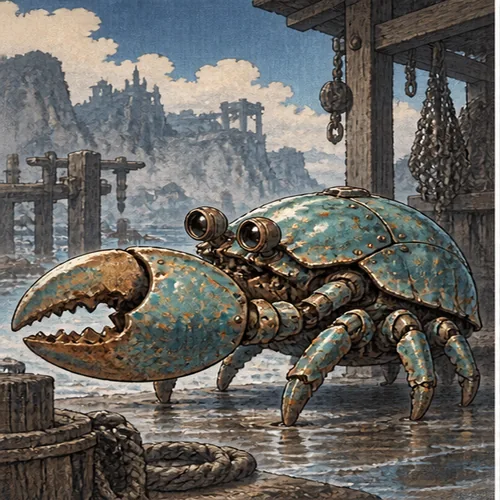 Rivet CrabC21 · 2 energy · 2/3The smallest workers in the foundry used to leave bent nails beneath the benches.Read this folio →
 Hearth-Anvil StagC22 · 4 energy · 3/6When the last forge went cold, the apprentices found a stag standing among its ashes.Read this folio →
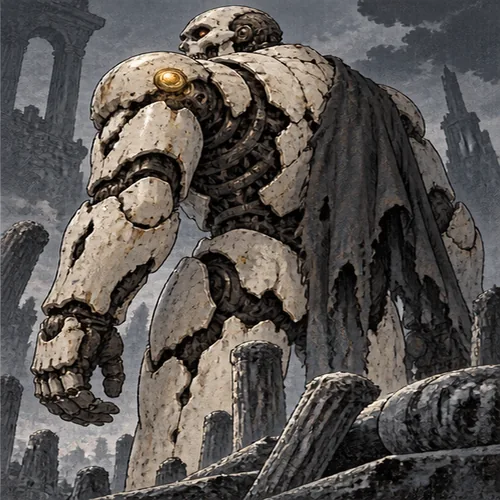 Last-Bolt GiantC24 · 5 energy · 4/6The giant once held the foundry roof above a hundred fleeing workers.Read this folio →