
Seven honey buttons
He was born on July 7, during the hottest week anyone in the candle shop cared to remember. The wax would not set properly. His mother, Sella, cooled her paws in a basin before touching him, and the shopkeeper gave up complaining about the ruined batches when he saw the enormous ears folded against that small cream-colored head. Sella was a little foxlike person herself, with brown spots at her ears and a tail she wrapped around the legs of her work stool. The child inherited both habits. His father belonged to memories too early for him to retain; Sella spoke of him sometimes, without making the absent parent into either a villain or a promise.
Their room was above the chandlery's storage cellar, reached by steps built for much larger feet. Sella stretched a cord along the wall so her son could climb without help. He learned to carry his tail high on the damp steps and flatten his ears before passing under the lowest beam. At night, the boards smelled of beeswax. He slept in a drawer lined with old wool until his feet hung over its edge, then insisted on keeping the drawer beneath his larger bed. It held smooth stones, twine, and the little pieces of broken crockery that he considered too beautiful for the rubbish pile.
Each July 7, Sella made seven small honey biscuits, pressing their centers with the back of a button. The number stayed the same as he grew older, which pleased him; a birthday could change things without changing everything. She saved two even when he declared he meant to eat all seven before supper. On the inside of his first proper coat, she stitched the date so he would never have to explain it to a clerk who assumed he was too small to know. The coat was burgundy cloth bought from an old theater wardrobe, cut down so thoroughly that nobody could tell what role it had once played.
He was affectionate with people he trusted and suspicious of a kindness that arrived too loudly. Sudden laughter made his ears fold before he could stop them. He learned to laugh first when older children remarked on their size, then went home furious that he had helped them. Sella brushed the fur behind those ears with a damp scrap of linen and listened until the fury found its real shape. Sometimes he had been treated badly. Sometimes he had spoiled a game because he could not bear to lose. She did not confuse the two merely because he was her son. He remembered the cool cloth long after the exact words became difficult to retrieve.
The workbench under the stool
Baret, the chandler, paid Sella to braid cotton into wicks. She worked at a bench with a second, lower shelf fitted for her child. His earliest jobs were simple: separate the clean fibers, put the dirty ones aside, and stop keeping every knot because it resembled an animal. He liked the work when he could make piles. He disliked being told that two almost identical piles belonged together. Before long he could tell which cotton would burn evenly by rolling it between his dark little paws. Baret began leaving the awkward offcuts for him, claiming small fingers were an advantage, and paid in copper rather than sweets when Sella was there to insist on it.
He knew the shop's candles by their ordinary purposes. Tall pale ones went to households expecting visitors. Smoky cheap ones lit stairwells. Thin tapers were carried to sickrooms, where families watched their length because they had nothing useful to watch in the faces on the pillows. He did not yet hear voices inside flames. What he heard was the conversation of customers who forgot anyone stood beneath the counter. They worried about rain, rent, toothaches, sons who had stopped writing. He learned that people sometimes bought the smaller candle because it was what they could afford and sometimes because they were afraid a larger one implied they expected someone to die.
His favorite work was trimming cooled candle ends. He used a blunt blade with a handle Sella had wrapped to fit his grip. The colored shavings curled away like tiny shells. From the scraps he made lopsided figures for a human child named Nim, who delivered paper sleeves from her aunt's print shop. Nim supplied ruined labels for his stone collection. They invented elaborate names for pebbles, then accused each other of forgetting them on purpose. He could remember six different names for the same gray stone but still left his work apron in the wrong place every day. Nim found this endlessly funny until he hid her lunch inside the apron.
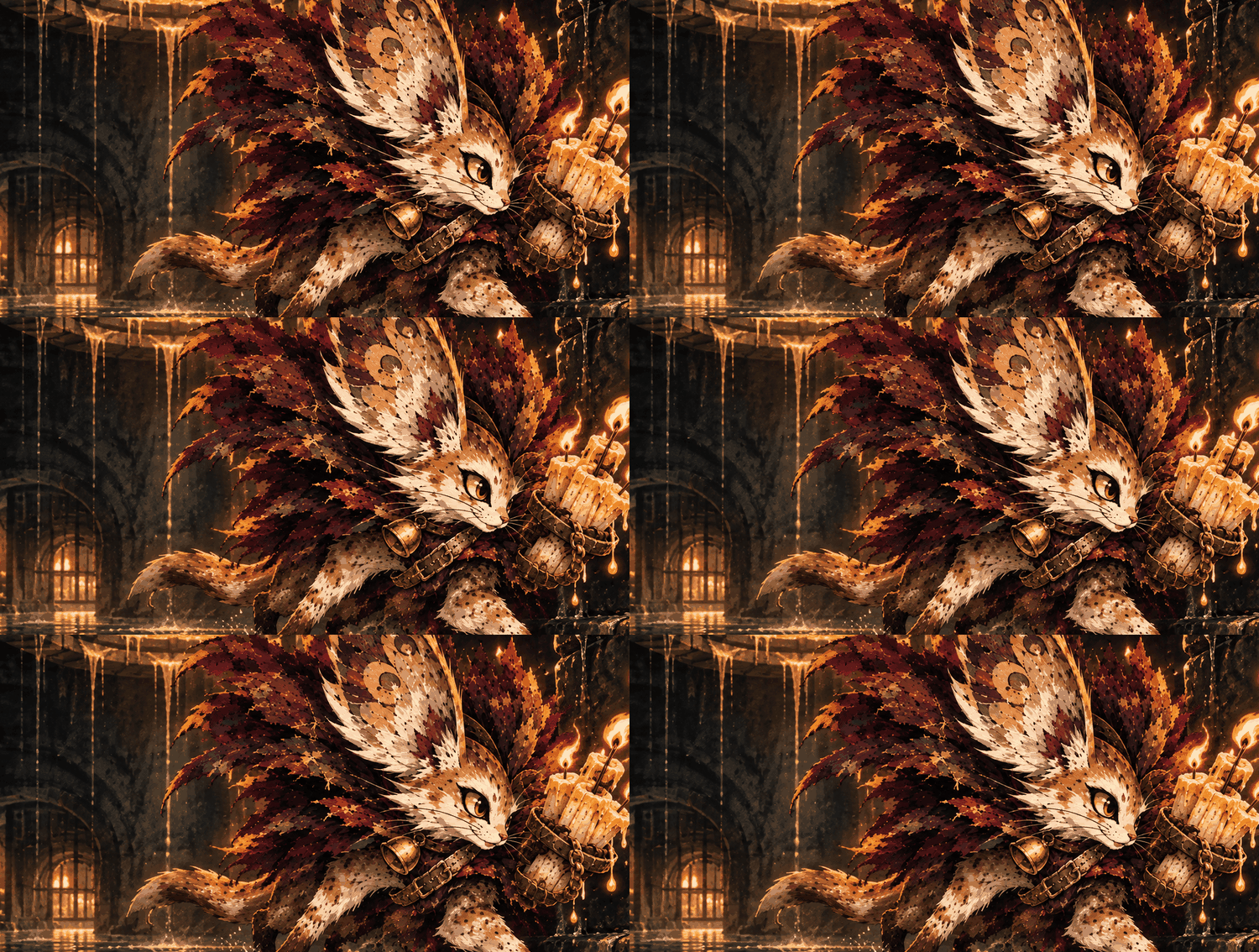
He wanted a job that required a chain across the chest, like the delivery clerks wore. Baret finally fitted an old candle cup to a short chain so he could carry a light without occupying both paws. Sella added a small bronze bell at the collar, allowing workers to hear him beneath the benches. He pretended the bell was an indignity and polished it in private. He liked the weight it made when he ran. The cup, bell, and burgundy coat became his idea of what a useful person looked like. On his first evening carrying deliveries, he circled the block twice before going home so more people would see him working.
The long way home
Delivery routes taught him a second version of the neighborhood. Aboveground, carts and grown people's feet made every crossing an argument. Beneath the shops, dry service channels connected cellars, culverts, and coal doors. He was small enough to use them without stooping. Nim called his routes secret tunnels, although most smelled like onions and ended under someone's sink. He drew maps on damaged labels, marking low grates with three scratches and unfriendly dogs with four. When he discovered a sunny ledge above a warm pipe, he claimed it as an office and arranged his cups of pebbles where an actual desk would have stood.
The tunnels were not always safe. Baret taught him to listen for water before rounding a bend and to watch the wall's stain where previous floods had reached. Sella made him recite the way home when she thought he was growing careless. He sometimes lied about taking the surface streets because he disliked having his routes examined. Once he stayed out to watch a moth circle a lantern and returned long after his promised time. Sella had gone looking. He found her on the cellar steps with damp fur and a face he had not seen before. Her anger arrived only after she touched him. He remembered that order, although it did not stop him being careless again.
Nim spent one summer teaching him letters. He had a quick eye for symbols and little patience for copying the same one neatly. His pawprint was more distinctive than his handwriting, so he signed their pretend business agreements with a soot-marked pad. They planned to open a shop where every purchase included a free pebble. Nim said the pebbles were the valuable part, and he agreed until a customer actually offered to buy one. Then he demanded so much that the amused woman walked away. For days, he blamed her for not understanding. Eventually he put the pebble in Nim's coat pocket with a very small written apology.
Sella saved for a room with more light. Her son saved for a brass clasp engraved with a curling leaf, having noticed her coat fastened with an ordinary pin. Neither knew the other's plan. Their meals improved when work was plentiful and became more inventive when it was not. He loved toasted crusts dipped in broth and disliked soft pear unless he had stolen it himself. In the evenings, he tucked his tail around Sella's ankles while she worked. She moved her foot twice when she wanted him to stop fidgeting. The gesture survived in his memory with astonishing precision: one patient movement, a pause, then the second.
Things priced by weight
As new chandlers opened along the avenue, Baret lost customers who preferred brighter colors and cheaper wax. Sella's orders shortened. The boy began collecting discarded candle ends from gutters and asking to be paid for what could be reused. He knew which households put out their rubbish before dawn and which swept it into the channel beneath the pavement. At first the work felt like being rewarded for a game. His cup caught crumbs of wax; his coat caught everything else. He could bring home money without having to ask anyone whether he was old enough. That freedom mattered to him more than he admitted.
A reclamation dealer called Harl bought wick cotton by weight. His cellar held sacks of stubs from chapels, lodging houses, and the old infirmary. Harl did not ask where the small collector found his loads, provided he separated metal before weighing them. The first time the boy mixed a clean wick with a heavier lump of wax to increase the payment, Harl noticed and quietly removed the whole bag from the scale. He had to wait until the following day to earn anything. He never tried the trick again with Harl. For a while, he treated that narrow success as proof he had learned honesty.
Then he took a bundle Nim had been saving to light her aunt's workroom. He intended to replace it before she needed it. Harl paid him, he bought the brass clasp, and a rainstorm delayed the next collecting round. Nim spent the evening trimming printed sheets beside a neighbor's borrowed candle. When she found out, she did not shout. She asked him whether he had imagined her sitting in the dark while he chose the present. He had not. The question followed him home more effectively than an accusation would have. He put the clasp away and spent his next payments on the missing candles.
He told Sella before he gave her the clasp. She wore it, which surprised him, but required him to explain to Nim where its price had come from. Apologizing did not repair their friendship at once. Nim stopped leaving materials unattended near him. Slowly, through returned loans and kept meeting times, they recovered the ease he had treated as something that could not be lost. He retained a weakness for believing that a good eventual purpose made a theft smaller in the present. Later, when the stolen things began speaking in children's voices, he would have to examine that habit with considerably more care.
The lamp with a return mark
Harl eventually offered him a better-paid route collecting old wick ends from channels under the infirmary. The work required a covered lamp; open tapers failed in the drafts. He could not afford one. Harl lent him a squat returning lamp, so called because its flame could lead a borrower back through passages where ordinary light became unreliable. The lamp belonged to an older trade than Harl's own. A name entered in its lending book connected the carrier, the lamp, and the return route. Harl wrote the boy's name beside the date. The boy pressed a soot-black pawmark on a stiff account token as a receipt.
The lamp did guide him. When he took the wrong junction, its light leaned toward the proper turn. He delighted in showing Nim how it straightened after he corrected his course. Its brass looked expensive under the tarnish, and he imagined polishing it until Harl forgot to ask for its return. Beneath the removable oil cup was a narrow black wick fed through a small iron ring. Harl told him not to pull that wick out. He also told him to keep the oil above the scored line, and offered the first fill without charge. Thereafter, lamp oil came out of the boy's earnings before anything else.
What Harl did not explain was why the line mattered. The returning lamp had been made to keep a route open as long as it possessed something of its borrower. Usually the written name was enough. Without oil, it would begin consuming the name itself to maintain the flame. After that came the breath of the person attached to it. Harl knew the lamp had a dangerous reserve and convinced himself the warning about oil covered his responsibility. He had used it for years without an accident. His smallest worker heard the warning as advice against getting lost, not as an account of what could be taken from his body.
Sella distrusted the loan. She did not recognize the mechanism, but she recognized a wage reduced by a charge the worker could not avoid. Her son showed her his first full payment and asked her to stop assuming he would make a mistake. She let the conversation rest badly between them. Before his next shift, she placed fresh bread in his coat and checked the oil herself. He objected to the inspection, then ate the bread on the way down. The two feelings could coexist without troubling him then: wanting the dignity of doing his own work and wanting his mother's care packed where he could reach it.
A light that would not go out
The fatal collection took place after heavy rain, when runoff had carried an unusual number of old candles into the lower channels. He was pleased by the size of the haul. Near the infirmary outlet, he heard something like speech coming from the lamp. He first thought a patient was talking through a drain above him. Then the sound shifted with the light. The discarded wicks had begun to wake around the returning flame, releasing wishes held by children who had died while their little sickroom candles burned. He heard a request for a window to be opened. Another voice wanted its brother told where a hidden toy had gone.
He forgot the collection time. He set wick after wick beside the lamp, trying to hear a whole sentence without the water interrupting. Some fragments were so ordinary that he laughed, then felt ashamed of laughing when he understood who spoke. The oil cup caught against a low brick as he moved deeper beneath the outlet. It tilted, spilling part of its contents unnoticed into the dark water. The flame continued at the same height. He had learned to read an ordinary candle by its shrinking body; this light gave him no useful measure of what remained. When he finally looked at the scored line, the cup was almost empty.
He turned for home. The flame leaned behind him. Thinking he had mistaken the junction, he obeyed it and returned to the place where he had been listening. He tried the other branch and arrived there again. The lamp had begun feeding on its borrower, and its route now closed around the thing it meant to keep. He called his own name aloud to reassure himself. Halfway through the sound, he could no longer remember its ending. Then he could not recall the beginning. He knew Sella, Nim, the shop, the clasp. The word they used for him had become a space his thoughts slid past.
He set down the lamp and ran, but his breath shortened with every step away. Its little iron ring held the borrowed connection tighter as the flame drew upon it. He made it as far as a dry shelf and rang his collar bell with both paws. Water swallowed the sound before it reached the street. He thought of Sella searching in the rain and tried to ring more quietly, irrationally afraid of making her worry. His last breath left him as a thin brightness that traveled back along the channel into the black wick. The body on the shelf stayed still. The lamp remained alight, needing no oil now.
The place where his name should be
He woke inside the lamp's reflection. Across the water lay a pale open shore, with no drain roof above it and room for his ears to rise. He stepped toward it and felt an answering pull beneath his ribs. Part of him was still burning in the iron ring. The far shore moved no closer, however hard he walked. When he tried to call across, every word came except the name by which he understood himself. This was not a refusal to leave Sella or a vow to complete a task. The lamp physically held the stolen part of his spirit, and the rest could not pass without it.
Harl eventually found the body and extinguished the visible flame. He removed the blackened wick with tongs, terrified by what he understood too late. Snuffing the lamp stopped its light but did not return what it had eaten. Hoping to destroy the evidence and the danger together, he cut the wick into short lengths and put them among the discarded remnants for washing. The boy felt each cut as a different direction opening inside him. His spirit followed the pieces through the reclamation drain, while the body and the ordinary objects he had worn were carried elsewhere. He could no longer remain near one lamp and wait for someone to repair it.
He gathered a shape around what he remembered touching: the ragged coat, the candle cup, the bronze bell. His spotted ears and cream fur returned as clearly as the dark pads of his paws. The name did not. When he followed a familiar smell upstairs, he found Sella receiving the bell Harl had recovered. The bell at his own throat made no sound when he shook it. Hers rang once against her clasp. He pressed himself against her leg and saw her look down, hopeful for one terrible second. Then the connection to the scattered wick pulled him back beneath the floor before she could reach toward him.
He tried the limits repeatedly. Walking beyond the candle district stretched him thin until he snapped back to a wet junction. Diving toward the reflected shore returned him to the same shelf where he had died. Burying the wick fragments he found made him faint and brought him no closer to freedom. He could not leave the mortal world because the lamp had divided and retained what it stole. He also could not reconstruct himself merely by choosing a new name. The loss was an actual piece of him, held in the lamp's altered wick, and he did not yet know which of the thousands of black threads belonged to it.
The pockets that learned to listen
The abandoned wicks no longer looked alike to him. A faint warmth clung to some; others trembled before they spoke. He began gathering those that held a voice, believing his own missing word must eventually appear among them. These were the stubs nobody remembered lighting, swept away after a bed was emptied or a household moved. The city's living hands treated them as material. He heard the children who had asked for one more story, another blanket, or the return of a borrowed whistle. Their last wishes survived the people who had heard them. Keeping a flame did not bring its child back, but dropping one felt increasingly unlike dropping a scrap.
He made separate pockets in his remembered coat. A neat row held wishes he could understand. An untidy row held fragments still interrupted by coughing, rain, or the noise of his own fear. He marked their wrappers with Nim's old symbols because his handwriting still displeased him. Whenever two voices began together, he moved them farther apart. One child repeatedly asked someone to let a dog indoors. He carried that wick aboveground and searched for the door it described. By then the household had changed. He sat outside for most of a night, angry at a new tenant for not owning a dog that had probably died long before.
He learned to make smaller useful responses. He left a recovered marble at the address named in one whisper. He placed a ribbon beneath a loose paving stone another voice remembered. Sometimes a living person noticed. Sometimes morning rain destroyed the work. He remained a thief: taking candle stubs without permission was easy, and taking a little extra wax could make a borrowed flame last longer. When he stole a whole candle from a child's window, the sudden darkness reminded him of Nim's aunt working by another person's light. He returned it before dawn and kept only the gutter end it shed. The restraint cost him a possible clue and therefore meant something.
His search grew routines around it. He listened to unfamiliar wicks first, then checked the ones he had kept longest. He brushed soot from his ears with the edge of his sleeve. He kept one silent, unidentified thread sewn into an inside seam because its warmth felt familiar without yielding a single word. Some nights he was certain it was his own. Other nights he suspected he had protected it so long that protection itself had become the familiar feeling. He would not discard it to make room. He also would not tell the other little flames that he knew who he was.
A supper he cannot find
The steady wick came to him in a chipped saucer among ordinary rubbish. Its flame stood straight despite the draft and refused to consume the small collar of wax beneath it. He carried it to his warm-pipe ledge and waited for a voice. What reached him instead was a sound like spoons touching bowls, followed by the movement of several small chairs. He smelled bread, then a sweetness he could not place. The sensation was so much like sitting near a room where someone else was being cared for that he put the saucer down abruptly. It made his own collection feel untidy, his coat dirty, his absence from home permanent.
In the candle district he had heard stories of the Waxwork Matron Waxwork MatronC10 · 4 energy · 2/6She casts a new face for every child the winter takes, setting them around a supper that never cools.Read this folio →, who set supper for children lost to winter. The unshrinking light could have come from her table. A missing wick in one account seemed to match the saucer's empty fitting. But he had not seen the Matron remove it, nor had he crossed her threshold. The saucer could have passed through many hands before arriving in the refuse. When a whisper finally rose from the flame, it asked for a seat to be kept. It did not say whose. He listened for his name with such force that he sometimes supplied a syllable himself, then had to start again.
He tried to find the supper room by following its warmth. The route led through an alley whose walls had been rebuilt, then ended at a locked storehouse. For a while, he sat outside every evening. He hated the thought of taking a place belonging to someone else and hated equally the thought that someone might be holding it for him while he waited at the wrong door. One night he set the saucer down and backed away, intending to return it to whatever path had brought it. Before he reached the corner, he went back. Returning something precious required a confidence in the world he still did not possess.
He kept the steady wick apart from the others, with enough room beside it for a second saucer. This was not proof of an invitation. It was an arrangement he could bear to look at. When the other voices became too crowded, he sat near that quiet flame and braided loose cotton as Sella had taught him. His small paws still remembered where to cross the strands. He sometimes placed seven stones in a line and pretended they were honey biscuits cooling. Then he gathered the stones again before anyone could find them laid out that way. He wanted to be discovered, and was deeply embarrassed by how much.
The people who kept looking
As his shape strengthened around the gathered wicks, the living occasionally saw him. Nim was the first person from his old life to remain beside him long enough for a conversation. She had grown taller. He noticed ink on her sleeve and felt, absurdly, that she ought to be told before her aunt saw it. Nim noticed him staring and laughed with her hand over her mouth. Then she cried, which frightened him more. He tried to present the encounter as an ordinary meeting interrupted by an awkward gap. She sat on the cellar step and let him talk about a damaged candle cup until he could bear to say that he had died.
She spoke his name. To her, it was a word she knew. To him, the water outside grew suddenly loud where the syllables should have been. She wrote it on a label, but his gaze slipped from the marks without understanding their shape. Other words remained legible. They tried again in chalk, spoken softly, spoken angrily, traced against his paw. The lamp's theft made the recognition fail each time. Nim wanted to keep trying. He asked her to stop for that evening and disliked himself for sounding impatient. It was difficult to explain how much hope hurt when it was raised every few breaths and struck against the same invisible obstruction.
She brought Sella's old sewing packet. His mother had searched the channels, taken work elsewhere, and eventually left the district with relatives when the damp worsened her breathing. Nim's last letter from her was already old. There was no simple reunion Nim could arrange, no clear answer to where Sella was now. Inside the packet lay a scrap of the original coat lining, with July 7 stitched in her hand. The date remained readable. It was a birthday he could keep without recovering his name. Beside it was a little drawing of the brass clasp. He pressed one paw against the curling leaf until Nim put the paper somewhere drier.
They met when his collecting routes allowed. Nim grew older while he retained the shape the lamp had taken. She repaired his wrappers and taught him a few letters again, accepting that one word still escaped both their efforts. He brought her pretty stones without demanding their return. There were seasons when she could not find him and seasons when he was ashamed to be found unchanged. Around the period later recorded as c. 2940 A.B., people began calling the small figure in the drains the Wick Thief. He accepted the title as a direction someone could use to reach him. He never mistook it for the missing name.
The small square that held him
Nim recovered his old account token when Harl's business was cleared. Its stiff paper still carried the soot-dark pawprint he had pressed beside the lamp loan. The written name had blurred where oil crossed it. Neither of them could retrieve it from the stain. The token felt unpleasantly warm when he touched it, and the flames in his pockets leaned toward the little square. Nim found a matching return mark inside the lamp's damaged lending book. The account token had been part of the same circuit as the name, lamp, and route. Harl had kept it in a drawer after the lamp itself was broken, leaving one last anchor intact.
He wanted to tear it up. Nim held his wrist, gently, and reminded him what cutting the wick had done. Together they wrapped the token in a piece of clean paper and placed it beneath his candle cup. For the first time, his outline stayed solid when he walked past the district's boundary. Every step farther away made the token's pawmark darker. He returned before he discovered the limit. He understood enough to be frightened: the surviving record could gather the pieces of his presence that the scattered wick kept pulling apart. It could not return the word the flame had consumed, and the silent thread in his coat still gave no answer.
The binding happened as he tried to move the cup. Its chain caught the wrapped token and drew it into the small circle of light. The pawprint opened like a tiny shadow on the paper. He felt all the routes tug at once: the dry shelf, the warm pipe, the cellar stair. His bell sounded clearly for the first time since death. Then his coat, ears, and reaching paws folded into the token's depth without becoming smaller to themselves. Nim caught the card before it fell. The wrapping dropped away. The square account token had drawn itself into a tall rectangle. Thornlike gold and silver borders enclosed its black reverse; teal circles surrounded a red seal bearing a skeletal hand. On the other side, the cream-furred little thief stood in his burgundy coat amid gathered candlelight, held inside a surface that had once recorded only a loan.
He had not elected to die, remain a spirit, or enter a card. The returning lamp's unfinished connection finally closed through the surviving mark of its borrower. The card became his vessel in the mortal world, carrying the tether with him instead of leaving it stretched through the drains. Nim stayed beside it until he answered her tapping with a soft note from the bell. She placed the birthday scrap under its case and left the top unfastened while he learned the boundaries of this new condition. He could travel now with the wicks he guarded. Somewhere among those borrowed flames, he still hoped to find the wish that would speak the one word neither friendship nor careful handwriting could yet give back.

 Thimble KnightC02 · 2 energy · 1/4A seamstress fashioned his armor from her last thimble and asked him to guard the nursery door.Read this folio →