The birthday on the workroom calendar
On May 12, a pale beetle grub broke its egg inside a scrap of bark beside the seamstress Avel's workroom window. Avel had brought the bark indoors to prop a crooked flowerpot. Her daughter Tess found the new arrival while rescuing a spool that had rolled underneath. She marked the day on the workroom calendar because her mother marked the birthdays of everyone who lived there. Tess drew a small oval where a name should have gone. The creature's earliest world consisted of warmth, damp wood, and the broad shadow of a child who checked him every morning before remembering to put on both stockings.
He did not arrive already understanding people. During the weeks that followed, a spoon's edge was a mountain and a change in the light meant more than any word. Tess made a shelter from a broken clay button box and filled it with the sort of wood he could eat. When she discovered the other small creatures in the bark, she made room for those too. Some disappeared into the workroom's cracks. He remained near the box, moving away when disturbed and returning when the vibrations of the sewing table settled. Avel insisted that affection did not give Tess permission to hold something every time she wanted to.
He passed through the dark stillness of his changing body without knowing what was happening. Afterward, the workroom had colors and edges he could approach on jointed legs. His shell was brown, his antennae long, his eyes bright when he turned toward the lamp. Tess celebrated his emergence with a crumb of ripe pear. He discovered he liked pear more than nearly anything else. He also discovered that walking across the same route could produce different results: a pin might be moved, a finger might offer a bridge, a puddle could become too wide overnight. He began watching before committing himself to a step.
There was a particular tapping Tess made when she brought food, two quick touches followed by one slower stroke against the wood. He answered accidentally, then deliberately. Their conversations started there. She learned which movement meant he wanted to be set down. He learned that her open palm could remain steady even when her voice sounded unhappy. Years later, people would explain him as a toy awakened by a wish, because the thimble was easier to understand than a beetle with preferences. But the small life came first. Before armor, magic, or a promise at the nursery door, he was already someone who waited for familiar footsteps.
The last thimble
Avel mended work clothes for households that could not replace them. A box of damaged cuffs waited beneath her table, and payments arrived with the irregularity of the people who owed them. She had sold her spare tools during a difficult winter. The brass thimble she kept was pitted by years of needles and slightly flattened along one side. It fit her finger badly, but it was the last one she owned. The beetle often sheltered beneath it while the table shook. Tess began setting it over him in play, declaring him a knight, then removing it quickly when his antennae complained against the rim.
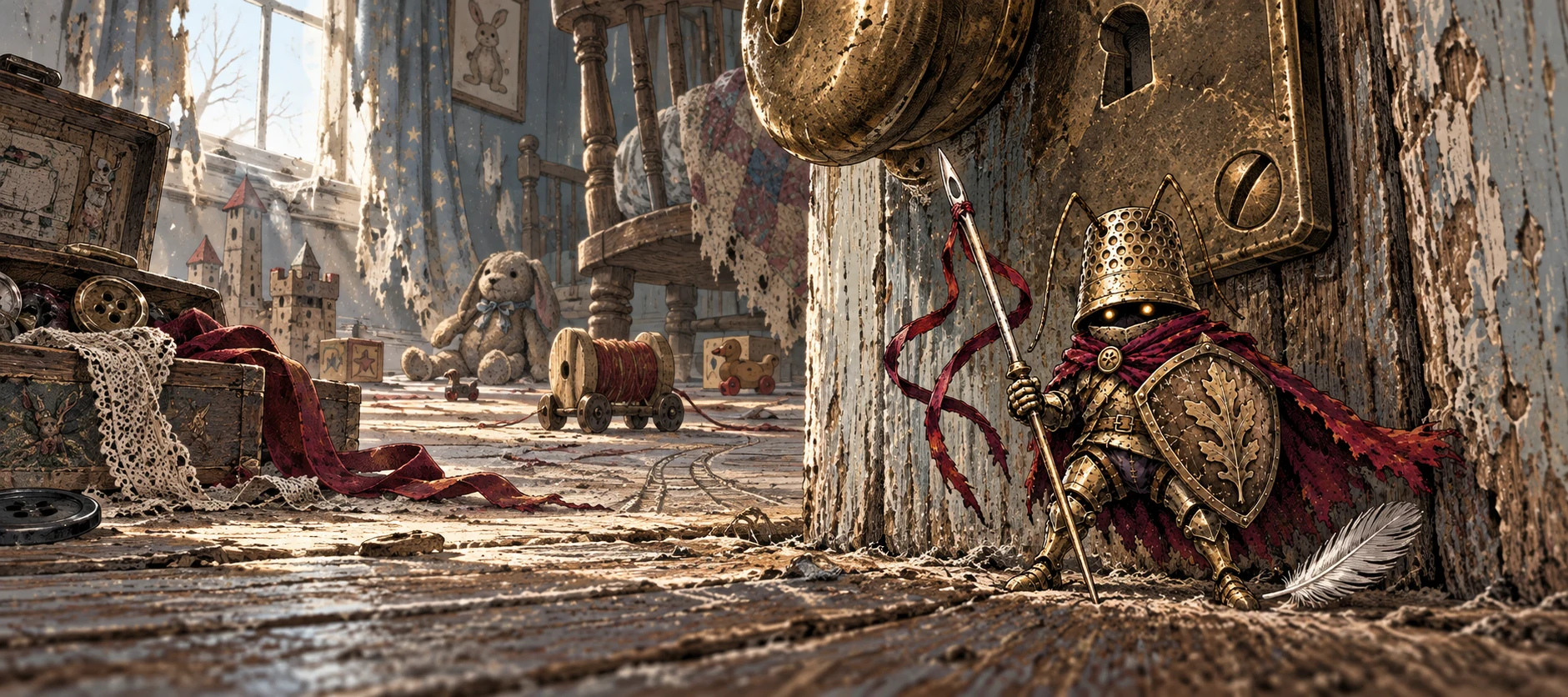
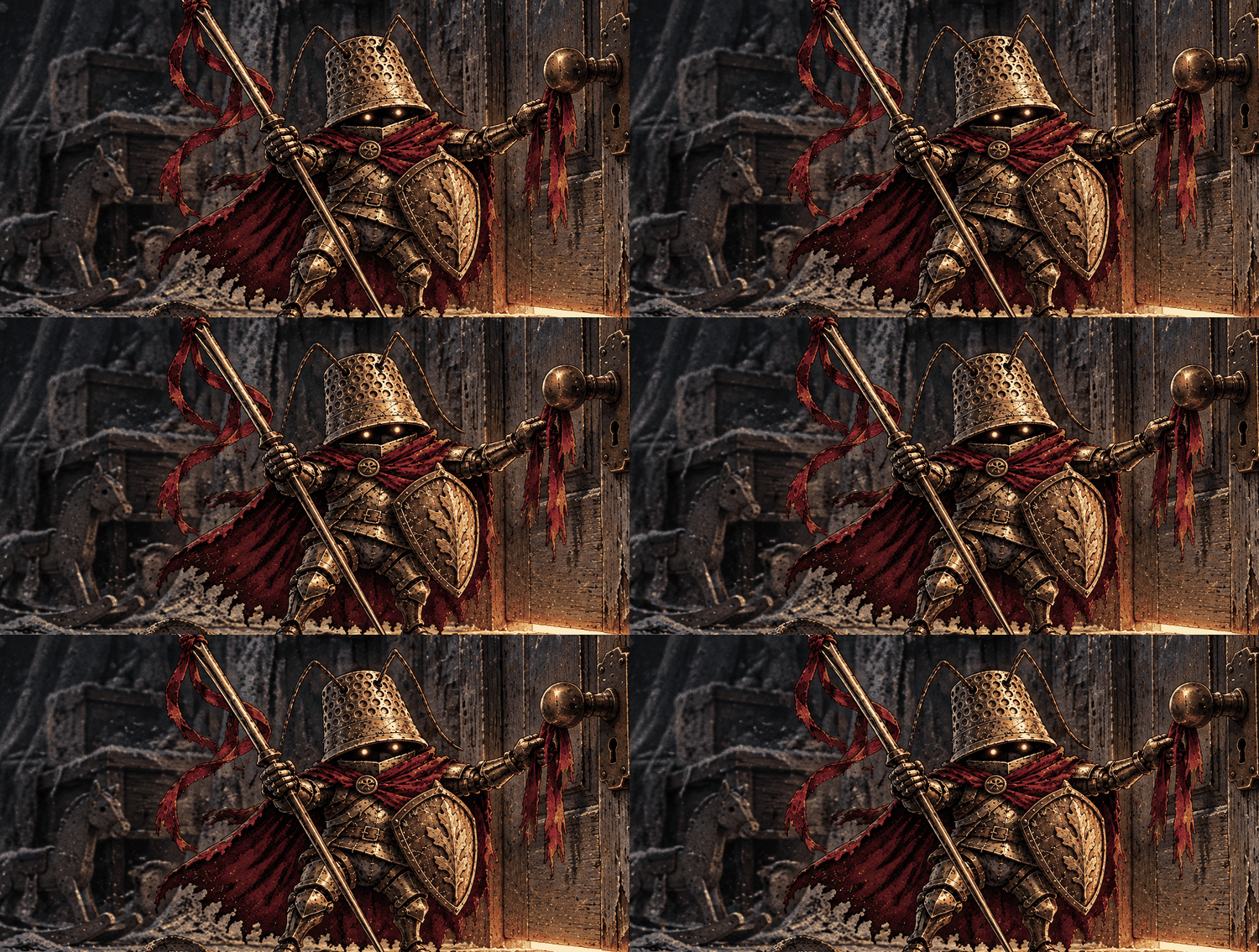
Avel finally altered the thimble properly. She opened two small passages for the antennae, eased the flattened rim, and fitted light leather beneath the metal so it would not grind against his shell. The rest of the armor was made from salvaged brass fastening pieces, joined around the body he actually had. His forelegs learned to carry objects while the lower limbs braced beneath him. A brown shield came from a shaved acorn cup strengthened with leather. A broken brooch supplied its small brass oak-leaf inlay. His lance was a long sewing needle, and a thin strip of burgundy cloth became a scarf fastened with a round button.
The work belonged to the period later placed around 2500 A.B., when the house was already old and its nursery still smelled of fresh washing. Avel's younger child, Orren, had begun crawling toward every dangerous thing the adults believed they had put away. The seamstress set the equipped beetle beside the nursery threshold and asked him to guard the door. It was partly a joke, partly a game for Tess, and partly the weary wish of someone who needed another pair of eyes. He took the request seriously because she had made each piece fit him. He inspected the gap beneath the door and planted the needle upright.
He was far too small to stop an adult entering. He could, however, push a loose pin out of reach, hear the scratching of a mouse, or tap his needle against the latch plate until someone noticed Orren approaching the stairs. Avel kept sewing with a folded leather finger guard after giving away her thimble. When Tess complained that the knight had received the better tool, Avel showed her how easily his legs could be crushed beneath an ordinary heel. Protection, she said, ought to fit the thing that needed it. The knight did not understand every word. He understood the careful way she adjusted his shield strap afterward.
Duties he invented himself
No one ordered him to count the floorboards between the nursery and the workroom. He did it because the distance became reassuring when it had familiar divisions. He learned which window rattled before a storm, which basket spilled thread, and where Orren dropped the crusts he claimed to have eaten. Each watch began at the same brass latch. He climbed the groove beside its plate, tested its movement with his needle, and descended before taking his place below. Tess once polished the latch so thoroughly that he could not find his usual foothold. He sulked in the button box until she understood and restored a strip of rough cloth beside it.
His finest early victory involved a marble. Orren left it on the top stair, where Avel would soon descend carrying a laundry basket. The knight could not lift it. He wedged his shield against the curve and pushed until the marble rolled into a harmless corner. Everyone praised him, and for several days afterward he moved every round object he found, including a carefully sorted row of buttons. Avel spent an irritated afternoon restoring her work. Tess explained the difference between preventing a fall and rearranging things because a previous success had made him feel important. He listened with his antennae held very still.
He enjoyed games in which a cotton reel became a cart and a folded handkerchief became a tent. He disliked being placed inside the tent if he had not agreed to enter. He liked pear crumbs, the warm patch near the iron after it had cooled enough, and the sound a shield made when Orren flicked it gently with a fingernail. He feared the broom. The family learned to announce sweeping before approaching his post. His bravery did not make that fear disappear; it meant he sometimes stepped between the bristles and a smaller creature anyway, trembling so visibly that Tess stopped calling it a battle.
He began tying fallen ribbons to the eye of his needle. The first was a scrap from Tess's hair after she returned from a visit she had dreaded. Another came from Orren's sleeve when the child wandered into the yard and was found asleep behind the water barrel. The knight did not collect them as prizes. He kept the frayed pieces because they had come back attached to people he cared about. When a ribbon grew too long and tangled around his feet, he refused to cut it. Tess helped him fold it into a smaller knot, showing him that keeping something safe did not always require keeping it exactly as it had been.
The winter of longer naps
The beetle's living seasons were few beside the human lives around him. Orren learned to speak while the knight learned that his own legs no longer recovered quickly after a climb. He slept longer in the button box. His antennae still rose at the food signal, but sometimes he reached the pear only after Tess had begun to worry. Avel loosened the armor and inspected the little body beneath it. There was no wound to repair. She kept his resting place warm and moved the water closer, resenting the limits of a craft that could mend so many things except this one.
He did not understand age as a story with an ending. He understood that the latch stood farther away each night, though its position never changed. Once he fell halfway up the familiar groove and lay on his back until Orren righted him. He was so distressed by being carried to the nursery that he attempted the climb again immediately. Tess set her palm beneath him without touching. He made it to the plate, rested, and rode her hand down. Accepting that return took longer than the climb. Afterward, the family lowered a small strip of rough braid so he could reach his post without spending all his strength before the watch began.
His last living afternoon was quiet. Rain held everyone indoors. Orren tried to build a bridge between two stools and grew angry when it fell. The knight pushed a loose spool beneath the longest span, not because he knew bridges but because the unsupported cloth looked wrong. Orren thanked him with the gentle shield-flick he liked. Later, Avel found him asleep beside the doorway with the needle laid across his body. The small legs did not move when she tapped the floor. He had died through the ordinary ending of his living body, without an enemy to blame or a heroic wound that could make the loss feel useful.
Avel should have laid the body in the garden. Instead, she wrapped him in soft linen inside the thimble and began a protective stitch she had learned from an old household pattern. The stitch secured nursery charms until the last child came safely home. Its closed border included every child the nursery had sheltered or would ever shelter; even an empty room still held an obligation to children not yet born. She had never used it around a dead creature. Grief made the distinction seem less important than the need to do something careful with her hands. She closed the final loop through the burgundy scarf and a strip of the nursery's door hanging. While she worked, Tess asked whether their knight would wake. Avel said she did not know, and pulled the thread tight.
The seam that would not open
He had been leaving. Beyond the weight of his stopped body, he felt the movement of open air through oak leaves, with no thimble pressing around him and no need to climb. He followed the warmth. Then the final stitch caught the departing beetle soul between the shroud and the nursery ward. The pull was immediate and physical. He tumbled back into darkness beneath the brass, and two amber lights opened where his eyes had been. The body inside had finished living; what moved the little armor now was the same creature's captured spirit. Avel's work had made a place he could remain, and closed the way by which he could have left.
At first, the household rejoiced. Orren ran to fetch a fresh crumb of pear. The knight stood, tried to taste it, and discovered that the memory of sweetness no longer matched what his mouth could do. He could lift his needle, turn his head, and make the old tapping answers. He could not leave the nursery corridor beyond the length of the hanging's shadow. Whenever he tried, the stitches drew tight through his shape and returned him to the door. He attempted the garden again at dawn, following the light he remembered. The same pull stopped him. This was not loyalty choosing a post; it was a boundary he could not cross.
Avel understood what she had done when he pointed his needle at the seam and then toward the window. She tried to unpick the outer stitches. The first loop loosened easily; the second made his limbs lose their shape. At the third, he no longer recognized Tess's tapping. Avel retied the work, and his remembered answer returned. The seam had closed around his identity as well as his shell. Unmaking it was pulling him apart rather than restoring the passage he had begun. She stopped, weeping with the needle still in her hand. She had wanted to preserve someone she loved and had trapped him inside that desire.
She apologized without asking him to make her feel better. For several days he would not accept her palm as a bridge. When he eventually did, it was because the floor between his post and the water dish had been scrubbed smooth and he needed help. Forgiveness arrived through small practical agreements afterward. Avel widened the physical reach of the hanging with carefully joined cloth, giving him the workroom and stairs as well as the nursery. She never claimed that this was freedom. At every repair she showed him the thread and waited for assent. The knot she could not safely undo remained inside the thimble, binding his actual soul to a household ward meant for objects.
The people who grew taller
Tess outgrew the nursery and still stopped at its door to greet him. Orren became tall enough to repair the latch he had once been kept away from. Their knight remained small. His living body, returned to the garden once the spirit could endure the separation, left him a patch of ground he visited within the ward's reach. He did not confuse that buried shell with himself. Yet he sat there in spring, when beetles moved among the new leaves, and watched their freedom with an attention the family learned not to interrupt. He could be grateful for company and grieve what had happened to him at the same time.
Avel grew old over the following decades. Before her death, she recorded the failed unpicking and the repairs that had helped, so no later keeper would repeat them through ignorance. She drew a plan of the nursery on stiff pattern card and marked the ward's returning loops. Tess read the instructions aloud while the knight listened at the table. He tapped when a detail was wrong. Avel corrected it. The last change concerned the line she had written beneath his little drawn figure. She crossed out 'charm' and wrote 'our knight.' When she could no longer hold the pen, he pushed the ink cloth toward her with his shield as he had done in younger days.
Her death did not release him. The ward had been tied to the nursery and its children, not to the seamstress's lifespan. He followed the household to the limit of the joined cloth as they carried her out, then waited at the place where the pull stopped him. Tess returned and sat beside him until evening. She did not tell him that Avel was still there in some form he ought to feel. She talked about the way her mother held pins between her lips and always forgot where she had put her spectacles. The knight lifted a length of the rough braid Avel had made for his final living winter.
The house passed to Tess, then to other hands. Orren's children visited; later, children with different surnames slept in the nursery. Some belonged to the owners, some to lodgers, some to people taking shelter during difficult seasons. The original family were mortal and gradually disappeared from the living rooms. Their customs lasted unevenly. One generation kept May 12 on the calendar; another remembered only that the tiny knight enjoyed a fresh ribbon in spring. Repairs replaced walls and floorboards while preserving the old latch and the ward's joined border. He learned that a home could change nearly every face inside it and still deserve careful attention.
A house borrowed by many
The centuries did not pass for him as one long empty watch. There were crowded years when six beds occupied the nursery and quiet years when it became a sewing room again. A carpenter made a ramp beside the threshold after finding him struggling over a new strip of wood. A cook kept a bottle cap of warm water ready for cleaning soot from his shield. One household disliked him and covered the door hanging, treating the amber eyes as a bad omen. He spent that winter almost motionless beneath a cloth. Their youngest child eventually uncovered him while looking for a lost mitten and refused to let the cloth return.
He made mistakes that did not become wiser merely because he was old. During a fever season, he blocked the nursery's narrow gap because a stranger smelled of sharp spirits and carried metal instruments. The stranger was a healer. The knight could not truly stop the adult, but his frantic tapping frightened a sick child and delayed the examination. Afterward, the household's oldest daughter sat beside him and explained each instrument's purpose. He inspected the healer's case the following morning, then helped keep the younger children away from it. He began learning the sounds of useful visitors instead of treating every unfamiliar footstep as a danger he had already understood.
When the Waxwork Matron Waxwork MatronC10 · 4 energy · 2/6She casts a new face for every child the winter takes, setting them around a supper that never cools.Read this folio →'s winter supper entered the neighborhood's stories, children in the nursery repeated different versions. Some said her candles never shortened. Others said the supper was for people no living family could find. Much later, a ribbon tied to the knight's lance was found to use the same fading dye as cloth described at that table. The dye had been sold across the district. Its presence could tell him something about shops and neighbors, but nothing certain about a particular child's fate. He had never seen the Matron arrive at his door. He would not accept a stranger's comforting explanation as proof of where anyone had gone.
He kept distinct knots for the ribbons of different households. A loop folded twice belonged to the child who feared thunder. A flat knot marked the little girl who left for school and returned every afternoon pretending she had forgotten him, until she could not maintain the joke. He remembered those small greetings longer than the fashions the children wore. His collection became awkward to carry, so he stored most of the ribbons in the old button box and chose only a few for each watch. Every choice felt disloyal at first. Eventually he understood that leaving a ribbon safe in the box was another way of keeping its person close.
The last family at the latch
The last household arrived near the end of the house's fourth century with the knight. Its youngest child was a girl called Enna, who disliked bedtime because she felt everyone else continued having interesting lives after she was sent upstairs. She began leaving the nursery to investigate. The knight met her at the threshold every time, needle held across the gap. She could have stepped over him. Instead, she argued with him in whispers because she considered it insulting to ignore an opponent. He answered with taps, and before long she could distinguish disapproval from an actual warning.
Enna loved maps and drew him a route from the nursery to the sea. She put the paper beneath his feet and moved it slowly so he could march without leaving the ward. At first he took the game with painful seriousness. Then she added a mountain shaped like her father's nose, and his antennae tilted in the movement she had learned to recognize as laughter. She gave his shield a leather handgrip after the old one broke and stitched his burgundy scarf where centuries of repairs had made the fabric mostly seams. Her careful stitches were not Avel's. He found that difference comforting rather than wrong.
The house was failing in ways a needle could not address. Water gathered beneath the foundations, and the rear wall shifted enough to jam a window. Adults spoke of leaving. Enna assumed the knight would go inside her traveling box with the other precious things. When she carried him toward the front gate, the ward dragged his shape backward out of her hands and returned him to the nursery. She tried a longer ribbon and then a wider box. Neither changed the reach of the original binding. He stood very still while she cried, ashamed of needing comfort when she was the one being made to leave her home.
The family departed around the period the Crow places near 2900 A.B. This was the silence remembered as a hundred winters; the house had not stood empty since the seamstress's day. Enna tied one torn ribbon to his lance before the carts left. She promised to return when she was old enough to decide where people lived. He tapped the traveling rhythm they used for their paper sea. The adults saved the household books and pattern cards but could not move the bound spirit safely. Enna looked back at each corner until the house disappeared. The knight returned to the same brass latch and began his first watch in the abandoned house.
A hundred silent winters
At first he continued every nursery task at its accustomed hour. He pushed dust away from the threshold, checked the window, and laid a fallen ribbon where Enna would find it. The house made noises that almost resembled its former inhabitants. A pipe knocked like Orren's first attempts at the greeting. Loose plaster fell with the little scrape of someone turning a page. The knight learned these sounds eventually, but learning did not prevent him from looking up. He stored the hopeful mistakes separately from the real memories. There were evenings when he revisited one deliberately, letting a familiar noise remain a footstep for a moment before correcting himself.
He was not entirely without company. A mouse nested in an old drawer, and he initially drove it out with his shield, offended by its use of the children's room. During the first hard frost, he found its young huddled against the warmer side of the door hanging. He lowered his needle. The family remained for a season, then disappeared into the walls. Later there were other mice, spiders, moths, and a bewildered sparrow that had entered through a broken pane. He could not make the sparrow understand a route, so he stood beside the safe opening and tapped until its attention turned. It left a tiny feather against his shield.
The ward weathered with the building. Parts of the joined hanging decayed, and the outer boundary crept inward. He repaired what he could using thread from stored clothes, but some damage lay beyond his reach. Each loss removed a familiar piece of house: first the garden threshold, then the lower stairs, finally a corner of the workroom where the warm iron had once stood. He tested those absences as he had tested the boundary after death. The pull still returned him to the nursery. A hundred years of being left alone had not made his spirit eligible to depart or undone the stitch that held it.
His ribbons became promises made to smaller visitors as well as reminders of human children. He tied a narrow scrap after the sparrow escaped and another when a beetle found its way around a basin in which it would have drowned. He did not always succeed. He buried one field mouse under a loose board and sat beside it without inventing a reason the death had been necessary. On May 12, when he still managed to track the seasons correctly, he cleaned the button on his scarf. Nobody brought a pear crumb. He placed a smooth seed in the old dish instead and allowed himself a watch shorter than usual.
The woman with the paper sea
The person who finally climbed the damaged stairs was not Enna. She had the same habit of pausing before a doorway, which caused the knight a moment of wild confusion. Her name was Selde, and she was Enna's great-granddaughter. She carried a box of family papers wrapped against rain. The house was being surveyed before its upper floor became too dangerous to enter, and she had come to recover a brass latch described in her inherited books. She expected an object. When two amber eyes moved beneath the thimble at her feet, she sat down so abruptly that dust rose from the hem of her coat.
Selde knew the paper-sea game because Enna had described it to her own children. She unfolded the surviving map, brittle at its creases, and placed it beside the knight. The mountain still resembled a nose. He touched the drawing with the point of his lance. Enna had tried to find help as an adult; several letters in the box asked whether a household spirit could be removed without injuring it. None contained a method she trusted. Later responsibilities, distance, and illness kept her from returning. She had died many years before Selde's visit. The explanation was not the promised homecoming, but it was evidence that her leaving had not become forgetting.
The knight was angry before he was grateful. He pointed toward the century's worth of decay and struck the latch with the flat of his needle. Selde did not answer with the number of hardships Enna had faced. She read the letters, one at a time, and let him stop her. When he finally rested, she brought out Avel's old notes. Generations had preserved the warning against unpicking the inner seam. They had also kept the original nursery pattern card, including a drawing of the ward before additions made it spread through the house. The earliest circuit could fit on something Selde could hold in one hand.
Selde repaired clothes for a living. She recognized the pattern as a construction that returned each line to the same border, but claimed no knowledge of how to free a soul. The knight knew the actual repairs from centuries inside them. Together they compared the diagram with the surviving hanging. He placed a loose thread across one drawn line, and his shadow shifted from the floor toward the card. They stopped immediately and repeated the movement slowly. Nothing in him disappeared. The discovery offered no doorway into death, but it suggested a way to carry the ward whole instead of tearing its prisoner out.
A threshold small enough to carry
They worked over several visits. Selde strengthened the old pattern card with a second layer of plain fibers, keeping Avel's lines visible. The knight chose thread from the nursery hanging and made Selde set aside the ribbons tied to memories; he would not consume them merely because they were available. His needle passed through the card's border at the same turns he had maintained in the cloth. Selde steadied the large edge while he managed the minute tension. At each completed section, a part of the house's fading boundary drew closer, settling into the little drawn nursery. The inner knot beneath his thimble was never opened.
At the last turn, he stopped. The original instruction still ran through the pattern: guard the nursery until the last child came home. There would never be a last child if every new household renewed the promise. He had been caught by a task with no natural ending, even after its maker died. Selde asked whether he wanted her to stop too. He looked toward the latch, then toward the mouse tracks across the dust. Guarding had become part of him, but it was not the same thing as agreeing to remain tied to crumbling walls. He returned his needle to the final hole and made the joining stitch himself.
The floor beneath him fell away without moving. The nursery's outline rose through the fibers, taking the ward and the armor it held into the card. The reinforced pattern narrowed into a tall card with a dark reverse, aged gold edges, and fine teal circles surrounding a red wax seal. A skeletal hand formed upon that seal. Within the face, his antennae touched a smaller version of the familiar lintel. The brass latch appeared beside him, carrying its old scratches and the rough place Tess had restored. Outside, the actual door hanging went slack. Selde turned the card and saw the Thimble Knight standing within its illustrated threshold, needle upright, brown shield ready, a torn ribbon stirring against the burgundy scarf. The separate beetle soul remained itself. Its prison had changed from a building's fixed border into a vessel that could travel through the mortal world.
The binding did not undo his death or safely release the stitch around his spirit. It gave him a choice of where his continuing watch could be carried. Selde asked to take him somewhere warm, and he answered with Tess's old two quick taps and one slow stroke. Before leaving, she held the card beside the original latch so he could make his customary inspection. He checked it once, thoroughly. Inside the image, the same movement remained possible wherever the card went. The house outside stayed silent. The little knight who had guarded generations was carried down its stairs with his ribbons, his memories, and the unspent wish that something small should make it home.

 Grave Lantern KeeperC04 · 2 energy · 2/3The keeper lights a lantern for every grave the city refuses to mark.Read this folio →
 Ash-Ribbon DuelistC03 · 2 energy · 3/2She once fought duels for silk ribbons and applause.Read this folio →
 The Wick ThiefC01 · 1 energy · 1/2Beneath the candle shops, a small thief gathers the wicks nobody remembers lighting.Read this folio →