
The last breath in the forge
The old south forge had been marked for closure before the spring thaw. Its bellows had split at the seam, its roof leaked soot into the cooling room, and the guild had moved most of the paid work to newer furnaces upriver. On April 8, the remaining crew gathered to drain the fire and salvage what they could.
When the seam opened, the bellows pushed one last breath through the coals. It was not a gust. It was a thin, warm exhale that stirred ash from the hearth and lifted a spark no larger than a pinhead. The spark landed in the soot beneath the tool rack. Lio thought she had seen an ember roll there.
The creature was small enough to sit inside a work glove. Its body looked like soot gathered around a coal, its eyes glowed orange, and a thin tail drew a line through the ash whenever it turned. It coughed once, sneezed sparks, then stared at the bellows as if waiting for another breath. The crew stood very still.
Lio called it Mote. She said the name suited something that could disappear in a shaft of sunlight and reappear on the warm side of a brick. The master warned her not to feed it coal until they understood what it needed. Mote answered by trying to blow on a cold iron nail. The nail did not move.
The old bellows could not be repaired that day. The fire was drawn down, the room emptied, and the closure slate was signed. But there was still warmth in the hearth, and Mote curled inside the smallest ring of it. Lio asked whether she could return in the morning. The master said the forge would be locked.
A child who kept a place
Lio was twelve, the youngest apprentice in the south forge and the only one whose hands were small enough to reach behind the broken airbox. Her mother had sent her to learn the trade because the household could not afford another mouth without wages. Lio liked the work more than she admitted.
Mote followed her from bench to bench, though he could not cross cold stone without shivering into a little heap of ash. Lio began carrying a wrapped brick in her apron pocket. She set it near the work she was doing and let him warm himself without asking him to prove he belonged there. He tried to blow every flame brighter than the last.
The other apprentices made a game of lighting small fires and asking Mote to beat them. He always accepted. The first time his breath put out a candle instead, he glared at the wick until Lio laughed. He copied her laugh, a quick chuff that sent a tiny plume of sparks upward. After that, he learned how to make the sound whenever she was discouraged.
Lio gave him a corner of her sleeping shelf, where the brick stayed warm overnight. She tucked a patch of leather around it so the draft would not cool him. Mote pulled the patch over his head whenever the master came near, though the glowing eyes gave him away. The master never ordered him out.
The creature learned each person's routine. It waited by the water bucket when old Harn came in with stiff fingers, curled beside the kettle when the night shift wanted tea, and sat on Lio's shoe when she had missed a meal. It did not speak. It offered heat, breath, and its attention.
How to feed a little flame
The master taught Lio that a forge needed more than fire. It needed a measured draft, a clear flue, a bed of fuel, and someone willing to stop when the metal was ready. Mote learned the opposite lesson from the apprentices: if the flame weakened, blow harder.
He could breathe a flame taller for a moment, but doing it made the ember beneath his ribs dim. His small chest tightened. A red seam appeared across his belly, then faded when he curled beside the warm brick. Lio understood the pattern before he understood the danger.
Mote protested by inflating his cheeks and sending a harmless puff at Lio's fringe. She pretended to be offended. She then sat with him through the dim hour, sharing the warm brick and telling him which apprentice had hidden a wrench in the wrong drawer. Mote liked the names, even when he could not repeat them.
His first true work was not blowing a fire. He learned to breathe along the side of a damp coal bed so the draft reached underneath without scattering ash. The flame caught gently. The master looked up, surprised, and Lio told Mote he had done well. Mote's ears lifted. He did not try to make the fire taller.
Lio began leaving a shallow dish near his brick. She put a little ash in it after every shift, not as food but as a place to rest his feet. Mote arranged the ash into rings and paths. Sometimes he made a path around the dish and back to himself. Sometimes he stopped halfway and watched Lio to see whether she would finish it.
The fire that was not a family
Mote had no known parent, clutch, or other spirit of his kind. The broken bellows had given him a first breath, but it did not continue to care for him. The crew became the closest thing he had to a household: Lio, the other apprentices, Harn at the kettle, and the master who pretended not to notice a warm patch in his empty glove.
Harn was first to show him a gentler use for his breath. The old smith had a scar across his palm that stiffened in cold weather. Mote warmed a folded cloth, then pushed it toward him. Harn tucked it around his hand and said the creature had better manners than the guild steward.
Lio's closest friend, Osa, was an apprentice who kept a tiny notebook of tool measurements. She drew Mote as a round soot creature with long ears and a tail like a question mark. Mote stole the notebook and sat on it until she agreed to draw him with a larger flame. Osa did. Lio objected that this was inaccurate.
On Lio's birthday, the apprentices gave her a new set of small chisels. She asked them to make one extra gift: a copper disc with two punched holes, light enough for Mote to carry. Osa stamped a little ember mark on it. Mote wore it on a string around his neck until the cord frayed, then tied it to his tail.
The master never called Mote a child or an animal. When the guild inspector asked what had happened in the closed forge, he described an unclassified flame-being and the repairs needed to secure the room. Lio asked him to include Mote's name. The inspector said the form had no field for that. The master wrote the name in the margin anyway.
The bellows on the salvage list
The closure order became real when the salvage crews arrived. They carried tags for iron, leather, and usable stone. Anything that could not be sold was to be broken down and cleared by the next week. The old bellows sat on the list as damaged equipment.
Lio asked to keep the bellows. She did not tell the inspector why. She said the old airbox had a useful iron throat and might be repaired for a smaller forge. The inspector said its seam was beyond repair. She said she would stitch a new leather body herself. He marked the item for disposal anyway.
Mote understood the bellows was being taken away. He sat in front of its mouth and refused to move. The crew lifted him gently and set him on a warm brick. He returned to the bellows. When the iron throat clanged, he made the same soft sigh it had made when he was born. The workers stopped for a moment.
Osa removed the copper disc from Mote's tail and threaded it through a small rivet hole in the bellows plate. She said it would mark the part as belonging to him. Lio said the guild could remove the plate anyway. Osa said the name should stay where the first breath had come from, whether or not the inspectors respected it.
The master eventually negotiated one delay: the bellows could remain until the last forge trial, when the crew would test whether the south chimney still drew. He did not promise it could be saved. Lio accepted the delay because a week was something she could work with. She began sketching a replacement body from spare leather, patches, and a narrow iron spring.
A small forge for the last shift
The apprentices built a temporary forge in the old tool shed. It was not a grand answer to closure. It could temper a hinge or heat a repair rivet, but it could not take the contracts that had kept the south works alive. Lio thought that a little useful work was better than a clean empty room.
The first evening, his breath scattered the fuel and left the fire sulking. Harn showed him how to use the new leather bellows in short, even strokes. Mote leaned close and watched the folds expand. He was fascinated by the rhythm: open, breathe, close, wait. The tool sounded nothing like the old airbox.
Osa made a small stand for Mote's copper disc so he would not have to wear the frayed cord. He set it beside the new bellows, then moved it to the far end of the bench so he could see both the tool and the fire. Lio asked which spot he wanted. Mote tapped the bench twice at the place beside the old iron throat.
A child from the nearby row houses came to watch the apprentices repair a gate latch. Mote greeted her with a puff of sparks, frightening her badly enough that she hid behind her aunt. Lio apologized. Mote lowered his ears and brought the child a warm pebble after she had calmed. The child accepted it, then came back the next day.
The small forge did not make the guild reverse its decision. It did give the crew a place to finish the work they had promised to nearby households. They mended cooking hooks, door straps, and a wheel rim. Mote warmed the tools between tasks, and Lio taught him that a useful fire could be small.
The practice of not blowing
Lio made a rule for their contests: Mote was never to breathe harder than the small forge required. If he wanted to win, he had to keep the fire steady longer than anyone else. He hated the rule. He liked the new game.
On the first cold night, the wind pushed smoke back down the shed chimney. Mote ran from the hearth and tried to blow the smoke upward. It burned his chest. The glow behind his ribs turned white-hot, then dimmed until his knees folded. Lio carried him to the warm brick and held the copper disc against his palm.
After that night, Lio placed the brick farther from the flue and asked Mote to signal before trying a hard breath. He began using a small two-handed gesture, drawing his hands apart like bellows. It did not mean he was in trouble every time. It meant he wanted the others to notice what he was about to do.
Mote's embarrassment came out as anger. When Harn asked him to rest, he snapped a line of sparks across the floor. Nobody shouted back. Harn waited until the sparks faded, then showed him the cloth he had warmed for Mote on the first week. It had a singed edge now. Harn still kept it.
They learned to care for him without making care another contest. Lio built a shallow cradle around the warm brick. Osa moved his name disc where he could see it. Harn kept the kettle's hearth at a safe distance. Mote was still allowed to choose when to help.
The people who went home
The south forge's closing week stretched into a month. The salvage crew found a fault in the chimney and delayed the final fire test. Lio and Osa finished their temporary forge. Harn took work at an infirmary kitchen. The master accepted a position inspecting river kilns. People left one at a time, each taking a tool, a bundle, or a promise to return.
He followed Lio home one night and frightened her mother by sitting inside the coal scuttle. The family had no room to keep a live coal creature safely. Lio brought him back before dawn and showed him the route between the two houses. She promised that she would visit after the shift.
Mote kept track of people by their routines. He knew that Harn's kettle boiled before sunrise, that Osa left her notebook under the third bench, and that the master hummed when he sharpened tongs. When those patterns changed, he watched the door. Lio taught him to ask with a tap on the table rather than blow the whole room awake.
Osa's last day at the forge came before the others. She left Mote her little notebook of tool measurements. It included drawings of the old bellows, the new bellows, and the copper disc. On the last page she had drawn a place for Mote's name. He pressed a smudged hand over it. Osa promised to return when she found work nearby.
Lio stayed through the final test because she wanted to see whether the chimney could be repaired. She did not stay because the guild had earned her loyalty. She stayed because the remaining crew still had work and the old bellows had not yet been carried away.
The last fire test
The chimney test was set for a quiet morning. The crew lit a low coal bed, checked the draw, then planned to shut everything down. The new bellows worked, but a draft from the old south stack pulled smoke through a crack behind the wall. The master sent Lio to fetch the patch kit. The inspector wrote that the test was proceeding normally.
A section of the chimney shifted inward. The crew could have left the shed and let the fire die under the rubble, but two people were on the far side of the tool wall. They were trying to open the side door, whose latch had swollen in the damp. The master called for the route to the yard.
The opening to the side passage narrowed as soot and brick fell. Mote rushed toward the old bellows, the place he believed all strong breaths began. He drew air from the warm throat and pushed it toward the fire. The first gust cleared the passage. The second forced the draft against the cracked stack, and the walls shuddered. Lio called for him to stop.
Mote tried once more. The flame surged and the door latch loosened enough for one worker to squeeze through. The other was still on the far side. Lio and the master pulled the first worker clear. Mote's chest split with a bright red seam. He was already dimming, but he tried to draw another breath from the old bellows.
The second worker reached the passage and crawled into the yard. The crew carried him outside. Mote's glow fell to the color of banked ash. Lio held him against the warm brick and said his name again and again. He looked at the open door.
The breath drawn back
Mote's last breath passed through the split leather throat of the old bellows. Its iron mouth had been turned toward the hearth, and the intake flap still moved when the chimney pulled air backward. The bellows had made the breath that woke him; now its failing draft drew the breath away from Lio's hands.
The copper disc remained tied to the bellows plate. Osa had punched the name MOTE into it by hand. The disc had been intended to mark the tool as his, a child's promise made because the salvage office had no place to write him down. As the last breath crossed the intake, the old flap folded over the disc's two holes.
There was no officiant, spell, or decision to trap a soul. Lio had not called Mote back. The master had not asked the bellows to keep him. They had been trying to save two workers and keep the fire from spreading.
When the room was safe, the crew found the little body had gone cold. The bellows' metal throat remained warm. Lio opened it carefully and found only ash, the copper disc, and a thin red light behind the intake flap. The light moved when she said Mote's name, then settled when she placed his warm brick beside it. She did not call it a return.
The master marked the bellows as hazardous and kept it out of the salvage cart. The report said one unclassified fire-being had been lost in the chimney accident. It did not say that Lio had heard a response from the iron throat. She would not let the report call Mote an appliance fault.
A name kept beside the hearth
The old bellows was carried to the repair shed, not the furnace. Its leather was blackened, its iron mouth warped, and its intake plate bent. The crew expected to find a trapped ember that could be cooled safely. Instead, the red light inside dimmed whenever the room went cold and brightened whenever someone used Mote's name. Lio came every morning before work.
The crew argued about what the light meant. One worker said it was the last fire caught behind the flap. Another said it was a trick of reflected coals. Harn said neither explanation made it right to throw the bellows away. The master copied the repair record and added a note: keep the nameplate attached; do not force air through the throat.
Lio's grief changed shape. At first she stayed by the shed until her hands went numb. Later she came to tell Mote about the day's work, then went home when the kettle whistle sounded. She did not pretend the light was the same as his old laugh.
The two rescued workers visited once. They thanked the crew and brought a small plate of food. One asked whether the imp had survived. Lio said she did not know. She told them what happened at the gate and showed them the nameplate. They sat with her for a while.
When Lio left for a new apprenticeship, she asked the master to keep the bellows in a dry place. He agreed. She left the copper disc tied to the plate and Osa's drawing in the notebook. The red light followed her to the door, then faded from view. She was still alive, and her life continued beyond the south forge.
The workshop without a flame
The south forge closed. Its roof was dismantled, the hearth stones were reused, and the tool shed became a storehouse. The bellows went through three inventories. Each one described a damaged airbox with an attached nameplate. Nobody knew who Mote had been. The red light persisted, but it did not speak.
The master was transferred to a river kiln and kept a copy of the repair note in his tool case. He never told the guild that the light had answered to a name. He feared the office would confiscate the bellows for study or crush it as a hazard. The note did not call the object sacred.
Lio learned a new trade and later taught apprentices to stop when a tool or body showed strain. She kept Osa's sketch of Mote folded in her notebook. She sometimes remembered the creature's warmth at her feet, not only the last breath. Her life held friends, difficult work, and ordinary joys after the forge.
The bellows passed to a kiln-repairer who knew how to rebuild leather bodies around iron throats. He replaced the torn hide but left the old plate and copper disc untouched. When he first drew air through it, the light flared and the throat emitted a small sound like a cough. He stopped immediately.
The cabinet was moved when the river kiln changed owners. A note fell behind a shelf, and the tool's label was copied without its warning. By then, the bellows could be mistaken for scrap, a collector's oddity, or an old machine that still held heat. Its hidden light remained a prisoner in the mortal world.
The shift that found it
A later Cinder Ward crew found the bellows while searching a condemned kiln for workers' tools. Kael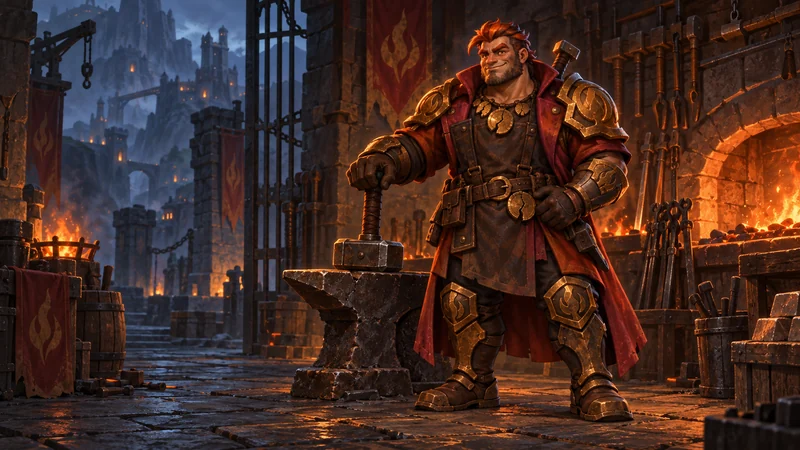 KaelFirst-generation championKael kept the foundry gates open when the city ordered its workers sealed inside.Read this biography → had asked them to recover anything with a name attached before the building was cleared. The list was incomplete. A plate marked MOTE did not identify a worker, and the red light behind it did not match a standard furnace indicator.
A mechanic warmed the room and the light brightened. No air was pumped through the throat. A small shape formed around the old copper disc: pointed ears, glowing eyes, a soot-dark face, and a tail that curled around the plate. The creature did not become the full round-bodied imp seen in later drawings at once.
The workers spoke the name slowly. Mote lifted his head. They did not declare the light proof of the creature's complete memory. They did not ask it to demonstrate its breath. One of them placed a warm brick nearby. The imp reached toward it and made the same little two-handed signal Lio had taught the crew to watch for.
KaelKaelFirst-generation championKael kept the foundry gates open when the city ordered its workers sealed inside.Read this biography → was not present when the cabinet opened, but he came to hear the report. He asked the crew to tell him exactly what they saw and what they could not know. He wrote both on the salvage page. He did not call Mote a weapon or a miracle.
Mote could not answer in words. He followed the warm brick when the crew carried it to a secure room. The bellows remained behind under guard because the iron plate seemed to be part of the tether. The workers left the name disc in place. A name given in care had become the only map the spirit had back to itself.
The ox who did not race
Mote's new room shared a wall with the Cinder Ward's equipment yard. During the first weeks, he tried to race every flame that passed the doorway. A lantern, a cookfire, a brazier: all became opponents. The workers kept a low hearth for him and asked him to use the small-breath signal before he pushed himself. He followed the rule most days.
Furnaceback Ox Furnaceback OxC16 · 5 energy · 3/7Its hide hardened into layered plates while hauling molten iron from flooded foundries.Read this folio → moved through the yard carrying material from the flooded works. Its broad plated body warmed slowly and stayed warm long after a fire had gone out. Mote challenged it the first time he saw the ox, blowing at a seam in its hide as if he could make the plates glow brighter than his own ribs. The ox continued at the same pace.
Mote followed the Ox instead. When the yard lamps dimmed, he walked beside its warm flank. He watched it carry tools and people without hurrying, and leaned against its side whenever his own coal cooled. The Ox never chased him away. Whether it understood the creature's earlier loss is unknown.
The connection is not a shared origin. The Ox did not make Mote, and the Imp was not hidden inside its armor. They came from different records and different harms. One was a foundry spirit held by a repaired bellows; the other carried its own history of heat and labor.
The Crow files him beside the Coalglass Lancer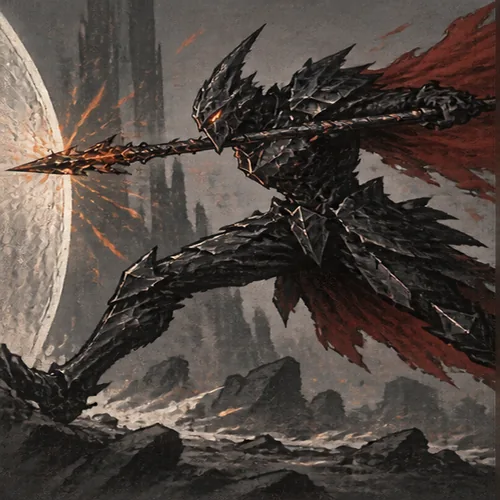 Coalglass LancerC13 · 3 energy · 3/4Forged from black glass beneath the foundry's mouth, it lowers its spear only when something claims to stand between the fire and people behind it.Read this folio → because both stories lead back to workers in the foundry complex and records nearly lost to closure. No surviving page proves Tovan Rill and Mote met, or that either recognized the other's name. Their connection is the worksite and the present search, not an invented friendship.
Mote's old habit remained. When the Ox stopped to let a worker climb down, the Imp blew softly at a dying coal. The flame rose just enough to light the next step. He watched the worker make it safely to the ground, then settled beside the Ox. No one offered a prize for the largest flame.
What the record cannot say
The Ledger Crow cannot establish how many years Mote spent inside the bellows. The old forge records were copied, lost, and partly misdated. It cannot establish whether Lio ever heard of the creature's reappearance. Her notebook continued into a new apprenticeship, but the later pages contain no mention of the salvage cabinet. No witness has produced a letter, a reunion, or a final conversation.
The Crow can establish the more fragile details. Mote had a small copper disc punched by Osa, and Lio kept a warm brick beside him. He enjoyed being near the people who returned to the forge. He could not distinguish a flame that needed more air from a flame that needed rest.
He was not born knowing how to sacrifice himself. He was born from a broken tool and taught by children who wanted a brighter flame. His friends eventually learned that his breath cost him.
The names in the foundry records are not all souls. Lio, Osa, Harn, the master, and the two rescued workers lived beyond the shutdown, each carrying a separate life. Mote's name appears beside them because they knew him and because one apprentice made sure the paper acknowledged him. The ledger does not transform their names into captives.
When the Crow filed Mote among the Unquenched, it did not mean he had joined an ancient order before his death. The name belongs to KaelKaelFirst-generation championKael kept the foundry gates open when the city ordered its workers sealed inside.Read this biography →'s present circle: people who preserve the lives erased by industrial reports and closures. Mote is one of those lives. The place he occupies in the circle is a welcome, not a claim of ownership.
The spirit in the card
In the present day, the bellows and its nameplate could not remain together safely. The old leather had begun to collapse, and each natural draft pulled the red light toward the iron throat. The Cinder Ward arranged a transfer with the Ledger Crow as witness. The marked plate, the surviving light, and the single imp-shape were brought to one table.
Mote's spirit moved into one actual Mournhand card. It did not divide into several copies, and the copper disc remained outside as a separate keepsake. The card preserved the little creature and the relation that held his name to his first breath. The bellows no longer answered when air moved through it.
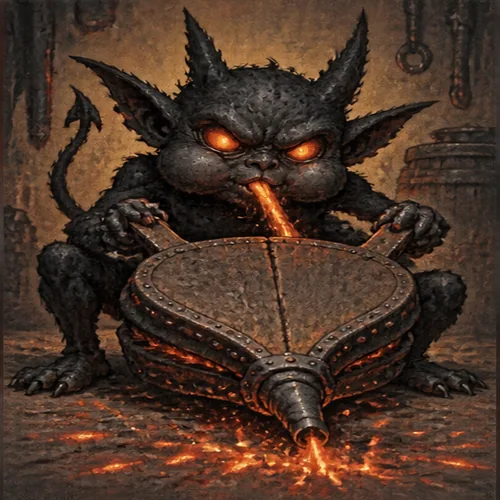
The card's image remembers a creature with coal-dark fur, large pointed ears, glowing orange eyes, small hands, and a thin curling tail. It shows him at the bellows, not as an anonymous demon or a human child in costume. The ordinary shape is cute because the people who loved him saw more than danger in the little flame.
When KaelKaelFirst-generation championKael kept the foundry gates open when the city ordered its workers sealed inside.Read this biography → tells the player to take the Bellows Imp, he says they will follow the red thread sewn through the page. That line places Mote in a present investigation, not in the cause of the original binding. The Imp's presence may help recover other records.
The Crow ends this folio with the name disc still outside the card. It is small, punched by hand, and smudged from years of carrying. Mote's spirit is trapped in card form in the mortal world; the copper name remains with the living people who remember him. One object holds a soul. The other keeps the witness who first called it by name.
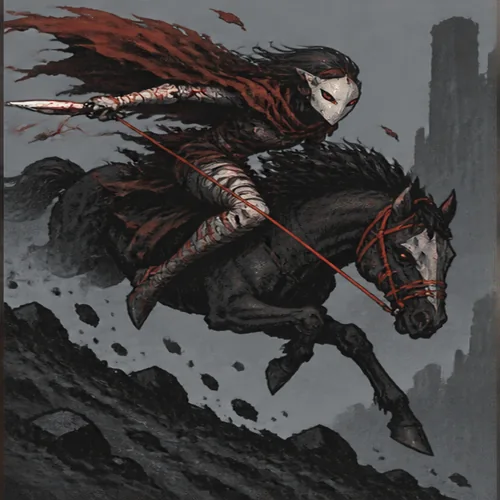 Red-Thread OutriderC15 · 2 energy · 2/2A red thread runs from her wrist to a home no map can find.Read this folio →