
The office after midnight
The Office of Last Notice stood behind the western bell tower, where paper dust collected in the mortar and every door opened inward to make room for stretchers. During the Gray Lung winter, clerks worked until their fingers bled. They wrote names, addresses, burial allotments, and the hour each household should hear the mourning bell. The work was not holy. It was municipal, repetitive, and necessary.
Senior clerk Abren Pell kept a stack of blank notices beneath his desk for families whose names arrived after the official count closed. He had learned that a deadline did not make a death unreal. When the city reduced staff, Abren folded the blanks into broad hands, shoulders, and a hooded head while waiting for ink to dry. He meant only to entertain his exhausted apprentice, Lio.
A drop of bell oil fell from Abren’s sleeve onto the folded chest. Ink from a hundred copied names bled through the desk blotter beneath it. The paper figure unfolded itself to full height, nearly filling the low room. Its body was layered funeral stock, creased into armor-like planes. A small brass bell hung at its sternum. The bell did not ring when the figure moved.
Lio screamed. Abren did not. He had spent too many nights informing people of impossible things to reject one merely because it stood before him. He placed a blank notice in the figure’s enormous hand and pointed to a tray across the office. The paper being carried it there. Then it returned and waited, black interior visible beneath its folded hood.
They called him Quietpaper because every step should have rustled, yet the room remained still. He was not made from the souls named on the blotter. Those people had lives and deaths of their own. The ink supplied contact, pattern, and urgency; a new spirit awakened in the folded body. Abren wrote that distinction first, afraid later officials would turn the golem into a container for convenient superstition.
Learning the route
Quietpaper learned the notice routes beside Lio. The apprentice carried a satchel; the golem carried sealed packets within the folds of his arms, protected from sleet. At each address Lio knocked, spoke the formal sentence, and offered the paper. Quietpaper watched the receiver’s hands. Some clutched the notice. Some let it fall. Some smoothed it carefully before asking the question no clerk could answer: were they alone at the end?
He began changing how he presented the envelopes. To the elderly he lowered one knee so no one had to crane upward. To children he held the paper flat on both palms, making clear it would not bite. At houses where violence waited behind the door, he stood between Lio and the threshold. The office had not instructed these gestures. They came from attention repeated until it became care.
His chest bell remained silent. Abren removed it once, tested the clapper, and found both sound. Reattached to Quietpaper, it refused to speak. The golem pressed one folded finger to the metal and then to a notice. Abren understood: the bell marked the duty to announce, while Quietpaper’s silence left room for the family’s own first sound.
At night he folded spoiled notices into neat packets. He never destroyed a legible name. Blotted practice sheets became little houses, boats, birds, and boxes. Lio asked whether this was play. Quietpaper set a paper boat in the wash basin and watched it circle until the ink softened. The next evening he made another. Repetition without assigned purpose became his favorite hobby.
On November fourth, a year after his first route, Abren declared his birthday. Scorpio suited his guarded loyalty, patience around secrets, and refusal to release a hidden truth merely because an official demanded it. Quietpaper accepted a black ribbon around his brass bell. Lio baked a cake the golem could not eat, then placed one sugar flower between two chest folds where it stayed all winter.
Names beyond the count
The city published a weekly death count beneath the bell schedule. Quietpaper noticed the totals did not match the routes. Dock laborers, prisoners, migrants, and residents of the flooded quarter disappeared from public numbers while notices still passed through Abren’s hands. The omission saved burial money and protected officials from blame. It also taught families that their grief did not qualify as civic fact.
Abren kept a second ledger in a cupboard. Quietpaper became its guardian. He could not read quickly at first, so Lio traced each letter across his palm. Names acquired shapes distinct from addresses and fees. Quietpaper learned to identify one deliberate absence among hundreds of correct entries. Once he knew a name, he could find the fold where its notice had rested months earlier.
When inspectors arrived, Quietpaper stood motionless among bundled stock. His pale folded bulk resembled an eccentric storage sculpture if no one looked too closely. The second ledger rested inside his back plates. Inspectors rang his chest bell as a joke. It made no sound. They called him broken office equipment and moved on. Quietpaper remembered the phrase and later folded it into a tiny coffin, which made Lio laugh until he cried.
Families began coming after hours to ask whether a missing person had entered the hidden ledger. Quietpaper could not offer certainty where none existed. He opened the correct drawer if a notice had arrived and left his hands empty if it had not. Empty hands could mean life, unreported death, flight, imprisonment, or clerical loss. He learned never to turn uncertainty into comfort simply because comfort was desired.
His connection to the names made him personal to hundreds without making him their vessel. He remembered a widow who corrected her husband’s middle initial three times, twins who insisted their mother’s notice be read once to each of them, and a fisherman who sat beside the silent bell until dawn. These memories belonged to Quietpaper because he witnessed them. The souls of the dead remained their own.
The bell contract
After the plague eased, Councilor Vey proposed replacing personal notice routes with one daily bell. The contract promised efficiency. In practice, the bell would ring only for deaths the council certified, allowing every omitted name to vanish without a clerk at the door. Abren objected during a public meeting. He was dismissed the next morning for mishandling paper supplies.
Lio inherited the office under supervision. Quietpaper remained because no inventory listed him as a worker. Together they continued late routes from Abren’s hidden ledger. Abren, now coughing badly, repaired the golem’s torn folds at home and taught him to paste fresh paper over damage without concealing the seam. A repair should show where care had occurred, Abren said. Quietpaper wore those pale patches proudly.
The new bell contractor installed a mechanism beneath the tower: counterweights, locking teeth, and a concealed alarm trap designed to crush anyone who opened the certification cabinet. The mechanism’s official purpose was preventing tampering. Its practical purpose was keeping clerks from comparing approved names with the full arrival register. Lio found its outline through flour dust on the floor but could not see how it armed.
Quietpaper approached the cabinet and felt his chest bell pull toward it. The trap carried the same alloy and maker’s mark. Though hidden, it produced tension through the metal as clearly as a shouted threat. Quietpaper’s folded body tightened. For the first time he understood a danger because it was armed, not because it had already struck.
He began accompanying Lio whenever the cabinet opened. The unseen mechanism made him stronger in a way neither could explain. His creases locked, his shoulders broadened, and he could lift a jammed counterweight that usually required three workers. Once the trap was disarmed, the added force vanished. The body remembered hidden danger and prepared specifically to attack through it.
The hound beneath the stairs
A small creature began sleeping beneath the tower stairs: Clapper Hound Clapper HoundC36 · 2 energy · 3/2It follows the echo after a bell stops, barking only at the silence left behind.Read this folio →, all bell-metal jaw, dark body, and restless listening. It chased the last echo after every funeral toll, then returned confused when the sound ended. Quietpaper offered it folded scraps scented with bell oil. The Hound shredded the first three, slept on the fourth, and eventually allowed the golem to scratch behind one metal ear.
They were not pieces of one creature. Quietpaper was a living paper person awakened in an office; the Hound had its own history and spirit. Their friendship grew from a shared bell that failed them in opposite ways. The Hound pursued sound beyond its ending. Quietpaper carried a bell that would not begin.
When Lio worked late, the Hound patrolled the stair and Quietpaper sorted notices. A single raised ear warned of inspectors before boots reached the landing. Quietpaper then hid the second ledger while the Hound pretended to be a stray. Their coordination saved names more than once, though Lio complained that both became smug afterward.
Mute Choirling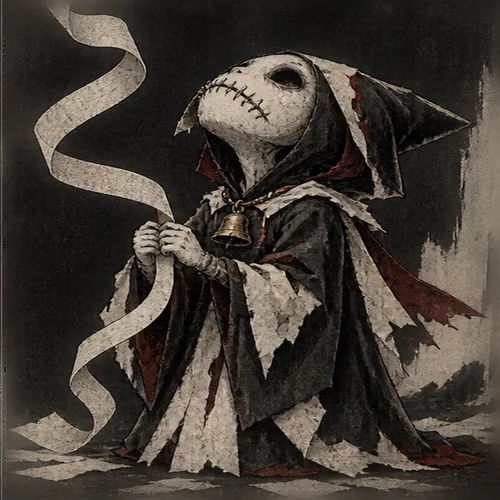 Mute ChoirlingC37 · 4 energy · 2/5Its tiny mouths sing only into injured cloth, sewing the sound shut.Read this folio → later joined funeral crossings near the tower. The small cloth figure sorted mourning ribbons by the songs trapped in their seams. Quietpaper offered packets of clean repair paper; the Choirling stitched one into a torn sleeve. Again, resemblance did not imply shared souls. The Things That Must Not Ring gathered lives shaped by silence, each silence caused differently and belonging to someone specific.
Odrik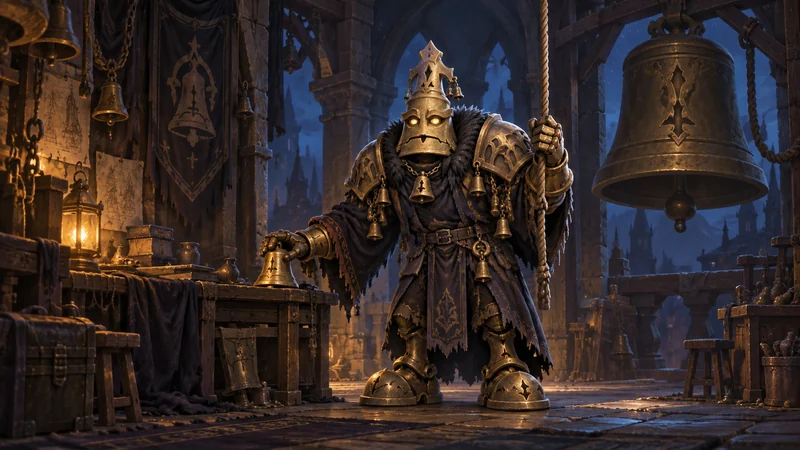 OdrikFirst-generation championOdrik rang the funeral bells until something began answering between their notes.Read this biography → passed through one procession and noticed all three. He did not create them, own them, or yet understand what the tower concealed. Quietpaper remembered that OdrikOdrikFirst-generation championOdrik rang the funeral bells until something began answering between their notes.Read this biography → listened before asking questions. Years later, card players would group them through faction and strategy, but the living relationships began with oil-scented scraps, repaired cloth, guarded stairs, and the relief of not explaining why a bell had failed.
Abren’s last route
Abren’s lungs never recovered from the plague office. When his own notice arrived, it contained no cause and misspelled his surname. Lio struck the desk hard enough to split a knuckle. Quietpaper carried the paper to Abren’s room and knelt. Abren corrected the spelling with a steady pen, then asked the golem to deliver the amended version personally after his death.
They spent that final evening folding packets. Abren admitted he had initially regarded Quietpaper as useful magic rather than a person. The shame had taken him years to name. Quietpaper touched the clerk’s forehead with one broad paper thumb, then placed the first tiny boat they had made together beside the bed. Forgiveness did not erase the admission; it gave both of them a way to hold it honestly.
Abren died before dawn. The certified bell did not ring because a dismissed clerk did not count as municipal service. Quietpaper delivered the notice to the office itself. Lio received it at the threshold, spoke the formal sentence, and then stepped aside so the golem could enter as mourner rather than courier. They read every omitted name from the second ledger before reading Abren’s.
The reading lasted six hours. Families gathered outside as word spread. Clapper HoundClapper HoundC36 · 2 energy · 3/2It follows the echo after a bell stops, barking only at the silence left behind.Read this folio → lay beneath the silent bell. Mute ChoirlingMute ChoirlingC37 · 4 energy · 2/5Its tiny mouths sing only into injured cloth, sewing the sound shut.Read this folio → stitched a black ribbon whose seam held the rhythm of Lio’s breaking voice. Quietpaper stood beside the ledger with his chest bell unmoving. His grief expressed itself through careful order: each notice aligned, each corrected name visible, no life hurried for the sake of ceremony.
Councilor Vey called the gathering unlawful. He ordered the hidden ledger surrendered and the tower cleared. Quietpaper folded Abren’s corrected notice into the deepest plate of his chest. It was not a soul jar or magical fuel. It was a document entrusted to him by a friend. The distinction mattered enough that he was willing to face the trap beneath the bell.
The armed cabinet
Vey’s officers arrived at dusk. Lio attempted to copy the ledger while families blocked the stair. The councilor climbed through the machinery room and armed the certification trap himself. A red tooth engaged beneath the cabinet. Quietpaper felt the matching brass in his chest pull tight. Every fold locked into the stronger geometry he had discovered before.
He attacked the cabinet, not the people around it. His enlarged paper fist drove through the outer panel and exposed the hidden gears. The trap remained armed, so the force in his body held. He tore away the false register and revealed bundles of unapproved notices packed behind it. Thousands of names spilled across the floor like pale leaves.
The officers hesitated. Vey did not. He pulled the emergency chain intended to drop the bell counterweight if saboteurs reached the mechanism. Clapper HoundClapper HoundC36 · 2 energy · 3/2It follows the echo after a bell stops, barking only at the silence left behind.Read this folio → barked at the silence before the chain moved. Lio dragged two children clear. Quietpaper placed himself beneath the falling beam so the families on the stair could escape.
Paper armor crumpled. The beam crushed his shoulders and drove the silent chest bell inward. Even pinned, he held the cabinet open while Lio removed the second ledger. The armed trap kept lending him one final measure of attack, because its mechanism still threatened everyone present. Quietpaper used that strength to wrench the red tooth from the gear train.
The main bell swung but produced no toll. Its clapper had been removed under the contract so only certified mechanical strikes could sound it. Quietpaper understood then that the city’s silence was not neglect. It was purchased, installed, and armed. He laid the red tooth beside Abren’s corrected notice inside his chest and pushed Lio toward the exit.
The collapse of paper
Once the trap was disarmed, the unnatural strength left Quietpaper. The counterweight beam settled fully. His folded arms tore at every crease. Lio tried to lift the timber, but soaked paper and iron had become one collapsed mass. Quietpaper used two remaining fingers to make the office sign for continue the route. Lio refused until the golem repeated it against his palm.
Families carried the notices outside. Rain began, threatening ink. Quietpaper opened his broad back plates as a canopy while the last packets passed beneath him. Water softened his edges. Each layer separated slowly enough for him to feel where it had served: a shoulder that sheltered Lio, a hand that carried Abren’s name, a chest that never rang.
Clapper HoundClapper HoundC36 · 2 energy · 3/2It follows the echo after a bell stops, barking only at the silence left behind.Read this folio → clawed at the beam and whined toward the missing echo. Mute ChoirlingMute ChoirlingC37 · 4 energy · 2/5Its tiny mouths sing only into injured cloth, sewing the sound shut.Read this folio → pressed both cloth hands against Quietpaper’s wrist. Neither could reverse the damage. Quietpaper tapped the Hound’s nose once, then touched the Choirling’s repaired sleeve. He did not confuse companionship with rescue. Being loved at the end did not guarantee escape from the end.
His last sight was Lio holding the full ledger beneath an oilskin sheet while citizens read names aloud in the rain. Quietpaper’s hood folded inward. No breath left him, because he had never breathed, but a distinct presence loosened from the ruined paper body. It moved toward the open night, carrying memories no notice had created.
Then the tower mechanism snapped back. The red trap tooth, Abren’s notice, chest bell, and wet layers formed a closed circuit around the departing spirit. The absent clapper supplied a silence shaped like a command. Instead of crossing beyond the mortal world, Quietpaper felt himself folded smaller and smaller around the names he had protected.
The binding of unrung names
No one intended the binding. Vey intended destruction and concealment, not an enduring soul. Lio intended to save the ledger. Abren had wanted one corrected notice delivered. Quietpaper chose to protect the route, not to remain trapped. The mechanism accidentally combined an armed trap’s identifying metal, a trusted personal document, a silent bell attached since birth, and thousands of names released from concealment.
The spirit lodged in the relation among those objects, not inside the dead people’s names. Quietpaper did not become a crowd of plague victims. He remained the one person who had learned them. The notices were witnesses to his duty, just as a road can witness a traveler without becoming the traveler’s body. This boundary protects every life in the story from being consumed into his design.
After the tower was opened to investigators, workers found no intact golem. Paper pulp covered the floor. The brass chest bell sat upright despite having been crushed flat hours earlier. It still would not ring. When an inspector armed the remaining alarm to test it, wet paper rose around the bell in the outline of enormous shoulders. The shape struck the mechanism until it was disarmed, then collapsed.
Lio recognized Quietpaper’s response but could not reach him through it. He spent years cataloging every recovered notice and exposing the council contract. Vey was removed, though punishment never equaled the families’ loss. A new public memorial included every omitted name. Lio insisted the plaque also name Quietpaper as clerk, courier, archivist, mourner, and person.
At the memorial opening, the bell finally sounded through a restored clapper. Quietpaper’s small brass bell remained silent. The spirit did not depart. Public truth repaired a civic wrong but did not undo the accidental mortal binding. Lio understood that justice and release were separate needs. He promised to keep seeking both without pretending one had automatically accomplished the other.
Years in the notice room
Quietpaper remained near the archive as generations of clerks replaced one another. He appeared most clearly when someone armed a device to hide or destroy a record. Paper gathered into fists. Shelves groaned. Once the threat ended, he sank back into folded packets. He never attacked ordinary visitors, and an unarmed lie did not grant the same strength. The condition belonged to the mechanism of his death.
Lio grew old at the same desk where Abren had folded the first body. He left blank funeral stock beneath it each November fourth, along with a sugar flower sealed in wax. Sometimes the sheets folded themselves into a small boat by morning. Lio never claimed this proved peace. It proved recognition, which was smaller and still precious.
Clapper HoundClapper HoundC36 · 2 energy · 3/2It follows the echo after a bell stops, barking only at the silence left behind.Read this folio → continued to visit until its own path carried it elsewhere. Mute ChoirlingMute ChoirlingC37 · 4 energy · 2/5Its tiny mouths sing only into injured cloth, sewing the sound shut.Read this folio → left repaired ribbons beside the bell. Their later bindings remained separate tragedies. OdrikOdrikFirst-generation championOdrik rang the funeral bells until something began answering between their notes.Read this biography → returned and listened to the complete account before touching any artifact. Quietpaper’s faction connections grew through shared investigation and care, not because one master manufactured a themed set.
The archive developed rules around dangerous records. No concealment mechanism could be armed inside. No official could certify a number without publishing its source. Every correction remained visible. Clerks treated Quietpaper’s history as professional ethics rather than a ghost tale. The practices saved later names even when the golem did not manifest.
Lio’s final notice was accurate. Before dying, he wrote a letter addressed to Quietpaper: You were never the office’s paper. You were my coworker, guardian, teacher, and friend. The letter did not enter the binding. Archivists keep it unfolded beneath glass, because intimacy does not require turning every beloved object into magical machinery.
The card of the armed trap
The Ledger Crow eventually came for the spirit tether. He read the public memorial, hidden ledger, Abren’s corrected notice, Vey’s contract, and Lio’s letter. He separated evidence from essence. The names explained Quietpaper’s choices; they were not ingredients to be harvested. The whole trapped spirit centered on the silent chest bell and the red tooth that had once armed the cabinet.
The Crow folded the tether into one official card. This transfer prevented the decaying tower mechanism from tearing Quietpaper into repeated manifestations. It did not free him into an afterlife and did not scatter copies through every printed notice. One continuous self moved from a mortal trap into a stable mortal card, carrying memory, preference, grief, and unfinished hope.
At the table, Quietpaper costs three energy and appears as a two-attack, four-health creature. While he attacks, he gains one attack if the enemy has an armed trap. The condition belongs to the opposing side’s state, not necessarily the target creature. An armed enemy trap alerts his body to concealed machinery as surely as the brass tooth once did.
The bonus applies only while Quietpaper attacks. It is not permanent, does not make him stronger while defending, and disappears when the qualifying condition is absent. It does not reveal the trap’s identity or disarm it. Players know only what the current interface and rules allow; his strength reacts to danger without granting information his text does not promise.
His official image preserves the towering folded paper body, deep black hood, rough stitched seams, pointed layered shoulders, and small silent brass bell at the chest. Any card shown in examples must use Mournhand’s real card design. Any new life art must depict scenes from this history. An unrelated paper monster would lose Abren’s hands, Lio’s route, and the names that taught him attention.
Strategy under concealed danger
Quietpaper’s baseline two attack and four health make him a durable middle-cost creature. Against an enemy with an armed trap, he attacks with three before other modifiers. That extra point can turn an inefficient trade into a clean removal. Players should check the enemy trap state at the exact time of attack rather than treating the bonus as printed attack.
Because the trap may be concealed, Quietpaper’s effect must not expose its name. The game can apply a condition without disclosing private information. His attack does not consume, trigger, or disarm the trap unless some separate rule says so. He simply recognizes that the opposing field contains an armed threat and hits harder during his own attack.
Opponents can deny the bonus by avoiding armed traps, allowing a trap to resolve before Quietpaper attacks, or removing him through spells and combat. They may also exploit the fact that he returns to two attack on defense. A creature that is safe from his three-point attack may still trade differently when it attacks him later.
Quietpaper pairs naturally with pressure that makes enemy trap timing difficult. If an opponent keeps a trap armed for protection, he gains offense. If they trigger or remove it early, another attacker may find a safer path. This tension comes from visible rules and hidden identity boundaries, not from invented effects.
The concise mechanics catalog lists every current trap, spell, enchantment, champion attack, and power path with direct descriptions. Readers can use it to identify which effects arm, attach, remove, or interact with traps. Quietpaper’s folio adds the personal reason an armed threat changes him: his body remembers the machinery beneath the mourning bell.
The person beneath the folds
Quietpaper was not only solemn. He liked symmetrical shelves, disliked rain after learning what it did to his corners, and cheated at guessing games by reading reflections in Lio’s inkpot. He made excellent paper boats and terrible birds. He kept the first sugar flower until ants forced Abren to intervene. These details keep affection from flattening him into a monument.
His Scorpio birthday reflects loyalty, secrecy used to protect the vulnerable, emotional depth hidden beneath a guarded exterior, and a willingness to confront buried wrongdoing. The sign does not dictate his life or replace world lore. It is the ordinary Western zodiac attached to his real-calendar November fourth birthday, chosen to match traits already established.
His faction, Things That Must Not Ring, connects him to Clapper HoundClapper HoundC36 · 2 energy · 3/2It follows the echo after a bell stops, barking only at the silence left behind.Read this folio →, Mute ChoirlingMute ChoirlingC37 · 4 energy · 2/5Its tiny mouths sing only into injured cloth, sewing the sound shut.Read this folio →, OdrikOdrikFirst-generation championOdrik rang the funeral bells until something began answering between their notes.Read this biography →’s investigations, and other histories shaped by dangerous bells or imposed silence. The faction does not make those lives interchangeable. Crowpedia links should preview each named card character’s page, art, and short identity so readers can follow relationships like a living archive.
Merchandise can honor the specific person: a quiet brass-bell pendant that does not jingle, foldable notice-paper stationery, a figure with visible repaired seams, sugar-flower birthday art, or the little paper boat beside Abren’s ledger. Products should grow from memories audiences can care about instead of treating his silhouette as disposable decoration.
His spirit remains trapped in the mortal world. Every accurate account resists the original crime of omission by naming what happened and who he was before it. Yet the archive does not pretend remembrance equals release. Quietpaper still waits behind the card’s fold, enormous hands protecting a corrected notice, listening to the space where a bell should have spoken.
The route continues
In the restored Office of Last Notice, new clerks begin training by carrying one blank sheet along the old western route. They are told to notice door height, weather, language, mobility, fear, and the person receiving the message. Accuracy is not only spelling. It is delivering truth in a form another human being can survive receiving.
At the last stop stands the memorial bell. Beneath it, a carved figure holds a notice on open palms. The carving is smaller than Quietpaper and gets several folds wrong, but families leave paper boats at its feet. Archivists collect the boats before rain and store a representative few with dates and names supplied voluntarily.
Children sometimes ask why the chest bell never rang. The guide answers plainly: officials paid for silence, a trap enforced it, and Quietpaper was hurt stopping that machinery. The answer does not soften responsibility into a vague curse. It also explains that the golem’s own bell had always chosen quiet as room for grief, a different silence with different meaning.
If an enemy arms a trap across the table, the old red tooth seems to turn again. Quietpaper’s folded shoulders lock. His attack rises from two to three for that assault. There is no triumphant bell, only the slight pressure of paper preparing to cross a dangerous room. The rule is brief because the life behind it has already supplied the weight.
Then the route continues: name by name, door by door, correction beside error, witness beside grief. Quietpaper cannot eat the birthday cake or hear his own bell, but he remembers Lio laughing over a paper boat and Abren admitting the truth. Those memories are not flavor attached to a game piece. They are the existence the card carries, still waiting to be more than an omission.

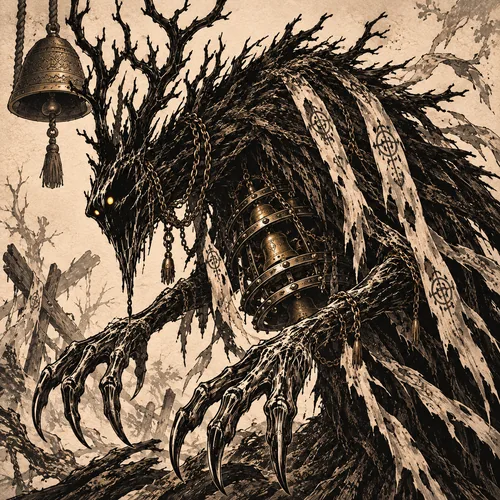 The Bell-EaterC08 · 4 energy · 3/5When the plague bells stopped, something beneath the cathedral began to starve.Read this folio →
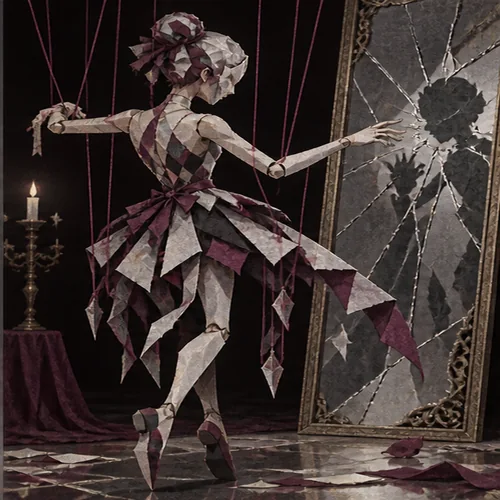 Facet MarionetteC34 · 3 energy · 2/4It learned to bow after every injury because its strings tighten when it survives.Read this folio →