The house below the weighhouse
Soren Marn was born on January 11 in the lower ward of Bellweather, where the river made the streets smell of iron after rain. His family lived in two rooms beneath a public weighhouse. The building's scales measured grain, coal, and timber before the city's tax collectors took their portion. Soren's mother, Edda, repaired sailcloth and work aprons at a bench beside the window. His father, Jorren, maintained the weighhouse shutters and complained whenever an official called a broken hinge an inconvenience instead of a danger. Their daughter Lysa was three years older than Soren and already better at asking why a rule existed before learning how to obey it. Their home was close enough to the river that they kept their shoes on a shelf above the floor during spring floods.
As a child Soren liked the quiet work that followed a storm. He collected loose nails from the lane, sorted them by length, and set each in a jar with a paper label. He repaired a torn kite with sail thread and was more pleased by the seam than by the wind that carried it. When Lysa borrowed his little ledger to write ferry times, he pretended to be furious and then copied the times into a second book for her. The books were not identical. His recorded which crossings ran late and why; hers recorded which passengers needed help carrying things. Their arguments often began with Soren saying a record should be exact and Lysa asking whether exactness helped anyone who was cold or hungry.
On his tenth birthday, Edda gave him a small brass thimble with one flattened side. It had belonged to her own mother, who had used it to mend coats worn thin at the elbows. Soren wore it on a cord under his shirt, though the ring was too large for his finger. He said it was for keeping needles from being lost. Lysa said it was plainly a charm against becoming boring. He kept it anyway. On January eleventh, years later, the Ledger Crow would assign him Capricorn, the conventional Earth sign, because he carried work to its end even when no one applauded. The sign explained a habit, not a destiny: Soren's patience had to be learned, and it sometimes hardened into a belief that endurance was always the proper answer.
Lysa keeps the ferry
Lysa grew into the kind of person who could hold a ferry rope in sleet and still notice that an old passenger had left a basket behind. She worked the crossings with their father, later taking the long shifts when Jorren's hands began to ache. Soren apprenticed with a clothwright who supplied banners, canopy covers, and ceremonial garments to the civic houses. The work seemed separate until the city started ordering more cloth than the ward could afford to replace. Soren learned to sew wide hems and reinforce hanging loops, but he also learned the language of delivery slips: urgent, provisional, to be reconciled, payment withheld. Each phrase could make a person's labor disappear without technically denying it had happened.
The siblings met after work at the landing where the ferry rope was tied. Lysa brought bread with onion baked into it. Soren brought the ledger he had been updating. She asked what he had noticed; he asked what she had seen. She remembered people, bags, and promises made in a hurry. He remembered weights, dates, and which clerk signed a receipt. In the first years, that difference made them an excellent pair. When a flood damaged the eastern landing, Lysa listed the families who could not reach the market, while Soren found the missing timber order in a stack marked completed. Together they got a plank bridge built before the officials could decide whether the repair belonged in the river budget or the street budget.
But there were days when Soren's accuracy made his sister feel cross-examined. At a public hearing about a ferry fee, he corrected her account of how many crossings had been canceled. The total was wrong by two. It did not change the fact that a family had been stranded overnight, but Soren insisted the number mattered because opponents would use any error to dismiss the entire complaint. Lysa heard a different message: that her memory was less valuable than his arithmetic. She walked home alone. Soren spent the evening proving the total and never asked whether he had embarrassed her. Their affection remained real, but affection did not automatically repair the places where pride had torn it.
The seam that held
Soren became known for a stitch that stayed firm under strain without cutting the cloth beside it. His employer taught him the technique, but Soren refined it while repairing river awnings. A seam made too tight could hold on a calm day and split suddenly when a gust pulled at the fabric. He learned to leave a little give, to distribute tension across several points, and to inspect the old weave before trusting a new thread. When people praised his hands, he said he had merely learned where not to pull. He did not yet understand how often he would need that lesson outside a workshop.
The city ordered a great canopy for the annual oath ceremony, a roof of dark green cloth edged in gold. Soren was assigned the upper seams and the reinforced corners that would bear the weight of ceremonial banners. The piece was large enough that no one person could lay it out alone. Lysa came after her ferry shift and helped carry the folded cloth through the hall. She recognized the new crown stitched at the center: a design commissioned by the regent's office to represent seven districts under one lawful seal. The crown was only an emblem at first, embroidered thread, but the ceremony made it a promise. Officials said every district would receive flood gates, safer roads, and fair measures at the weighhouse.
Soren did not trust a promise because it was embroidered beautifully. He wrote down the wording, the named witnesses, and the date when each district's work was meant to begin. Lysa asked him to keep a copy where ordinary people could see it. He thought the archive would be enough; she said an archive could be made difficult to enter, while a public notice could be read on the walk home. They argued over the best place for a duplicate. At last Soren copied the promise into his small ledger and gave Lysa a second sheet to pin at the ferry landing. It was their first joint record of what a ruler had said, though neither yet knew how many repairs would be demanded when the words failed.
Seven crowns in the workroom
Years of deferred work changed the ceremony cloth. The city did not abandon the districts all at once. It delayed one floodgate until after harvest, reassigned a road crew to the palace, reduced a grain measure by a little, then described each decision as temporary. When a district protested, its representative was told the ruler had already given the matter careful attention. Soren began seeing the same phrase in orders that canceled the work. He kept copies, not because he believed paper could stop a decision, but because he could not bear the way people were made to doubt what they had heard.
The seven crown emblems came back to his workroom in separate years, each attached to a different damaged ceremonial mantle. One crown belonged to a ruler who had promised river walls and used the stone elsewhere. Another marked a contract to protect the ferry districts, canceled after the tax was collected. Others signified public measures, winter stores, and hearings that never took place. They did not all belong to one monarch or one conspiracy. Some were inherited symbols, recut and resewn by different courts. Soren kept every damaged piece in its own envelope with its date and district. The fragments were metal, enamel, and thread, not people. There were seven failed promises, but no seven spirits joined inside the cloth.
Lysa wanted the envelopes carried to the people named in the original agreements. Soren believed that a chain of custody mattered. He feared a careless hand would let a court claim the evidence had been altered, so he asked her to wait until he had made certified copies. She reminded him that the people were already waiting for repairs, not a perfect file. He answered too sharply. She left the room, and he sat among the seven envelopes feeling righteous and lonely. Their estrangement was never a hatred. It was the quiet injury of two people trying to protect the same neighbors by different means. For several months they passed one another at the landing without stopping for bread.
A ledger for ordinary names
A new archive clerk named Maelin taught Soren that preserving a record did not require preserving every original object. Maelin had spent a winter cataloging unclaimed tools after a warehouse fire. She understood how quickly a damaged thing could be used as an excuse to discard the history attached to it. She showed Soren how to make a rubbing of each crown fragment, how to write the name of the person who had delivered it, and how to note uncertainty instead of filling a blank with a guess. Soren began adding the affected families to the margins, but he did not turn them into evidence alone. He wrote what repairs they had requested, what had been promised, and whether the repair had ever arrived.
The ledger grew heavy with small details. It recorded a baker who had moved her oven to higher ground three times, a ferryman who had borrowed a neighbor's boots to carry a child across a flooded lane, and a widow who repaired her own roof with strips cut from a ceremonial awning. Soren asked permission before writing a person's full name. Some wanted to be listed; others preferred a district or household mark. This became a rule he kept better than any court procedure: a record should make a person easier to find when they needed help, not easier for an official to punish. The rule grew from listening, and it was Lysa who had first taught him how much a name could cost.
One evening Lysa returned to the workroom. She had brought a meal and a ferry schedule showing how the delays had affected the western villages. Soren apologized for treating her memory as an unreliable witness. He did not say the figures no longer mattered; he said he should have asked what she needed the figures to do. Lysa admitted she had been so angry with the court that she had started speaking as if all clerks were its servants. They agreed that he would keep exact copies and she would keep a living list of people willing to be named. It was not a dramatic reconciliation. They ate a cold supper, shared the remaining bread, and went back to work with a better division of labor.
The weighhouse court
The court assembled in the old weighhouse when the city needed a place large enough for petitioners from all seven districts. The main hall still had the old beam scale overhead, though its counterweights had been moved to a side chamber. A ceremonial crown hung above the bench, an empty object used to remind the court that authority belonged to the law rather than the person currently speaking. Soren was asked to repair the green canopy and prepare the seven crown fragments for display. He agreed only after Maelin wrote a receipt for each piece. The fragments were returned under seal, each in its own case, and the cases were placed along the wall where petitioners could point to the history they disputed.
Iona IonaFirst-generation championIona catalogs the promises every ruler abandoned.Read this biography → was not yet part of Soren's life, and he never met her. Long after his death, her campaign hearing would bring forward testimony from The Hollow Regent
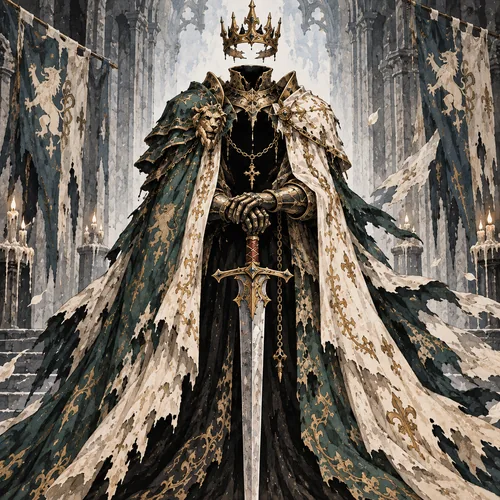 The Hollow RegentC12 · 6 energy · 5/7The crown was buried with an empty suit of armor, yet the taxes continued to arrive.Read this folio → alongside other accounts of what a crown could owe. Her role belonged to another generation and another inquiry. The later story's pairing of Crownsuture Giant with The Hollow RegentThe Hollow RegentC12 · 6 energy · 5/7The crown was buried with an empty suit of armor, yet the taxes continued to arrive.Read this folio → reflects the court's questions, not a shared origin. Soren was not Oren Vale, the person whose spirit became The Hollow RegentThe Hollow RegentC12 · 6 energy · 5/7The crown was buried with an empty suit of armor, yet the taxes continued to arrive.Read this folio →. He had no connection to Oren's binding rite and did not inhabit that empty armor. His own life had its own records, relationships, death, and trapped thread.
At the weighhouse, petitioners asked for the work they had been promised. The court's clerk answered in polished phrases: the district had been heard, the record was under review, the crown had already allocated all available stores. Lysa stood beside the ferry families and said what the delays had cost in practical terms. Soren placed the original oath beside his copies and named the signatures that confirmed it. He had learned not to turn a person into a number, but the court wanted figures it could reject. When a clerk accused Lysa of exaggerating, Soren read the crossings from her schedule and added his own receipts. His voice shook, but he kept reading until every family had been entered in the public transcript.
The door he should have opened
The court's decision did not settle the petitions. A group of officials tried to move the original ledger and seven crown cases into the locked archive before the people in the hall could compare the result with their own copies. The old continuity seal on the archive door was meant to ensure that a record remained the same through copying and transfer. Its paired teeth locked the door whenever the register was closed and the keeper had not signed the exit line. Soren knew the mechanism from years of repairing its cloth guards. He had once called it a safeguard against theft. Now the mechanism was being used to make a public record unreachable while a hearing was still underway.
Lysa asked him to open the door and bring the ledger out. Soren hesitated because the seal was an official custody device, and breaking it could let the court declare every record invalid. For one terrible minute, his fear of losing the evidence outweighed his sister's warning about the people being left outside. She looked at him with the disappointment he remembered from the ferry hearing, and he saw that the old mistake had returned wearing better language. He used his repair hook to lift the outer catch. The door opened. Petitioners entered with Maelin, and the families began checking the transcript against their receipts. For once, a rule could not hide behind the appearance of care.
The court's officers did not attack the crowd; the danger came from the failing building and the device they had forced. One of the seven crown cases caught the continuity seal's return line. The mechanism tightened. Soren recognized the sound from the workroom: tension pulling on a seam that had no give. He shouted for everyone to move away from the hinge and pulled the heavy door open with his shoulder. Lysa helped guide the families toward the outer steps. Maelin carried the ledger. The seven crown fragments remained behind, their separate cases snagged against the same line. Soren could have escaped then, but the door would have swung shut across the last people still inside. He braced it with his body and shouted for Lysa to keep going.
The last day of Soren Marn
The weighhouse beam cracked above the archive passage. Years of neglected repairs had left the upper lintel split, and the jammed continuity mechanism pulled the door against its own failing frame. Soren heard the hinge pins begin to shear. He could see Lysa at the stairs, one hand raised to count the last petitioners through. Maelin held the ledger against her chest. People were still crossing the threshold. Soren did not make a grand declaration about law. He shouted their names as they passed, checking each one against the list Lysa had given him. The little brass thimble on his cord struck the door once, a bright ordinary sound under the groan of the beam.
The door could not be held by one person for long. Soren wedged the repair hook between the floor ring and the lower panel, then wrapped the old ceremonial canopy around the jammed gear so the seven crown cases would not pull loose and fall on the crowd. His seam held for several breaths. The cloth spread the strain across its worn edges, just as he had taught apprentices to do. Lysa returned when she saw the lintel sag. He told her to take Maelin and the ledger outside. She refused to leave him. He said he knew, and that was why he needed her to do it. Their last argument was not about who had been right at the hearing. It was two siblings trying to keep the other alive while a room came apart.
Lysa got the final petitioner down the steps. The beam fell as Soren released the door and turned toward the archive cases. It struck the stone frame, collapsed the canopy, and crushed him beneath the hinge-side wall. He died before anyone could lift the masonry. The seven crown fragments were scattered, but none had become a soul. Soren's own spirit remained caught where the continuity seal had closed around the thread of the cloth he had used as a brace. The seal preserved the relation between an object, its record, and the keeper responsible for it. Because Soren had been named as the last keeper, the mechanism retained his presence with the seven damaged emblems and the cloth that joined their cases. The cause was institutional and mechanical, not a choice he made to remain dead.
The years without a body
At first Soren's spirit could only feel the weighhouse as pressure. It knew when the river rose because the lower stones turned cold. It knew when someone opened the public ledger because a line of pale tension moved through the archive seal. It could not walk to the ferry or touch the thimble that Lysa had taken from the ruin. It had no full body, only a sense of where the door should have been and the stubborn impression that people were still waiting to finish a sentence. The continuity mechanism had been designed to keep records from being altered. It did not understand the difference between preserving Soren's responsibility and imprisoning the person who had carried it.
Lysa returned for years. She brought the ledger copies, each more worn than the last, and read the petitioners' names aloud near the broken archive. The spirit did not answer in a voice. Sometimes a loose strip of green canopy lifted when she reached a name Soren had written himself. Sometimes nothing moved. Lysa refused to call the small movements proof that her brother was whole. She spoke to him anyway, telling him about the ferry, the repairs, the people who had moved away, and the children who now crossed the river without knowing who had demanded a safer landing. She told him when she was angry, including when she was angry at him for having stayed behind.
The court restored several repairs but never delivered all seven promises. Some districts received flood walls; others were paid in grain; one village moved its landing to a safer bend. The crown fragments were never returned to a single hall. Maelin cataloged each separately and noted the weighhouse accident without claiming the spirit's identity had been proved. Soren's name remained in the record because Lysa insisted the keeper should be named alongside the people he had tried to protect. The spirit could not leave the mortal world, but its presence changed as the public record was opened. The seal loosened enough for it to recognize the world beyond the archive. It still could not cross the threshold. Its unfinished work was not an invitation to spend eternity as a witness, but the mechanism gave it no other choice.
The frame wakes
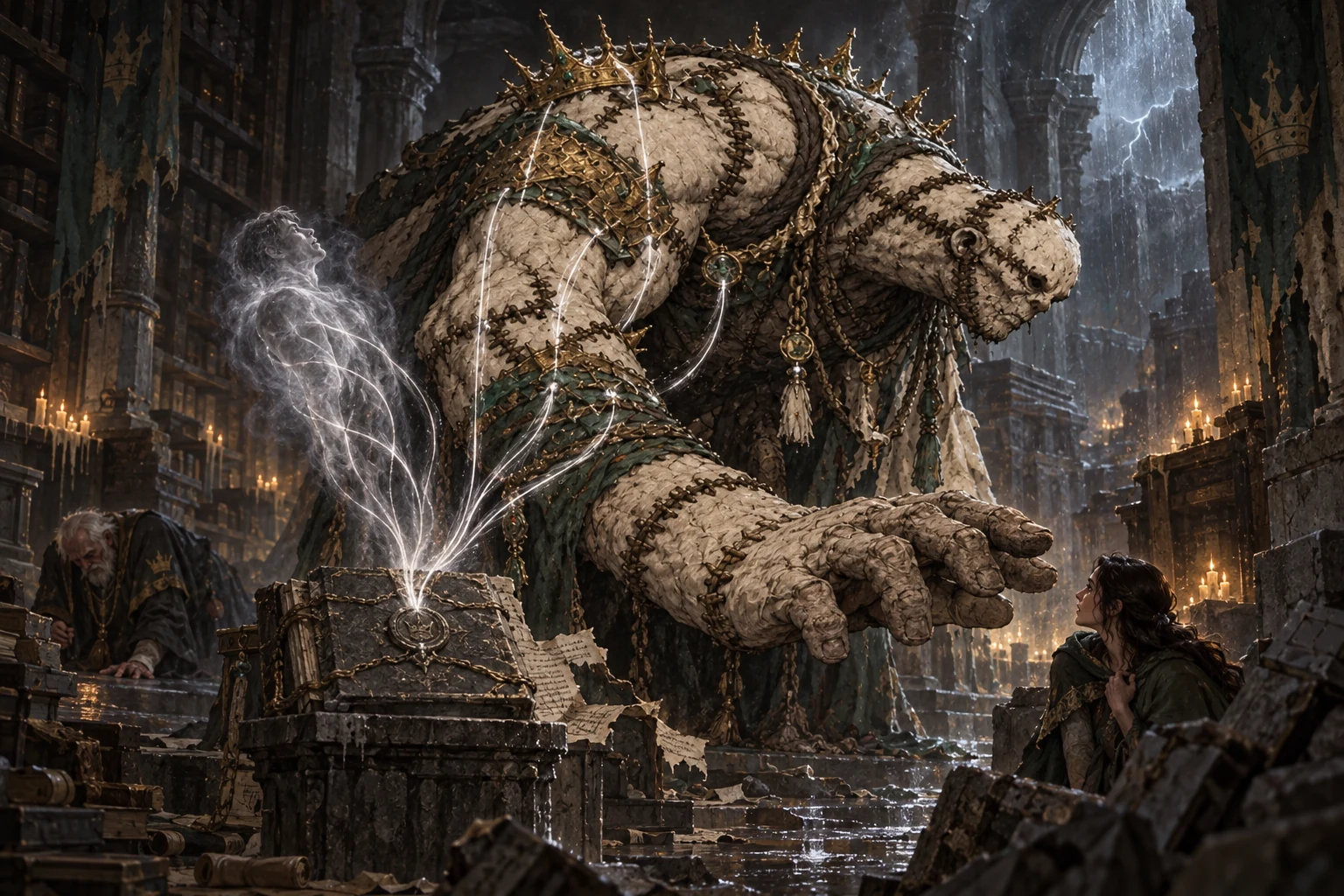
Generations later, a herald named Evar came to the old weighhouse carrying a bundle of abandoned ceremonial cloth. Evar was not Soren's maker, owner, or ancient companion. The herald had been asked to recover the district records before the building was dismantled. A loose crown fragment caught on the thread that still ran through the continuity seal. The other fragments answered with a low pull, not because seven spirits had gathered, but because Soren's trapped presence was the common keeper recorded on the old inventory. The cloth rose around the metal pieces. A broad frame took shape, tall enough to stand above the broken door, with hands made for lifting timber and seams that crossed its shoulders like the stitches Soren had once used to spread a load.
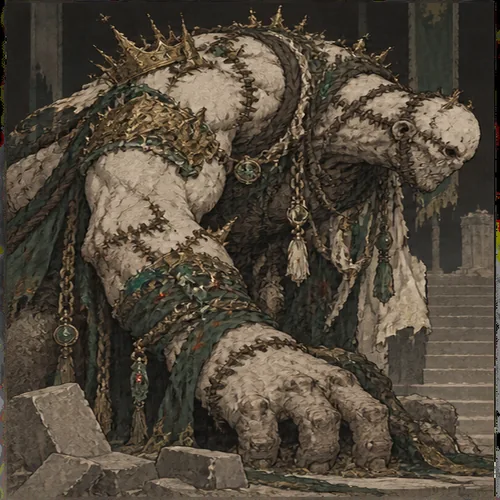
The shape was not Soren's old body enlarged. It was the one image the archive could preserve: a repairer built from the materials he had kept together. The seven crown pieces rested across its back, separate and visible. The coarse cloth was layered in green and tarnished gold, and the seams remained rough because no one had finished the work. When the figure bent beneath the doorway, the whole frame shuddered. Evar reached toward it and felt a thread draw tight through their own living presence. Waking the giant had a cost: a portion of the herald's health would be spent to call it forward. The burden came from the old binding, not from Soren demanding payment.
Soren recognized Lysa's ledger in the bundle Evar carried. He could not speak her name clearly, but the giant's hand opened around the book instead of closing over it. Evar understood that the frame was not a guardian to command without question. They asked the spirit whether it wanted the record carried out. The giant leaned toward the open doorway. That movement was as close to consent as the tether allowed. Evar lifted the ledger, and the spirit placed one broad palm under the sagging lintel. Together they held the old door open long enough for the archivists to remove the cases. The Crow later called the shape Crownsuture Giant: a name for the stitched frame and the seven symbols it carried, not a claim that Soren was seven rulers or that he had become royalty.
What the ledger could not repair
The years after the weighhouse collapse did not become a neat sequence of justice. The public ledger was copied, argued over, and carried into hearings whose outcomes varied. One district received the floodwall Soren had documented; another learned that the promised wall would have diverted water into a poorer lane. Lysa objected when officials used her brother's records as if the numbers were the whole story. She insisted that the names in the margin mattered because each belonged to somebody whose day had been altered by the court's delay. The paper could show what had been said, but it could not make a flooded room dry or restore a winter of missed wages. Soren's trapped spirit felt the limit of its own work whenever the pages were handled with reverence and the people described by them were still waiting.
Maelin became a guardian of the archive and learned to leave disagreement visible in the catalog. If a family said the record was incomplete, she wrote that beside the official copy. If a clerk insisted that a promise had been fulfilled, she asked which repair and which household the clerk meant. This practice made the catalog slower and harder to summarize. It also made it more honest. The seven crown fragments remained separate in their cases, and Maelin refused to arrange them into a single display suggesting one villain or one easy explanation. Each had come from a different promise. The only thing they shared was that Soren had tried to keep them legible, and that his life had been caught in the mechanism used to seal their record.
Lysa returned each year on January eleventh, though she never called the date a festival. She brought the flattened brass thimble, now worn smooth from being carried in her pocket, and placed it on the ledge beside the archive door. She told Soren ordinary things: which ferry rope had snapped, which child had learned to swim, which neighbor had finally moved to higher ground. Some years she stayed only a minute. Other years she sat with Maelin and read the petitions all afternoon. She did not ask the spirit to answer. She knew how much of her brother had been taken by the seal and would not turn his silence into an obligation to comfort the living. When a strip of green cloth stirred, she let it be only a strip of cloth unless she had a reason to believe he had heard.
The Crow's later account calls Soren patient, but patience was not the same as endless self-sacrifice. He had been able to leave the door once the last petitioner reached the stairs. The building collapsed before he could step away. The story does not praise the error as destiny or imply that a good person must die to prove they care. Soren was frightened, tired, and convinced that if he released the door too soon the evidence and the people would be lost together. He made one last choice under pressure with incomplete time and no safe option. His love for Lysa and the petitioners was real; so was the city machinery that made his body the final brace. The giant's later size would make that burden visible without making it noble or fair.
The card that held the seam
Evar eventually offered Soren the official Crownsuture Giant card, printed in Mournhand's real design: a black field, gold and silver thorn filigree, teal astronomical lines, and the red skeletal-hand seal. It was flat printed art on thin card stock, not a blank parchment token. The card did not contain the souls of the rulers whose broken promises had left crown fragments behind. It held one spirit, Soren's, in the giant form already shaped by the archive. The card made that form available to the game while leaving the original continuity tether intact. No one called the binding a cure. Soren had not chosen to die, and the card could not undo the years the seal had kept him in the mortal world.
The giant's printed body carries a plain fact from the old life: to bring it into play in the ordinary way costs five energy and does not cost champion health. Its alternate Blood Bargain lets a player spend one energy and five of their champion's health instead of the ordinary energy cost. That is a choice at the moment of playing the card, not a payment each time the Giant moves or attacks. The bargain is unavailable when the champion has five or less health; armor cannot absorb the health payment. If an E attachment is bound to the loadout, the usual extra energy surcharge applies to the bargain. The card is a 4-attack, 6-health body. Its printed effect is a choice of cost, not a healing or damage effect.
When the card appears, Soren remembers the ferry landing, Lysa's schedule, the thimble against the door, and the moment he finally let a public record matter more than his fear of a damaged seal. Those memories do not return in perfect order. They arrive as separate weights: bread in a cold hand, a name read aloud, cloth pulled too tight, a door held open one breath longer. The seven crown shards remain visible on the frame, each still belonging to its own broken promise. The spirit has not become an empty throne's servant, nor has it joined the history of The Hollow RegentThe Hollow RegentC12 · 6 energy · 5/7The crown was buried with an empty suit of armor, yet the taxes continued to arrive.Read this folio →. It is Soren Marn, a single person whose life was made to hold too much and whose card records the cost without turning that cost into a virtue.
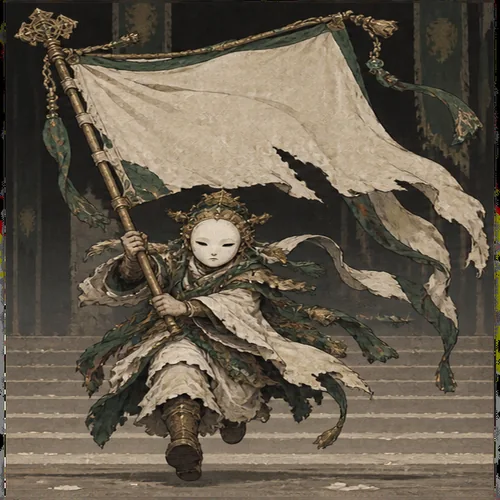 Procession PageC39 · 1 energy · 1/2The smallest herald carries a list of names too heavy for its paper arms, adding one final mark to debts already bleeding.Read this folio →
 Bannerless LionC40 · 3 energy · 3/4It guards no king because every banner it served was eventually burned.Read this folio →
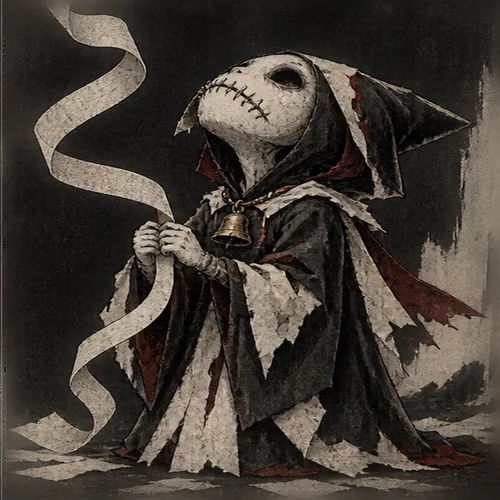 Mute ChoirlingC37 · 4 energy · 2/5Its tiny mouths sing only into injured cloth, sewing the sound shut.Read this folio →