The Thread Collector
4 energy · 3 attack / 5 health
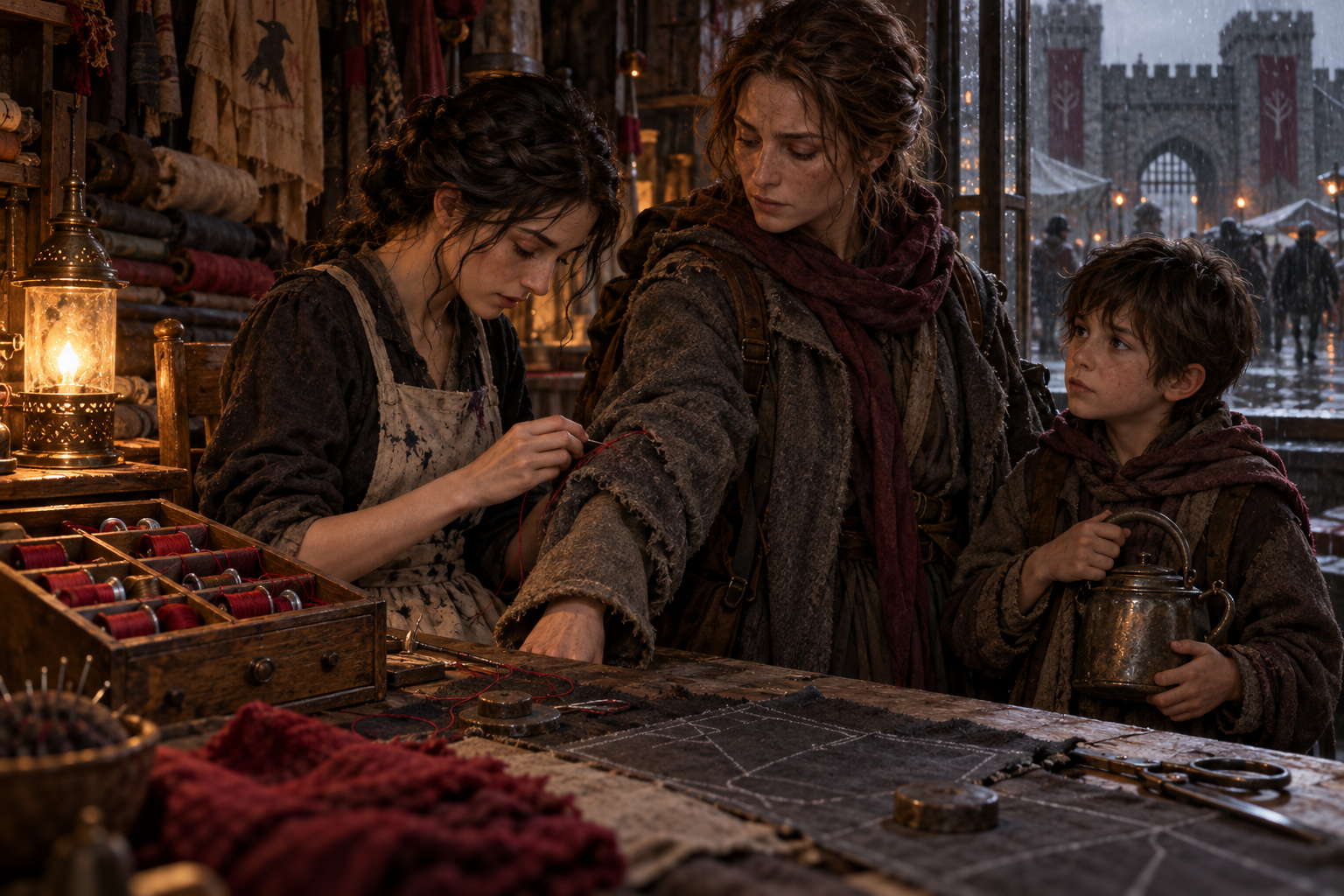
The Red Thread Between Departures
The assistant at the cutting table
Inis learned to sew by holding the other end of a thread. Her mother had been a tailor in the lower market, and when Inis was small, she sat on an overturned basket beside the cutting table while her mother worked. She was allowed to wind bobbins, sort buttons, and sweep the cloth dust into a tin. She was not allowed to touch the shears. When she was old enough to handle a needle, her mother gave her a scrap of linen and showed her how to make a seam that could be undone without tearing the fabric.
Inis’s mother died during a winter fever. Inis was nineteen. The shop did not close because the landlord still wanted rent, and the customers still needed coats before the river froze. Inis kept the shop open with a neighbor named Orla, who knew how to fit sleeves but not how to balance the order book. They took turns at the table and left a chair empty where Inis’s mother used to sit. The first months were mostly repairs. People brought garments to be patched because a new coat cost more than a family could spare.
Inis became a tailor’s assistant at a larger shop near the east gate. She was good at listening while she measured. A person’s shoulders tightened when a coat was too expensive; a child stood still when they were trying not to ask for extra cloth. Inis kept the fitting private. She did not turn a customer’s fear into a story to tell later. She learned which seams had to survive wet weather, which hems needed room for growing legs, and how to repair a sleeve so a worker could still bend an elbow.
She began keeping the loose ends of red thread left after she tailored their clothes. Red was easy to see against a dark sleeve and cheap enough to use for mending. Each household got a separate spool, wrapped with a narrow paper strip bearing the names the customers chose to give her. The spools stayed in a wooden drawer beneath her station. They were not a map, though Inis imagined that if the thread were long enough she could trace it all the way to a doorway in the next town.
Her employer, Master Rusk, told her the drawer was a waste of space. He wanted the scraps swept out with the lint. Inis asked to keep them after closing, when the cloth ends would otherwise be thrown away. She never charged the families for a spool. The small record made her feel less helpless when a coat left the shop and the person wearing it disappeared down a road she could not follow.
The thread names could not hold
The first spool belonged to the Derren family: Sella, her partner Jori, and their son Olan. Their room above the cooper’s yard had been condemned after the river wall cracked. The city promised another room, then withdrew the offer when the work crews ran late. Sella brought Inis a wool coat with a tear beneath the arm. She needed it repaired before the family left for the north road. Olan, who was nine, carried the household’s kettle in a sack and insisted he could carry more.
Inis did not ask Sella to promise she would write. She had heard too many people say “we will send word” as they hurried through an unsettled life. She asked what name to put on the spool. Sella said, “The Derrens. If we reach the mill town, that is enough.” Inis wrote it exactly, tied the thread around the paper, and tucked the spool in the drawer. Olan watched her knot it and asked if a thread could stretch from one town to another. Inis said a real thread would break. He asked about an imagined one. She said she did not know.
Families kept arriving. Nera, a seamstress who worked alone, brought three coats from the rooms near the south canal. She carried her Mourning Bobbin, which could hold a loose thread without asking where its owner had gone. Nera used it to mend one coat from the traveling families; Inis saved the red ends its repair left behind. A father named Beren hid his daughter’s letter in a pocket, while a grandmother stitched blue ribbon into a hem so a child could recognize her coat. Inis returned every scrap that had a clear owner.
She did not collect the scraps because she believed they could guide her to the travelers. She knew that was impossible. She kept them because the city’s records counted rooms, rents, and work permits, but did not record the way people chose to leave. A name in her drawer could not prove that a family arrived safely. It could remind her that they had once stood at her table and made a plan together. When the drawer filled, she moved the spools to a box lined with old pattern paper.
At night she opened the box and turned each spool until its paper label faced up. She imagined that every red end continued somewhere beyond the city. Sometimes she pictured a line crossing fields and bridges to a house with a lit window. Sometimes she pictured nothing at all. She did not mistake the image for evidence. Still, she found herself returning to the same question: had they reached the place they were going?
A new stitch in the old coat
One cold morning, a woman named Vara returned to the shop carrying a coat that had been patched at the elbow. The cloth was the same gray wool Inis had repaired the previous year. The new owner, Evi, was a young adult with a travel pack and a careful, tired expression. She said Vara had found the coat in a bundle left at a boarding house. It had belonged to Evi’s aunt, Sella Derren, who had died the previous spring after a long illness.
Evi did not know the shop’s name. She had found the old repair receipt sewn into the lining, where Inis had left it so Sella could remember the date of the work. Evi had followed the receipt back to the east gate because she hoped the tailor might remember her aunt. She wanted the coat fitted for her own shoulders before she moved west for work. She had not come to deliver a message from the road. She had come because the coat still smelled like Sella’s cedar chest, and wearing it made the next step feel less strange.
Inis asked whether Evi wanted the old seam unpicked or preserved. Evi asked what Sella had said when she ordered the repair. Inis recalled that Sella had wanted a stronger underarm seam for the long walk and a sleeve roomy enough for Olan to grow into. The memory surprised Evi. She had been too young to understand why the coat had been made so large. Inis explained that Olan carried the kettle and argued he could carry more. Evi laughed once, then covered her mouth. She had not heard that story in years.
The coat’s inner pocket still held a paper strip with the family name written in Inis’s hand. Evi asked if she could keep it. Inis said it belonged to the coat. Evi told her Olan had reached the mill town, grown up there, and learned the cooper’s trade. He had sent Evi to the city with a letter for Vara, but she had misplaced it during the journey. She remembered the message: he was alive, he was working, and he had kept the old kettle.
The facts did not turn the years into an easy path. Sella had been ill far from the city; Olan had been a child separated from his mother for part of the final winter; Evi carried grief that did not vanish because one detail could be confirmed. But a missing line in Inis’s imagination had become a real account. Olan had reached the town. He had a trade. He had kept a household object he once insisted on carrying himself.
Inis found the Derren spool in her box. Its red thread had faded and gathered lint. Evi touched the paper name with one finger and asked if she could take the thread with her. Inis said she could, but asked what she intended to do with it. Evi said she wanted to tie one end inside the coat and carry the rest to her brother. Inis offered a needle. Evi declined the needle and chose a simple knot. She did not need Inis to make the journey feel complete. She only wanted a small piece of its beginning.
The drawer becomes a road
After Evi left, Inis noticed how strongly she wanted another return. She imagined every family in the drawer arriving at a safe town, writing a letter, and sending it back through a chain of strangers until the story reached the shop. She knew that was not how life worked. Some had no time, some no address, and some no wish to return. A person could be safe and still never write. A person could write and still not be well. The thread could not tell her which was true.
She kept collecting scraps. That was part of her work and part of the habit she had made from it. A woman called Eda left with two sons after the river rents doubled. Their spool held enough red thread for one small patch. A glassblower, Fen, left alone and asked Inis not to put his surname on the label. She wrote only “Fen, east road,” because that was what he allowed. A family from the lower market asked her to discard their thread. She untied their label, wound the thread back onto the common spool, and did not keep their names.
The distinction mattered. Inis could remember a person without owning their story. She could hold a name temporarily and return it when asked. Master Rusk once found her box open and questioned why she kept a record with no practical purpose. Inis told him the spools helped her remember who had trusted the shop with a garment. He said a business could not afford to remember everyone. She agreed. She did not tell him that a shop which forgot everyone would not be worth keeping open.
Her own life narrowed around the box. She worked longer than she needed to, even after her hands began to cramp. She stopped taking the late meal with Orla because she wanted to finish another coat. A musician from the neighborhood asked her to join a Sunday walk along the river. Inis said next week. The musician waited one week, then asked again. Inis said after the winter orders. When winter passed, there was a spring fitting rush. She thought she was being kind by spending her time on work that mattered. She did not notice that care had become a reason to postpone every other part of being alive.
Orla saw the empty chair more clearly than Inis did. She began leaving half a loaf beside the spool box and sitting down without asking permission. Inis would sew while Orla told her about the market. The stories were ordinary: a cracked jar, a nephew who had taken up singing, a neighbor arguing with a goose. Inis listened and sometimes laughed. When Orla asked her to go for a walk, she still answered “later.” They did not stop being friends. The time they might have spent together kept thinning.
The caravan at the east gate
The caravan left after the first heavy rain of autumn. A foundry owner had closed several workshops and sold the land to a creditor. The workers were offered a few days to clear their rented rooms. Some had relatives beyond the northern hills. Others had only heard there might be employment at the roadworks. They assembled wagons near the east gate with blankets, tools, pots, and bundles tied in sheets. No one called it an evacuation. They called it leaving before the rent collector returned.
Inis spent the preceding week repairing coats. She knew Beren and his daughter Lysa; their hidden pocket held a folded letter from Lysa’s mother, who had left earlier to find a room. She knew Fen by the east road and had his permission to use only one name. She knew the Dask family’s little boy had outgrown his boots, but they could afford only a patch around the toes. She kept the red thread ends from each garment and wrote labels as carefully as she could before the shop grew crowded.
Orla asked Inis to come home after the caravan. There would be no more fittings that day. The rain had begun, and the gates would close. Inis said she needed to deliver two repaired coats and return a spool to Evi’s neighbor, who was traveling with the group. Orla offered to go with her. Inis told her the streets were full and the visit would be quick. Orla said she was not asking because it was convenient. Inis promised to be home before the lamps were lit.
The caravan began to move at dusk. Inis returned one spool to a woman named Mira, who was carrying her sister’s repaired coat. She put the other labeled spools into her bag. She had no plan to walk all the way north. She intended only to reach the first milepost, confirm that the caravan had taken the dry road, and return before night. She believed that seeing the line of wagons disappear around the bend would quiet the question that had kept her at the table.
Orla met her at the gate with an oilskin. She had brought a second lantern and said she would come as far as the waymarker. Inis protested that she could manage alone. Orla answered that this was not about whether Inis could manage. They walked behind the caravan, keeping to the edge of the road. Inis held the box against her ribs beneath the oilskin. The spools rattled softly with every step.
The mile beyond the last lamp
The caravan stopped before the marker to tighten straps and rest the animals. Mira came to Inis with the spool she had returned. She had not recognized the name on the paper until she read it at the gate. The thread belonged to her mother, who had died years earlier. Mira asked Inis how she had kept it. Inis said she saved the ends from the coat they had made for her mother. Mira asked whether she could take the spool. Inis gave it to her. Mira tucked it into the pocket beside her heart and said she would bring it back if she ever returned to the city.
Inis wanted to ask where Mira was going and how long she planned to stay. She stopped herself. The spool was Mira’s. The journey belonged to her. Inis had no right to make a person’s safe arrival the price of a thread. She watched Mira return to the wagon and tried to let the answer remain unknown.
Then rain began in earnest. It struck the hillside above the cut and pulled loose stones into the road. Orla called for everyone to move toward the marker’s shelter. Inis heard a crack, then saw one corner of the old stone canopy shift. She shouted for the people beneath it to get clear. The caravan moved. Someone dropped a basket. The stone roof collapsed across the track, blocking the way and throwing dust and rain into the air.
Inis pushed a child toward Orla and turned back for the box. She thought the spools would be crushed or scattered into the mud. She was still holding the box when a section of the old marker’s supporting wall gave way. The stones slid downhill. Orla grabbed Inis’s sleeve. The cloth tore at the shoulder. Inis fell with the box pressed against her chest, one arm around it so the labeled spools would not spill into the road.
The caravan crew lifted stones and carried the injured toward the first dry farmhouse. Orla was bruised and scraped, but alive. Inis had been struck beneath the collapsed edge. She was conscious for a little while. She asked whether the child had reached the wagons. Orla said yes. She asked if Mira had her spool. Orla said yes. Inis looked at the box and told Orla not to give the names to the guard. She did not want the families recorded as a single group if they had chosen different roads.
Orla held her hand. Inis tried to say something about the musician’s walk by the river. The words would not form in order. She had meant to go. She had meant to come back. She had meant to stop carrying each unfinished question as if the answer depended on her. Orla told her she could go now. Inis died before dawn, beside the road she had followed only to the milepost.
A spool without a destination
Orla knew Inis had died while trying to keep the travelers together, but the box could not tell her whether the families reached their destinations. She wrote to the north road crews, the mill towns, and the inns named on the caravan’s travel permit. A few replies came. The Dask family had found seasonal work. Fen had repaired a wheel for a farm and stayed there. Beren and Lysa had met Lysa’s mother in a town called Orrow. Other names received no answer. Orla added the replies to a separate envelope, never tying them to the spools without permission.
The first sign of Inis’s spirit appeared months later. A red thread ran out from beneath the box and stopped at the shop door. Orla wound it back onto the nearest spool. The next morning the thread stretched again, this time beneath a table where a traveler’s torn coat had been left for repair. It did not move by itself when Orla watched. It appeared after closing, when the shop was quiet and no one was expected to return.
The thread led to a spool labeled “Mira, east road.” Orla knew Mira had taken a spool belonging to her mother. She had not returned to the city, and no one could say whether she was safe. The box had never contained a spool for Mira’s household; Inis had given it away. The spirit seemed to be reaching for the journey that had left the drawer, the one name it could not hold anymore.
Orla asked the road crew for news. A letter came back from the first northern town. Mira’s caravan had split after the milepost. Her group had taken the west branch toward the farms, not the north road. The crew had not seen her again. No one knew whether she had reached her sister’s house. The report was not a loss notice, but it was not the answer Orla wanted.
The spirit of Inis formed beside the sewing table, visible as a thin figure threaded with red light. She did not speak. The loose ends in the box rose toward her hands and fell. She looked through each paper label as if she expected one of them to open into a road. Orla tried to tell her that some travelers had arrived, but Inis’s attention stayed fixed on the single absent spool. Her final memory had been the caravan moving beyond her reach and the box clutched against her ribs.
Inis was not waiting because she had failed to sew the right seam. She was held by a promise she had made to herself, not to the families: if she kept the thread, she would be able to know what happened. She had carried that promise past the last safe mile, beyond the point where she could help anyone. After death, she could not recognize that a person’s story continued without her. The missing answer became an unending task.
The names that came back
Years passed before Mira returned. She was older, with a limp from a wagon accident and a bundle of clothes for repair. She asked if Orla remembered Inis. Orla brought her to the back room and showed her the spool bearing her mother’s name. Mira said she had reached her sister’s farm, though the west road had been washed out and the caravan had scattered. She had sent a letter to the city but never learned whether it arrived. She had kept the spool until her mother’s coat wore through. Then she gave it to her niece, who had used the red thread to mend the lining of a winter cloak.
Mira had brought the cloak with her. It belonged to her niece, who was now living in the city and working in a print shop. A small red stitch crossed the inside seam. Mira said she wanted Orla to repair a tear without removing it. She did not ask to take the old spool. She asked whether they could put a new label beside it with her niece’s name. Orla said they could, if the girl agreed.
The niece, Ren, came the next day. She had heard that the tailor kept a spool from her grandmother’s coat and wanted to see it. Orla told her about Inis, about the way she had saved thread, and about the caravan. She did not tell the story as if Inis had followed them all the way home. Inis had died on the road. The thread had traveled through several hands. Ren listened and asked if she could add one sentence to the label: “Mira arrived at the farm.” Orla wrote it beneath the original names, preserving both accounts.
That night the red threads rose from the box again. This time they did not stretch toward the east gate. They moved in a loose circle around the spool, then settled across the new label. The thin spirit appeared. Orla read the sentence aloud. She added that Mira had returned to the city, that Ren wore the repaired coat, and that the family had chosen which part of the story to carry forward. Inis listened. The red lines drew close to her wrists, then slackened.
Orla did not claim this meant Inis was free. The spirit faded, but the following evening it returned to the drawer. It still searched for the names without a reply. Some people had arrived without sending word. Some had died. Some had changed their names. Some did not want to be found. The box could not settle those questions. Orla understood that she could not answer for them, and neither could Inis.
She placed the returned spool at the top of the box, not as proof that every road ended well, but as proof that a thread could travel beyond the person who first held it. Mira had brought it back by choice. Ren had added a name by choice. Inis had not made either decision. For the first time, the spirit’s hands opened without reaching for another strand.
The tailor at the crossing
The Ledger Crow visited after Orla described the red threads moving through the locked shop. He asked whether the box should be opened. Orla agreed, but only with the people whose names were legible and only if they could be contacted. Together they separated labels that could be kept, ones whose owners had asked for destruction, and those with no instruction. They destroyed none. The names stayed private.
As they read the replies, Orla named the travelers whose later lives were known: the Dask family had settled near the farms; Fen’s wheelwright shop had passed to his nephew; Beren and Lysa had found Lysa’s mother; Sella had died, and Olan had kept the kettle. For those without a reply, Orla said only that no letter had arrived. Inis’s spirit stopped reaching for the spools. She could not know every ending, and silence did not prove that someone had been lost.
The Crow asked whether Inis wanted to know every ending. Orla could not answer for her. She told Inis that she planned to close the shop and join her sister across the water; the box would stay private, and no one would be forced to produce an ending for the ledger. The Crow explained that the Mournhand card would let Inis answer a turn without making her responsible for tracking every traveler. Inis listened, looking from Mira’s returned spool to the names no one had answered.
The one thread she chose
The blank card lay beside the spools. Inis did not reach for it at first. Orla let the silence remain. She said the shop would close, the box would stay private, and the names would not be forced into a single ending. She said that she would visit her sister. She did not ask Inis to approve. The words were not meant to persuade the spirit; they were the truth of what the living would do.
The Crow offered the vessel again and explained that Inis could refuse. She could remain in the shop, or let the spirit fade without binding. No answer was owed to the tailor, the travelers, or the keeper of the ledger. Inis looked at the red thread around her wrists. It had once felt like a road that must be followed to the end. Now it was only thread: useful, fragile, and unable to decide where another person should go.
Inis selected one length from the common spool. She wound it once around the edge of the card and left the end loose. The card did not pull at the other labels. The red light entered slowly, following the strand she had chosen, then settled inside the paper. The rest of the threads stayed in the box. Orla kept the record of the binding separate from the household names, so the folio would remember Inis without claiming the lives she had cared about.
When the card was lifted, a single red thread remained on the table. Orla did not tie it to the box. She placed it in a small envelope marked “for mending.” It was not a promise to find anyone. It was material that could be used when a coat needed repair. Inis’s spirit had not lost its compassion; it had let go of the impossible task attached to it.
Orla closed the shop the next month. Master Rusk purchased the machines, and she gave the private box to the families who had asked to keep their records. The unclaimed labels went to a locked drawer at the cathedral, where they could be returned if someone came to ask. Orla crossed the river to live with her sister. She sent Mira a letter and received one back. She went on the walk along the water before winter.
Inis entered the Mournhand game as The Thread Collector. The Crow kept the loose red end tucked in the folio, not as a leash but as a reminder that one life may touch another without owning its destination. Her spirit no longer had to follow each spool beyond the gate. She could take part in a hand, make one careful choice, and let the next turn belong to someone else.
Draw, choose, and release
The Thread Collector costs 4 energy and enters as a 3/5 Fae. Its printed effect is: “Enter: draw a card then discard a card.” When it enters, draw one card from your deck if a card remains, then discard one card from your hand if you have one. The effect changes which cards you hold; it does not add a net card to your hand when both steps resolve.
Use the effect when your current hand contains a card that is less useful for the board you face than a fresh option might be. It can replace a situational answer that has no target, trade a high-cost card for a cheaper play, or let you look one card deeper for a tool you can use now. The decision is not always “discard the worst card.” A card that looks weak this turn may be essential later, so compare your hand with the opponent’s likely next action and the energy you will have available.
For example, you have 5 energy, a five-cost creature that cannot be played alongside anything else this turn, and a low-cost removal spell that already has a good target. You need a small body to keep pressure while removing that threat. Play The Thread Collector for 4 energy. Draw the top card, then discard the five-cost creature if the new card gives you a useful one-cost play. You can now spend the remaining energy on that play and use the removal spell only if its target still matters. The Collector’s 3/5 remains on the field; the draw-and-discard itself did not create an extra card in hand.
If your deck is empty, the draw produces no card, but the discard step is still requested when your hand contains a card. If your hand is empty after the draw, there is nothing to discard. The game caps the number of pending discards to the cards actually in hand. Plan for this when your deck is nearly exhausted: the effect may cost you a card without finding a replacement. Do not treat it as guaranteed card advantage or a way to choose the exact card you want from your deck.
At 4 energy, The Thread Collector competes with a direct-answer card and other midgame plays. Its body is substantial at 3/5, so you do not need to discard a good card merely because the effect is available. First ask whether improving your hand changes what you can do now. If the answer is no, preserve your options and spend energy elsewhere. Inis once held every loose end because she feared what she could not know. At the table, the better play is often to keep the card that still has a future and release only the one that no longer fits the hand.
 Mourning BobbinNera wound this bobbin with the final threads from a hundred funeral coats.
At the table
Printed effect: Enter: draw a card then discard a card.
Replace one card with a fresh option
On entry, draw 1 card, then discard 1 card from your hand. When both steps resolve, your hand does not gain a net card; the effect gives you a choice about which card to keep.
One move, shown
You have a card that is too expensive or too situational for the board, and the card you draw could open a useful play this turn.
Spend 4 energy to play The Thread Collector. Apply the printed effect exactly as written.
With 5 energy, a five-cost creature, and a one-cost play in hand, play The Thread Collector for 4. Draw one card, then discard the five-cost creature if the new card is useful now. Spend the last energy on the one-cost play. If your deck is empty, no replacement is drawn, but you still discard one card when your hand has one; with an empty hand after drawing, there is nothing to discard. The Collector remains a 3/5. Its effect is selection, not guaranteed card advantage.
The example explains a legal choice, not an additional card effect. Check the live game for current targeting and timing.
Chibi mode
This is the current game’s chibi rendering of The Thread Collector. The alternate art changes presentation, not the printed card rules.