Clockwork Rook
3 energy · 3 attack / 3 health
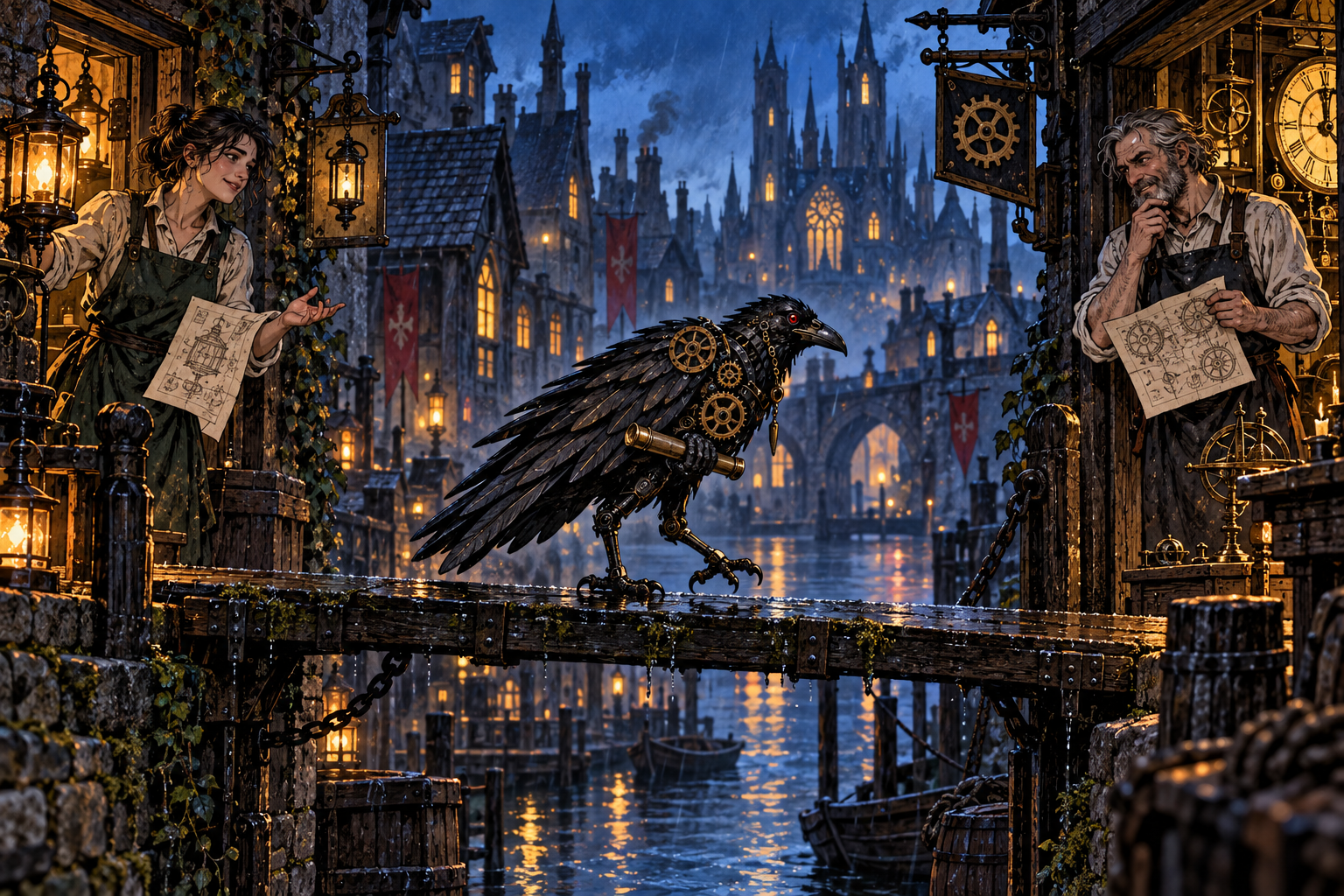
The Message That Crossed the Bell Tower
Two workshops, one narrow bridge
The rook was built on October 18, a date the two makers would later agree to call its birthday because that was the evening it first carried a message without dropping it. The day belonged to Libra in the almanac the workshops kept for choosing market dates: a sign said to notice balance, fairness, and the weight of two sides. Neither maker believed a chart could give a machine a heart. Both kept the date anyway. They had made the rook to cross a narrow bridge between their workshops, where their own arguments had become too heavy to carry by hand.
Mael Venn kept the eastern clock shop, a long room of brass filings and unfinished gears. Orla Senn worked across the bridge in a lampwright's shop that smelled of oil, hot glass, and wet wool. They had once shared a master and a bench. They had not shared a design in eleven years. Mael believed a mechanism should reveal how it worked. Orla believed a lamp should serve the person who used it, even when the design had to change. They still sent each other corrections, but only on paper and only through apprentices.
The rook's body came from pieces neither shop wanted to throw away: a black iron frame, a brass winding key, a pair of glass eyes, and a fan of thin metal feathers cut from a broken lantern shade. It could not fly. It walked on two articulated feet and folded its wings around a message tube. Mael built the gears; Orla shaped the beak and eyes. Each left a flaw the other could have corrected. They did not. The rook was supposed to be a neutral carrier, a small machine neither could claim as entirely their own.
The first message
The first letter was a set of measurements. Mael wrote that Orla's lamp hinge would fail under rain and drew a correction in the margin. Orla sent back a note saying his correction would trap heat against the glass. Their words were sharp enough to cut but accurate enough to help. The rook crossed the bridge, paused at the midpoint where the boards dipped, and delivered both pages dry. It returned with a small packet of lamp oil, because Orla had noticed the empty bottle on Mael's bench through the shop window.
Mael considered the oil an unsolicited repair. He set it on a shelf and wrote no reply. The rook tapped the shelf with its beak each time it passed, as though reminding him that the bottle had been placed there on purpose. After three days Mael sent an empty bottle back across the bridge, cleaned and fitted with a new stopper. Orla left it by the rook's return perch. Neither workshop called this an apology. The rook began to expect a reply even when no one had promised one.
The machine learned the bridge before it learned the shops. It found the board that rocked, the nail head that caught its left foot, and the dry strip beneath the west rail where a paper could be tucked during rain. It adjusted its pace to the load. A diagram traveled flat inside the tube; a folded note rode beneath the wing. When the bridge iced over, it waited by the warm vent at Mael's wall until Orla opened her door and scattered ash for traction. The rook never chose a side. It chose the next safe step.
A name written twice
A young apprentice named Ivo worked for Orla after leaving a crowded home where every tool had to be returned before anyone could finish using it. He liked the lamp shop because Orla let him ask why a piece was made that way. Mael's apprentice, Dena, had learned to ask the same question in a different form: what would happen if it failed? The two children met at the bridge whenever the rook carried a design. They began writing their names on the delivery slips, then corrected each other's spelling until both names fit on one line.
The rook's first name was simply Courier. Ivo disliked it. He said a name should belong to the one being spoken to, not to the job. Dena tried Ironwing, then Brassbeak, and rejected both because they sounded like parts on a shelf. At the end of the week, Ivo wrote “Rook” in the top corner of a note. Dena added “Clockwork” beneath it so Mael could tell which bird the note meant. The two names stayed together on the work ledger: Clockwork Rook, called Rook by the people who waited for it.
Mael said naming a machine made people careless about maintenance. Orla said refusing to name it would not keep its gears from wearing. The rook settled the argument by refusing to move until Dena finished tightening the winding key. It turned its glass eyes toward Mael, then toward Orla, then tapped the loose key with its beak. Mael repaired the pin. Orla added a drop of oil. The machine set off with the note and came back with a second name scratched onto its brass band. Neither maker remembered who had done it.
The library of small repairs
The shops shared no ledger, so the rook carried small records as well as plans. Orla tied a paper tag around its leg after replacing a glass feather. Mael wrote the gear size on the reverse. Ivo kept the tags in a biscuit tin, sorted by date and not by maker. Dena added a mark whenever the rook limped, stalled, or returned with the message tube wet. The tin became an account of a machine everyone had repaired but no one had made alone.
Once, a visiting merchant offered Mael money for the rook. He wanted a device that could carry contracts between warehouses without a runner. Mael said the machine had no price because it had never belonged to one person. Orla said it was not for sale because it had a route and people who depended on it. Later, each admitted to the rook that the answer had surprised them. Its work mattered, but neither wanted the work to turn it into property.
The rook's body began to change in ways the plans did not predict. Its right foot learned to lift higher over the bridge nail. A brass feather was bent outward to keep the message tube from catching. The glass eyes were set at slightly different angles so it could watch the boards and the door at once. No single repair explained the whole machine. Every fix remembered a hand and a particular day. When Ivo polished the frame, he left the scratches where the rook had stumbled. “Those tell it where it has been,” he said. The others let them remain.
When the shops stopped speaking
A contract dispute divided the bridge committee. The city planned to replace the old boards and charge both workshops for half the work. Mael thought the committee's measurements were wrong; Orla believed the bridge should be closed until it was safe. They argued through the rook for a week. Each message grew shorter. The last note Mael sent contained only a correction; the last reply from Orla contained only a time. The rook delivered both and returned without a packet.
It waited at the midpoint longer than usual. The bridge had started to sag near the western post, and a new split had opened beneath the railing. The rook tested each board with its foot, then turned back. It carried no words that evening. Ivo thought it had broken. Dena said it had made the correct choice. They walked to the bridge together and saw the split. They brought the repair list to the committee, where neither shopkeeper could dismiss a danger already mapped by the machine.
The bridge closed the next morning. The two workshops were still close enough to see one another, but the route between them was gone. Mael moved his bench toward the eastern window. Orla placed a chair near her western door. Neither called across. The rook remained on the sill, message tube empty, key wound, unable to cross. It could have been dismantled for parts or carried around the river by a person. No one chose for it. It stayed on the ledge where both doors could see it.
A second route
Ivo and Dena proposed using the old bell tower as a temporary passage. It had a covered stair that descended to the river landing and rose on the other bank. The tower was not safe for a crowd, but its service walk could carry one small machine at a time. The city refused to reopen it until the bellwright checked the supports. Mael wanted a full inspection before anyone entered. Orla wanted the city to send someone before the next rain washed out the landing.
The rook had carried notes for years, but it had never crossed the tower. Its legs were designed for flat boards, not steps. Mael made a third joint for its ankles; Orla wrapped the metal toes in thin strips cut from a worn leather glove. Dena fitted a small weight under the breastplate to keep the bird balanced on a stair. Ivo painted one mark on the first step and another on the landing, so the rook could see the path under lantern light. Each change responded to a different fear.
The first trial ended after four steps. The rook's right foot slipped, and it froze with its wings out. Ivo reached toward it, then stopped when Orla put a hand on his shoulder. They let the machine decide whether to continue. It backed down, turned around, and started again from the bottom. By dusk it had crossed once with no message. That was enough for Mael. He adjusted the ankle pin; Orla checked the leather grip. Nobody congratulated the rook as if it were a child. They left the lanterns lit for the next attempt.
A note neither would sign
The note that finally went through the tower was not a design correction. A flood warning had been issued for the river district, and the bridge committee had not yet delivered its notice to the houses below the west steps. Mael had written the warning after measuring the rising water against the tower foundation. Orla added a list of lamps that could be carried into the upper rooms. Neither wrote the other's name. Both put their signatures at the bottom, leaving space between them.
The rook started at first light. Dena followed as far as the tower door, carrying a lantern. Ivo waited at the west landing with a dry cloth. The stair shook where the upper bell support met the wall. The rook placed each foot on a marked board, paused at the cracked landing, and continued when the tower settled. It carried the warning to the first house, then returned to the tower because the list had more names than the tube could hold. On the second crossing, a child read the notice aloud while a parent packed blankets.
By noon, people had moved from the lower rooms. The water covered the path under the bridge, but the workshops stood dry. Mael and Orla met at the east stair with wet sleeves and no prepared speech. They compared the empty tube, the list of doors reached, and the names of two people who had not answered. The rook stood between them. Orla said they could have sent the note sooner. Mael said he had been waiting for the bridge to be declared safe. Neither statement erased the other. They began a new ledger with both observations on the same page.
The bell tower's keeper
After the flood, the bellwright discovered a crack in the tower's upper support. The bell had not rung in years, but its frame still held the service stairs together. Mael argued that the bell should be removed before it fell. Orla said the whole tower should be braced first. Their dispute was quieter now, but it was still a dispute. The rook carried a drawing between them and came back with a joint plan: reinforce the east column, lower the bell, and keep the service stair open only for people who knew the repair schedule.
The city hired both workshops to do the work. Mael made the brace, Orla made a set of portable lamps, and Ivo and Dena marked each safe step. The rook carried measurements, never heavy tools. It was assigned the least glamorous task: test the route at dawn and report any board that shifted overnight. The machine tapped each suspect plank with its beak and waited for the makers to inspect it. It had become a warning system by habit, not by decree.
For the first time, the shops kept a shared repair book. Mael wrote the gear sizes in narrow script; Orla added a drawing whenever a dimension could be misunderstood. Ivo listed who had checked the work. Dena noted what they still did not know. The rook's name appeared on the front cover beside the four people who had made and repaired it. It did not own the book, but each page depended on a route it had helped keep open.
The message about the makers
Years passed. Ivo became a lampwright in a neighboring ward, and Dena took over Mael's shop when his hands began to shake. Rook still crossed between the workshops, though its step had grown slower. It carried fewer urgent plans and more ordinary notes: a request for the blue glass, a reminder that a hinge needed oil, a recipe Orla wanted Mael to try. The makers had become friends again by practicing a form of care they could both tolerate: useful words, delivered on time, with room to disagree.
When Mael's sight worsened, Orla began writing larger labels on every shared part. Mael hated the labels until he noticed he could read them without asking. He sent the rook across with a new brass key, sized so he could wind the frame without straining his fingers. Orla returned the key in a cloth pouch that kept it warm against the cold shop. Rook carried the pouch to Mael and waited until he had opened it. Neither workshop called the exchange a gift. The ledgers recorded it as a repair.
Mael and Orla each began to fear that the other's death would reopen the silence. They were not young, and their hands were no longer steady. One evening, they asked Dena and Ivo to keep the shared repair book if either shop closed. They did not ask the rook to promise to continue. Orla said a route should survive without depending on one carrier. Mael nodded. The rook lowered its head as if listening and tapped the book cover twice, a rhythm no one had taught it.
The day the tower moved
A storm came late in the year, after a season of small tremors had weakened the riverbank. The bell tower shifted at its foundation. The first warning was a cloud of pale dust falling from the stair arch. Dena saw it from the east shop and sounded the hand bell. Ivo was visiting Orla and pulled her away from the west door. Mael reached the tower yard with the repair book under his coat. The service stair was still open, and the rook was inside with a sealed message tube.
The message was addressed to both workshops. It contained the final drawings for a shared lamp: a design that could be repaired with parts from either shop and a note asking the makers to show it to the younger apprentices. The rook had picked it up before the storm. No one knew the tower had begun to move until the bell frame groaned. Mael called for the rook to come down. Orla stood beyond the fallen gate, one hand over her mouth, the other holding the lantern that would have guided it.
Rook stepped onto the stair, then stopped where a new crack cut across the landing. The frame twisted. The upper bell dropped against its brace, and the tower shook hard enough to split the outer wall. The rook crossed the last boards, its tube held under one wing, and reached the far side. It delivered the sealed note to Mael and Orla just as the bridge of stone behind it gave way. The fall carried the rook down with the broken stair. The iron frame was crushed beneath a beam; the message tube stayed closed, pressed against its breast.
The unopened note
Mael and Orla survived because Dena and Ivo had pulled them back from the yard. They found the rook after the dust settled. Its glass eyes were intact but faced different directions. One foot had broken away. The brass key was bent, and the folded metal feathers covered the sealed tube. The makers lifted the beam together, though neither had the strength alone. They carried the machine to Orla's shop and laid it on the workbench where both could see.
The tube had not opened. Mael wanted to remove it carefully and read the plans before the ink faded. Orla asked whether Rook had completed the delivery. Mael said it had reached both of them. The note's seal had broken in the fall, so they could have opened it. They did not. They wanted to wait until Dena and Ivo were there, because the note had been meant for the apprentices too. The four of them sat around the table while the storm passed, keeping the tube beside the body without deciding what it meant.
By morning, the city had condemned the tower. The bridge approach was blocked by stone and river mud. The rook could not be repaired as a carrier; too much of its frame had been bent beyond use. Mael could replace every gear and Orla could remake every feather, but neither believed a copy would be Rook. They removed the key and stored it with the shared book. The iron body remained on the bench. The message stayed sealed until the apprentices returned from checking on the neighborhood.
A spirit in the iron frame
The spirit did not leave with the last vibration of the tower. It gathered in the frame around the unopened message. For years, the rook had carried words that neither maker could say face to face. It had been repaired by four pairs of hands, trusted by children, and allowed to stop when the road was unsafe. Its spirit did not remain because it wanted the tower back. It remained because the final message had reached its recipients but had not been opened by the people it named.
At night the iron feet shifted on the bench. The beak tapped the sealed tube. When a worker carried the shared ledger away, the machine turned toward the door and went still only when the book was returned. Mael heard the tapping from his room and thought the frame was cooling. Orla heard it too, but did not call the sound a haunting. Dena wrote the hour in the repair book. Ivo added that the message had been delivered, not lost. The distinction did not quiet the rook.
The workshops disagreed about whether opening the tube would free it. Mael worried that they were inventing a rule because grief made them impatient. Orla said they should not make the rook wait merely to preserve their uncertainty. Dena asked them to read the note exactly as addressed. Ivo reminded them it belonged to four people, not to the two who had built the frame. They agreed to gather at the table after the damaged district had a safe place to sleep. The rook's spirit settled whenever that promise was repeated and stirred whenever it was delayed.
What the note asked for
The storm displaced families from the low river rooms. Orla's shop became a lamp station; Mael's became a repair counter. Ivo and Dena organized the lists. The message tube stayed on the shared table, beside a lantern built from their unfinished design. They could have opened it during the first quiet hour, but there was no quiet hour. They kept choosing the work in front of them, and each time the rook's feet began to move, as if ready to carry a request no one had written.
Once the last family had moved above the flood line, the four returned to the table. Mael used the bent key to open the tube. Inside were the lamp plans and a short note in both makers' handwriting. It asked the apprentices to build the lamp together, repair it with parts from either shop, and teach anyone who needed light how to fix it. The note did not demand forgiveness or declare the old arguments settled. It described a way for the next generation to work without inheriting the silence.
Dena and Ivo read the note aloud. Orla corrected one measurement in the margin. Mael objected that the correction would make the lamp unstable. The apprentices tested it with a scrap frame and found that both were partly right. They adjusted the joint together. The rook's tapping slowed as the four people used the message instead of turning it into a verdict. The spirit had not been waiting for the perfect words. It had been waiting for the recipients to let the words change what they did next.
The Crow's ledger
The Ledger Crow arrived when the city marked the bell tower as unsafe and moved its surviving records into the public hall. It found Rook on the shared workbench, its iron frame cleaned but unrepaired. Orla showed the Crow the first delivery slip, with both names written on it. Mael showed the damaged key. Dena opened the common repair book to the page that recorded the rook's last crossing. Ivo placed the sealed tube beside the entry, now empty and open.
The Crow asked whether Rook had been a bird, a machine, or a promise between two workshops. Mael said it had been a carrier. Orla said a carrier could still have a life. Dena said it had chosen safe roads and taught them to stop treating disagreement as a reason to stop speaking. Ivo said the rook had carried care more often than anyone had admitted. The Crow recorded each answer without choosing one to erase the others.
In another folio, the Crow found Brass Owlet, a smaller mechanism from Ansel's separate clock shop. The Owlet and the Rook had never met, shared no maker, and belonged to different lives. The Crow kept their records distinct while placing them near each other in the archive: one soul carried messages between two rival workshops; the other marked the long hours Ansel's apprentices had worked. Their connection is the Crow's wider record of crafted souls, not a hidden encounter or a shared origin.
A way to carry it forward
Dena and Ivo finished the shared lamp in winter. Its joints could be opened with tools from either workshop. They made a simple repair sheet for the public hall, then tested it by asking a child from the river district to find the loose hinge. She found it, fixed it, and took the lamp home. The makers did not put the rook's name on the lamp. They wrote it in the repair book, where its routes and pauses could be remembered without turning its body into a product.
Mael kept the brass key in his apron pocket until his hands could no longer wind a clock. Orla kept the metal feather that had once bent around the message tube. They did not keep the broken body in a locked cabinet. The Crow's folio traveled between the public hall and both shops, and anyone could read how the rook learned the bridge. A copy of the route map went up beside the new lamps. The old tower remained closed, but the work it had carried did not end there.
The Clockwork Rook entered the game as a 3-energy, 3/3 Construct with Iron affinity. When it enters, its effect gives its champion 1 armor, up to the five-point cap. That protection is a small buffer for a later champion hit: useful but limited, not healing, not a shield for other creatures, and not a promise that danger disappears. Its printed effect is “Enter: gain 1 champion armor.” The Crow keeps its account near Brass Owlet's separate folio as two different crafted souls in the same archive.
The record becomes a card
The Crow did not rebuild the rook or ask the spirit to fly. It asked the four keepers what remained unfinished. Mael and Orla answered that the city still needed a safe way to share repairs after the tower's loss. Dena and Ivo brought the common ledger to the public hall, where the apprentices could copy it. The makers agreed that no one workshop would own the design, and the apprentices agreed to keep the instructions available to any household with a broken lamp.
The spirit's feet stopped tapping when the shared repair book was placed beside the open tube. The Crow offered a folio that could hold the Rook's name, its first crossing, its final delivery, and all the hands that kept its route possible. It did not bind the machine to a tower or make it serve another pair of rivals. The iron frame turned toward the common ledger. Its bent key touched the page. The Crow wrote the date, October 18, as the first birthday the makers had recorded, and left a small mark to show that it was the night of the first successful delivery, not a claim about the spirit's creation.
When the folio closed, the rook's shadow crossed the public hall floor. The Ledger Crow felt the weight settle into the page, not as a prisoner but as a message kept where it could be read. The workshops continued to disagree about lamps, gears, and the cost of repairs. They also kept a shared ledger and a route around the fallen tower. Rook had not made them identical. It had carried them far enough to meet at the same table.
At the table
Printed effect: Enter: gain 1 champion armor.
Add one armor before a champion hit
Clockwork Rook is a 3-energy 3/3 Construct with Iron affinity. When it enters, your champion gains 1 armor up to the five-point cap. Armor absorbs incoming champion damage before health; it does not heal, protect your creatures, or prevent an attack that already resolved.
One move, shown
Your champion has fewer than 5 armor, and playing the Rook develops a 3/3 while adding a small buffer before the opponent's next champion hit.
Spend 3 energy to play Clockwork Rook. Apply the printed effect exactly as written.
If your champion has 2 armor and 10 health, play Clockwork Rook before an incoming 4-damage champion attack. Armor rises to 3, then the attack consumes all 3 armor and deals 1 to health, leaving 9. The Rook remains a 3/3. If you already had 5 armor, the effect adds none; if the attack has already happened, the new armor cannot undo it. Its armor belongs to your champion, not the Rook or another creature.
The example explains a legal choice, not an additional card effect. Check the live game for current targeting and timing.
Chibi mode
This is the current game’s chibi rendering of Clockwork Rook. The alternate art changes presentation, not the printed card rules.