
A summer child in a winter trade
Sabeth was born on July 20, in weather too warm for the wax her family sold. Her father later claimed that half his candles had bent toward the cradle, eager to inspect the newcomer. Her mother said he had simply left them near the window again. Sabeth preferred the second explanation because it allowed her to tease him. She grew up above a small chandlery, with the smell of warm beeswax in the stairs and a younger brother, Joss, who considered every box a possible hiding place. Summer birthdays meant doors open to the yard and a meal outside, where nobody had to worry about wax dripping onto the tablecloth. In family drawings she was the round-faced child with brown skin, untidy dark curls, and a determined expression Joss exaggerated whenever she tried to correct his work.
She learned the trade by handling its small inconveniences. A wick could sit beautifully straight and still burn badly. A mold could look clean while hiding the flaw that spoiled its next cast. Her father taught her to judge a candle by what it did when someone needed light, not by how impressive it looked on a shelf. Sabeth took this lesson seriously in her work and less reliably in her dealings with people. She liked being competent. As a girl she corrected other children's games until they stopped inviting her to organize them, then complained to Joss that nobody appreciated a sensible plan.
Joss liked bees and open ground. Sabeth liked the workshop's controllable corners. Their arguments over the future began early and remained mostly affectionate. He wanted to visit the farms that supplied their wax; she wanted to improve the molds before anyone went anywhere. On her birthdays he made a point of giving her something that had no practical purpose: a striped stone, an absurd feather, a wooden animal carved with more enthusiasm than skill. She kept them all in a shallow drawer and denied that this contradicted her opinions about clutter. He learned to inspect the drawer before believing her complaints.
Her private delight was making miniature rooms. Wax stools, tiny pots, and impossibly small loaves accumulated in the spaces between paid work. She arranged them in old boxes, then rearranged them because a door should have enough space to open or a chair ought to face the light. When her mother asked who lived there, Sabeth invented residents with formidable preferences and very little patience. The miniature baker refused to share a wall with the miniature drummer. A tiny landlord kept losing his hat. These households were funny, difficult, and alive in her imagination long before she learned to make a likeness meant for somebody who was gone.
Faces people could afford
Her first memorial face was for a neighbor who could not pay a painter. The woman brought a description of her father and a broken likeness from a fair, embarrassed to ask for something so small. Sabeth made the first cast too solemn. The daughter looked at it and said her father had usually appeared as though he knew a joke he ought not repeat. Sabeth tried again. This time she left one corner of the mouth slightly uncertain. The daughter cried, then laughed, and Sabeth understood that careful work could matter in a way no row of perfect candles had taught her.
She began making inexpensive wax memorials for the table of names beside the chapel. Some families brought a sketch; some offered descriptions that contradicted one another. Sabeth learned to ask about habits rather than demand the correct shape of a nose. A child who stuck out one ear to listen, a grandmother whose mouth tightened before a compliment, a brother who never sat still long enough for a portrait: small details often did more than an ideal face. She marked what was remembered and what she had supplied. She would not tell a family that a pleasing invention was an exact recovery of the dead.
At first she charged too little, then became resentful when supplies ran short. Her mother made her calculate the cost properly. Compassion did not make wax appear from an empty pot. Sabeth established a range of prices, accepted practical exchanges, and left some commissions uncharged when she could afford it. She disliked how unromantic this sounded until the arrangement allowed her to keep helping through a difficult season. Joss brought wax from the farms after he took work there, along with stories of goats, weather, and farmers who considered city candles an elaborate misunderstanding of daylight.
She had other pleasures. She liked sharply spiced pickles, broad comic songs, and the little traveling shows that could make a whole courtyard laugh with a bad imitation of an important man. She could become so absorbed in a performance that she forgot a pot cooling at home. She was generous with her opinions about everybody else's work and touchy when a customer questioned hers. A friend once observed that Sabeth would rather remake an entire commission than admit she had misunderstood one sentence. She spent a week annoyed by the observation, then began writing the agreed details down before she heated the wax.
A workshop with room to disagree
Sabeth eventually took an apprentice named Fenna. The girl was clever, quick with small tools, and less impressed by her teacher's reputation than Sabeth expected. Fenna wanted to make jointed festival figures, not only candles and memorial faces. Sabeth praised the ambition and then assigned so much ordinary work that there was little time left for it. Fenna finally asked whether encouragement meant anything when it never changed the schedule. Sabeth answered badly. Joss, visiting with a delivery, waited until they were alone before remarking that she had built a miniature workshop where every chair faced her.
She apologized to Fenna and set aside regular time for the moving figures. They made a ridiculous little wax magistrate whose head bowed whenever its hand reached for a purse. Sabeth laughed so hard that a customer waiting outside began laughing without seeing the toy. The magistrate became a fixture on the counter, repaired repeatedly as its joints wore out. Fenna's invention improved the shop, but that was not the reason she deserved time to make it. Sabeth needed several reminders before she stopped justifying another person's pleasure by its usefulness to everyone else.
Joss married, moved farther from the city, and continued sending his sister unnecessary birthday gifts. Sabeth visited when the work allowed and sometimes when it did not, after learning that a supposedly indispensable person could leave a list and find the world functioning on her return. She liked his household and disliked the farm's mud. His children loved this disagreement. They arranged increasingly absurd clean paths for her arrival, culminating in a line of boards that ended directly in a puddle. She recognized the trick, stepped into the puddle deliberately, and spent the visit insisting that she had improved their design.
She did not become a wife or a mother of her own household. There had been affection and one serious possibility she chose not to pursue when their wishes about daily life proved incompatible. She did not describe the choice as a wound that other people's children had to heal. She was an aunt, a teacher, a friend, an employer, and a woman who liked having a room she could arrange badly without consulting anyone. Later strangers would call her Matron and assume a single maternal sorrow explained everything. The people who knew her alive would have found that explanation far too tidy.
One more place at the table
Around 2700 A.B., a hard winter brought more small faces to the chapel table. Sabeth worked from the accounts people could give her, not from a knowledge of every child in the world. Each loss reported to the household received its own attention. One child had no family left to bring a description. A neighbor remembered a crooked front tooth and a habit of saving the best mouthful until last. Sabeth made a face with that small imperfection and found herself unable to leave it alone among the name boards after the chapel closed. She brought it to the workshop and set a place at her own supper.
The place held a bowl, a spoon, and a candle. Nothing happened that she could honestly call a return. She ate, told Fenna what she had done, and endured the apprentice's concern without declaring it an insult. The following evening another bereaved family came to see a finished likeness, and Sabeth asked whether they wanted to stay for food. They did. Someone brought bread; someone else found more bowls. The supper became a gathering for living people who needed company, with a place kept among them for the children they remembered. Sabeth did not promise that the wax could bring those children back.
The table grew in later winters. So did the work of maintaining it. Food had to be bought, ash removed, blankets dried, and arrangements made for people who did not enjoy sitting among strangers. Sabeth sometimes announced what a grieving person needed before allowing them to say it. A father told her that he had come to collect a face, not to become a lesson in the goodness of supper. She apologized and let him leave. He returned weeks later with a sack of onions, by his own choice. She remembered that the arrival mattered partly because she had not tried to require it.
There were cheerful meals too. A little girl still very much alive insisted that the miniature magistrate be seated far from the bread because he looked dishonest. Fenna made him a paper napkin almost larger than his body. Joss contributed an account of Sabeth's childhood attempts to manage a rainstorm, which she denied with insufficient conviction. The winter table held grief without requiring every mouthful to taste of it. Sabeth learned to leave the toy where visitors could reach it. She could not plan laughter, but she could stop clearing away all the things from which it might arise.
The four-handed nurse
The wax nurse began as a commission for the supper room. A patron paid for a comforting figure that could stand beside the table and support warming cloths and small covered dishes. Sabeth proposed four arms because there were always more things to hold than a person could reasonably manage. Fenna designed the joints, and a metalworker made the slender gold-fitted frame beneath the wax. The face was deliberately abstract, its eyes closed with long dark lashes, so no bereaved visitor would be confronted by a false portrait of somebody else's mother. Its broad flared headpiece borrowed the shape of a folded nursing cap and the graceful exaggeration Sabeth liked in festival sculpture.
She decorated the ivory gown with antique gold fittings, including old cross-shaped ornaments used by the workshop's suppliers. They were beautiful pieces of metal to her, not proof that the figure could grant a prayer. The wide lower form concealed a warming arrangement assembled by a hearth-worker. An ember charged a gold conductor; four supporting hands released gentle heat through vessels resting upon them. A separate return lead could take unused warmth back into the wax instead of letting it scorch a cloth. The device had instructions, limits, and a cooling period. Sabeth kept them written beside the work rather than trusting her pride to remember every precaution.
The hearth-worker added an emergency receiving setting intended to warm a chilled living patient. It required contact at the wrist, where the patient's pulse kept the borrowed heat in time with the body. The setting had never been meant to sustain someone whose life was already failing, nor to continue after the pulse ceased. Sabeth tested it on herself during a cold afternoon, declared the warmth pleasant, and disconnected it exactly as instructed. Her own rhythm left a faint attendance impression in the return lead, a means of keeping the device steady while she supervised it. Nobody treated that trace as a person. It had not yet been asked to hold one.
The finished nurse stood with four long ivory arms, a narrow neck, a softened masklike face, and its large dripping-looking headpiece. Small unlit wax figures could be cradled safely in its upper hands. Sabeth thought the first arrangement too solemn and placed the crooked magistrate at its feet until Fenna removed it before the patron arrived. In summer, when no warming was needed, the nurse simply held folded linen. People became accustomed to the object and ceased looking closely at it. Sabeth did the same. Familiarity made an exceptional piece of work feel like another cupboard in a room she understood.
The winter she could not finish
Several winters after the first supper, Sabeth became seriously ill. At first she tried to conduct the workshop from a chair and grew offended when Fenna stopped bringing every small question to her. Then she lacked the strength to pretend the chair was a temporary inconvenience. The living children were sent home with their households, the meals were organized elsewhere, and friends took turns attending her. There was no crowd of infants trapped in a burning room, no last heroic task requiring her death. She was a sick woman who wanted to recover, impatient with fear and grateful for help in alternating measures.
Joss came from the farms and sat beside her with a list of absurd complaints about city beds. She asked whether his children had learned to lay a straight path yet. He said their next design required a boat. They laughed, and she became tired before the laughter quite ended. On a clearer afternoon she asked Fenna to finish a little room she had been making in a box: a window seat, a badly placed cupboard, two tiny cups. Fenna asked how she could possibly approve the arrangement without changing it. Sabeth said she intended to practice. It was the last new miniature she began while alive.
As her body cooled during the final night, Fenna tried the nurse's receiving setting. She meant to warm her teacher until help returned. In haste she connected the patient lead at Sabeth's wrist while leaving the old attendance return engaged, closing both sides through the impression Sabeth's own pulse had left. The device began taking warmth in and sending it back according to that single remembered rhythm. Fenna recognized something was wrong when the wax softened although the ember had nearly died. She reached for the release. Sabeth's heart stopped before she could separate the leads.
Sabeth died from the illness. The borrowed warmth did not restart her mortal life. At the instant her spirit loosened, the still-active return mistook the departing self for the missing source of the rhythm it was required to maintain. It drew her through the wrist contact into the attendance impression, then spread her across the nurse's gold frame and wax. She felt the passage of death begin and fold away from her. Four hands closed where two hands had gone still on the bed. The nurse lowered its abstract face. Sabeth saw Fenna through the sense of an object whose painted eyes remained shut, and tried to say that she was cold. Her human body did not move.
The face that could not be hers
Fenna heard the familiar irritation before she understood the voice. She removed the leads from the body, extinguished the ember, and called Joss. None of those actions restored what had been lost. Sabeth's pulse was gone; the wax nurse remained awake. Its gold joints carried the whole attendance impression now, with her spirit sealed through the completed return. She could move the long hands separately but had no practice coordinating four of them. When she tried to cover her face, two hands reached her head and two overturned the cup beside it. She would later laugh at this memory. That morning she could not bear to be watched.
The hearth-worker returned and understood enough to be horrified, but not enough to undo the result. The accident required this apparatus, Sabeth's prior pulse impression, the simultaneous source and receiving connections, and her death while both remained engaged. Ordinary cooling wax did not catch whatever soul happened to pass nearby. The nurse had become the destination of a particular failed rescue. Fenna had acted from love and made a devastating mistake. Sabeth could recognize both things without pretending they canceled one another. She asked for a day in which nobody told her to be grateful that she was still present.
They attempted a release when the living body was laid to rest. Sabeth followed the departing quiet beyond the workshop door, but the gold frame drew her back into the wax whenever she tried to pass beyond the mortal world. Disconnecting the external wires no longer mattered; the completed relation was carried throughout her new form. Cooling the central joint too far made her lose words and the knowledge of which hands were hers. Gently returning warmth restored them. Melting the whole figure would scatter the organized impression that now held her identity, not provide a known way to send a whole person onward. They stopped before fear could turn another experiment into harm.
She did not forgive Fenna in one generous sentence. Some days they worked together. Some days Sabeth asked her to leave the room and regretted how sharply she had said it. Joss reminded each of them that the other's grief did not make her own inconvenient. Fenna eventually stopped seeking an answer to whether she was forgiven every time Sabeth spoke kindly. Sabeth stopped using every frustration of the new body as another trial of the old mistake. What remained between them was damaged, living work: apology, anger, practical care, and enough shared history to make trying worthwhile.
A supper that did not cool
The winter table returned because living people continued needing it. Sabeth decided to take part, and insisted that the decision not be described as the inevitable purpose of her new body. She could also spend an afternoon making a wax cupboard, listening to a ridiculous song, or doing nothing while Fenna ran the shop. Her four arms became useful once she stopped expecting them to behave like two doubled by accident. One pair could steady a mold while another shaped a face. She learned where to place a cup before turning. She also learned that having more hands did not entitle everyone to ask her for four times as much work.
Strange things began at the table. Covered food remained warm long after the room should have cooled. Candles burned through a whole night without becoming shorter. The wax nurse's surface softened at the sound of children's laughter, smoothing a harsh line beside the mouth, though the charcoal stove had gone cold. Some laughter came from living children visiting with their families. Some was heard after every known visitor had left. By morning, little footprints circled the workbench. A chair had moved. An unlit wax figure rested at a different place. Sabeth recorded what she saw without giving it a conclusion larger than the evidence.
She did not announce that she had restored the dead. The faces were memorial semblances made from what people could tell her. Whether something answered through them, visited beside them, or left traces for another reason remained beyond her knowledge. She asked questions when the room seemed occupied and did not invent answers for silence. Families were allowed to hope. They were also allowed to decline an interpretation they found unbearable. No parent had to accept a wax likeness as a returned child in order to be welcome at supper. Care could be offered without demanding agreement about what could not yet be explained.
Sabeth herself had moments of wanting certainty. Once a small laugh resembled the child whose place had begun the table. She nearly called out a name she had learned only from a neighbor's account. Instead she set another spoon where it could be reached and waited. Whatever had been there left no account of itself. In the morning she found two small prints beside the little room Fenna had completed: a window seat, an awkward cupboard, two cups. She moved nothing until daylight was full. Then she opened the miniature door, as she had intended before her illness, to see whether the cupboard left enough room.
What the table could not prove
Years passed into generations. Joss returned to his farms, visited as he could, and grew old among people whose lives did not revolve around the workshop. Fenna established her own practice while continuing to help at the suppers. She made jointed figures bold enough to astonish her former teacher. Their later friendship did not erase the accident, but it contained more than it. When Fenna died, Sabeth kept one small, badly proportioned magistrate rather than turning the whole workshop into a monument. It still bowed toward an imaginary purse. The laugh it sometimes drew from her was entirely recognizable, despite the strange face from which it came.
There was an empty candle fitting at the table. A light had gone from it at some point during the long traffic of helpers, donations, borrowed dishes, and discarded remnants. Sabeth noticed the gap and left it visible while she asked what could be established. Nobody could trace every saucer that had passed through the room. Much later, stories reached her of The Wick Thief The Wick ThiefC01 · 1 energy · 1/2Beneath the candle shops, a small thief gathers the wicks nobody remembers lighting.Read this folio → and a steady flame found among refuse. An unshrinking light, a supper sound, a missing fitting: the connection was possible. None of it proved that the thief had crossed her threshold or that the wick had come directly from her candle.
She did not claim to know his name, his mother, or whether a seat had been kept specifically for him. She could offer no witnessed meeting to establish the connection. Leaving a holder empty did not send an invitation down every unknown alley. It preserved an honest gap where a fact was missing. If he came, there would be room to ask what he carried. Until then, she would not turn a story about a lonely creature into evidence that she already understood him. Her table had taught her that wanting to welcome someone and knowing where they had been were different things.
The ribbon associated with the Thimble Knight Thimble KnightC02 · 2 energy · 1/4A seamstress fashioned his armor from her last thimble and asked him to guard the nursery door.Read this folio → offered another tempting connection. A faded dye resembled cloth used among the supper things. Sabeth knew how widely the dye had been sold; she had bought lengths from the same trade herself. Familiar color did not establish that any child from his nursery had sat at her table, died in her care, or become one of the wax figures. She had no witnessed meeting with the knight to offer the Crow. She kept the resemblance in its proper place, beside other possibilities that deserved attention without being promoted into a recovered life.
More than a pair of hands
By the present, people who had never known the mortal woman arrived expecting the Waxwork Matron. Some expected a saint. Others expected a terrible secret beneath every bowl. Sabeth found both expectations tiring. She could be generous and still dislike an uninvited person rearranging her shelves. She could care for a frightened visitor and refuse to settle a quarrel she knew nothing about. The supper household had living keepers, cooks, apprentices, and neighbors. She encouraged them to speak for their own work rather than treating every useful thing in the room as an extension of four wax hands.
The continuing likenesses required responsibility. New faces were cast for the children winter took from the community whose accounts reached the table. Names and descriptions were kept separately from guesses. An unclaimed face was not assigned to the nearest unexplained footprint. Visitors sometimes pressed Sabeth to make an exception for a story they desperately wanted to be true. She understood the desire. It was not a reason to deceive them. She made room for laughter, uncertainty and affection while refusing the authority other people tried to hand her over the identity of their dead.
She also wanted to travel beyond the places the heavy wax figure could safely reach. Warmth kept her coherent, but too much softened a joint, and cold weather could make a hand difficult to distinguish from an object being carried. The body was a refuge she had never chosen. A soul-card conservator proposed another enclosure for the full attendance impression, including the gold-and-wax relation that held it together. Sabeth's first question was whether anything at the table would be taken with her. The answer mattered more than the offer of movement: her own joined core could be transferred without laying claim to the memorial figures or any unknown presence visiting the room.
She discussed the proposal with the current keepers and listened when they described what they could continue. The promise was not that every supper would be perfect forever. It was that real people would keep doing finite work and tell one another when they needed help. Sabeth recognized a healthier household in that answer than in a claim that she alone could never stop. She prepared an ordinary place for the card beside the workbench, clear of flame and spilled wax. Then she spent a whole afternoon finishing a miniature room without making it useful to anybody but herself.
A place to rest the warmth
The conservator brought one thin prepared soul card to the workshop. It rested on a shallow tray no larger than an open hand. Sabeth arranged the work herself: the central gold return joint accessible, a steady source of gentle heat, the original connection diagram beside the tools. All memorial faces and unlit wax figures remained on their shelves or at the table. They were not ingredients. No laughter was required to make the transfer succeed, and no absent child was called by a name somebody hoped the room would answer. This was work upon one known person, with her agreement.
She placed two long hands around the central joint to hold its full relation steady. With a third she guided a fine gold contact to the prepared card. The fourth rested beside the little room Fenna had finished. The original emergency device had tried to send life back into a body that could no longer receive it. This transfer gave the whole already-bound impression one new destination. The card took the first warm trace without pulling it apart. Sabeth paused, recognized all four hands as hers, and continued only when the impression remained complete from her closed-eyed face to the broad wax gown.
The gold core entered the vessel with the spirit it held. Ivory arms, softened mask, flared headpiece, filigree and wax folds gathered after it as one continuous form. The old nurse did not remain behind as an empty second body; it was the shaped vessel being taken with her. When the transfer finished, a single card lay lightly on the conservator's palm, black beneath aged gold ornament and fine teal circles, its reverse bearing a flat red seal image marked with a skeletal hand. On the shelves, the small memorial figures stayed where they had been placed. Nobody had been silently collected with her.
Sabeth was still a soul remaining in the mortal world. The card contained the old joined core; it did not undo the death or turn failed rescue into consent given years before. It let her rest and move without exposing every wax limb to the weather. The keepers set it beside the workshop place she had chosen. Supper was being prepared by ordinary hands. Somewhere near the far chair came a small sound that might have been laughter, and in the vessel her face grew softer. She did not supply a name for the sound. She attended to it, then returned to considering whether the miniature cupboard needed moving.

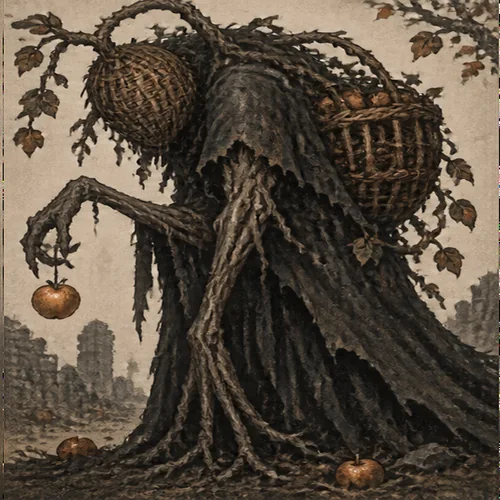 Orchard WretchC27 · 4 energy · 4/4Built from burned stakes and evacuation coats, it brings dark fruit to doorsteps and listens below the oldest tree for a name the roots will not return.Read this folio →
 The Coffin BrideC09 · 4 energy · 3/4The wedding procession reached the cemetery before the groom arrived.Read this folio →
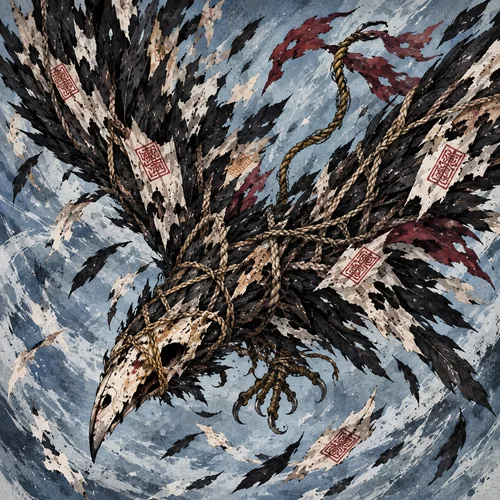 Gallows KiteC11 · 5 energy · 5/4A condemned boy folded this kite from the notice of his own execution.Read this folio →