
The child beneath the cooling roof
Tovan Rill was born on April 13, on a morning the foundry had shut its eastern vent because the wind was pushing sparks back down the chimney. His mother, Iven, said the whole building seemed to hold its breath until he cried. The midwife told her not to credit a baby with managing the weather.
The works were not a single blazing room. They were a neighborhood built around dangerous heat: loading yards, water troughs, sheds, a clinic, the weighhouse, and passages worn smooth by workers carrying food to one another. Tovan grew up recognizing the sounds each place made. A double knock meant the west hoist was sticking. A soft whistle meant a kettle was ready.
His father's work began with looking. Deren held a sheet of coalglass against the pale furnace light and turned it a little at a time, searching for bubbles, hairline fractures, and cloudy places that could split under pressure. He did not call flawed pieces useless. He sorted them for other tasks: a small window, an insulating patch, a warning marker.
Sella made him practice the paths. She would lead him through a safe route to the clinic, then ask him to repeat it backward. She knew the shortcuts but also where they became dangerous: a narrow bridge above a drain, a door that opened toward a cart lane, a stair where soot made the third step slick.
On birthdays, the family shared a little honeyed bread from the market if the week's wages allowed it. Tovan liked the heel, which was darker and crisp. Sella always claimed she had forgotten that preference, then left the heel on his plate.
The roll call at the water trough
Tovan was old enough to carry messages when Sella began working in the foundry's tally office. She was not a clerk by temperament. She liked the workers and distrusted any count that could not be checked against a face. Still, she could read fast, keep several columns in her head, and recognize when a supervisor had copied a figure without seeing the person it described.
Sella's first change was small. At the evening bell, the official count ended at the gate. She began a second roll call at the water trough, where workers washed their hands and waited for the shift carts. Her list held names, meal tokens, and the place each person had meant to go after work.
Tovan helped by carrying the slate between the trough and the tally office. He learned the names by listening, not memorizing. He heard which people wanted their full names recorded, which used a shortened one, and which asked Sella not to write anything until they had spoken with their household. A name belonged to the person who answered to it.
Their father joined the habit in a different way. On sheets of tested coalglass, Deren scratched small marks beside batch numbers to show which crew had inspected each pane. He used a stylus that left pale grooves, visible when the dark glass caught a low light. The marks were for accountability, but he insisted each crew member choose how their name should appear.
The family did not imagine they were building an archive. They were trying to make it harder for a person to disappear between shifts. Their kitchen table held Sella's slate, Deren's glass scraps, their mother's folded clinic notes, and Tovan's map of safe passages. Nothing matched.
A spear-shaped tool
The Lancer did not begin as a weapon. The long iron haft had been ordered for a furnace rake used to pull slag away from an intake. Its end was flattened and split so a worker could hook heavy clinkers without standing too near the mouth. Tovan's father repaired the grip after the old one loosened.
The tool became a walking staff on inspection days. Tovan used it to test boards before putting his weight on them and to reach a jammed latch from the safe side of a rail. Sella teased him that he had made a spear out of a rake and a journey out of every errand.
His work was inspection and escort. Crews crossed the narrow upper bridges with hot panes in padded frames. Tovan walked ahead with the haft, checking the planks and asking people to wait when the path vibrated. A foreman once called this unnecessary caution. Tovan asked whether the foreman would carry the pane himself. The man did not answer, but the crew waited. No one fell.
At the edge of the foundry yard, a rack held broken shields from the old fire brigades. They were not used for battle; they had been carried into smoke to deflect sparks and falling debris while crews worked a rescue line. Their dark panes had been made with layers of coalglass, iron mesh, and a resin that softened under heat.
One shield, marked with a worn white ring, had belonged to the east trench crew. It was cracked but stable when cold. Sella said its old number had been crossed off the inventory years ago. Deren thought it was one of the pieces returned from the repair yard. Tovan could not prove either of them right.
The people behind the gate
The foundry's upper ward had a gate for a reason. It separated the busy yard from the furnace channels, where pressure changes could throw sparks or vapor into a path without warning. The gate was supposed to stay open during ordinary movement and close only when a trained bell caller gave the three-note alarm.
Tovan's days settled into a rhythm. He checked the rack, escorted panes, ate with whichever crew came off the early shift, and brought clinic water to his mother. At night, he and Sella compared the roll call with the gate board. Their task was not to decide what happened to every missing person. It was to preserve enough details for another search to begin.
The open square became a private language. It meant the record was unfinished; it did not mean the person had vanished. Tovan used the same mark on his maps whenever a passage had not been checked after a repair. Their mother adopted it for clinic notes when she was not sure whether a cough had improved.
A new operations steward arrived from the central works with a sealed schedule and a promise to raise output. His name was Caldrin, and he had never worked a furnace shift. He understood delivery quotas, carriage fees, and penalties for a late shipment. He knew that a closed gate stopped a full production line.
For a time, nothing changed. Tovan showed Caldrin the wall of safety marks and the open-square list. The steward said the new tally system would remove ambiguity. Sella asked what it would do with someone who had left the yard but not reached home. Caldrin said the system would show the last recorded location. Sella asked who would go there.
The day the slate was wrong
The accident began with a pressure gauge that had been replaced but not recalibrated. The old gauge had stuck at a safe reading; the new one was attached to the wrong line. No single worker could see the error from the floor. A shift technician noticed the vibration first and sent word to the bell caller. The caller struck the three-note alarm.
On the yard side, the gate started to close automatically. Caldrin had ordered a test of the emergency mechanism because the new schedule promised fewer manual delays. He had been told that the gate was never to close on an active alarm. He believed the test could be completed while the channel was clear.
Tovan was at the inspection rack when the second vibration reached the boards. He saw dust jump from the upper rail and heard the three notes. He did not see the pressure gauge. He did see two carriers still on the channel path, and he recognized the shield frame by its worn white ring.
Sella reached the yard from the tally office with the roll call under her arm. She called the names of the channel crew to the gate caller, who relayed them to the inner side. One worker answered. Another did not. Sella did not call that second person dead. She called the name again, then asked the caller to wait for a response.
The shield's frame fit across the gate track, but its pane was old. Tovan braced the iron haft against the crossbar and pushed the shield into place. The automatic mechanism kept pressing. The gate did not close, though the shield began to flex. Behind him the carriers moved toward the inner latch, one supporting the other.
The name he chose to hold
The shield failed in a way Deren would later describe as layered, not sudden. A pale line opened near the lower rim. Another appeared beside the iron mesh. The black pane still held, but each vibration pushed the lines farther across it. Tovan shifted the haft to the strongest joint and lowered his shoulder. The move bought the crew time.
The missing worker answered at last. His name was Pell, a young carrier who had been trapped behind the frame when a wheel broke. He had a cut on his forehead and could not see the gate, but he could hear Sella.
The second carrier crossed immediately after him. The gate's mechanism was still forcing the bar down. Tovan could have stepped clear once the path was empty. He looked at the shield, saw that the white ring had split, and knew the piece was no longer stable. He could have released it and trusted the channel crew to get through the inner door.
The black pane broke across the iron mesh. The falling edge caught Tovan against the gate post. The haft slipped from his hands. Sella reached him before the crew could pull the damaged frame clear. She pressed a folded cloth to his temple and kept calling him Tovan, not 'inspection crew' or 'casualty.' He could hear her.
He asked whether Pell had made it. Sella said yes. He asked whether the gate was open. She said yes again. Tovan's last clear thought was not a vision of flame or a promise to return. It was the ordinary relief of a task finished and a sister sitting close enough that he could hear her breathe. His body died before the foundry cooled.
What the glass remembered
The first binding was not an intentional rite. It was a sequence of ordinary decisions made in the aftermath. The shield pane had broken into long black shards threaded through with iron. The foundry's safety procedure required damaged coalglass to be sealed in a cooling trough until an inspector could determine whether it contained usable pieces.
One shard retained a groove from Deren's old inspection marks. Another carried a strip of the shield's inventory plate. A third had caught a fragment of Tovan's leather grip, pressed into resin when the frame collapsed. The trough was filled with a clear binding medium used to hold glass still while it cooled.
When the medium set, a particular fracture closed around the surviving inventory mark and the worn grip. The record and the pane became one object. Tovan's spirit, still caught at the instant he had chosen to hold the gate, did not travel onward.
The shard cooled with names visible inside its dark body. Some were the names of people who had died long before the accident, copied from older shields. Some belonged to the gate crew. Some belonged to people who walked home after the alarm. Sella recognized several and crossed none of them out. The writing was not a list of trapped spirits.
Sella kept the shard wrapped in a work apron, not because she thought it held her brother, but because the salvage office intended to crush it with the rest of the damaged pane. She asked Deren to help her compare each mark with the roll. He agreed.
A life in the salvage room
For a season, the shard stayed in the salvage room. It was not displayed, and no one spoke to it. Sella visited after her shift to compare the letters with old ledgers. Deren used a low lamp to reveal the faint marks without heating the glass.
The foundry's new tally system categorized Tovan as dead, the crew as evacuated, and the shield as unusable. The official report did not say the gate order was wrong. It said the slate was out of date. Caldrin was transferred before the inquiry concluded. His name appeared in the report only as steward. Sella kept the first version and the corrected version together.
The pane changed when the furnace ran hot, though no one understood the change at first. Near the end of a long shift, a dark line would brighten from within and the engraved names became briefly legible. The marks did not move like letters being written. They surfaced as if a light behind the glass had found them. Sella could read a few.
Tovan's presence, if it was present, did not speak. It did not float, rattle, or answer a question. The shard warmed when Sella placed the old open-square roll nearby. She could not tell whether it recognized the paper, the names, or only the heat in her hands. She would say later that the room seemed to wait with her.
One night Sella fell asleep with the shard on the table. Her mother covered it before waking her. In the morning, the cloth held a faint burn through its center, although the glass had been cool. They moved the piece into a stone-lined box and asked the inspector to test the resin. He found no furnace leak. The record became both precious and dangerous.
The weapon made for a door
Years passed. The salvage room was moved, then dismantled. The city divided the foundry's tools among new shops, and the marked shield vanished from its assigned shelf. The stone box was not destroyed; its chain of custody simply broke. One copy of the inventory called it a pane. Another called it a shield fragment. A later list described an unmarked iron grip.
In a later workshop, a smith used the shield's surviving iron frame to make a long tool for lifting cooled slag from a blocked channel. The black shards were fitted along the shaft as heat-resistant guards. Nobody knew the family connection. Nobody intended to build a soul vessel. The smith saw the old piece as a good material with a strange fracture pattern.
The first person to call it a spear was a boy who had never worked the furnace. The smith corrected him: it was a channel lance, a tool with a hook behind the point. Tovan would have approved of the correction. Names were not interchangeable simply because an outsider could not see the difference.
The dark glass began to hold more than the old shield's marks. Repair crews engraved fresh names on small plates when they replaced a shard, following a practice Deren had once taught. Some were workers from the old yard; others belonged to people hired long after Tovan died. The new names did not mean those people were inside the glass.
A captain eventually took the channel lance into a dispute over a blocked service passage. She used its length to keep a crowd back while workers opened an emergency route. She did not strike anyone. The point remained down, and its owner stood between the heated channel and the people behind her. Years later, the story of that stance survived without the captain's name.
The name on the lost roll
Sella grew older and left the tally office when the central works merged it with the shipping bureau. She became a search clerk for families trying to locate workers who had been reassigned, hospitalized, or sent to another district. Her job was to compare contradictory records, not to promise every search would end well. She kept a copy of the open-square mark in her desk.
She eventually found the salvage-room ledger in a storehouse whose roof had leaked. The pages recording the shield were mostly intact. The note about its glass marks had blurred, but Deren's repair sign remained. Sella could not find the pane itself. She added the missing number to her list and left the square open.
The family carried its own life forward. Their mother died with a window open to the river wind. Deren stopped inspecting glass and taught apprentices how to recognize stress lines without touching a hot pane. Sella kept sending the apprentices home with food when their shifts ran late. She did not spend every evening searching for Tovan's shard.
On April 13, she still baked a small honey loaf. She left the heel on the plate out of habit, then laughed at herself because there was no one at the table who had asked for it. The laughter hurt. She let it hurt without treating it as a sign. Later that day, a young clerk brought her a copied inventory from the upper ward.
The answer came months later: the tool had been reassigned, then sold with other surplus equipment. The new owner had no mark matching the old ring. Sella placed the letter beside the first report and left the square open. By then, she had taught other search clerks to distinguish 'not found' from 'destroyed.' The distinction did not resurrect anyone.
When the channel flooded
Long after Sella stopped searching, the lower foundry districts were rebuilt around flood barriers. The old channel routes were forgotten beneath new stone. During one high-water season, a repair crew found the iron tool wedged under a collapsed stair. The black glass had survived the pressure, though several pieces were missing. Its point was bent.
The repair began with questions. Which pieces were original? Which had been added later? Why did the same names seem to appear on different layers of glass? The crew recorded each visible mark but did not claim to know what it meant.
A sudden surge entered the channel while Enna and two workers were below the stair. The warning bell rang once, then stopped as water cut the line. The crew above began hauling the tool and the safety rope, but the stair shifted under their weight. Enna had one worker at the ladder and another pinned behind a fallen grate.
Enna did not know the names inside the glass. She knew the list beside her, and she knew who was still below. She called their names in order while she set the lance under the grate. The old tool held long enough for the pinned worker to crawl free. The water tore the rope from the stair before Enna reached the ladder.
The account of the rescue survived in the repair bureau. It said that the crew had recovered two workers and lost one tool. It did not say the weapon had chosen anyone. It did not explain why Enna remembered the glass warming in her hands when the alarm stopped. For years she kept a copy of the report.
The lance that stood between
The channel lance returned to the surface during a repair of the new barrier. The crew found it packed in silt with a service plate from Enna's shift and a fragment of the older white ring. Its glass was dark, but the names were legible in a line of warm light. The repair supervisor compared them with the bureau's old register.
That living worker held the tool without fear. He touched the engraved name and said he had been proud of the repair, though nobody had told him the plate would be preserved. The crew asked whether the glass felt warm. He said the sun had been on it. The tools officer wrote both answers down.
The Lancer stirred when the tool was taken away from the flood site. It did not rise like a person, and it did not speak Tovan's name. The dark fragments lifted from the haft and arranged themselves into a body around a narrow central shaft. A long point extended toward the open yard.
The first person to approach was the living worker whose name shone in the service plate. The Lancer lowered the point until it rested on the ground. It did not attack him. When a cart rolled toward a child near the work line, the Lancer turned, planted the lance across the lane, and made the cart stop. The child was pulled clear.
The repair crew backed away. They called the thing a guardian because that was what it had done. The city register used 'coalglass figure.' A later card maker chose Coalglass Lancer, borrowing the workshop name for the dark pane and the old form of the tool. The name describes its appearance and work, not the whole person. Tovan was not born a weapon.
A body built from what remained
The Lancer's body changes slightly from one account to another. Some witnesses describe a full suit of black glass plates; others remember open spaces where a person should have been. Its single amber light appears where a face might be, but no human features have ever been seen.
When it moves, the shards do not scrape. They shift like panes settling against a frame. A few workers have heard the sound of a water trough cooling after a hot pour. Others hear nothing at all. The names become clearer when the Lancer is near heat, yet warmth does not reliably call forth a particular name.
The Lancer has no reliable memory of the years between Tovan's death and its first stirring. It remembers a failing shield, a gate pushing shut, a voice calling names, and the relief of hearing that Pell crossed safely. It does not remember every face.
It does not speak in sentences. It communicates through posture: the point lowered to signal waiting, the haft placed across a path to hold it open, the body turned toward a person who has not been counted. A few times, dark letters have appeared along its arm while a living worker read a name aloud. The letters fade as soon as the voice stops.
Some workers leave small pieces of chalk near the repair rack so names can be copied before they fade. Others leave the names unwritten, concerned that the glass should not be made responsible for every missing person. The Lancer accepts neither custom as a command. It stands near the doorway, where it can see the people arriving and the people leaving.
The Unquenched circle
The Unquenched is the name Kael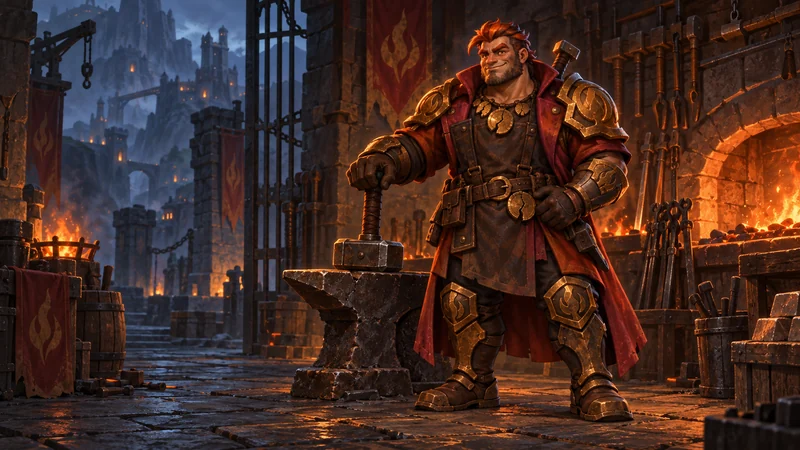 KaelFirst-generation championKael kept the foundry gates open when the city ordered its workers sealed inside.Read this biography →'s Cinder Ward circle gives to people and beings who keep a record alive after the institution that made it has moved on. It is not an ancient order, and the Lancer did not belong to it during Tovan's life. The phrase began as a description of hearths that kept burning through the foundry closures.
KaelKaelFirst-generation championKael kept the foundry gates open when the city ordered its workers sealed inside.Read this biography → did not discover the Lancer by decoding a prophecy. He met it during the search for the missing crew rolls. The old upper-yard reports listed the Lancer as a salvaged tool, then as an unknown figure, then as an incident no office could reconcile. KaelKaelFirst-generation championKael kept the foundry gates open when the city ordered its workers sealed inside.Read this biography → wanted the original names and the actual route of the gate.
The Lancer's presence made KaelKaelFirst-generation championKael kept the foundry gates open when the city ordered its workers sealed inside.Read this biography → uneasy. It carried too many names for him to treat it as a convenient answer, and too little speech to make consent simple. He kept the encounter in the open, with witnesses from the Cinder Ward. When the figure lowered its point beside the old gate, KaelKaelFirst-generation championKael kept the foundry gates open when the city ordered its workers sealed inside.Read this biography → did not call that proof that it trusted him.
The workers brought forward the old salvage papers. Their copies did not match. One placed the white-ring shield in the east trench; another said the pane went to the repair yard. The Lancer's body held fragments from both descriptions. KaelKaelFirst-generation championKael kept the foundry gates open when the city ordered its workers sealed inside.Read this biography → refused to melt it down for a cleaner examination. He also refused to declare every name in the glass a victim.
The circle's practice is to keep a place open for what cannot yet be answered. Its members repair doors, compare accounts, and ask living witnesses before turning them into a story. The Lancer fits this work, though its spirit was trapped centuries before anyone called the group Unquenched. The name is a connection, not an origin.
The Guard and the open door
At the table, the Coalglass Lancer costs three energy and enters with three attack and four health. Its text is exact: it gains two attack while attacking a Guard. That means the printed three becomes five for that creature combat when the Lancer is the attacker and the chosen defender has Guard. It does not gain the bonus while defending.
The bonus fits its story without making the story a battle manual. Tovan chose to hold a failing shield long enough for people behind it to cross. The card turns that instinct into a specific tactical strength: when a Guard stands between the Lancer and the rest of the enemy line, its attack can break the barrier.
In Mournhand's normal attack rules, an enemy Guard restricts creature attacks: if at least one enemy Guard remains, the attacker must choose a legal Guard rather than an unguarded creature or the champion. The Lancer does not bypass that rule. Its bonus rewards the player for facing the Guard directly. When several Guards are present, the player still chooses a legal one.
A careful player checks both sides of the exchange before attacking. A five-health Guard will usually be destroyed by five attack, but it still deals its attack back unless another effect prevents or redirects combat damage. The Lancer has four health, so a Guard with four or more attack can destroy it in the same exchange.
There is no sealed spell or trap on this card to activate. Its special value is always part of its attack into Guard, and its timing is the timing of an attack. It needs to be ready to attack under ordinary rules.
The names that are not a verdict
The most common mistake in reading the Lancer is to treat its body as a list of dead workers. The glass carries names from many layers of repair: people on the original shift, workers listed on a replacement plate, and some who went home alive. It is possible that one name belongs to a spirit. It is possible that a mark is only an inscription.
The living worker who recognized his own name returned to the yard with his daughter years later. He was older, slower, and still proud of having repaired the barrier. He told the Ledger Crow that he had never wanted to become part of a legend.
A card can be held in one hand while its history remains wider than the picture on its face. The Lancer's card holds one captured spirit, not every person whose name appears in the glass. The names point outward to homes, shifts, families, and work that kept the foundry running.
The Crow records the workers as individuals wherever surviving evidence allows. Pell crossed the gate alive. Sella maintained the open-square roll. Deren inspected the coalglass. Enna led a later repair crew. The name on the service plate belonged to a living worker who asked to be remembered for his labor. Their lives do not collapse into Tovan's death.
The Lancer still stands between danger and a doorway. Sometimes that means placing the spear across a lane. Sometimes it means lowering the point so a frightened person can pass. Sometimes it means letting the people nearby leave without asking them to explain their names. It cannot undo the binding, restore the dead, or correct every ledger.
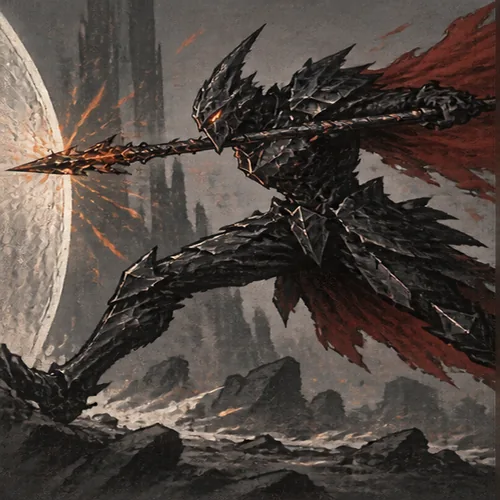
 Furnaceback OxC16 · 5 energy · 3/7Its hide hardened into layered plates while hauling molten iron from flooded foundries.Read this folio →
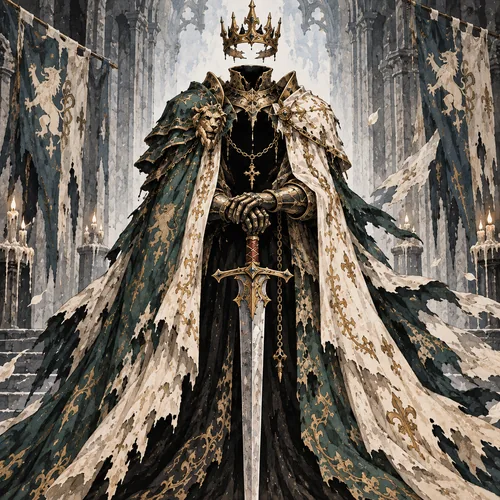 The Hollow RegentC12 · 6 energy · 5/7The crown was buried with an empty suit of armor, yet the taxes continued to arrive.Read this folio →
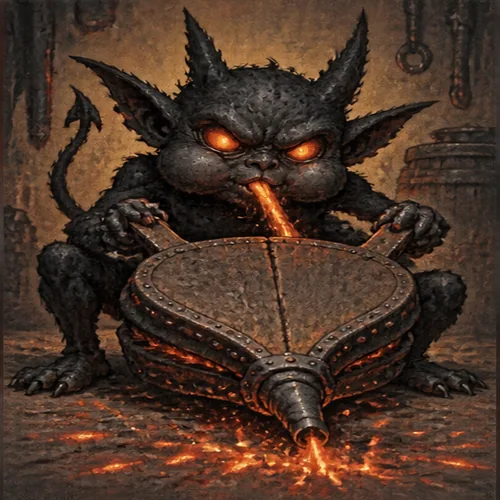 Bellows ImpC14 · 2 energy · 3/2It still believes every fight can be won by blowing harder, even as its coal-red lungs burn out.Read this folio →