
The lamp in the window
Mara Vey was born on November 17 in the Cinder Ward, in a narrow room above a dye shop where wet wool hung from rafters all winter. Her mother repaired work clothes and her father kept the building's stove.
As a child, she was quiet in crowds and unexpectedly stubborn in private. She disliked being told that a missing person was surely dead, or that a household should stop setting a place for someone who might return.
Mara's first important lesson in sewing came when her mother gave her a coat with a split lining and asked her to mend it without making the seam visible.
Her birthday was never a feast. Her mother made onion bread, her father lit one extra lamp, and Mara was allowed to choose the thread for a new spool. She preferred deep red, not because she believed it lucky, but because it remained visible against soot-black fabric.
At seventeen, Mara took work repairing uniforms, aprons, funeral veils, and anything else a household could not afford to replace. She would accept payment in coin, soup, or a useful story, but never asked for a story if the person offering it was not ready.
The door left unlatched
Mara's first room of her own was a narrow storefront near the south stair, with a window facing the Ward's most crowded lane. She put a lamp in that window each evening.
Women from the stairwell began bringing her torn cuffs and their news. One had a husband gone to a furnace shift that never ended. Another had lost a sister to a fever whose name the city clerk would not record.
Mara did not call the group a guild or a circle. They were neighbors who knew where the water pump froze first and which stair rail could hold a child's weight. When a woman had to leave her home to search for someone, another woman sat with her children.
Her closest friend was Ilye, a lamp-glass cutter whose partner vanished during an inspection at the lower furnaces. Ilye refused to wear black because she said the Ward had already made enough decisions about how grief ought to look.
The lamp stayed lit even on nights Mara had no work. She had learned from her father that fire needed attention and from her mother that mending required turning a thing toward the light. Those were ordinary habits, not omens.
The first loose thread
The custom began after Ressa Venn's door was sealed by a municipal notice. Her wife had disappeared during a night shift, and the clerk had crossed the name from the household register before Ressa had received a body, a letter, or any account of what happened.
Mara found it at dawn and did not sweep it away. She knocked, waited, and asked whether the thread meant something.
By the end of that week, three more threads appeared under neighboring doors. Some marked a missing sister, some a spouse taken for questioning, and one belonged to a woman whose son had simply left without saying where he would sleep.
The widows chose their own practice: a thread at the threshold meant, 'This name is still being held here.' It did not invite strangers inside. It did not authorize the city to search a room.
Ressa later found work at a distant mill and moved away. Before she left, she asked Mara to return the thread to her when her wife came home, or keep it if the answer never arrived. Mara promised only to keep it safe.
A ledger made of cloth
Mara's paper list grew difficult to protect. A clerk could take it, a rain leak could ruin it, and a person afraid of being seen could not always speak a name aloud.
The code was useful only to the women who had agreed on it. Mara never claimed it was a universal language, and she did not sew a stranger's history into a garment without asking. Each coat remained wearable.
Ilye helped make the marks consistent. She cut glass beads small enough to sit beside a knot and polished their edges so they would not catch on cloth. A clear bead meant the report came from a direct witness; a smoked bead meant the account had passed through several people.
The women who left thread under their doors began visiting Mara's shop at dusk. Some brought a mended sleeve, others a new report. They sat wherever there was room: on the stool, the floor, or a crate of buttons.
Mara kept a separate notebook listing the consent given by each household. If someone asked her to remove a stitch, she did. If a family chose to close its search, its thread came off the spool and back to the owner. The record was not hers to possess.
The Ward that went dark
The lower Cinder Ward changed after a series of furnace failures and official closures. Smoke settled into the stairwells. Shifts ended without warning.
Mara's shop became a place to ask what the lists omitted. She did not investigate like a constable. She compared the hem of a returned coat to the work roster, asked who had last seen its owner, and wrote down contradictions.
When a warehouse fire forced several families into the lane, Mara carried her sewing kit outside and repaired torn sleeves under a cart awning. The women made a temporary shelter from canvas and their own coats. Children passed cups of water.
A young widow named Sella brought Mara a work jacket belonging to her wife. The garment had been found at the end of a furnace passage, but the torn inner cuff showed a neat repair Mara remembered making. The jacket did not tell them where its owner had gone.
The women began to leave longer threads under their doors, and Mara tied them to the corresponding entries on her spool wall. Each strand carried a knot for the household and a loose end for what remained unknown. It was a fragile system, but it made deletion visible.
The quiet work of remembering
Mara's habit of writing names brought people to her shop who were not ready to discuss the missing. They came because a coat needed a button, a child's scarf had unraveled, or a funeral veil had been stored in a wet cellar.
She kept a tin of small practical things by the door: needle packets, dry matches, cloth tape, and coins for the stairwell pump. People took what they needed and replaced it when they could.
On her own birthday, she used to close the shop early and walk the long path above the cooling canal. She liked the hour when dye vats emptied and the water reflected every window in broken color. She was not lonely in the way the neighbors assumed.
Ilye once asked whether Mara feared the people who came looking for answers. Mara said she feared the certainty of those who had stopped looking. The answer was less brave than it sounded.
Her work did not bring the missing home. It could keep a search legible, prevent a coat from being misidentified, and give a grieving person a place to put a question. Mara considered that enough for one day's work.
The notice at the shop
The first official notice arrived folded around a brass seal. It ordered Mara to surrender the coats, spool tags, and notebook associated with unauthorized claims about missing workers. The listed reason was protection against panic.
Mara went to the clerk's office with Ilye and asked for the evidence behind the order. She was offered a stamped copy of the notice and told the underlying documents were restricted. She asked how a person could correct an error without seeing it.
At the shop, the women disagreed about what to do. Some wanted the records burned rather than seized. Others argued that destruction would make the missing easier to deny. Mara asked everyone to take their own threads home and leave the notebook with no one person's name exposed.
She moved the notebook to a storage niche in the public archive stair, behind a loose panel near the old register room. The niche was dry and known to two other women, both living and capable of retrieving it. Mara did not expect the hiding place to outlast her.
The next morning, the brass seal had been broken and placed on the shop step. No one had taken a coat, but the spool wall had been cut down. Mara spent the day gathering strands from the floor, checking every tag, and asking the neighbors which thread belonged to whom.
The web above the stair
The web began by accident in the archive stair, where Mara hung the first recovered threads while she repaired the paper tags. The air carried dust and damp from a cracked window. Each strand caught a fleck of ash, and the crossing lines made a shape wider than the wall.
She tied each strand to a name only after checking its owner's permission. Missing people had open knots; confirmed deaths had a closed one; unresolved reports remained plain. No line meant that one person belonged to another. The web mapped how a neighborhood remembered, not how a soul was claimed.
The shape spread as more widows brought thread. They arrived after their shifts, alone or with a neighbor, and left before the stair became unsafe. Mara read the tags aloud only when the family asked.
A child named Tavi started visiting with her aunt. She could not read the tags yet, so Mara taught her to recognize the different knots by touch. Tavi liked the open loop because it could be undone and tied again.
The web's red strands caught the lamplight above the narrow stair. People began saying that a name remembered there could not be lost. Mara corrected them every time. A record could be damaged, misunderstood, or made inaccessible.
The patrol comes at night
The patrol came after the city declared the archive stair a restricted passage. It arrived with orders to remove the web and secure any materials connected to unauthorized lists.
The women nearby had already gone home. Mara had told them not to stay just because the patrol might come. Ilye had gone to check on a lamp shipment; Tavi was with her aunt.
The officers found the web across the upper landing. They cut several strands with their knives, then realized the cords had caught around their sword arms and belt loops. The binding was gentle but firm. They could walk and breathe; they could not raise a hand to strike.
She unfastened each soldier by following the line back to its tag. At every crossing, she named the household that had left the thread and asked the officer to repeat the name before she cut the loop.
By dawn, the patrol was free. Mara had mended a split cuff and returned it to the youngest officer with no charge. The official report described the incident as a safety hazard caused by unsecured fibers.
What a web can and cannot hold
The incident made Mara more visible, which was not the same as making her safer. Some families came hoping the web could reveal where a missing person had gone. Others asked whether a name woven into the stair would keep a loved one from dying.
She changed how the entries were recorded. Each report gained a source, a date, and a line for what had not been checked. A strand could mark a question, not answer it.
One woman, Dema, came to Mara after finding her brother's name in a patrol ledger marked dead. She had heard from a traveler that he was living in a work camp beyond the southern ridge. Mara marked the file disputed and wrote the traveler's account beside the official line.
Dema returned six months later with a letter in her brother's hand. He had been alive, but the letter did not say whether he wanted to come home. Mara added the verified date and left the last knot open. The family had information now, not an ending.
Mara often washed soot from the strands using a bowl of water and a soft cloth. She never pulled hard. A web could hold evidence in place while people examined it, but pressure could tear the fiber or distort the record.
The person she could not find
Ilye was the one person Mara could not find a reliable account for. Her partner had disappeared in the furnace inspection, but two separate records placed the same worker at different gates at the same hour. One report named a body carried out.
Ilye did not ask Mara to invent a conclusion. She asked her to keep the contradictory records side by side. On the day of her own birthday, she brought Mara a small pane of lamp glass with one corner left uncut.
Mara set the pane on the worktable and did not try to finish it. The two women spent the evening eating lentil stew from chipped bowls. They talked about old customers, a broken pump, and how the south stair smelled after rain.
Some weeks later Ilye moved out of the Ward to take a job at a safer glassworks. She left the red cuff in Mara's keeping, along with permission to show it if a future witness could identify the repair.
After Ilye left, Mara stopped lighting the shop lamp every night. She lit it when someone needed the stair, when she was working late, or when the weather made the lane hard to see. The lamp had never been a signal to one person.
The stair is closed
The archive stair was finally closed for repairs, though the city made no promise that the web or records would be returned afterward. Mara was allowed one hour to retrieve personal tools.
Before she left, she walked each landing and checked for tags caught behind the railing. There were three: one confirmed return, one death witnessed by family, and one unresolved name. Mara carried the first two to their owners.
Tavi, now old enough to read, asked whether the web would be rebuilt somewhere else. Mara said perhaps, but not by her alone. If the neighbors wanted a new place, they would choose one together. Tavi asked whether the strands could be moved without changing what they meant.
The women moved the surviving threads to a sewing room above the pump house. It was smaller, brighter, and accessible from a public lane. The web lost its grand arch across the stair, but the people who used it could reach the tags without passing an official desk.
She returned to the closed archive once to retrieve the unfinished name from behind the railing. The panel had been replaced and painted. There was no safe way to open it without damaging the stair.
A life outside the record
Mara's days were not spent only among missing names. She liked strong tea with too much honey, rain tapping on the shop awning, and the small satisfaction of a sleeve lining that lay flat after repair.
She had no spouse or children, and she disliked when neighbors treated this as an absence that needed explaining. She had loved people, including Ilye, without making a public claim that the relationship had to become a household.
Once each week she taught basic mending in the pump-house room. The lessons were open to anyone, including patrol families. She showed people how to tie off a knot, turn a seam, and replace a button without cutting away more cloth than necessary.
A boy named Ren asked whether the web could tell him if his mother had forgiven him for leaving. Mara said thread could not answer a question the living had not asked each other. She helped him write a letter, then let him decide whether to send it.
Mara's patience did not mean she was gentle in every disagreement. She could be sharp when an official used a missing person's name to end an inquiry, or when a neighbor shared a private account without permission. She apologized when she was wrong and expected the same from others.
The name in the damaged register
Years after the first notice, the city ordered the pump-house room cleared. A water main had cracked above the old register vault, and officials planned to discard the damaged books before anyone could compare them with the neighborhood's copies.
Mara went to the vault with a request to inspect the pages. She was not allowed inside. A clerk brought out one soaked register and asked her to identify the handwriting from the exposed entries.
She told the clerk that the entry was wrong and named the two people who could verify it. The clerk said there was no time to delay disposal. Mara asked for the page number and copied it on the back of her hand.
The damaged page contained a name the women had been searching for: Ilye's partner, listed as transferred to a shift beyond the river on the date everyone thought she had died.
They compared the ink and shift marks with the red cuff, a saved gate pass, and a note from a worker who had later left the Ward. The evidence still ended before the person did. Mara kept the entry open.
The night of the second cut
The patrol returned to the pump house on a wet November night. This time its orders named the web itself as a threat and instructed the officers to cut every strand, seize the notebook, and remove anyone who resisted.
She could have left through the back stair. Instead, she asked the patrol to wait while she carried the living tags out first. Several neighbors stood in the lane, but no one drew a weapon.
The first cut dropped a web of red thread across the stair. The strands tightened around the lead officer's arm when he raised his sword. He pulled, and a shelf of old registers began to slide from its brackets.
The old wood split above her. The register shelf fell, and the iron spindle struck the stone. Mara was pinned between the shelf and the stair rail. Her neighbors lifted what they could, but the wet timbers had twisted together.
Mara could not be freed before the pressure in her chest became too great. She asked Tavi to carry the open-loop tag to the family who had left it, and asked the lead officer to say Ilye's partner's name aloud. The officer did.
The thread that caught a breath
Mara died before the neighbors cleared the shelf. Her body remained under the timber, and the living worked for hours to lift it without causing another collapse. The patrol later recorded the death as an accident during an unauthorized archive rescue.
At the instant her breath left, rainwater ran down the stone and crossed the broken spindle. One red strand still tied the tool to the unfinished name from the register.
The spindle turned once though no hand held it. A faint pressure moved through the web, following every line Mara had gathered over the years. The names did not enter her. They stayed on their separate tags, and the missing did not rise from wherever they had gone.
No priest or magistrate performed a binding. The neighbor who had tied the first knot recognized the thread's pull and stopped the patrol from cutting it. She wrapped the spindle in the old notebook cover and carried both to the sewing room.
The people there could not agree whether the tool had held Mara or whether her spirit had chosen to stay with the names. They did not decide that disagreement by force.
The shape beneath the veil
Mara's spirit first appeared as a shadow spread across the sewing-room rafters, too many points of contact for a human body. A pale oval shape hung at its center like a face reflected in old glass.
The web had changed the shape of her presence. It drew itself around the spindle and stretched into eight long, jointed lines, each ending where a thread had been cut or left open. Dark fibers gathered behind the pale center.
The first person to approach was Tavi, who had carried the open-loop tag out of the stair. She asked whether Mara could hear her. The thread lifted when Tavi spoke her own name, then went still when she said the person they were trying to find. No voice answered.
The spirit could draw a thread tight around an attacking hand, much as the web had once caught a soldier's sword arm. It could also let a person pass without contact. The neighbors learned to announce themselves and wait.
At dawn the pale center lowered toward the old worktable. A seamstress found one of her own cuffs neatly mended, with the hidden knot still visible on the inside. The stitch matched Mara's habit but could have been made before her death.
The Ward learns to ask
The women rebuilt the name wall in a room where the door could be opened from either side. Each household decided whether its thread would be displayed, covered, or returned. The spindle remained wrapped, and the pale spider-shaped spirit watched from the ceiling without forcing any name onto the web.
A patrol family came to ask for its cuff back. The youngest officer had been the one whose sister's name Mara read on the first night. The sister was alive and working in another district; the officer had forgotten her after a fever, not a supernatural curse.
That ordinary reunion became important to the neighbors. The web had not restored memory or summoned anyone. It had made a forgotten name visible long enough for the living to act. They marked the entry as a confirmed return and let the family remove its thread.
Tavi took over some of Mara's work, but she refused to wear the same coat or speak as though Mara had chosen her as an heir. She had her own voice, and the neighborhood's account should not turn one woman into the continuation of another.
When new widows began leaving loose thread under their doors, the practice spread beyond Mara's street. Some strands reached the sewing room, and others stayed at home. The choice remained with each household.
The long wait of the spindle
The years after Mara's death did not bring one final answer about Ilye's partner. A second witness remembered seeing her near the river road, but the date on the account could have been copied from a later schedule. Ilye was contacted through the glassworks.
The spindle's thread responded when people brought a new verified detail, but it did not distinguish a true report from a lie by itself. The living still had to check sources, ask permission, and compare dates.
A group of officials later tried to burn the sewing room. The neighbors removed the name tags first and doused the wall with water. The spirit wrapped the attackers' arms in thread, reducing their reach until the flame was put out. Once they lowered their torches, the web loosened.
One of the attackers had lost a brother during the same furnace closures. He returned alone and asked to leave a thread. Tavi accepted it only after he agreed that the record would carry his brother's name, not the accusation he wanted to attach to a rival family.
The Ward's records grew unevenly. Some names gained dates and witnesses; others remained open loops for decades. People died, moved away, reconciled, or chose not to continue searching. The spirit did not demand that their grief remain unchanged.
The coats and the bobbin
Long after the first room was cleared, a later keeper named Nera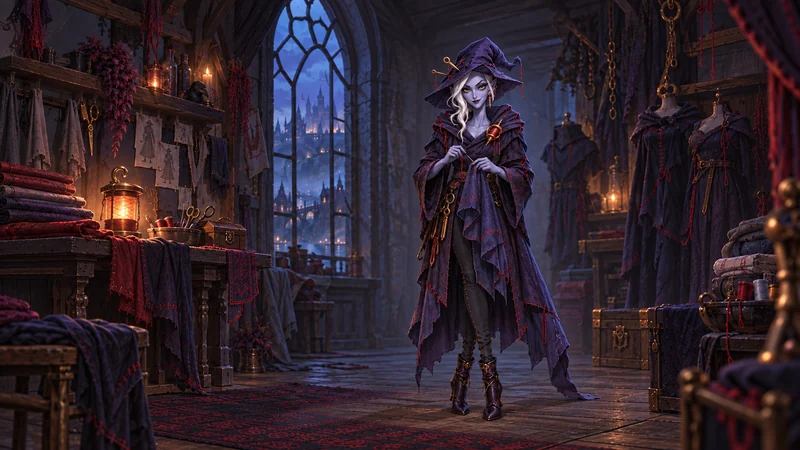 NeraFirst-generation championNera is Mira's estranged twin sister.Read this biography → began saving the final thread from funeral coats. Her Mourning Bobbin
 Mourning BobbinC19 · 3 energy · 1/5Nera wound this bobbin with the final threads from a hundred funeral coats.Read this folio → gathered those remnants into a separate object.
The two records preserve different kinds of work. Mara's web holds names and the limits of what is known about them. NeraNeraFirst-generation championNera is Mira's estranged twin sister.Read this biography →'s bobbin holds the last threads from garments worn at funerals.
The Crow later placed the folios beside each other because both ask what a thread can carry. That arrangement is an archivist's interpretation, not a claim that Mara and NeraNeraFirst-generation championNera is Mira's estranged twin sister.Read this biography → met, that the objects share a soul, or that one caused the other's magic.
A later page records that NeraNeraFirst-generation championNera is Mira's estranged twin sister.Read this biography → used the bobbin to mend mourners' clothing and that she would not let a name be mistaken for a garment. The note is in a different hand from the one that recorded Mara's first threads.
The Spindle Widow's story can stand without the Bobbin. Mara listened, kept a careful list, and died trying to protect one unresolved name from being erased. NeraNeraFirst-generation championNera is Mira's estranged twin sister.Read this biography →'s craft gives the Crow a neighboring page, not a missing answer. If future evidence identifies the fiber, the archive can add it.
The card that keeps the question
Centuries later, a cardmaker found the spindle wrapped in the notebook's cloth cover beneath a floorboard in the pump-house room. The red thread had not rotted, but its paper tags had faded.
Only the spirit's own tether was transferred: the spindle, the unfinished register fragment, and the single knotted strand tied at the instant Mara died. The process did not draw the absent workers into the card.
When the seal closed, the web gathered into a compact shadow with a pale face and long, jointed limbs. The card showed a defender who could wait to be approached.
The name Spindle Widow came from the Ward's loose-thread custom and the shape the spirit had taken after death. It was not Mara's birth name, nor did every widow in the city become part of her.
No card text promises that the missing returned, that the spirit knows what happened to them, or that the binding will end. The record keeps what Mara could not finish: a question, a name, and the right of the living to continue searching without pretending that uncertainty is an answer.
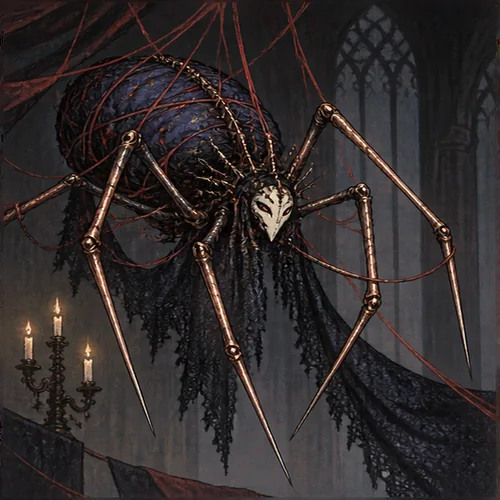
 Furnaceback OxC16 · 5 energy · 3/7Its hide hardened into layered plates while hauling molten iron from flooded foundries.Read this folio →
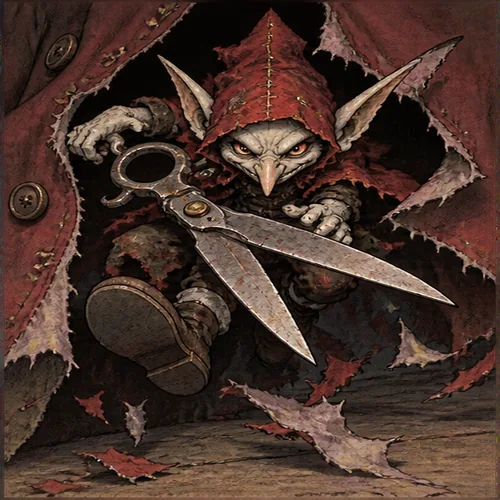 Hem-GoblinC18 · 1 energy · 2/1The goblin who lives inside Nera's coat insists he is her business partner.Read this folio →