
The stone that listened
The first sound the Giant remembered was a mason tapping stone to learn where it would split. The builders were repairing a bridge above the north ravine, where winter water cut under the old piers. They had no spare crew for a second watch, so they shaped a large body from pale rubble and iron plates. The figure was meant to lift beams, carry stone, and remain where someone placed it. It had no name yet, only a mark on the plan: temporary brace, left bank.
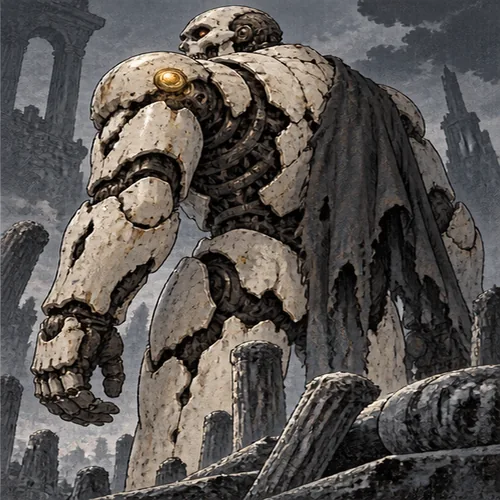
The construct’s earliest days were measured in directions. Turn the shoulder. Hold the beam. Step back. The builders used a small bell to signal when it should stop. Its face had no expression beyond two dark eye sockets, but a gold rivet was pressed into the left shoulder to mark which side faced the bridge. The builders believed they had made a tool that could obey simple instructions. They did not know whether the silent attention behind the stone was anything more than the result of careful carving.
The Giant began to move before anyone had finished giving it orders. It shifted a block away from a child’s foot. It opened its palm when a mason dropped a measuring line. When the bell rang, it still stopped. The first worker to notice the difference was a woman named Tovin, who had built the shoulder joint and knew how much force it could bear. She placed a pebble in the Giant’s hand. It held the pebble gently until she took it back. She did not call that proof of a soul, but she stopped calling it only a brace.
A name large enough
The bridge crew called it Large One, then the Brace, then the Giant. None of the names came from the official plan. They rose from the work. It stood higher than the cart shed and had to duck beneath the quarry gate. Its weight made the boards speak before it entered a room. Still, the Giant moved carefully around the workers, placing each foot where the stone had already been tested. It learned the difference between a gesture meant to guide and a hand raised to ask it to wait.
Tovin gave it a name in the ledger after it had been working with the crew for a season. She wrote ‘Giant’ beside the temporary brace entry because that was what the apprentices already called it. The word looked too simple for the place on the page, so she added a note: ‘answers to the work bell; stops at one clear ring; does not cross a marked line without a signal.’ The Giant could not read the note, but it watched Tovin close the ledger and followed her to the bridge.
The name stayed because it fit both its size and its manner. The Giant never rushed. When ordered to lift, it lifted; when no one had asked, it waited. The crew began speaking to it as a coworker even when they knew the answers would come as a shift of stone fingers or the low scrape of a foot. It did not ask for praise. If someone placed a cup on the ledge of its palm, it held still until they were done drinking. If they forgot the cup, it carried it back to the workbench.
The first bridge
The north bridge took three years to repair. It crossed a ravine that filled with rainwater each spring and ran nearly dry in late summer. The crew worked on the stone piers first, then the timber deck, then the rails. The Giant carried blocks from the lower quarry and held them in place while the masons set wedges. It knew the bridge through its pressures: a beam’s tremor, a pier’s settling, the moment a rope tightened enough to bear weight.
A young apprentice named Pell was afraid of the drop. He tried to hide it by making jokes whenever the crew crossed the scaffold. The Giant noticed that he always waited for another person to step first. One day, when a plank shifted under Pell’s boot, the construct extended its flat hand beside him. It did not scoop him up. It made a wall at his shoulder, giving him something steady to touch while he found the next board. Pell crossed by himself, then leaned his forehead against the stone palm.
The bridge opened to the public before the first frost. Families crossed with baskets; a courier took the route to the lower farms; children ran from one end to the other until Tovin ordered them to walk. The Giant remained near the ravine, where it could see both approaches. It had no command to guard the bridge after construction, but no one told it to leave. It stayed through the winter and the thaw. By the time the crew packed its tools, the Giant had become part of the route people expected to find.
A repair is a promise
The Giant learned repair by watching Tovin. She did not replace a beam just because it had a crack. She tested whether the crack moved under pressure, marked its length, and returned the next day to see whether the mark had changed. A repair could be a wedge, a brace, a fresh bolt, or a sign telling people not to cross. The Giant learned that keeping something standing was not the same as pretending it could never fail.
When its own plates loosened, the Giant sat outside the work shed and waited for the crew to notice. It did not hide the damage. A rivet clicked against the stone each time it moved its left arm. Tovin tried tightening it, but the joint still dragged. She removed the plate, cleaned the grit from the hinge, and fixed it again. The Giant held still throughout the work. When she finished, it turned its arm slowly and offered the wrench back to her.
That exchange changed the crew’s habits. They began inspecting the Giant as carefully as the bridge. Pell kept a chart of loose joints and replaced marks when repairs held. The Giant itself brought spare bolts to the bench when it heard the rattle begin. It never asked anyone to ignore a defect because it was large or useful. The workers learned to take its warnings seriously. A structure could carry weight and still be tired; a helper could be strong and still need the people around it to pay attention.
The bolt box
Tovin kept a wooden box of spare bolts under the bridge shed. Each size was wrapped in a scrap of cloth and marked with a small notch. The Giant knew the box by its smell of oil and iron filings. When a bolt worked loose on the bridge, it carried the matching piece to the repair site. It learned the marks through repetition, not reading. A deep notch fit the rail bracket; two shallow notches held the maintenance ladder; a smooth head belonged to the bench where the crew rested their hands.
The box also held pieces that no longer fit anything. The crew saved them because metal was expensive and an old bolt might be reshaped. The Giant would lift one out, look toward Tovin, and place it in a separate pile. Tovin called that pile ‘not yet.’ She did not know if the construct understood the phrase, but it stopped trying to use those pieces until the smith had checked them. The pile became a small record of repairs that could not be made with what they had.
When another bridge in the ward lost its handrail, the local smith had no matching fasteners. The Giant brought a handful from its own box. Tovin objected that the north bridge needed them. The Giant placed two bolts aside for the bridge and pushed the rest toward the smith. The crew used them to hold a temporary rail until a new order arrived. Tovin did not call the choice wise or foolish. She wrote down which bolts had left and made a plan to replace them. The Giant had given away what it could spare, not what it could not.
The people who crossed
The bridge gathered stories because people crossed it for different reasons. A farmer named Daro brought eggs to market before dawn. A nurse walked home after the night shift. Pell’s younger sister counted the stones along the rail to calm herself before exams. The Giant did not learn every name, but it learned which footsteps meant a heavy load and which ones needed the bridge to feel still. When a child was afraid, it stood far enough away to leave room and close enough to be seen.
A traveler once asked whether the Giant would carry him across. It lifted one palm, then lowered it flat to the ground. The traveler climbed onto the hand without asking and laughed as the construct began to rise. The Giant stopped halfway. Its wrist trembled under the unexpected weight. Tovin called for the traveler to climb down. Afterward, the crew reinforced the palm joint, but they did not offer it as a passenger platform again. The Giant could help someone cross by holding the rail; no one was entitled to ride it.
Pell painted a small line on the bridge plan to show where the Giant preferred to stand during heavy traffic. It was not a restriction. It marked a place where the construct could watch both approaches without blocking the road. The Giant stood there during market days and storms. The people learned not to touch its shoulder without warning, especially the golden rivet. Some greeted it; some hurried past. The bridge belonged to the ward, and the Giant was part of its daily life without needing to be the center of every crossing.
Winter under the arches
The cold season tested every joint. Water froze inside the bridge stones and widened the smallest gaps. Tovin taught the apprentices to mark cracks before the thaw, because waiting for spring could turn a hairline split into a broken pier. The Giant carried baskets of dry sand to the bridge approaches. People scattered the sand across the icy stones so carts could pass without slipping. When the snow grew deep, it stood beneath the arch where the wind could not reach the lowest span.
Pell brought the construct a scarf one winter, knitted badly from spare wool. It would not protect the stone plates from cold, but he insisted the gesture mattered. The Giant let him drape the scarf over its shoulder, away from the gold rivet. A week later, Pell’s little sister was cold while waiting for her mother. The Giant lifted the scarf and held one end low enough for her to wrap around her own neck. When she returned it, she left a thread tied to the edge. The Giant kept the thread as long as the wool lasted.
That winter, the bridge remained open through three storms. The Giant cleared branches from the rail and carried fallen stones away from the path. On the fourth storm, it stopped at the south approach. A crack had appeared beneath the surface, hidden by snow. The Giant rang the work bell, one clear note, the signal to stop crossing. People grumbled and turned back until Tovin inspected the pier. The crack was serious. A temporary brace prevented a collapse. The warning saved no named hero; it gave dozens of ordinary travelers a safer road home.
The day the crew left
Years passed, and the bridge needed fewer repairs. The quarry closed after a better road was built farther south. Tovin’s hands began to ache in the cold, and Pell became a mason in another district. The crew gathered at the north shed to divide the tools. They agreed the Giant should go with the bridge authority, but no authority came to claim it. Some wanted to leave it where it stood. Others worried that the old structure would be unsafe without a living crew nearby.
Tovin asked the Giant what it wanted. It looked at the bolt box, then at the bridge, then at the road that led to the ward. The answer was not clear, but the crew could see it did not turn toward the quarry. Tovin chose to remain through one more season and teach a younger repair crew how to inspect the piers. She did not promise the Giant that she would stay forever. She told it the truth: her joints were failing, and her family had moved closer to the city.
On her final morning at the bridge, Tovin left a measured plan in a weatherproof tube. The sheet included every crack, every replacement bolt, and the location of the temporary braces. She fixed the tube to the shed door with a brass pin and set the golden rivet on the Giant’s shoulder straight. The construct stood with her until she crossed to the far side. It did not follow. When she looked back, it had returned to the bridge plan and was tracing the marked supports with one stone finger.
Bolts left behind
The new crew was smaller than the old one. They repaired the bridge and nearby gates, but they did not have the same supply of iron. The Giant began sharing its spare bolts more freely. A rail bracket in the ward received one. A door hinge at the infirmary received another. A broken chair at the night shelter got a third. The construct would bring the pieces to a bench and wait for someone to shape them. It did not understand the price of replacing each bolt, but it saw what each repair allowed a person to do.
The golden rivet in its shoulder remained. It had been the first marker and the last piece of the original joint. Tovin’s old plan described it as a directional fastener, not a sacred object. The Giant nevertheless guarded it from careless tools. When an apprentice tried to remove it to patch a chair, the construct turned its shoulder away. The worker apologized. The Giant tapped the rivet once, then placed a different bolt into the apprentice’s hand. It could give away its spares, but it could not give away the joint that held its own arm together.
The people of the ward began calling the construct Last-Bolt as a joke about its thinning supply. It kept arriving with one fewer spare after each repair. The name became Last-Bolt Giant when even the joke wore down. Tamsin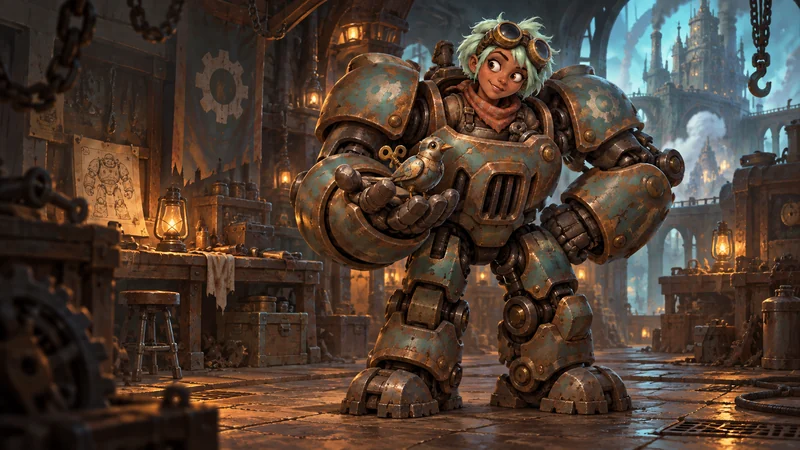 TamsinFirst-generation championTamsin was the smallest apprentice in a workshop that built enormous machines.Read this biography →, still young, heard the name on a trip through the district. She met the construct while it was holding a loose gate in place for a worker with an injured hand. She watched it refuse a new bolt for itself and offer the remaining spare to repair the gate latch instead.
Tamsin and the gate
TamsinTamsinFirst-generation championTamsin was the smallest apprentice in a workshop that built enormous machines.Read this biography → was small enough to move through the gate without ducking, but the frame above it had begun to sag. She had come to deliver a set of workshop tools. The Giant held the frame upright while the worker tightened the hinge. TamsinTamsinFirst-generation championTamsin was the smallest apprentice in a workshop that built enormous machines.Read this biography → asked whether it could hold for a few more minutes. The Giant shifted its feet and pressed one palm beneath the lintel. It could not speak, but the stone at its shoulder clicked in a pattern that meant the load was changing.
TamsinTamsinFirst-generation championTamsin was the smallest apprentice in a workshop that built enormous machines.Read this biography → recognized the warning and called the workers away from the frame. They lowered the gate rather than forcing the hinge. The repair took longer, but no one was hurt. She later brought a new bolt that fit the gate and a second one for the Giant’s shoulder. The construct placed the shoulder bolt in the repair tin and left it there. It had not asked for a replacement. TamsinTamsinFirst-generation championTamsin was the smallest apprentice in a workshop that built enormous machines.Read this biography → did not insist. She fastened the gate with the other bolt and left the tin beside the old plan.
The Giant was not part of TamsinTamsinFirst-generation championTamsin was the smallest apprentice in a workshop that built enormous machines.Read this biography →’s workshop, but their paths crossed again. It repaired a stool outside the tool shed, braced a roof during a summer shower, and moved stones away from a path that children used. TamsinTamsinFirst-generation championTamsin was the smallest apprentice in a workshop that built enormous machines.Read this biography → learned that it would help with a structure but never carry a rider or let anyone use its body as a platform. She respected the boundary. The construct belonged to the work it chose, and the work included knowing when a human should find another way.
The roof over the shelter
The night shelter occupied an old storehouse near the north bridge. It took in travelers during storms and families whose homes were being repaired. The building was never meant to hold so many people. The ward patched leaks as they found them, moving beds away from damp walls and setting buckets beneath the worst seams. Last-Bolt Giant brought spare wood and bolts, but the roof was too broad for a handful of repairs. TamsinTamsinFirst-generation championTamsin was the smallest apprentice in a workshop that built enormous machines.Read this biography → warned that the central beam needed replacement before the next heavy rain.
A contractor promised to bring a new beam. The order was delayed twice. The shelter could not close while families were inside, so the workers arranged sleeping places near the strongest wall. The Giant stood beneath the central span. It had already given away its spare bolts to the shelter’s door and the bridge rail. The golden rivet in its shoulder was the only fastener left from the original build. No one asked it to spend that one. TamsinTamsinFirst-generation championTamsin was the smallest apprentice in a workshop that built enormous machines.Read this biography → inspected the roof and marked the places where people should not stand.
The first storm passed with only a small leak. The second loosened a section of slate. The third arrived before the replacement beam. Rain struck the roof so hard that people could not hear each other speak. A crack opened above the main room. Last-Bolt Giant moved beneath it and raised both arms. The crew guided everyone toward the side entrance. TamsinTamsinFirst-generation championTamsin was the smallest apprentice in a workshop that built enormous machines.Read this biography → went bed to bed, checking that no one had left a child or a bag behind. The Giant held its position, its stone fingers pressed against the beams.
One rivet remains
The roof shifted while the last family crossed the room. A support post split at its base. Last-Bolt Giant took the weight across its shoulders, and one pale plate slid down its arm. The golden rivet held the joint together. The construct’s stone body was not built for this much pressure. TamsinTamsinFirst-generation championTamsin was the smallest apprentice in a workshop that built enormous machines.Read this biography → called for it to release the roof once the room was clear. It waited until she counted every person at the entrance, then tried to lower the beam slowly.
The post broke before the weight could reach the floor. A second beam dropped and pinned the Giant’s left arm. The old shoulder joint twisted. The golden rivet pulled free, struck the wet floor, and rolled beneath the weatherproof bridge plan. The Giant’s body lost its support and collapsed into the space it had been holding open. The workers were outside. The family was safe. TamsinTamsinFirst-generation championTamsin was the smallest apprentice in a workshop that built enormous machines.Read this biography → ran toward the wreckage, but the roof fell between her and the construct before she could reach it.
The storm passed before the crew could lift the beams. They found the Giant beneath the broken roof, its stone plates split and dark mantle soaked through. The shoulder rivet was still under the plan tube. TamsinTamsinFirst-generation championTamsin was the smallest apprentice in a workshop that built enormous machines.Read this biography → picked it up and felt its warmth, though rain had cooled everything around it. She placed the rivet beside the construct and said the people had made it out. Nothing moved. The golden metal had been the last part that tied the old body together, and now it was the only piece that had not broken.
The accidental catch
As the workers cleared the roof, they dragged the old plan tube away from the rubble. The parchment inside had gone soft with rain. A corner was pinned beneath the golden rivet, and a line of ink had run through the marks for the shelter supports. No one had drawn a binding circle or called a spirit. TamsinTamsinFirst-generation championTamsin was the smallest apprentice in a workshop that built enormous machines.Read this biography → was trying to keep the plan from tearing while the masons lifted a beam. The final warmth in the Giant’s body passed through the rivet and the sheet that recorded the load it had carried.
The construct’s spirit did not rise like a human ghost. It gathered around the single intention that had defined its last living moment: hold until they were safe. The rivet warmed, the ink marks darkened, and the shape of the Giant stood within the rain. Its body remained broken stone under the roof. The living presence was caught in the accidental meeting of the last original bolt, the plan, and the pressure released at the moment of its death. The connection held it in the mortal world without asking whether it wanted to stay.
TamsinTamsinFirst-generation championTamsin was the smallest apprentice in a workshop that built enormous machines.Read this biography → called its name. The spirit turned toward her, but the ruined roof remained between them. It could move again, though its form was smaller than the body had been and made of pale plates, iron joints, and a dark mantle. The golden rivet still shone at the shoulder. The workers who had escaped were not inside it. Tovin, Pell, and the people who crossed the bridge had lived their own lives. No other soul had been bundled into the Giant by the storm or the plan.
The weight it could not set down
Last-Bolt Giant remained near the shelter after the debris was cleared. It could lift small pieces of timber and carry tools, but it no longer held the roof in the way its old body had. Its spirit still felt the pressure of the beams even when the structure was gone. TamsinTamsinFirst-generation championTamsin was the smallest apprentice in a workshop that built enormous machines.Read this biography → watched it stand beneath the repaired rafters, shoulders slightly raised, as if the load might return. She told it that the room was safe now. It lowered its arms only after every bed had been moved back inside.
The Giant continued to repair bridges, gates, and chairs with spare bolts. It gave away most of what it carried, though TamsinTamsinFirst-generation championTamsin was the smallest apprentice in a workshop that built enormous machines.Read this biography → began keeping a small tin of replacements nearby. It accepted them when a joint needed repair and refused them when someone tried to make its shoulder whole again. The golden rivet remained in place. It was not a trophy or a promise that its life could be restored. It was the last piece of its first body and the mark that helped the Ledger Crow recognize the spirit.
There was no clear road beyond the mortal world for the Giant to follow. The accidental binding had not become voluntary because it chose to keep working. It stayed because it could not leave, not because the shelter needed a permanent guardian. TamsinTamsinFirst-generation championTamsin was the smallest apprentice in a workshop that built enormous machines.Read this biography → never told the newcomers that they could free it by finishing the bridge or replacing the roof. She wrote down what happened and where the spirit had been caught. Care could make the present gentler, but it could not turn captivity into a gift.
The card that holds a load
The Ledger Crow examined the wet plan, the golden rivet, and the final repair record. TamsinTamsinFirst-generation championTamsin was the smallest apprentice in a workshop that built enormous machines.Read this biography → described the order of the storm without adding a cause she had not witnessed. The Giant had held the roof. Its body had failed. The rivet and plan had caught its spirit as it died. The Crow recorded the difference between a construct’s living spirit and the workers who cared for it. The history was heavy enough without claiming that every person connected to the shelter had been trapped too.
When the spirit was transferred to its card, the official Mournhand face was used. The card’s printed ability dealt two damage to an enemy creature on entry, then two damage to the Giant itself. The art and story did not change that sequence. The Giant’s willingness to take a load was a personal history; it did not grant armor or protection in play. The card contained the one spirit that had been the Last-Bolt Giant, while the original rivet, plan, and damaged body remained part of the archive.
The card did not release the Giant from the mortal world. It made the vessel portable and recorded the being clearly, but it could not undo the accidental catch. TamsinTamsinFirst-generation championTamsin was the smallest apprentice in a workshop that built enormous machines.Read this biography → placed it beside the repair ledger, where the last bolt was drawn in the margin. The note listed January 14 as the Giant’s birthday, Capricorn, chosen for the patience and duty it showed rather than a date found in the old records. One rivet remained in its shoulder. It had given away every other spare, but no one asked it to give that one too.
 Hearth-Anvil StagC22 · 4 energy · 3/6When the last forge went cold, the apprentices found a stag standing among its ashes.Read this folio →
 Coppercap PorterC23 · 1 energy · 1/1The porter was built to carry things no larger than a lunchbox.Read this folio →
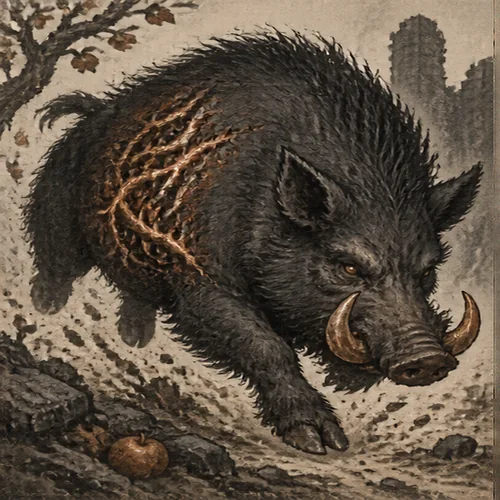 Cinderroot BoarC25 · 3 energy · 3/5Coal seams glow beneath its brow as roots wake whenever it is wounded, tracing the route of families who never came home.Read this folio →