Before the name
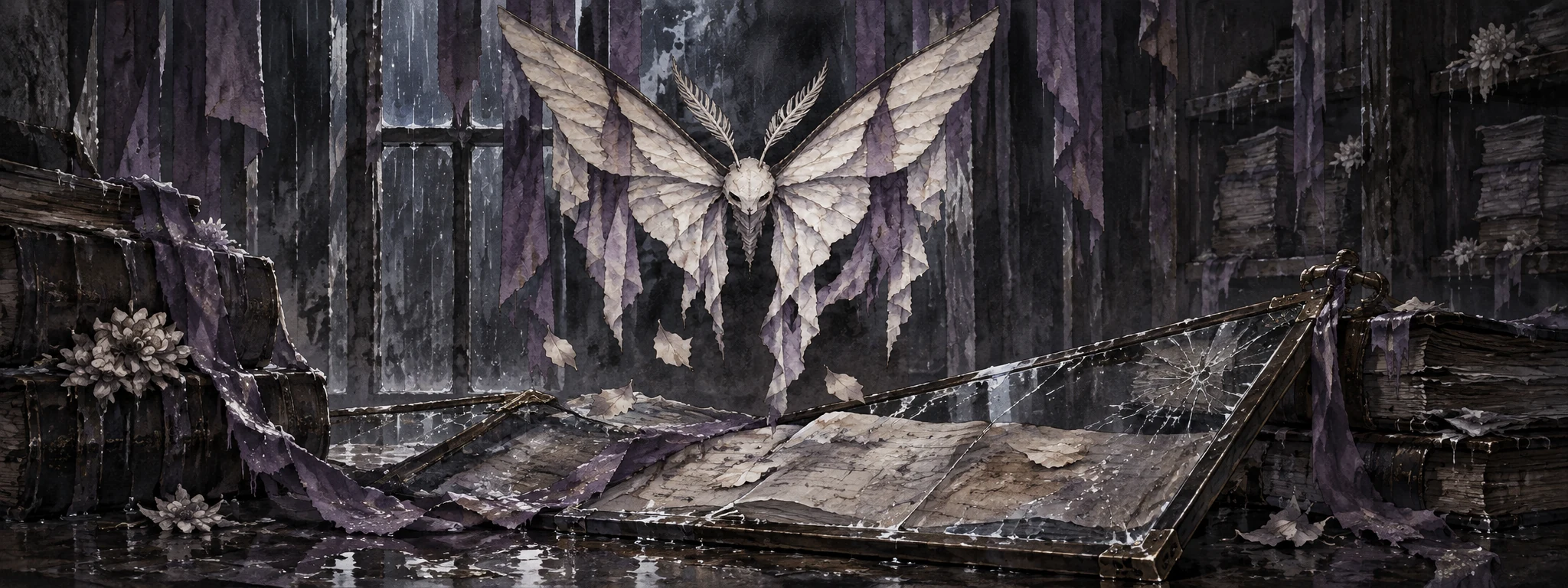
The pale moth first appeared above the washbasin in the hospice laundry at the end of Ash Lane. Its wings were not smooth ivory, but layered like scraps of burial cloth, with violet shadows along the seams. It rested on the wooden lintel while women boiled sheets and kept clear of steam. Nella, who worked nights, called it a shroud moth because it arrived whenever a family brought linens after a death.
Nella was young enough to believe a name could make a creature stay. The moth never came when called, but returned most nights. She left a saucer of sugar water on the sill. Sometimes it drank; sometimes it sat beside the saucer until dawn. Nella never put it in a jar or reached for its wings. She liked that it could leave and still chose the lintel when the room grew quiet.
The laundry stood between the hospice and the narrow street descending to the river. People carried bundles after a death: sheets, shirts, a child’s blanket, a coat worn through one final winter. Nella marked each bundle with the family’s chosen name, washed what could be washed, and returned it with both hands. She learned not to ask for the whole story. The moth watched her from the beam above the table.
When frost came, the moth’s wing edges looked almost transparent. Nella worried it would not survive the cold and set an open box near the stove, lined with clean lint. The moth never entered. It stayed by a drafty crack and flew each time Nella reached toward it. She learned that shelter offered as a trap was not shelter. The box remained empty, useful only for spools of thread.
The room with two beds
Nella’s younger brother Pell lived in the hospice after a fever damaged his lungs. On good days he could walk to the laundry, though the stairs made him stop to breathe. During an outbreak, two narrow beds shared his room: his and one for an old mapmaker named Orin. Pell counted ceiling cracks when he could not sleep. Orin described where each crack might lead if it were a road. The moth sometimes rested between them on the latch.
Pell hated being treated as fragile in every way. He could mend a torn cuff, fold a paper boat, and notice when Nella skipped supper. He asked her not to tell visitors he feared the night cough. She promised. When the moth entered, Pell did not ask to catch it. He watched its wings fold and open, as if it were deciding whether the room held enough air.
Orin’s letters had gone unanswered for years, but he still addressed them carefully. Nella washed his coat and found a map in its lining. He had drawn the hospice, river stairs and laundry, then marked a route from bed to front door. He wanted to walk it once more. Pell traced the route and pointed out the missing side ramp. Orin accepted the correction and added it in the margin.
The moth began visiting the room after Nella brought clean linens upstairs. It landed near Pell’s bed, never on his skin. When his breathing grew difficult, it tapped its wings against the screen until Nella came to check. She did not call it an omen. It could not diagnose fever or promise recovery. It made a small sound in a room where someone had begun believing he was alone.
The ledger of returned things
The laundry kept a ledger because bundles were often exchanged by mistake. Nella wrote each household’s name, the state of each item and where it belonged. Some people could not read, so she drew a mark they knew: a bent spoon, blue thread, crossed reeds. The moth watched her make the marks. Nella believed a name on paper was a promise that the right thing would reach the right hands, not mere decoration.
A woman named Sella came for her son’s coat but found only a folded blanket. The coat had gone to the hospice by mistake. Nella checked the ledger and walked it there herself. Pell wore it because it was the only warm one in his room. He offered to lend it until Sella returned. She refused to take it from him and came back next morning with another coat. Nobody planned the kindness; the wrong delivery made space for it.
Nella kept a page for belongings no one claimed. She wrote a name if known, where an object had been found, and who might know more. She never recorded a cause of death unless the family chose to share it. The moth settled on the page after the ink dried. Its wing scales left dust like gray snow. Nella brushed around the creature, careful not to sweep it away with the evidence.
At the foot of the ledger she wrote a rule for herself: return the object, and return the name with it. If no one claimed the object, keep the name visible until someone asks. The moth did not understand letters, but recognized the care in her hand. It came closer when she read a name aloud, then lifted when the room treated the dead as a list instead of people who had been loved.
The blanket on the stairs
One winter evening, an attendant left a blanket on the river stairs while carrying medicine upstairs. It belonged to Mara, moved to the hospice during a cold snap. River wind dampened one corner. Nella found it, took it to the laundry, and saw the moth follow the bundle through the covered passage, flying low as if the wet wool were a landscape it knew.
Mara had taught Pell to fold paper boats. He kept one in a drawer, the creases softened by handling. Nella asked whether Mara wanted the blanket washed or only dried. Mara asked for it back as it was, because the smell of smoke and rosemary belonged to her late wife’s kitchen. Nella dried the wet corner without soap. The request was simple; honoring it meant resisting the urge to improve what grief had kept.
The moth circled the blanket and rested on its brass clasp. Mara watched and said her wife used to leave the window open for night insects. She did not claim this was the same moth. Nella agreed that a different creature could still make the room feel less empty. Mara folded the blanket over her knees. The moth stayed until lamplight, then followed the passage back toward the laundry.
Pell asked whether the moth could carry a message to their mother, dead before he could remember her voice. Nella said she could write a note, but could not promise it would reach anyone beyond the living. Pell wrote that he was learning to mend cuffs. He put the note in the ledger, not as a prayer, but because he wanted the words to exist somewhere outside his chest.
The errand no one would take
Flood damaged river rooms and left families sleeping in the hospice hall. Iven had lost his grandmother’s name from the relocation list. He knew her only as Gran and could not remember their street. The clerks needed a full name to search. Nella saw him clutching a scrap of blue curtain and understood that missing information was not proof of missing love.
She searched the laundry bundles and found a coat with stitching that matched the curtain. Inside lay a note addressed to Elra, in the same hand as parcel marks. The message was ordinary: a promise to return a pot, a reminder about the stove, a complaint about wet boots. It gave Iven a family name and street, but no guarantee his grandmother was alive.
Nella walked the information to the temporary registry herself. Pell wanted to come, but his breathing was poor, so she left him with Orin and promised to return before lamps were lit. The moth followed her along the river wall, pausing at open doorways. It did not reveal a secret route. It kept pace while she carried one fragile clue through a city full of people needing someone to look carefully.
The registry found Elra in a school above the flood line. She and Iven reunited that evening. The child kept the curtain scrap; his grandmother kept the note. Nella wrote no miraculous ending in the ledger, only that a name had been restored and two people found each other. The moth returned with her, its wings carrying river grit.
A name left out
The hospice asked Nella to help prepare notices for people who died during evacuation. The form had room for a name, date and destination for belongings, not a favorite song or the habit that made a kitchen feel inhabited. She copied required details, then kept a private page of memories families chose to share. She never published them without consent.
One notice listed a man as Unknown, found near the east sluice. A red scarf and brass thimble were in his pocket. Nella brought the thimble to the registry. A seamstress named Tavi recognized it as her father’s. He had been searching for her after the flood. The registry corrected the record when it learned his name; the thimble offered a beginning, not proof of every detail.
The moth settled on the blank line beside Unknown, wings spread across the paper. Nella could not write a name she did not know. She left the line visible. Tavi stopped, read the description, and took the thimble home. The moth lifted only after Nella copied the notice and filed it where water could not erase it.
A clerk asked Nella to remove the blank because it made the register look unfinished. She said an unfinished record was more honest than a false one. That evening the moth returned to the ledger. It did not turn the blank into a name. It kept the page from being shut before the search was truly over.
The night of the storm
The storm began as rain on high windows and ended with the river pressing through the lower street. Nella was closing the ledger when the alarm sounded. Pell and Orin remained across the lane. She ran for them with a dry blanket under one arm. The moth flew ahead along the covered passage, turning at each bend; in gusts its wings looked like paper trying not to tear.
The side ramp was already underwater. Orin could walk, but slowly; Pell could not climb stairs without stopping. Nella found a handcart and asked two attendants to help. They wrapped Pell in the blanket and guided Orin beside him. The moth landed on the handle whenever they paused. It could not pull or lift the cart. The people did the work, calling names so no one was left behind.
A washhouse roof section collapsed before Nella could retrieve the ledger. The river took boxes, sheets and the open page of unclaimed names. She tried to turn back, but an attendant caught her sleeve. Pell asked her to keep moving. The moth disappeared in spray. Nella saved a small duplicate list in her coat, though rain blurred several entries past reading.
They reached the school above the flood line near dawn. Pell’s breathing worsened but he survived and received care. Orin’s map was gone, yet he drew their route from memory on a food wrapper. Nella counted everyone she brought out and found the moth was missing. She returned only after the water fell. Mud held one pale wing scale, no body.
The search for the ledger
For three days Nella searched the flooded laundry with neighbors. They recovered a kettle, two boards, a jar of buttons and sheets no one nearby claimed. The ledger remained missing. Each day she recopied remembered names before visiting the registry. Families supplied details she had forgotten; other facts stayed lost. She marked uncertainty rather than filling it with a story that merely sounded complete.
Pell improved slowly in the school infirmary and insisted on sorting recovered objects while seated. He made paper labels, careful even when his hands trembled. An unmarked coat had a blue-thread cuff. He recognized Sella’s repair stitch. She had mended coats for half the lane. The garment found its owner without a name inside it.
The moth did not appear. Nella left a saucer near the school window, but did not say it was waiting for the creature. She told Pell that wanting a thing to return could not make it happen. He answered that leaving the saucer out cost little. They did not turn hope into certainty; they kept the place open while the search for the ledger continued.
A ferryman reported a pale moth near the sluice gate. Nella went at once, finding torn paper in reeds but no moth or ledger. Violet curtain cloth had caught on a branch. A family recognized it as a tie from their flooded home. Nella returned it. The search had recovered one more possession, and she refused to call that nothing merely because it had not brought the moth home.
The name in the sluice
The next week a child brought a waterlogged envelope to the registry. It had been wedged in a sluice grate and addressed to Nella. Inside lay a ledger page, swollen and torn. Names ran into one another, and the bottom corner was gone. A pencil note on the reverse read: Pell’s room is safe; the moth is here. There was no signature or location.
Nella recognized her handwriting and the marks she used for returned parcels. The page listed three bundles, two names and a blank line, made on the storm’s eve. The note might have been added later by someone who found the sheet downstream. She could not know. She copied the surviving entries and asked the registry to preserve the fragment with recovery records.
Pell examined it under a lamp. A pale scale was caught in the fold, nearly invisible until he tilted the paper. He said it resembled the one Nella found by the river. She placed it in an envelope beside the page. Neither sibling declared that the moth had sent the note. They allowed the possibility to remain without making it carry more weight than evidence.
The message about Pell’s room made him smile. He had hated being carried from the hospice, but felt glad someone had thought to tell his sister he was safe. Nella added it to her private record with a question mark. She could not say who had seen the moth or how it survived. She could preserve the message for whoever might need to read it later.
The last return
The flood loosened stone around the old sluice, and the city closed the lower path. Nella heard hospice sheets were trapped in a cavity beside the gate and went with a registry runner to identify them. The river had receded, leaving the passage damp. Beyond the grate, something pale beat its wings in a pocket of air.
The moth was there, weak and powdered with silt. It could not pass through the bars. Nella asked workers to open the gate, but the stone shifted when tested. The runner went for a brace. While they waited, Nella spoke the moth’s name—not because it understood words, but because naming steadied the person afraid of losing it. “Shroud, I see you.”
The brace held briefly, then the bank slumped. Water rushed into the cavity and knocked workers backward. Nella reached, but falling stone closed the opening. Someone pulled her away before she was hurt. The moth vanished in dark water with ledger scraps and cloth caught at the grate. No body could be recovered. The river carried the creature beyond sight.
Nella survived with a bruised shoulder. For weeks she replayed the instant someone pulled her back, wondering if another step could have changed it. Pell told her that failing to rescue the moth did not mean she had abandoned it. She did not wholly believe him, but kept the words. The city recorded the sluice collapse, damaged bundles and missing moth as separate facts. Her grief joined them.
The lantern room
Nella and Pell moved to a room above the registry after the water receded. Orin found a new hospice bed and continued drawing maps on saved paper. Together they rebuilt the list from conversation, household marks and returned belongings. Nella left the moth’s line open. She did not say it was dead: there was no body. She did not say it survived: nobody saw it again.
A lantern hung in their window so late visitors could find the registry door. Pell repaired its wick each morning. On certain evenings a pale shape crossed the light and vanished before either sibling opened the window. Nella never claimed it was the moth. It could have been paper or another night insect. Still, they left room in their account for the possibility of a return.
They began reading restored names at dusk. Families could join or pass; no one had to give a story. The ritual began with an empty chair and ended when the last visitor chose to leave. Nella found grief easier to carry when it had somewhere to rest, without pretending a reading could cure it or turn loss into a lesson.
The moth’s final entry remained: pale wings, seen near the sluice; not recovered. Nella kept the words exactly. A clerk offered to replace them with lost, but she refused. Lost sounded like an object waiting in the right drawer. The moth had been alive with routes of its own, and the record needed to leave room for that truth.
When the page held fast
Years later, fire damaged the room where Nella kept flood records. She carried ledger fragments into the street, coughing through smoke, and saw a pale moth circling the doorway. It landed on the wet sluice page. She reached, then stopped. Its wings looked like the moth she remembered, layered ivory with violet shadows, though grief might have enlarged it in memory.
The page held the line about its disappearance, blurred but legible. Nella could not know if the visitor had been near all along or had arrived from the night. It settled over its own entry until ash stopped falling. The ledger had become a place where the living stored what they could not carry alone. The moth did not explain the past; it steadied the present for a breath.
Pell came from the archive with rescued records. The moth lifted between them and paused above an attendant with a cut hand. Dust drifted over the bandage, but the wound did not vanish. Pell tightened the cloth and called for help. The moth had drawn their eyes to the injury before they moved on. Nella thanked it for the small warning, not for a miracle.
The creature returned to the page and rested beside the names. One wing was torn along a seam. Nella did not try to mend it. She wrote that the visitor had been seen again, leaving the date uncertain. For the first time the ledger recorded a living return beside an unresolved disappearance. She did not need to decide which meaning was correct.
The binding at the window
Nella’s registry was rebuilt with fire doors and a deep sill for its lamp. On opening night she placed the surviving page in a glass folio, protecting the paper from damp. The moth arrived while neighbors cleared chairs. It circled the lantern, then settled against the glass above its own name. The window stood open to river air; no one tried to close it around the creature.
A gust pushed rain over the sill. Page, glass and a violet curtain thread shifted together. The moth’s wings caught as the old window frame lurched. Nella reached to free it. At that instant the lantern fell and struck the ledge. Glass cracked; the folio snapped shut over the wet page and loose wing scales. A reflection flashed across the room, and the moth’s body was gone.
The witnesses heard the window slam and saw the moth’s pale outline pressed into the folio reflection. Nella pulled at the hinge, but it would not open. The shape moved on the inner surface as if still trying to cross the room. Its spirit had not chosen glass as a home. Page, ink, thread and sudden break had caught it when the boundary between record and living memory gave way.
They wrapped the folio and carried it away from the broken window. The moth’s outline stayed in the reflection, though no one could find a body inside. Nella asked them not to call it miracle or punishment. She believed it had followed a familiar route and accident interrupted its passage. The folio became the most carefully handled object in the registry.
A spirit that could not cross
After the binding, the moth appeared at thresholds but could not leave the ledger’s reach. It moved in the folio reflection, then hovered against the nearest window as if the street were one wingbeat away. Nella could carry the object; the moth stayed with it. The trapped spirit was no messenger with power over doors. It followed remembered routes and lingered near names that needed care.
Nella brought the folio to the hospice, where Pell recovered from another illness. The moth’s wings opened when it saw him and closed when his breathing steadied. It did not heal him. Doctors treated him and his body recovered at its own pace. Its arrival made Nella notice a patient struggling in the next bed. She called the attendant. A small signal mattered without becoming a cure.
The registry stored the folio under a cover, with a note that the presence was not to be invoked as a tool. Families could ask for help finding records, but the moth could not identify someone whose name had never been given. When it hovered near a damaged entry, clerks checked source documents instead of treating movement as proof. It deserved the careful distinction between a lead and a fact.
Visitors left sugar water beside the folio. Nella allowed it, though the spirit no longer drank. The offering was for people who missed the living creature, not payment for service. A child asked if the moth could fly away if everyone wished hard enough. Nella said she wished it could, but wishing did not undo the accident. She sat with the child until the answer hurt less.
The card and the small heal
The Ledger Crow recorded Shroud Moth as a card-soul, preserving its single spirit in the official Mournhand design. The card did not release it from the mortal world. Its wings recalled torn hospice cloth, the ledger’s pale page and violet curtain thread. No human soul was inside. The moth had lived its own life: choosing a lintel, following a route, and returning to rooms where people feared being alone.
In the game, Shroud Moth costs 2 energy and enters as a 2/2. Its printed entry effect heals another friendly creature by 1. The target must be a different friendly unit; the moth cannot heal itself. The repair cannot exceed maximum health and happens once on entry. It does not heal the champion, return a destroyed unit, grant armor or restore health over time. Lore adds meaning, not new rules.
A useful play is to deploy beside a damaged ally that would otherwise fall to the next small hit. If a 3/3 has taken two damage, the one-point heal returns it to two health; the moth adds a separate 2/2 body. If no other friendly creature is damaged, the heal has no value though the body enters. If no ally remains, the effect has no target. Check the board before playing.
Mira MiraFirst-generation championMira is Nera's estranged twin sister, the softer of the two.Read this biography →’s Beyond the Veil circle is a later record of those attending to passages, names and unresolved endings. It does not mean she owned the moth or caused its binding. The moth’s private life predates the card. Nella’s ledger kept the line open; MiraMiraFirst-generation championMira is Nera's estranged twin sister, the softer of the two.Read this biography →’s circle later gave the Crow a language for thresholds. Their connection enriches both folios without making separate lives into one person.
The page left open
The surviving page rests in the registry archive, protected by a case whose hinges open easily. The original folio remains closed because no one has found a safe way to free the spirit. Nella’s family lights the window lamp on the flood anniversary, not as a promise the moth will return. They do it because a light once helped them find one another, and visitors still arrive carrying names they fear will disappear.
Pell keeps the paper boat made from a recovered wrapper. Orin’s hospice map hangs near the door, corrected to include the ramp. Iven grew up and helps families search recovery lists. Sella’s father’s thimble rests in a drawer with a note about how it returned home. These people do not orbit the moth as props. They made choices, endured losses and continued beyond the nights they shared.
When a name cannot be confirmed, the clerks leave the line open. When a family asks that a private detail be removed, they remove it. Nella taught them that remembering is not the same as claiming every part of someone’s story. The moth’s record separates witness, game fact and unknown. Its final crossing remains unresolved; the card does not pretend there is an answer.
At dusk the archive glass sometimes holds a pale shape above the old entry. The moth cannot tell visitors who they have lost or guarantee a reunion. It can remind them to ask a name, check an empty bed, return a coat to its family, and sit beside someone whose night has become long. Nella would have called that a small thing worth doing.
 Grave Lantern KeeperC04 · 2 energy · 2/3The keeper lights a lantern for every grave the city refuses to mark.Read this folio →
 The Coffin BrideC09 · 4 energy · 3/4The wedding procession reached the cemetery before the groom arrived.Read this folio →
 Coalblossom HartC28 · 5 energy · 2/6It walks only where ground remembers heat.Read this folio →
 Mourningglass HareC30 · 2 energy · 1/3Its reflection arrives a moment before it does, looking for the wounded it intends to follow.Read this folio →