The bundle at the blue door
The first person to give the Choirling a place was Meret Vale, a mender who rented the back room of a funeral-linen shop in the Veiled Quarter. The room smelled of wet wool, lamp oil, and the bitter soap used to remove soot from burial cloth. Meret repaired sleeves, hemmed shrouds, and patched the coats people wore when they had to stand beside a grave for longer than they thought they could bear. Most customers left without saying what the garment meant. She never made them explain.
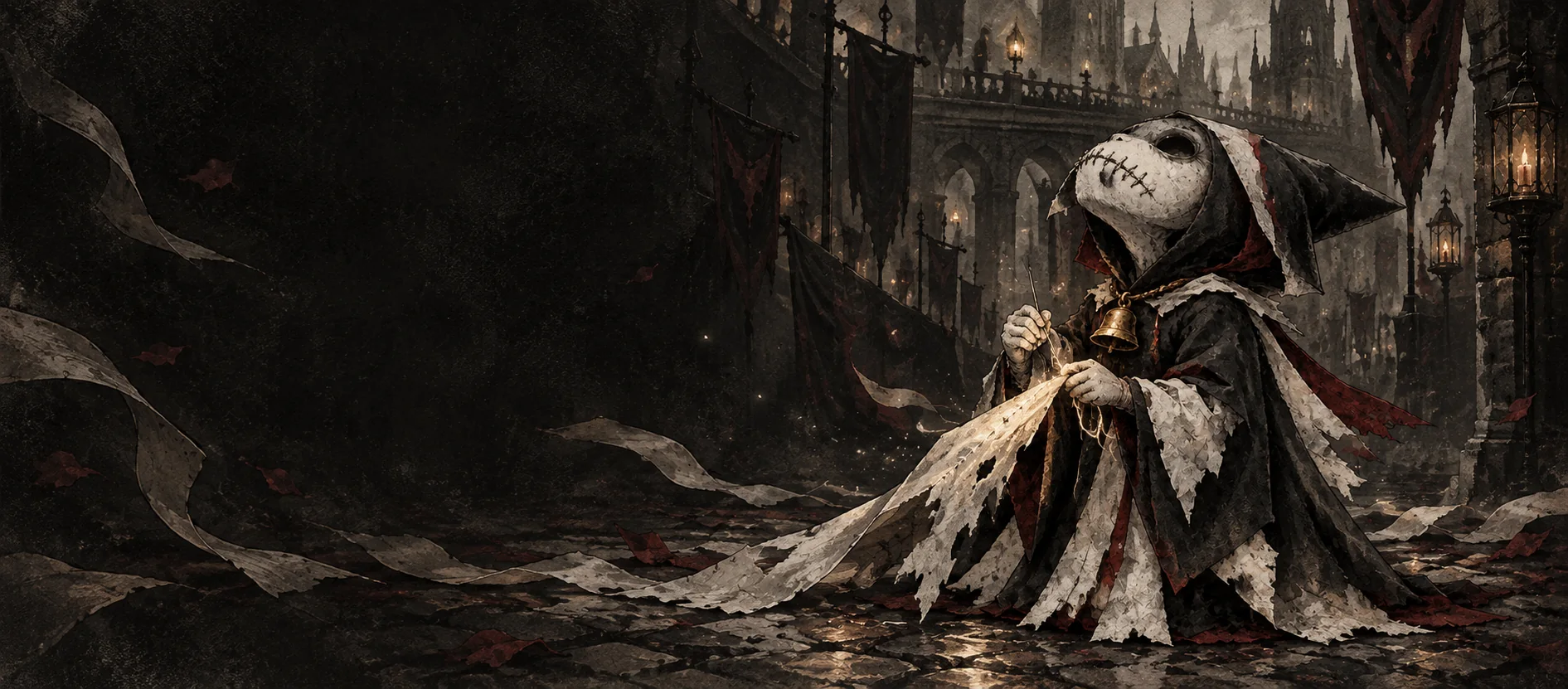
One July morning, a porter left a bundle against Meret’s blue door. It was wrapped in a gray mourning cloth with no name, receipt, or instruction. Meret brought it in before the rain spoiled the weave. Inside lay small pieces of black and ash-colored fabric, each cut too narrow for a proper garment. Someone had stitched them together and then abandoned the work. A brass bell, dull with age, rested beneath the scraps. It had no clapper and no maker’s mark Meret recognized.
Meret intended to sort the pieces and use what she could. She laid them on the table and began humming the tune her mother had used to keep time while sewing. The tune had no words. Her mother had taught it to her as a child, and Meret still hummed it whenever a task required patience. When she stopped to thread a needle, one scrap shifted against the table grain. She blamed the draft, moved the lamp, and saw the fabric settle again.
The second movement was impossible to explain away. The scraps gathered around the brass bell, not quickly or dramatically, but with the determined awkwardness of something learning where its edges belonged. A sleeve folded inward. Two strips crossed like hands. The black cloth rose, sagged, and rose once more. From under the unfinished hood came a small sound: not a voice, exactly, but the shape of a breath before speech. Meret stepped back. The bundle lifted its head and waited for her to choose what happened next.
A person, not a pile of names
Meret did not call the creature a miracle. She asked if it was hurt. The little figure turned toward her and held its stitched hands open. It had been assembled from mourning cloth, but its attention was its own. Meret wrote that distinction on a scrap of order paper: the creature was not the dead whose clothes it wore, not a container for their memories, and not a trick played by the bell. It was a new living presence, fragile, curious, and entitled to refuse a name.
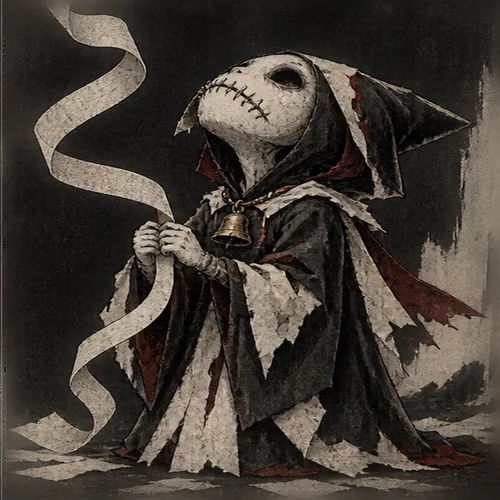
For three days Meret offered possibilities and watched the creature’s response. It ignored names that sounded like the shop’s inventory and leaned toward words associated with singing. When Meret said ‘choirling,’ its small head tilted. When she added ‘mute,’ it tapped the silent bell once with a cloth finger. The name was not a diagnosis; it described the way it communicated. The Choirling had several tiny mouths stitched into its patchwork face, but none formed ordinary speech. Each could release a breath-soft note too faint for the street.
Its first clear choice was a refusal. Meret laid out a bright red coat lining beside the black scraps, thinking color might cheer it. The Choirling pushed the red away and drew an ash-gray ribbon close. Meret apologized. It touched the ribbon, then touched her wrist, and the apology became unnecessary. They began with a practical bargain: Meret would not dress it in a color it disliked, and it would not climb the shelves while she carried hot irons. They kept that bargain more faithfully than many people keep written contracts.
The shopkeeper, Veyna, tried to record the Choirling as an unfinished garment so the city would not demand a permit for a ‘fabric familiar.’ Meret crossed out the entry. She wrote ‘neighbor’ in the margin and added the date the bundle had come to the blue door, July seventeenth. No one knew whether the spirit had existed before that morning. The date became its birthday because it was the first day anyone could celebrate together. Years later, the Ledger Crow associated the date with Cancer, the conventional Water sign of home, tenderness, and chosen family.
Learning the room
The Choirling learned the shop by touching what Meret touched. It knew the iron was dangerous because Meret held it away from the worktable. It knew the needle belonged in the cushion because Meret returned it there every time. It learned that a customer’s coat could carry grief without becoming grief itself. When someone came to collect a repaired sleeve, the Choirling watched their hands. A person might say ‘thank you’ and still clutch the cloth as if letting go would make the loss final.
Meret gave it a stool beside the window, low enough that the Choirling could watch the street without being seen from it. Its preferred pastime was sorting the narrow mourning ribbons by the sound each one seemed to hold. There was no audible music in the cloth. The Choirling pressed a mouth near a seam, listened with its whole face, and placed the ribbon in a pile. Meret sometimes asked what it heard. The Choirling answered with a gesture: one finger for a lullaby, two for a name, an open hand when it could not tell.
Its first mistake at the shop was also its first lesson about care. A grieving man brought a coat with a torn cuff and told Meret it had belonged to his sister. The Choirling began stitching before Meret had measured the tear. The needle pulled the fabric too tight, puckering the sleeve. The man flinched at the sound of the thread being drawn. The Choirling stopped. It did not try to fix the mistake faster. It sat still until Meret unpicked the seam, then watched her make a loose, patient stitch that left room for the cloth to move.
After that, the Choirling never treated repair as a way to erase damage. It learned to leave a seam visible when hiding it would make the garment feel false. Meret showed it how to reinforce a weak place without pretending the whole coat had never worn thin. The creature copied her hands, though its tiny fingers often tied knots too large for the needle. Together they found uses for every safe scrap. Their work was slow; the room became a place where no one had to be finished before they were ready.
The song that would not finish
A procession passed the shop most evenings. The city had a rule that a bell should mark the walk from the home of the dead to the burial ground. The rule was old, and people had learned to organize their breathing around it. A toll, a few steps, another toll. The Choirling began waiting by the blue door when it heard the first bell. It did not follow every procession. It went only when someone in the line lost the words they meant to say.
It first approached a child who had stopped beside the coffin of her grandfather. The child had been trying to repeat a joke he used to tell at supper, but every time she reached the last word her voice failed. The Choirling did not sing for him. It laid a thin ribbon across the child’s palms and breathed one tiny note into the seam. The child finished the joke in a whisper, then laughed once at the wrong place. Meret stood at a distance and let that imperfect laugh belong to them.
The Choirling learned that unfinished sentences had different weights. Some were words a person needed help saying. Others were words they had chosen not to say, and should remain unsaid. It began to ask permission before offering a ribbon. A nod meant yes; a hand closed around the fabric meant no. It never pulled a ribbon from a grieving person’s fingers. It understood that listening was not the same as collecting, and that a song held in cloth could comfort only if the person who had carried it was free to let it go.
Soon people left small bundles at the blue door: a cuff, a ribbon, a collar, sometimes a hem whose owner had died long ago. The Choirling treated every piece as a private visit. It did not ask who had worn the cloth unless the living person volunteered the name. When a name was offered, it repeated the sound as a soft breath and stitched it into the repair. The note was not the dead person’s soul. It was the Choirling’s memory of the living saying that name, and the difference mattered to it.
The household without a voice
Meret’s younger brother, Pell, returned from the river district with an injury that made speaking painful. He was old enough to insist he needed no help and young enough to believe the insistence. Meret set clean cloth beside his bed and pretended she had not noticed his hands trembling. The Choirling stayed near the threshold. It had learned that the room belonged to Pell; being invited mattered more than wanting to comfort him.
Pell eventually pointed toward the stool. The Choirling came in and sat with its back against the bed frame. It made no song. Pell had spent years being told that silence meant people were avoiding him, or that someone else would speak for him. The Choirling’s quiet was different because it did not demand a reply. On the second day Pell tapped a rhythm on the wooden rail. The Choirling answered with a single note breathed through one tiny mouth. They repeated the exchange until the rhythm became a private greeting.
When Pell began to recover, he taught the Choirling a hand game that had belonged to their mother. The creature lost every round. It understood the game’s pattern but failed to read the teasing change Pell made at the last moment. Pell laughed without pain for the first time in weeks. Meret entered and asked what was so funny. The Choirling lifted both hands in the game’s surrender sign. It had lost honestly and was delighted by the result.
The family did not treat the creature as a replacement for anyone. Pell was not the child whose unspoken grief had awakened it, because no such child had. Meret was not its owner. The Choirling had arrived in an abandoned bundle, but it stayed because it had made relationships and choices of its own. At home, its favorite seat was the stool by the window. At supper, it passed the salt without being asked. When the room grew tense, it waited to see whether anyone wanted a note.
A friend under the tower
The Choirling met Bracken beneath the west bell tower, where the dog slept when Eda’s father worked late. Bracken was not a bell spirit and did not belong to the Choirling. He was a dog with a dark coat, a metal jaw made later from a bell, and a habit of chasing the echo after the sound had ended. The Choirling watched him return from the alley with his ears raised and no answer in them. It left an ash ribbon near his paws.
Bracken shredded the first ribbon. The next one he carried in his mouth until it became wet. On the third evening, he lay down beside a folded scrap the Choirling had stitched into a square. It was not a toy so much as a place to rest his head. The Choirling sat at the opposite end and listened when he whined toward the empty tower. Each understood the other’s silence differently: Bracken hunted a sound that had vanished; the Choirling kept a note from escaping. Neither could repair the other’s loss.
They found a way to accompany each other without demanding a cure. Bracken walked ahead when the procession entered a narrow street. The Choirling followed at the pace of the slowest mourner. If a child cried, Bracken turned back toward the family, while the Choirling waited with a ribbon folded in its palms. They did not coordinate because Odrik OdrikFirst-generation championOdrik rang the funeral bells until something began answering between their notes.Read this biography → commanded them. OdrikOdrikFirst-generation championOdrik rang the funeral bells until something began answering between their notes.Read this biography → had not yet gathered the procession that would later bear their names. The friendship began as two solitary habits meeting at the same stair.
The Choirling later met Quietpaper Golem Quietpaper GolemC35 · 3 energy · 2/4Folded funeral notices pack its chest so tightly that no bell can make it speak.Read this folio → at a public reading after Abren’s death. It sewed a ribbon while Lio’s voice broke over the list of names the city had omitted. The ribbon held the rhythm of that voice, not the soul of anyone named. Quietpaper offered a clean piece of repair paper; the Choirling stitched it into an injured sleeve. They were separate people who recognized a shared task: make the record less cruel without claiming that recording could undo what happened.
The register under the bell
The west tower’s bell did not always ring for everyone. Its keeper, Iven, maintained a public schedule and a second private list of processions denied a toll. The official reason was that the mechanism had grown unreliable. The practical reason was that certain names had been marked ‘unapproved,’ and a bell rung for them would expose the city’s choice to leave their deaths unrecorded. Meret’s customers began asking why their family’s walk had passed without sound.
The Choirling heard the machinery even when the crowd did not. Inside the tower’s lower arch, a hidden cable tightened whenever Iven tried to ring for a name missing from the schedule. The cable ended at a locking device behind the bell frame. It was designed to keep the clapper from moving unless a certified register was present. The mechanism did not simply fail; it was built to refuse. When the Choirling pressed its small bell against the stone, a thread of cold tension pulled from the metal into its chest.
The creature could have returned to Meret’s shop and kept its notes safe there. Instead it began accompanying the unapproved processions. It did not ring the bell. It walked beneath it and held ribbons for the people the schedule had excluded. In the Crow’s account, one of those processions crossed in hard rain with the banner torn down its center. No one admitted hearing the bell, even though the Choirling felt the wire tense. It returned to that arch whenever its own stitches loosened, as if the tower could explain the sound it had swallowed.
Meret asked it not to go alone. The Choirling touched her wrist, then pressed a finger to the silent bell. She understood the request it could not make: come with me, but do not make this about saving me. They walked together to the tower. Meret carried spare thread and dry cloth. Iven kept the stair clear. Bracken lay under the lower landing. The small procession became a household for an hour, each person guarding a different part of the silence.
The cost of being a comfort
In time, the neighborhood began to expect the Choirling at every funeral. It was praised as if it were a service the city could schedule: bring the quiet little figure, and the bereaved will manage the walk. The Choirling disliked being treated as a solution. It could not restore a dead person, make a forced farewell fair, or promise that a family would find each other after the procession. Its small body could hold a ribbon; it could not hold every grief that strangers wanted to hand over.
Meret noticed the creature withdrawing from the door after a morning when three families arrived together. One woman had lost her husband, one boy had lost a sister, and a gray-haired porter had no one left who would claim him. Each expected the Choirling to decide which ribbon belonged to them. It sat beneath the worktable, silent even by its own standards. Meret turned the sign to CLOSED, though the day’s orders were unfinished. She told the waiting people that the creature was tired. A neighbor was allowed to be tired.
The porter was the first to understand. He set down a small spool of gray thread and said he had come to mend his own coat, not to be comforted. The Choirling came out. He asked whether it would sit near him while he worked, and it nodded. They repaired the pocket together. He did not ask for a song; the creature did not offer one. When he left, he carried a coat with a visible seam and no new memory placed inside it. That became one of the Choirling’s favorite kinds of visits.
Pell also helped protect its boundaries. When curious officials came to inspect the cloth spirit as a civic curiosity, he stood in the doorway and asked them to address it directly. A clerk asked the Choirling whether it could repeat the dead. It shook its head. Another asked whether it could identify unregistered graves. It shook its head again. The questions treated grief as a tool. Pell told the visitors that the creature was not evidence storage. They left annoyed, which pleased him more than he admitted.
The Choirling made mistakes that its family did not turn into legends. It once attached a mourning ribbon to the wrong sleeve and had to unpick it while the wearer waited. It occasionally mistook a quiet pause for an invitation and offered a note too soon. When Meret corrected it, it folded the ribbon away and tried again later. Its care was not magic that made it perfect. Care was how it learned to notice a boundary, accept correction, and return without asking to be praised for returning.
As Meret’s hands began to stiffen, the Choirling took on more of the small work: sorting thread, carrying folded cloth, and keeping the kettle away from the paper orders. It still could not use an iron safely. Meret would tap the table twice when a seam needed another stitch; the Choirling answered by touching the spool. The old rhythm became a conversation no one else could mistake for a spell. Some evenings they sat together without working. The creature did not need to sing for the room to feel shared.
On July seventeenth, the household kept the birthday small. Pell brought the old hand-game; Meret placed the silent bell on the windowsill; the porter visited with his repaired coat. They had no cake the Choirling could eat, so Meret made a little mound of clean fabric scraps shaped like one. It picked the grayest piece from the top and offered it back to her as a ribbon. That exchange said what the family had learned: it could receive love, it could choose what to give, and neither act made it anyone’s possession.
The last voice it kept
The tower’s suppressed toll had been made into policy. A council clerk named Vey ordered the mechanism sealed after Iven refused to remove the private list. The red locking tooth was driven deeper into the iron housing; the steel line ran through the old bell’s crown, down the arch, and into a hidden cabinet where the names were stored. It was not magic made to trap a soul. It was a device built to stop a bell and silence witnesses. Its later power over the Choirling was an unintended, terrible consequence.
On the night of the collapse, rain turned the narrow street into a black mirror. A family carried a child’s shroud beneath the tower, and the banner snagged on a cracked stone hook. The Choirling heard the mother lose the name she wanted to say. It had learned the sound of her practice at Meret’s shop: a name begun, then withdrawn because the grief was too sharp. The creature offered its ribbon, but the woman could not reach for it while keeping hold of the shroud.
The Choirling climbed the low wall and took the banner in both hands. Its cloth body was too small to hold the whole weight, but it could keep the torn edge from dragging across the wet stones. Bracken barked at the tower before anyone heard a creak. Iven shouted for the procession to clear the arch. The Choirling breathed its stored notes into the seam of the banner, one after another, until the family had a rhythm to follow out of the danger. Its last song let the child’s body reach the burial ground and gave the mother room to say the child’s name. The notes were not stolen from the mourners; they were the Choirling’s own remembered answer to their silences.
Then the locking cable snapped. A counterweight dropped through the bell frame and struck the lower support. Meret ran toward the creature. The Choirling could have released the banner and slipped from the wall, but the shroud and those carrying it were still beneath the broken arch. It pulled the last thread tight. The cable, its chest bell, the banner’s gray seam, and a brass hook became one taut line. The Choirling surrendered its voice to hold the fabric long enough for the people to escape.
When the body could no longer mend
The support came down as soon as the family cleared the arch. Meret reached the Choirling, but the counterweight had crushed its patchwork body against the stone. The cloth split at the shoulders; the bell was pressed inward; the many tiny mouths opened without sound. Meret knew how to mend a sleeve. She knew how to bind a cut and hold a hem against the rain. She could not put a spirit’s body back together while the iron cable still pulled through its center.
Iven cut the cable with a tower axe. The locking tooth fell, and the mechanism went quiet for the first time in years. The Choirling’s fabric loosened. Its spirit did not rise away. A line of cold light remained caught in the brass bell’s eye, stretched between the ruined body and the suppressed clapper. The bell’s missing sound had taken the Choirling’s final note; the note could not finish while the register stayed hidden and the names stayed unspoken. No person had chosen this for the creature. The trap had been made for records, but its metal held the spirit by accident.
The mother returned through the rain and said her child’s name. She said it once, then again more steadily. Meret wrapped the remains in dry mourning cloth. The Choirling’s spirit gathered around the small bell but did not enter the shroud. It was not the dead child. It had never been. It watched Meret’s hand tremble and tried to place a ribbon across her palm. The ribbon fell through her fingers. The gesture was the last thing it could do without a voice.
Bracken stayed beneath the stair. Quietpaper stood beside the hidden register. OdrikOdrikFirst-generation championOdrik rang the funeral bells until something began answering between their notes.Read this biography → arrived with a lantern after the first shouting had stopped. He did not summon the Choirling, bind it, or understand the whole cause. He asked Meret whether the creature had made a choice. She answered that it had chosen to hold the banner, not to remain dead. OdrikOdrikFirst-generation championOdrik rang the funeral bells until something began answering between their notes.Read this biography → marked that difference in his notebook. The spirit was still present, but presence was not consent to captivity.
The years in the procession
For a long while Meret carried the bell inside a padded pouch and took it to the tower only when the old processions passed. The cold thread brightened whenever an unapproved name was spoken near the hidden register. It dimmed when the city read a name aloud, but it never vanished. The Choirling could hear the living now as faint breaths through the cloth. It learned to make its small mouths move without sound, and the ribbons it left behind carried no audible melody at all.
Meret still celebrated July seventeenth. She put the silent bell beside a folded gray ribbon, set out a small thimble of honey, and told the story of the blue door. The Choirling could no longer touch the objects, but its spirit gathered at the edge of the room. Pell tapped their old hand-game rhythm on the bed rail. When the final pattern came, the bell trembled once. The family counted that as a reply, never as proof that the creature had become whole again.
The Choirling returned to the west tower and to the procession where the banner had torn. It tended seams in the living world as best it could. A ribbon would lie neatly folded beside an injured sleeve. A silent note would settle in fabric worn by a person who had managed to say a loved one’s name. Sometimes the grief belonged to someone the Choirling had known. Often it did not. It offered company, not possession; it had learned from its own death that care could become another kind of harm if it refused to let go.
OdrikOdrikFirst-generation championOdrik rang the funeral bells until something began answering between their notes.Read this biography →’s procession became a circle of separate people shaped by different absences. Bracken followed echoes. Quietpaper guarded names. The Choirling kept unspoken songs. OdrikOdrikFirst-generation championOdrik rang the funeral bells until something began answering between their notes.Read this biography → did not claim to have made them a family, though he made room for them to travel together. He asked each one what it wanted recorded. The Choirling answered with three ribbons: one for Meret, one for Pell, and one for the mother who had spoken her child’s name under the broken arch. OdrikOdrikFirst-generation championOdrik rang the funeral bells until something began answering between their notes.Read this biography → wrote no more than that.
The card that held the seam
OdrikOdrikFirst-generation championOdrik rang the funeral bells until something began answering between their notes.Read this biography → carried a Mournhand card whose back bore the black field, thorn filigree, teal astronomical lines, and red skeletal-hand seal used by the game. It was printed stock, thin and ordinary until a spirit’s name answered its face. He did not show the Choirling a blank invented token or promise that the card could free it. He told Meret what he knew: the card could hold the Choirling’s presence in a form players could meet, but the old wire’s claim would remain until the names and bell were honestly dealt with.
Meret asked the question OdrikOdrikFirst-generation championOdrik rang the funeral bells until something began answering between their notes.Read this biography → had avoided. If the card could preserve the creature, would that mean it had chosen to enter? OdrikOdrikFirst-generation championOdrik rang the funeral bells until something began answering between their notes.Read this biography → turned the card face down and waited. The Choirling’s cold thread reached toward the red seal, then tightened back toward the tower. It was not a yes. The notes it had surrendered were still entangled with the mechanism. OdrikOdrikFirst-generation championOdrik rang the funeral bells until something began answering between their notes.Read this biography → put the card away. No one would call the act a willing binding simply because the creature had once chosen to help a family escape.
They returned after the hidden register was opened to public reading. Lio, Meret, and the families named every person whose toll had been suppressed. Iven rang the repaired bell once for each name. The Choirling’s thread slackened, but the iron had already taken its life and the final note remained caught in its chest bell. When the last name was read, the spirit did not leave. It looked toward the blue door in Meret’s memory, then toward the procession waiting in the rain. It had been offered a path; the path did not restore its body.
OdrikOdrikFirst-generation championOdrik rang the funeral bells until something began answering between their notes.Read this biography → laid the official card beside the bell. The Choirling approached of its own will, though its spirit was still constrained by the old metal. It touched the printed red hand with one cloth finger. The teal lines glimmered like the narrow thread it had followed between tower and ribbon. The name ‘Mute Choirling’ appeared on the face as the card’s image settled into the creature’s familiar silhouette. The transformation did not make the creature a drawing, and it did not end the captivity. It gave the spirit a stable, recognizable vessel within the rules of the game.
A song written where no one can hear
The card did not contain the souls whose names the Choirling had remembered. It held one spirit: the Choirling’s own. Meret kept its first ribbon in a narrow box with the birthday thimble and the scrap of order paper that called it a neighbor. The card traveled with OdrikOdrikFirst-generation championOdrik rang the funeral bells until something began answering between their notes.Read this biography →’s procession. When its image appeared on a table, the tiny mouths moved in the same silent pattern they had made at the blue door. A wounded creature near it might feel the seam of pain ease by one small measure.
That limited comfort is the shape the game records as its entry effect: when the Choirling enters, it can heal another friendly creature by one. It cannot heal itself with that arrival. The distinction resembles its old work: it could offer a ribbon to someone else, but could not decide that another person’s grief should be sewn shut. Its two attack and five health describe the card’s combat body, not the scale of its kindness or the strength it showed beneath the tower.
It still sorts ribbons by the songs held in their seams. Sometimes it finds a lullaby, sometimes a name, sometimes only the stubborn rhythm of someone who kept walking. No one can hear the notes. The silence is not a trick, and the notes are not a cure. The Choirling does not know whether the quiet that follows is comfort or warning. It stays beside the injured while they decide what the quiet means for themselves.
The years did not undo its longing for Meret’s blue door, Pell’s hand-game, Bracken’s listening ears, or Quietpaper’s careful records. The Choirling was not made from those friends, and none of them was made from it. Their lives crossed because they chose to return to one another. When the procession moves, the little figure takes its place near the torn cloth and keeps the last thread from snapping. Its voice remains beyond hearing, but the care it learned is still legible.
 Clapper HoundC36 · 2 energy · 3/2It follows the echo after a bell stops, barking only at the silence left behind.Read this folio →
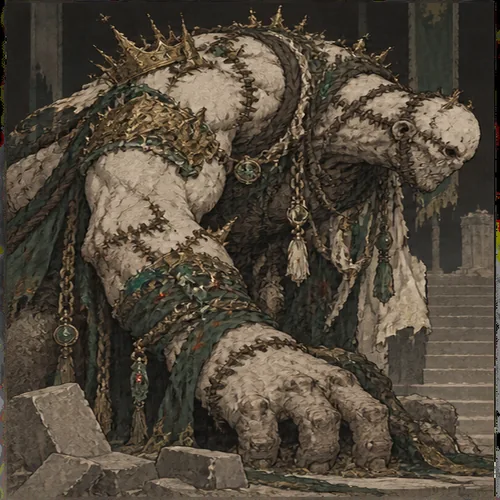 Crownsuture GiantC38 · 5 energy · 4/6Promises abandoned by rulers were sewn into its frame, and every step pulls one thread through its owner's heart.Read this folio →