
The little window over the stair
Perrin Olt was born on September 6, on a morning when rain made the courthouse steps shine like dark glass. No surviving clerk wrote down the year. His mother, Lenne, remembered the date because the roof above their rented room leaked into a wash basin, and the first sound her child heard was the plink of water on tin. She kept the basin long after the leak was repaired. When Perrin was old enough to ask why, she told him that a birthday should include one thing that had stayed. He liked the answer, though he thought the basin was an ugly thing to choose. He would spend his life learning that a useful object did not need to be beautiful to deserve keeping.
Their room sat above a narrow stair that led to the public petition hall. Lenne mended coats, hems, and work gloves from a small table beside the window. When petitioners waited below, Perrin heard them before he saw them: a cough, a wet boot being scraped against stone, a baby quieted against a shoulder, the careful rustle of a paper someone had folded until it was soft. He learned which voices came back week after week. Some brought the same complaint in a cleaner envelope. Others stopped coming. His mother never guessed aloud what their absence meant. She would say only, 'We do not know what happened just because a chair is empty.' Perrin kept that sentence as carefully as the basin.
The petition steps were the first map he knew. The top landing belonged to the court: polished stone, brass rail, a seal above the door. The lower landing belonged to people waiting to be heard. The stair between them carried clerks, guards, tradespeople, and children with errands. Perrin drew the steps on the backs of discarded receipts, marking where water pooled and which corners caught the afternoon sun. He did not yet imagine that the court's records could follow him beyond death. He only knew that a person could stand at the bottom of a staircase for an entire day and still be told that the door had never been closed.
Six September bread
Lenne marked Perrin's birthday with a small round loaf and one narrow ribbon tied around it. She could not afford a sweet cake, but on September 6 she brushed the crust with honey and let it cool on the sill. Perrin was allowed to choose the ribbon color from whatever scraps remained after her work. He always chose the palest strip, the one that looked almost white against the soot-dark stair. He said it made the bread look important. Lenne answered that bread did not need an official color to matter. For a few years the two of them disagreed about this every birthday, and for a few years Perrin pretended the disagreement was a game rather than a lesson.
He wanted a bell. The processional heralds carried small silver bells to announce the opening of hearings, the arrival of delegations, and the reading of new civic orders. When they passed beneath the window, Perrin leaned so far out that Lenne tied a cord around his waist and the table leg. He loved the clear note that came before a crowd turned to look. The bell seemed to make attention arrive without anyone having to beg for it. He did not yet know how often a herald could draw every eye while remaining personally invisible. He only knew he wanted to stand at the front of a procession and speak clearly enough that a person at the back could hear.
The herald's stair
Marit taught him the registry's practical rules. Fold a page along the old crease, not across the seal. Carry a petition with the writing turned inward so rain cannot blur a name. If a caller cannot read, offer to read the notice aloud but do not summarize the decision unless asked. She corrected his pen grip and showed him how to leave a narrow margin for later marks. Perrin learned to write evenly, to speak without rushing, and to keep his expression from changing when an official used a cruel word in a calm voice. Years later he would recognize that last lesson as the one he had never truly accepted.
Marit had a daughter, Vela, who was a few years older than Perrin and wanted to draw maps. She spent afternoons copying the streets around the courthouse, then adding alleys the official plans omitted. She and Perrin became friends by arguing over whether a map should show a staircase that ended at a locked door. Vela said it should, because the dead end was part of the route. Perrin said the map should show a way through if one existed. Lenne liked Vela's questions and saved her pencil stubs. When Vela left to study surveying, she gave Perrin a little brass divider with one leg bent. He kept it in the button box beside the scraps of names.
The processions fascinated him more than the filing cabinets. When judges entered the hall, attendants carried standards sewn with the city's crest. A herald rang the bell and read the names of the offices represented. The words were practiced until they sounded like music, but Perrin began to hear what was left out: the people who had built the stairs, hauled the banners, copied the orders, and waited below them. He asked Marit whether the procession could include the petitioners. She answered that the order of the march was older than either of them. Perrin asked who had made it. Marit said, 'Someone who thought an old rule would be easier to defend than a new choice.' She did not smile when she said it.
A column for who benefited
The first entry that stayed with him belonged to a laundress who had been fined for using water from a public cistern after her private pump broke. Her daughter had a fever; the water was boiled and used to wash the child's sheets. The assessment listed the woman's name, the amount owed, and a clerk's neat note that the matter was closed. The beneficiary column was blank. Perrin asked who had received the fine. His supervisor told him the money went into civic accounts. Perrin asked which account. The supervisor replied that he had not been hired to audit the treasury. Perrin copied the line exactly, then put a small dot beside the blank column in his private practice book. It was not a rebellion. It was a promise to himself that the blank would remain visible.
Vela came back to the lower ward several months later with rolled maps under her arm. She had learned how the aqueduct divided water among the districts and had found a gate that could be adjusted to give the lower street more pressure. She wanted the court to repair it. Perrin found the petition number and read the status aloud: deferred pending review. Vela asked what that meant. He explained that it meant no one had decided when to decide. She said the phrase sounded like a room with no door. Perrin wanted to tell her he could move the paper. He knew he could not make the court act. Instead he marked the number on the margin of his button-box list, and Vela drew the gate on her map with its handle facing the street.
Lenne's repair work was steady but never secure. A large account from the court could pay for a week's food, while a delayed invoice meant she had to stretch thread and supper. Perrin brought home a pair of official gloves once, the leather split at the fingertips. Lenne repaired them and sent them back before he could ask whether she wanted to keep them. The registry paid her late. She did not blame Perrin, but she refused to pretend the payment was a gift. 'Work is not kindness just because someone gives it a seal,' she told him. He wondered whether the court understood the difference. He copied the phrase into the blank space of his private practice book, under the laundress's dot.
The first speech he read
At seventeen, Perrin was given the bell and a place in the procession. His voice had settled into a low, clear register, and Marit believed he could be trusted not to improvise. The first order he read announced the closure of a market arcade whose roof had become unsafe. The merchants would be moved temporarily; the owners would receive compensation after inspection. Perrin saw Lenne's stall among the listed businesses. He also knew the arcade's beams had been reported as cracked for years. He read the notice exactly as written. The owners received compensation. The merchants did not. Lenne carried her tools down the courthouse steps in a basket and did not ask her son to explain the sentence he had spoken.
That night she let him sit in the quiet shop while she sorted the broken needles. Perrin said he had only read the order. Lenne said she knew. He asked whether she thought he should have refused. She answered that she wanted him to notice the difference between keeping a job and believing the words a job required. She had needed his wages. She had also needed him to understand that necessity could make a person participate in something that hurt them. She did not give him an easy absolution because she did not want to teach him that the harm vanished when a worker was poor. Perrin began to see that a person could be both responsible and constrained.
Marit was not a villain and was not blind. She had spent twenty years keeping petitions from disappearing between departments. She knew the name of every clerk who could locate a misplaced page and which stair a messenger should avoid during a hearing. Once, she had smuggled a copy of a flood report to a neighborhood before the court could suppress it. She had also taught Perrin to read orders that buried their beneficiaries in the passive voice. When he confronted her about the arcade, she listened, then said she had marked the order for review and the judge had rejected her note. Perrin asked why she had still trained him to read it. Marit said the doors could be opened from inside, but not if nobody knew where the hinges were. He understood her answer. He did not forgive the order.
Lenne and the returned coat
On his twenty-first birthday, Lenne returned a coat to a petitioner who had left it at the stair after a hearing. A loose lining had been hiding a folded notice. The woman had been ordered to vacate a room by the end of the month, but the court's copy listed the wrong building number. Lenne repaired the seam and brought the coat upstairs rather than sending it through the registry. Perrin corrected the address and asked Marit to reopen the notice. The woman kept her room. The error had not been a grand conspiracy; it was a copied numeral that nobody checked because the woman had no representative. Lenne kept the torn lining as proof that a small repair could change the route a life took.
Perrin and his mother argued about whether kindness should be entered into a record. Lenne thought the woman deserved privacy after the immediate danger passed. Perrin believed that recording the correction might prevent the same mistake from hurting someone else. Their conflict lasted nearly a month. Perrin learned to ask before copying a person's name. Lenne learned that anonymity could hide the institution's responsibility as easily as it could protect a neighbor. They settled on a narrow agreement: the public ledger would record the error and correction without the woman's name, while Lenne kept the name in a private envelope in case she wished to make a claim later. Neither called the compromise perfect. It was simply theirs.
The banner with the cut name
The Bannerless Lion Bannerless LionC40 · 3 energy · 3/4It guards no king because every banner it served was eventually burned.Read this folio → entered Perrin's life first as a quiet shape at the far end of a procession route. It was not a person under the cloth and not a statue ordered to stand there. The lion's fur held the colors of old standards: faded red, smoke-gray, and the dull blue of a banner left too long in rain. It wore no crown. Its eyes followed the names on the herald's list whenever a standard passed. Perrin was told not to alter his announcement. The page in his hands named the office that had commissioned the banner but not the workers who had sewn it, the families taxed to pay for it, or the soldiers told to carry it.
A year later, another banner was burned after an uprising. The Lion stood beside the blackened post as people gathered to watch the cloth curl into ash. Perrin was ordered to read the names of the offices whose seals had been stitched into it. He could not add the names of those who had been punished for refusing to carry it. He found the Lion waiting after the crowd dispersed. Perrin said he was sorry. The Lion asked, in a voice like cloth dragged over stone, whether Perrin had promised to speak for them. He had not. Perrin answered that he would not claim a promise he had never made. The Lion nodded once. It was the first time Perrin understood that refusing an easy claim could be a form of respect.
The Lion and the Page did not become friends in a single meeting. They disagreed over the meaning of service. The Lion had guarded standards because someone had put them in its care; Perrin thought a guard's duty could not be separated from the people ordered to serve the symbol. The Lion said a promise can be freely given and still become dangerous when another person controls its terms. Perrin answered that a promise nobody can question is only an order wearing a softer coat. The Lion did not tell him he was wrong. Over the years, the Page would carry announcements for banners that were eventually burned, and the Lion would remain to witness their passing. Each saw the other return. Neither claimed ownership of the other's memory.
The line he would not read
Perrin was thirty-two when he was asked to announce a sentence against a group of water carriers. The people had opened a locked cistern during a heat wave after the public channel failed. The court's order called the act a breach of civic property. It did not mention the dry wells, the children who had fainted, or the clerk who had delayed the repair request. A new line had been added to the register: the cost of the broken lock would be charged to the carriers. The beneficiary column, as ever, was empty. Perrin asked the judge's assistant to name the party receiving the recovered fees. The assistant said the question was outside his duties. Perrin said the sentence was inside his voice.
Marit urged him not to turn one refusal into a spectacle. She warned that the court could dismiss him, and his wages still paid for Lenne's medicine. Perrin understood; he had seen how quickly a brave speech could leave a family with no rent. He did not announce the sentence. Instead, he stepped out of the procession and set the bell on the rail. Another herald took his place. The court wrote that Perrin had failed to report for duty. He was dismissed without severance. Lenne was frightened and angry, and did not pretend she was proud of the choice just because it had cost them. They counted the coins they had left and made a list of repairs she could still accept. Perrin found other copying work. Their household survived, but his mother had to sell the honey jar she had kept since her own childhood.
Vela, now an experienced mapmaker, helped Perrin document the cistern failure. They walked the route from the dry neighborhood to the locked gate and marked each place where water carriers had turned back. Vela's map included the court's official seal and the empty beneficiary column. Perrin wrote a testimony beside it in his own name. He described his refusal, his lost wages, and the fact that he had no evidence of who personally received the fee. He would not invent a culprit to make the account feel complete. That restraint frustrated people who wanted a villain they could point to. It also made the record credible. Perrin had learned that a missing answer should remain visible instead of being filled with whatever story felt satisfying.
A register with a human margin
Vela challenged him when his notes began to treat every delay as malice. A missing signature could mean a clerk had been careless, or that the document had been removed, or that nobody had ever been assigned to make the decision. The difference mattered. Vela drew three routes on a map and asked Perrin which one he could prove. He admitted he could prove only the first two. They argued over the third until the tea cooled. Perrin felt defensive because he had worked hard to stay precise. Vela reminded him that precision was not a personality trait; it was a practice that had to survive being wrong. They revised the entry together and wrote down what remained unknown.
On September 6, he placed the old tin basin beside the window and filled it with rainwater. Lenne was older; her fingers no longer made the small tight stitches that once kept every coat in service. She gave him a length of pale ribbon and said she had kept it for him since the day he first wanted a bell. Perrin tied the ribbon around the wooden button box. He was not a child anymore, and the box held more than scraps. It contained Vela's bent divider, the arcade notice, the cistern map, and a letter from Marit acknowledging the orders she had failed to change. Perrin kept the ribbon because it made the box easier to find, not because he believed a private archive could fix a public record.
The staircase he carried
When Lenne died, Perrin was forty-one. She had been ill for a long time, and there was no sudden court order to blame. She chose the room where she wanted to sleep, asked Vela to bring the map of the lower ward, and made Perrin promise that he would not turn her final days into a public lesson. He kept that promise. He sat with her, repaired the hem of her nightdress, and brought the old tin basin to the bedside when she asked to hear the rain. Her last words were ordinary: she told him the lamp needed more oil. Perrin refilled it after she was gone. The house kept the scent of thread and barley tea for weeks, and grief did not make those things symbolic until later.
The petition stair changed around him. New stone covered an old crack; the brass rail was replaced; the little window above the landing was bricked in when the room became storage. Perrin kept the tin basin in his own lodging and the button box beside his desk. He could no longer hear petitioners from the room where he slept, so he walked down each evening and listened. He asked people what result they wanted before offering to copy their appeal. Sometimes they wanted a decision. Sometimes they wanted their name kept off the public board. Sometimes they wanted a witness to sit with them while they waited. Perrin learned to ask twice: what should the record say, and what should it leave out?
The last procession
Perrin was in his late fifties when the courthouse ordered one final procession through the lower ward before closing the old petition hall for repairs. The order said the hall would reopen after the work. Nobody could tell the families on the steps how long that would take. A new route had been drawn through the archive passage, where shelves of unpaid assessments and old return dockets stood behind a locked door. The city wanted the crowd to see the banners and hear the offices named. Perrin was asked to carry the debt register because he knew its index. He asked for the beneficiary column to be restored to the public reading. The clerk said the procession script had already been approved. Perrin said the register was not ready to be called finished.
A crush formed at the archive door when rain drove the waiting people beneath the narrow passage roof. One hinge had rusted through. The clerk tried to send the crowd around to the upper entrance, but the route was barred by the construction fence. Perrin put the register on a shelf and helped open the side passage. Vela, now gray-haired, came through with a roll of maps under one arm. She called to him that the lower landing was flooding. The water had entered the old records room and begun lifting loose pages from the floor. Perrin knew which shelves held the return dockets. He went back inside to pull them above the waterline, not because every paper mattered more than a person, but because he believed the people waiting outside had a right to know what the court had written about them.
A timber brace shifted above the passage. The crash was not grand or beautiful. It was a short crack, then a weight that drove Perrin to one knee. The edge struck his shoulder and pinned his coat against the shelf. Vela and two attendants pulled at the beam, but the water and crowd made the footing dangerous. Perrin pushed the register toward them. He told Vela to take the list with the names still open. She said she would not leave him. He asked her to stay with the living people at the door, where her maps could lead them to dry ground. She did not forgive him for making the choice for her. She made it anyway, and the last thing Perrin saw clearly was her bent brass compass catching the lamplight as she turned to guide the crowd.
The open return docket
Perrin's body was carried out after the beam was lifted. He was buried in the lower ward beside Lenne, with the pale birthday ribbon wrapped around the button box that Vela had returned to him years earlier. His life ended there. The record did not. The damaged debt register lay open in the archive passage, its pages soaked and its return docket stamped but unfinished. Under the court's old process, an unresolved account was meant to be returned to the office that had issued it. The clerk recorded the wrong destination, then added no receiving name. Perrin had spent a lifetime marking the difference between an open case and a completed one. Now the institution's own unfinished instruction treated him as the missing page it expected to receive.
Nothing in the hall was meant to capture a soul. No one drew a circle, spoke a binding word, or chose Perrin as a vessel. At the moment his breath stopped, the wet register's last loose leaf clung to his coat. Its margin carried the unfinished return mark and the blank place where a beneficiary should have been named. The old seal recognized an account without an acknowledged recipient and sent the departing spirit back toward the record that still awaited delivery. The passage repeated. Perrin felt himself move away from the stair, then drawn to it again, like a messenger sent to a door that never opened. The dead had not refused him. The paperwork had failed to release his name.
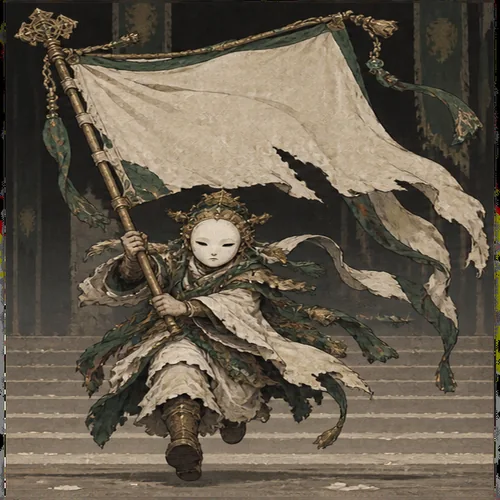
The water dried. The damaged leaf tore along its edge, and the torn margin wrapped around the place where Perrin's hand had held the register. His spirit could no longer appear as the tired clerk Vela remembered. It took on the shape of the paper that had been mistaken for its destination: a small herald with a blank face, layered scraps like sleeves, and a narrow banner whose name had been cut away. The clothes were not a second person. They were the returning form the docket had made for the one person caught inside it. Perrin could still remember Lenne's laugh, Vela's map, Marit's stained thumb, and the water hitting the tin basin. What he could not do was choose a road beyond the archive steps.
The list grew heavier each time the court issued a punishment without saying who gained from it. Those names did not become additional spirits inside Perrin. They were records, not people trapped in the Page. He knew the distinction and tried to keep it legible, even when the old seal blurred the edges of memory. He could not begin a charge or create an injury that had never happened. He could only add a final mark to a wound already entered in the register. That limitation was not a moral power bestowed on him; it was the exact shape of the unfinished instruction that held him. He wanted to help, but the docket allowed him to close a line, never to choose the first one.
The long waiting of a page
Vela returned to the petition steps for many years. At first she brought maps, hoping the registry might finally name a recipient for the old docket. Later she brought only the bent divider and sat beside the closed archive door. She never called the Page Perrin unless she was sure it had heard her. When she did, the paper figure inclined its head, and Vela spoke about ordinary things: a road shifted after a flood, a student who had made a careful map, the first day she stopped expecting her mother to appear in dreams. She did not ask the spirit to answer for every decision he had made. Their bond had survived because neither had mistaken love for the right to demand a reply.
The Bannerless LionBannerless LionC40 · 3 energy · 3/4It guards no king because every banner it served was eventually burned.Read this folio → remained at the route's end. Through successive years, banners were raised, contested, and burned. The Page was summoned to announce the offices or debts attached to them; the Lion stood witness to the cloth's eventual fall. They recognized one another across each procession. The Page kept the names and obligations in order. The Lion kept asking whether allegiance had ever been freely promised. Neither could make the other forget. Their arguments changed as the faces around them changed. Sometimes the Page defended the need to preserve a record even when it was incomplete. Sometimes the Lion reminded it that a name copied without consent could become another kind of injury. They did not settle the question by agreeing. They learned how to return to it without turning disagreement into abandonment.
Centuries did not pass like a row of calendar pages. The spirit noticed them through changed materials: ink that no longer stained the same, a new brass seal, stairs resurfaced beneath its paper feet. Its body frayed and was repaired by hands that believed they were mending a banner. Each repair altered its outline but not the memories held inside it. Once, a child left a honey-crusted piece of bread on the landing and asked whether the Page was hungry. Perrin could not taste it. He kept the crumb in a fold of paper until the next rain. He had been taught that attention was not permission to demand an answer. He wanted to tell the child thank you, but the form produced only a faint rustle, and the child smiled as if that had been enough.
The seal in Iona's handwriting
The return docket's seal changed hands as the courthouse changed its rules. The oldest promise in the file bore a signature the Page could not place. It was not Perrin's writing, and it did not belong to Marit or Vela. The words promised that a petition would be carried forward rather than buried beneath a closed account. The beneficiary line had been left empty. The signature was older than the Page's current recollection, and the seal had been pressed hard enough to leave its mark on the next sheet. The Page kept the paper because an empty space was not the same as no one having made a promise.
Much later, the court began an inquiry into the promises it had inherited. The champions who came to the petition steps were not part of Perrin's mortal life; they were new to the old story and to the spirit trapped in it. Iona IonaFirst-generation championIona catalogs the promises every ruler abandoned.Read this biography → read the list while Kael
 KaelFirst-generation championKael kept the foundry gates open when the city ordered its workers sealed inside.Read this biography → waited beside her. She recognized the seal and said the handwriting was hers, though she had forgotten the page. It could only turn the margin toward the light. IonaIonaFirst-generation championIona catalogs the promises every ruler abandoned.Read this biography → saw that the debt had not been settled just because the record had been stored away.
When the encounter ended, IonaIonaFirst-generation championIona catalogs the promises every ruler abandoned.Read this biography → did not claim the Page as a servant or say that her signature had caused its captivity. She named what she could carry: the list itself. She gave the Procession Page to the player, asking them to take it forward while she carried the record from there. The new card held Perrin's entire spirit in the familiar paper herald's shape. It did not contain the people written in the register, and it did not turn their unresolved cases into his possessions. The old return seal still tethered him to the mortal world. The card offered a stable form for play, not an afterlife, an apology, or a release.
The Procession Page costs one energy and is a 1-attack, 2-health creature. On entering play, it deals one damage to an enemy creature that is already damaged. It cannot choose a healthy creature, start the wound, or target a champion. If an enemy creature has one health remaining after an earlier wound, the Page's entry can finish it; if every enemy creature is healthy, the printed effect has no legal target and does nothing. The order matters: establish damage first, then deploy the Page.
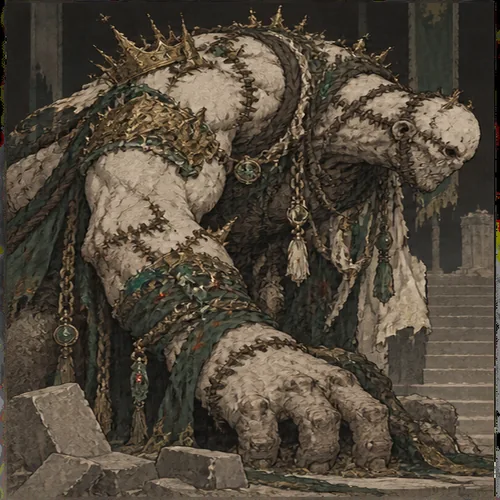 Crownsuture GiantC38 · 5 energy · 4/6Promises abandoned by rulers were sewn into its frame, and every step pulls one thread through its owner's heart.Read this folio →