
The warm stone
Barro broke his shell on December 9, in a bed of sand beside the orchard's south wall. The people who tended the glass frames were arguing over whether the weather would spoil the late pears. His mother, Sove, ignored them until he had freed his second front foot. Then she lowered her broad head and nudged a piece of eggshell away from his mouth. He remembered the touch longer than he remembered the wall. There were three other hatchlings that season. His sister went directly toward the brightest patch of sun. Barro went toward a fallen leaf, climbed onto it, and seemed offended when it moved.
The orchard accommodated tortoises without pretending they were small people. Its thresholds were shallow, drinking basins wide, and gates fitted with low bars that a blunt nose could lift. Sove could speak when she wanted something said precisely, but much of the household's conversation happened through movement: a hind foot shifted to offer space, a patient head rested across a path to insist upon a pause. Barro learned both languages. He was especially good at looking harmless beside a stripped lettuce bed. He was less good at remembering that the people who planted it could count.
A human child named Hessa marked his first birthday on a slate because she marked everything. She recorded rainfall, bird nests, quarrels between adults, and the occasions when Barro's sister pushed him from their favorite stone. On subsequent December birthdays, Hessa put a slice of stored pear beside his basin. He preferred the bruised edge, where the flesh had softened. He never understood why people apologized for offering it. His mother explained that some creatures valued a thing more when it looked untouched. Barro considered this unfortunate, since almost everything he liked had first needed someone to make a mark upon it.
His earliest ambition was to get beyond the orchard gate. He could see carts pass through the gap and imagined each returning with a different sky folded under its cover. Sove allowed him as far as the first roadside hollow, then blocked the way with her shell. He complained that she knew nothing about travel. She waited while a heavy wagon rattled past, close enough to shake grit onto his nose. Afterward she took him to the hollow and showed him where its dry edge stayed above the rainwater. The lesson irritated him because it was useful. He would remember that irritation whenever somebody younger mistook caution for a wish to keep them small.
The useful wrong turn
Hessa grew into a keeper of trees. Barro grew into a tortoise too large to disappear beneath her bench, although he tried for several summers after it had become impossible. They worked together along the irrigation channels. She opened the narrow cuts with a hoe; he pressed loose banks into place with the side of a forefoot. He could distinguish a thirsty tree by the smell beneath its bark, but he could not prune one. Hessa could reach the branches, but she hurried past changes in the soil. Their arguments usually began when either forgot the other possessed a useful sense that could not be borrowed by issuing instructions.
They developed an undignified method of making decisions. Hessa laid three flat stones beside a disputed tree. Barro touched one for agreement, another for refusal, and the third when he wanted her to stop talking long enough for him to explain. He used the third stone excessively. She began calling it his stone, which made him refuse it for a week. During that week he agreed to an arrangement he disliked merely to avoid the joke. The resulting drainage ditch flooded his sleeping hollow. Hessa helped repair it without mentioning the stones until he pushed all three back into their proper places himself.
His first journey alone was to deliver grafting shoots to a nursery beyond the hills. He carried them in damp cloth secured around his shell, walked too confidently past a turning, and arrived at a lime quarry instead. The quarry workers gave him directions and a shallow bowl of water. He returned with the shoots delivered, two days late, and a story claiming that the longer route had been deliberate. Hessa let him finish. Then she pointed to the nursery's note, which thanked her for the unexpected entertainment. For years afterward, Barro called any wrong turn an inspection of alternative ground. He liked the joke more after it stopped concealing an excuse.
There was a pale thorn hedge around the nursery's grafting yard. Its inner bark could keep a severed shoot responsive while a graft took, so growers wrapped tiny shavings around difficult joins. Hessa handled those shavings with gloves and never used them against living flesh. They belonged between one plant and another. Barro watched her demonstrate the difference, then forgot most of the explanation because she had also brought a bag of seed cakes. Much later he would remember the smell of that hedge before he remembered its danger. The nursery owner never invited him inside the house, even in rain, but while he had an orchard to return to, he did not yet understand that as a refusal.
A roof small enough to carry
Barro's adulthood was long and busy. He helped keep the orchard paths firm, carried tools when he agreed the load was reasonable, and escorted visitors who otherwise lost themselves among identical rows. He charged fruit for that last service and sometimes accepted payment twice from people too distracted to remember. Hessa discovered the practice and made him lead a whole afternoon's visitors without reward. He protested that she was ruining his reputation as a guide. She replied that his reputation was precisely what she was trying to repair. Years later he told the story honestly, including the part where he had pretended not to understand her.
Human lives moved faster than his. Hessa's hair grayed; a granddaughter took over the pruning; the slate with his birthday passed into a different cupboard. He disliked being addressed as though he had become a piece of inherited equipment, and said so whenever a new keeper assumed his help came with the land. Yet he loved the changing household. He learned new voices, tolerated dreadful attempts at Hessa's old cakes, and allowed each generation to believe it had invented polishing his shell with fallen leaves. Sove eventually settled farther along the river with other tortoises. Their visits grew less frequent, but she remained herself in every message: practical, affectionate, unimpressed by the weight of anything he volunteered to carry.
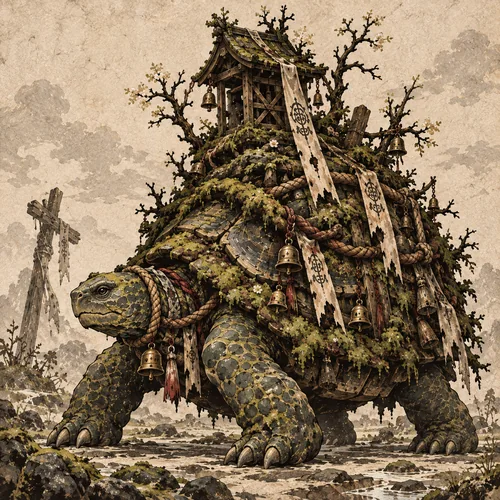
Hessa's grandson Tavik became a carpenter. As a young man he built a miniature wayside shrine to replace one that had rotted near the orchard gate. Barro objected to its location, because travelers had to stand in the cart track to approach it. Tavik suggested putting it on his back. Barro thought this was mockery until he saw the drawings: a light wooden structure, a broad padded saddle, no nails into shell, and doors that could open while he rested. He agreed after making Tavik reduce the roof twice. The shrine gave travelers somewhere dry to leave a written hope. It did not promise anyone an answer.
They enjoyed testing it. Tavik walked backward to watch the bells swing, stumbled into a ditch, and spent the rest of the afternoon insisting the ditch had moved. Barro repeated this explanation whenever the carpenter measured anything. One bronze bell had a low, uneven note that Barro particularly liked. He learned to rock his shell just enough to sound it when Tavik became solemn. The carrying cloth beneath the shrine was moss green, cut to leave his neck and legs free. Hessa had been gone for years by then, but the birthday slate remained. Tavik put it beside the shrine each December and offered a pear with its bruised side facing outward.
The first refusal
The orchard's ownership changed after a dispute Barro never fully understood. He understood the consequences. Water was diverted, tenants received notices, and men who had never pruned a branch began measuring the ground for a different use. Tavik and the remaining household were given rooms in a distant street. Those rooms stood above stairs. Barro could neither enter them nor fit beneath the building's low storage arches. People spoke of finding him a yard as though a yard were interchangeable with every place he had lived. He responded badly. When Tavik asked what would satisfy him, he said a friend would already know.
He later wished he had answered differently. Tavik had work, debts, and an injured wrist that made every carrying job painful. He spent evenings asking for somewhere a large tortoise could rest without being penned as an attraction. Barro saw only that the answer remained unfinished. He set out with his shrine and a folded length of the green cloth, announcing that he would find a household which understood a guest should not need to defend his size. Tavik offered to walk with him after the week's work. Barro replied that a week was a long time to remain unwelcome. It was a cruel thing to say to someone who had not sent him away.
He went first to the nursery that had received his grafting shoots. Its owner had died; the owner's son recognized the shrine but refused the covered yard. He feared the tortoise would damage the paving and said the outer hedge provided enough shelter. Rain came through it. Barro waited until the household lamps had gone dark, then bit a thorn from the pale branches, carefully turning its point away from his tongue. He pushed it into a fold of damp carrying cloth he could reach beside his shoulder. He meant to keep an account of the refusal. The thorn's cut end touched an old scuff in his shell, and by morning it had put out a white thread of root.
That was the first thorn. He did not foresee an orchard. He only wanted something that could not be explained away by a person who had slept indoors. At the next village, where he was sent away from an empty cart shed, he took another thorn from the lane and lodged it in the same cloth. A woman at a roadside stall helped him secure it after asking permission to touch the load. He thanked her stiffly, ashamed that kindness from a stranger made him want to cry. He had not yet learned to receive a small welcome without comparing it to the larger welcome someone else had withheld.
A garden made of no
The pilgrimage began as a search for shelter and became an argument he carried everywhere. For each village that denied him a place, Barro planted another roadside thorn in the moss and cloth across his back. He worked with his mouth where he could reach. Willing travelers placed the others higher, guided by his directions; no one was allowed to pierce the shell. The pale nursery cutting accepted the strange grafts. Blackthorn, crooked hedge twigs, and branches whose names he never learned grew into a single close network. Roots held moisture in the saddle, and the shrine gradually acquired a roof above its roof.
Some refusals were simple cruelty. Children were encouraged to throw stones at the creature their parents called an ill omen. An innkeeper offered a stable, then demanded more money after Barro had already settled and the rain began. Other refusals were harder to place among these. One household had no ground firm enough for his weight. Another had room but feared losing its lease. He initially took a thorn from both. When a widow walked half a mile to bring him water after turning him away, he concealed the cutting beneath his cloth. He wanted his collection to tell a clear story about other people. It was becoming an uncomfortable record of his own judgments as well.
He still found pleasures. Sunlight reached his shoulders through the lattice of new leaves. Bees investigated the shrine doors. He could tell whether a town was near by the smell of its bread before he heard its bells. He discovered an excellent resting place under a broken aqueduct and returned to it so often that a shepherd began leaving him a flat stone warmed beside her cooking fire. She asked no vow, accepted no grand account of his suffering, and laughed at his route jokes. Barro found this restful. He stayed three days the first time and nearly a month the second, then left because remaining began to feel like admitting his pilgrimage could have an ordinary answer.
The young orchard bore small, hard fruit. It was bitter enough to make people accuse him of joking when he offered it. He was embarrassed and blamed the road dust. Once, a courier with a torn heel rested beside him, unable to continue until her companion returned with a cart. Barro lowered his body so she could lean against the cool edge of his shell. By evening the fruit above her had softened. She tasted one and described the sweetness before he tried it himself. For a moment he tasted his old orchard's late pears, although the fruit was nothing like a pear. He remembered the basin beside the south wall so sharply that he could almost feel its rim against his chin.
The road with company
The courier was called Adeli. Her heel recovered slowly, and she traveled with him between two market towns rather than risk walking alone. She had a quick laugh, a careful way of dividing provisions, and a habit of asking questions just after Barro thought a conversation had ended. He told her which villages had refused him. She asked which had not. The question annoyed him enough that he pretended a bell had drowned it out. Later he listed the aqueduct shepherd, the woman who had secured his first cuttings, and a miller who had lowered a gate for him. Adeli made him include them whenever he repeated the journey. He accused her of spoiling a good complaint.
She taught him to distinguish company from assistance. Some evenings she needed his shade; others she walked ahead simply because she liked arriving at the next bend before he did. He did not have to be useful every moment to justify her presence. They argued over the correct amount of salt in a traveling meal and whether rain smelled different on a road one knew. When she finally left for her own destination, she tied a plain cord beside the shrine's low bell. Barro asked whether it meant she would return. She said it meant she had enjoyed being there. He took longer to accept that answer than he had taken to learn the route.
The orchard responded most strongly to those carrying hurt. Its fruit stayed bitter beside comfortable travelers, but ripened under the shelter of a bandaged limb or a body too tired to hold itself upright. The branches seemed to listen through the roots laid across his shell. Barro could not make them respond by commanding them. Nor did the fruit close a wound or promise a cure. It was food, unexpectedly good food, offered to someone having a difficult day. He began following the slower tracks along roads, where the wounded were more likely to travel after everyone else had passed.
He was not always gentle. Once he drove an injured man from his shade after recognizing the badge of a household that had thrown stones. The man limped away without arguing. Barro kept the fruit until it spoiled, unable to enjoy its sudden sweetness. The next morning he followed the broken trail, found him beside a culvert, and placed a branch within reach. He apologized without asking the man to explain whether he had been among the throwers. It did not settle whom Barro ought to forgive. It did show him that refusing another creature shelter could become an easy habit, even for someone who had built his whole life around remembering the pain of it.
The roots beneath the shell
Winter caught him on a high road after a longer journey than he should have attempted. The orchard had grown heavy, and a fall on loose stone had opened a narrow fracture beneath the saddle. He concealed the injury from a carter who offered to seek help, embarrassed to admit that carrying his refusals had become painful. At the last village before the pass, the covered yard was full of grain. He was told to move on. He collected a thorn from the hedge, lodged it beside his shoulder, and continued until the wind made his eyes water. He intended to reach the aqueduct. Instead he found a hollow scarcely wide enough for his body.
He died there during the night. It was not a noble bargain or an attempt to save somebody else. He had been cold, hurt, thirsty, and too proud to let a stranger see how much assistance he needed. As breathing became difficult, he thought of Tavik's unfinished sentence at the orchard gate. He tried to form an answer to it. The bells moved once when his weight settled. Snow entered the shrine through a door he had forgotten to fasten. Beneath the carrying cloth, the old pale root had found the shell fracture and followed its warmth inward.
The nursery hedge had been bred to hold a failing graft at the edge of separation until living wood could join it. Barro's cutting had spent years feeding through the orchard and learning his living rhythms through damaged shell. In that final night it found his departing spirit where it expected its host's warmth. It fastened there. His breath stopped, but the root would not release the pattern it had been keeping alive. He felt himself rise toward an opening beyond the hollow, then jerk backward as though every branch on his back had caught inside his chest. The passage closed while he was still trying to lift one foot toward it.
By thaw, his dead flesh no longer carried him. A body of remembered scale, root, and stubborn sensation rose around the old shell instead. He could feel the cold stones, but no heartbeat answered beneath them. The shrine stood above him, its doors still open. The root knot inside his broken shell pulsed when he tried to remember the way home. It drew nourishment from that recognition as it once had drawn warmth from living tissue. He knew Sove's touch, Hessa's impatience, and Tavik's crooked smile. Yet the road connecting those people to a place dissolved whenever he reached for it. The orchard was alive. He was not. Its desperate method of keeping a host had made the difference impossible to escape.
The place that would not hold
Barro tested what had happened before he gave it a name. He lay still for days, hoping the remembered body would grow quiet enough to let him leave it. Instead the branches tightened and forced sensation back through his limbs. At a spring where travelers left offerings for the dead, he saw another opening, pale and deep behind the water. He went toward it without the shrine's loose decorations, trying to leave everything he could set down. The moment his head reached the edge, the root knot pulled. He found himself facing the spring again, all four feet planted on mortal earth. Wanting to depart had not been the missing condition.
A patient grower later examined the pale roots through the fracture. She removed a small outer strand, and Barro briefly forgot the sound of Hessa laughing. When she laid the strand back against the knot, the memory returned with a pain that made him withdraw his head. The spirit had become the graft's living join. Simply cutting it free would tear apart the self caught within it, not open the passage it had missed. This was the work of that particular altered hedge, that long attachment, and that wound. The grower did not mistake it for the ordinary behavior of trees, and refused to experiment further merely because he was desperate for an answer.
He tried planting the orchard in real ground. Helpers loosened the carrying cloth, settled its outer roots into good soil, and supported the shrine while he attempted to move away. The fine roots took beautifully. The knot inside his shell did not transfer. Each step thinned his remembered body and pulled the new growth from the earth. He returned to the shallow bed before the strain destroyed it. The helpers were disappointed on his behalf. Barro was ashamed of how angry their hopeful faces made him. He had wanted a home to be something one found by choosing the correct ground. Even generous ground could not undo what had closed around his soul.
Afterward he let people repair the saddle. Tavik's low bell was rehung where it could ring without striking his neck, and the torn green cloth was patched around the roots rather than pulled through them. He resumed collecting thorns after refusals, but left room for other things: a strip from Adeli's cord, a smooth stone from the shepherd's fire, flowers offered without a question attached. His orchard remained heavy. It no longer recorded only the people who had hurt him. When injured travelers rested nearby, the fruit still sweetened, and for one mouthful he could remember the taste of home without recovering the road that led there.
The man who kept the slate
Tavik found him through a description of the shrine. The carpenter was older, his injured wrist stiff, his beard threaded with gray. Barro first recognized the way he inspected a bad joint before he spoke. He stopped in the middle of a road and remained there while Tavik walked around him twice. Neither began with the things they had rehearsed. Tavik complained that someone had hung a bell from a weak crosspiece. Barro said the crosspiece had always been weak. Then the carpenter leaned his forehead against the side of the tortoise's head, and both were silent long enough to obstruct a cart.
Tavik had searched, lost the trail, searched again, and eventually learned how to live without expecting every traveler to bring news. He had also kept the birthday slate. He took it from his bag wrapped in cloth, its old marks protected under later repairs. Barro could read December 9. He could remember Hessa crouching over it. He could not reconstruct the position of the orchard gate from Tavik's careful description. By then the former ground had been divided and changed; even a visit to its surviving edge gave him no intact household to step back into. The loss was real, but it was not evidence that his friends had never tried to make a place for him.
Their apology lasted several conversations. Tavik was angry that Barro had turned his need for time into proof of disloyalty. Barro was angry that everyone had spoken of rooms and yards while the shape of his entire life was disappearing. They allowed both things to remain true. The carpenter described the places he had approached, including an abandoned work court he had nearly secured. Barro did not tell him that this would have solved everything. He did tell him that he should have waited to hear about it. Saying so hurt more than any account he had given strangers of how he had been wronged.
Tavik could not travel indefinitely. He had a household of his own, work he still enjoyed, and knees that objected to the road. This time Barro did not demand that affection prove itself by abandoning those things. They chose a meeting place accessible to both and kept returning to it. The carpenter repaired the shrine doors, replaced rotten braces, and left the old uneven bell untouched. Barro listened to stories about neighbors he had never met. On his next birthday Tavik brought two pears, one for the remembered taste and one for the living man who had carried them. They ate together without pretending that either hunger was exactly the same.
The orchard that listened
Over the following years the Pilgrim became familiar along roads that respectable maps omitted. He rested near washed-out bridges, injured workers' lodgings, and places where a traveler might sit down because another step had become impossible. Some people mistook the shrine for a guarantee of holiness. He corrected them by complaining about badly cooked vegetables. Others expected the fruit to perform miracles and became angry when it only fed them. He refused to promise more. The thing he could offer was a lower patch of shade, a sweet mouthful, and company that would not hurry away simply because the next stage of a journey looked unpleasant.
He kept his faults. He remembered insults accurately and compliments badly. If someone praised his patience while keeping him waiting in the rain, he grew less patient with every repetition. Sometimes he collected a thorn too soon, then returned it to the hedge after an explanation. That embarrassed him enough to make Tavik smile. The old account was no longer a verdict carved beyond correction. Yet he could not decide whether the pilgrimage continued because he wanted to forgive, because he wanted an apology, or because stopping might leave him alone with the part of himself that still expected the first gate to open.
Near the present day, paths through the Cinder Ward brought his roots against other roots rising through burned ground. A branch beneath the shrine turned toward them before he noticed the movement. Reports placed the Cinderroot Boar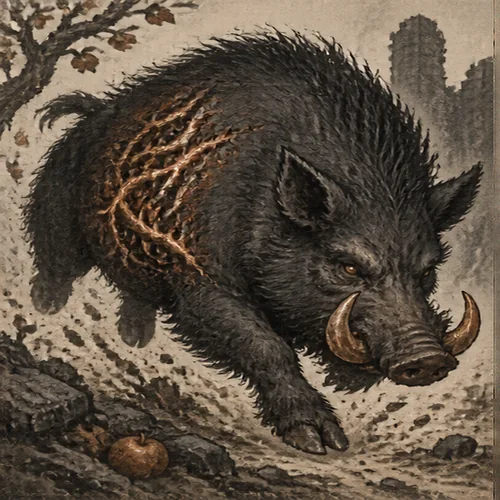 Cinderroot BoarC25 · 3 energy · 3/5Coal seams glow beneath its brow as roots wake whenever it is wounded, tracing the route of families who never came home.Read this folio → along the same buried lines, and spoke of new growth among the roofs Brann
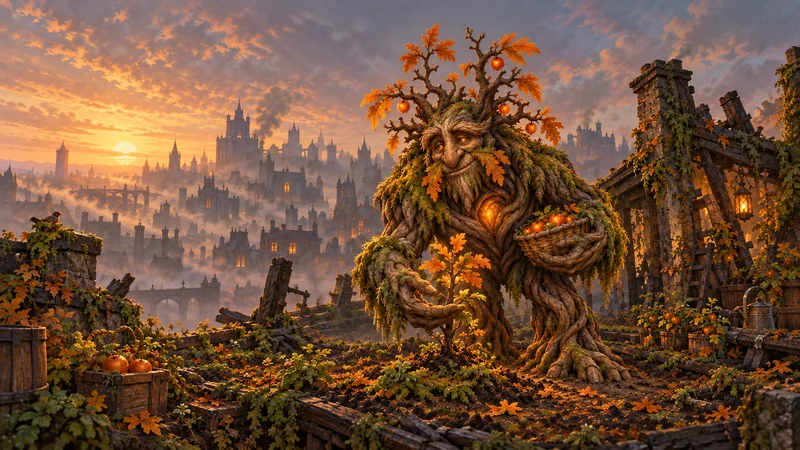 BrannFirst-generation championBrann tends fruit trees growing through the roofs of burned houses.Read this biography → was tending. Barro recognized a scent without knowing what he recognized. No surviving mark proved that his lost orchard and that burned place were once the same. They might have been remnants divided by fire, or entirely separate survivors responding to one another. He followed the pull without converting the hope into a history he could not remember.
What changed his course was smaller than a revelation. An injured traveler resting beside him asked where Barro went when he needed to rest somewhere unreachable by his feet. He began his customary answer about roads and weather. Then he stopped. There were sheltered rooms, boats, and narrow passages he could never enter with the shrine and its root mass. He had spent years making his size into a test of other people's welcome. His size was part of him, but carrying the damaged graft in the open world was a separate burden. He began asking whether there was a vessel that could hold the whole tangled join without tearing the spirit out of it.
The garden in one hand
The answer came through a craftswoman who conserved souls already lodged in fragile objects. She would not promise to separate Barro from the pale knot. Instead she proposed making one prepared soul card its new enclosed ground. The orchard's outward shape had grown around his retained spirit; roots, remembered body, and shrine could be gathered with it if the original join remained continuous. An ordinary cutting would not do. Neither would a card containing only his likeness while the knot stayed behind. Barro asked her to describe the failure before the success. She did, and he chose a second meeting rather than agreeing merely because he had become tired.
Tavik came to help. They worked at their familiar meeting place, with the shrine doors open and the birthday slate safely outside the binding. The craftswoman laid a thin, palm-sized card on a shallow board beside Barro's reachable shoulder. Within the prepared surface she drew a continuous bed with sap taken from the outer graft. Tavik loosened the carrying cloth without cutting a living strand. Barro lowered his head, caught the first pale root gently between the edges of his beak, and guided its tip onto the card. The line accepted it. He could feel a small, steady space where there had been none, but the knot still answered from his shell.
He had to bring the whole orchard after it. As he settled his weight toward that new ground, the continuous root drew his remembered forelegs inward, then the shell and its hidden join. The thorn branches folded as impressions of distance rather than breaking. The wooden shrine dwindled with them, its low bell sounding once. Tavik kept the loose cloth from snagging until it too passed into the shape Barro carried. The card completed as a slender dark vessel: gold ornament, fine teal circles, and the flat red seal image of a skeletal hand upon its reverse. It lay within the craftswoman's open palm, small enough to carry through a doorway that had never admitted him.
Nothing inside it became free of the mortal world. The pale root still held Barro's spirit, but it no longer needed to drag an exposed body and orchard along every mile. He could rest within the card's enclosed ground without being cut away from himself. His lost home's location remained lost; no hidden address appeared among the branches. When Tavik lifted the card, Barro heard the carpenter say that the meeting place would remain the same. This time he did not hear a promise to abandon everything else. He heard an invitation. Somewhere within the small vessel, beneath the weathered shrine, the uneven bell answered before the journey continued.
 The Wick ThiefC01 · 1 energy · 1/2Beneath the candle shops, a small thief gathers the wicks nobody remembers lighting.Read this folio →
 Hearth-Anvil StagC22 · 4 energy · 3/6When the last forge went cold, the apprentices found a stag standing among its ashes.Read this folio →
 Mirror-Fang DancerC05 · 3 energy · 3/3Her reflection learned the final step before she did.Read this folio →
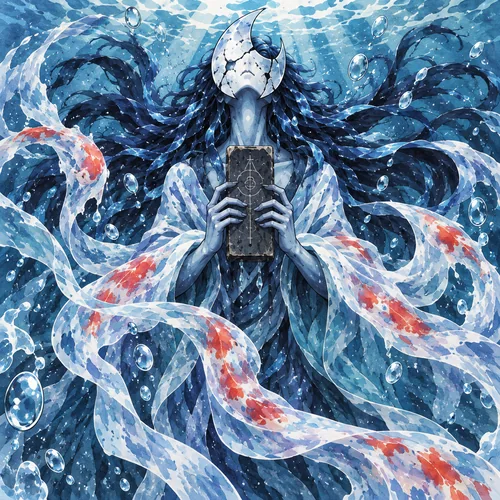 The Drowned OracleC07 · 3 energy · 2/4They lowered her into the reservoir to silence a prophecy.Read this folio →