
The bowl that sang
Sivren was born on March 11, during rain that found every unfinished repair in her family's roof. Her mother, Ruva, caught the leaks in bowls and later claimed the room had welcomed the child with music. Sivren liked that account better than the version in which everybody spent the night moving furniture. As a small girl she collected chipped vessels from the pottery yard and arranged them beneath the eaves. Different depths of water made different notes when she tapped their rims. She would sit with her blue knees folded beneath her, long fingers poised, waiting to hear where the next drop landed.
Her family made useful things: storage jars, roof tiles, water measures, and the pale ceremonial masks worn by several households along the river. Sivren's first mask had a pointed brow and uneven glazing. She objected to its crooked edge until Ruva offered to remake it. Then she refused to surrender it. There was comfort in knowing exactly where the edge touched her cheek. Her dark hair was already troublesome, escaping every tie in broad, curling strands. Her younger brother liked hiding spoons in it. She retaliated by telling him solemnly that the spoons were eggs and would hatch into ladles if he left them long enough.
The household was affectionate without being quiet. Ruva could spend an hour arguing over a clay mixture and then forget where she had set the cup in her hand. Sivren's father measured everything twice and mistrusted the weather even while standing in sunshine. Her brother wanted to leave the river and see a hill from above. Sivren wanted to know why rain announced itself differently on a roof than on open water. She listened before storms, trying to separate the approaching sound from the drops already falling. Sometimes she heard water that had not reached the city. At first she assumed everyone else did too.
The first unmistakable vision concerned an ordinary bowl. She saw it lying in three pieces beside her mother's bare foot, then looked up to find it whole on a high shelf. She moved it to the floor. Ruva nearly stepped on it and demanded an explanation. When Sivren gave one, her mother placed the bowl on a lower shelf instead. It remained unbroken for years. That was the first useful thing anyone taught her about seeing ahead: a glimpse could describe a danger without demanding its completion. Sivren treasured the lesson. Later, when people begged her for certainty, she sometimes behaved as though she had forgotten it.
A tablet for uncertain things
An elderly water measurer called Orven helped her distinguish observation from prophecy. He maintained the city's level marks and knew how many supposedly miraculous warnings began with somebody finally noticing a crack. He made Sivren record what she had seen before discussing what it meant. A dark shape under water might be a fallen beam, a boat's underside, or a person. He refused to let her name the person merely because a listener grew impatient. She found his caution tedious until a vision she had described as a funeral turned out to be a wedding procession reflected in black festival cloth.
Orven gave her a narrow divination tablet, dark-faced and edged in worn pale wood. Its fine metal lines helped her hold a water surface still while she concentrated. It was a working instrument, longer and heavier than a playing card, with a small notch where his thumb had rested through years of measurements. Sivren copied his habit before she noticed herself doing it. She carried the tablet wrapped beside her lunch rather than treating it as a sacred relic. Once a drop of plum preserve stained its cover. Orven said the stain proved she had remembered to eat, which was more useful than keeping every tool immaculate.
Her gift was uneven. Most days it offered nothing. Sometimes it showed a minute so near that she could barely speak before it arrived; sometimes an unfamiliar street lingered for weeks without explanation. Looking deliberately was harder than receiving an accidental glimpse. She could keep a remembered moment steady in her mind, let water settle against the tablet, and see the image turn toward what might follow. Afterward the memory she had used was thinner. Repeating the attempt could erase its lived texture entirely. Facts remained, but the feeling of having been there did not. Orven made her stop when she could no longer remember the tune she had used that morning.
She disliked admitting the cost. People who called her gifted did not usually mean that they wanted to hear about something missing. She practiced with trivial recollections until she discovered that they rarely held a vision together. A loved person, remembered with feeling, made the strongest anchor. At sixteen she spent the memory of her brother teaching her a rude song to warn him away from an unstable landing. He survived its collapse and thanked her. When he sang the song later, she knew the words but not why the last verse had once made her helpless with laughter. She decided the exchange had been worthwhile. She also began a notebook of things she did not want to lose.
The woman who raced leaves
Anet entered her life carrying a broken water jug and an opinion about the price of repairing it. She worked repairing ferry seats and awnings, had a broad face, quick brown hands, and a laugh that arrived before she tried to suppress it. Sivren was old enough to run the pottery counter when her parents traveled. She quoted the correct price, then lowered it because Anet argued with such inventive politeness. Anet returned the following week with another jug that did not need repairing. Neither managed to pretend very convincingly that this was a practical errand.
They courted in places where nobody expected an oracle. They ate fried dough on a low wall, watched workers launch new boats, and raced leaves through the rain channels beside the market. Anet cheated by choosing heavier leaves and denied that weight had anything to do with winning. Sivren threatened to look into the future of the race. Anet told her that would be an exceptionally expensive way to learn she was a poor loser. The joke mattered. With Anet, her gift could be something inconvenient and occasionally ridiculous rather than the only interesting fact about her.
Their first shared room had a window above a noisy lane and a shelf too narrow for Sivren's collection of chipped bowls. Anet extended it, badly, then improved it after three bowls fell. They established a March birthday custom: a meal with no questions about tomorrow, followed by a performance on whatever vessels Sivren had brought home that year. Anet could never hear the difference between two notes Sivren considered entirely distinct. She applauded both. Sivren loved her for this and criticized her hearing anyway. When they quarreled, Anet folded the awning cloth with unnecessary precision, and Sivren washed bowls that were already clean.
Their difficulty was not a lack of love. Sivren often tried to remove uncertainty from another person's life before asking whether she had been invited. She warned Anet about a journey, a business partner, and once a conversation whose hurt she had only imagined. Anet eventually said that being loved should leave room to make a decision without first consulting a bowl. Sivren answered defensively, then apologized the following morning while they repaired a torn ferry cushion together. They made a rule: a vision could be offered, and an offer could be refused. Keeping that rule required more effort from Sivren than making it had.
The answer people wanted
As her reputation grew, strangers came to the pottery with questions its shelves could not answer. Would a missing son return? Would a fever end? Was a promise worth believing? Sivren listened longer than she should have and gave more than she could afford. She liked helping, but she also liked being the person whose presence made a frightened room become quiet. That desire was difficult to examine because it wore the same expression as kindness. When Anet found her trying to recover a childhood memory by reading its description aloud, Sivren said she had simply become tired.
The city council consulted her after she correctly warned of a damaged ferry chain. Councillors began asking about water levels, grain shipments, and the moods of districts they rarely visited. They preferred definite answers. Sivren initially supplied careful descriptions, then gradually shortened them to the phrases her listeners repeated back. One dry vision became a declaration that there would be no dangerous flood before the next repairs. She had seen a dry stair on one possible morning. She had not seen the entire season. Orven challenged her wording. She resented being corrected in front of officials who finally appeared willing to listen.
The council used her answer to postpone maintenance and increase the weight carried through an aging sluice. People living below it heard that the oracle had declared the district safe. Sivren discovered how far her words had traveled when a washerwoman thanked her for making it possible to sleep. She returned to the council and explained what she had actually seen. The correction was received politely and filed. The original declaration remained painted on a notice board. She scraped it away herself, which made her look unstable to people who had trusted the first announcement and frightened those who understood why it mattered.
She had not caused the council's neglect, but she had helped give it a reassuring voice. Admitting this changed her work. She accompanied Orven on inspections, learned the difference between a clogged drain and a failing wall, and wrote down uncertainties in letters large enough to survive copying. At home Anet made tea and listened without trying to absolve her before she finished speaking. Sivren kept the stained tablet on her lap, thumb in its notch. She wanted to undo the moment in which being believed had felt more important than being exact. The gift that showed possible mornings offered no route backward into that afternoon.
The drowning that was not hers
The prophecy came while she watched rain gather in a shallow basin. She saw a sluice worker named Hadrin beneath a tilted iron wheel, his sleeve caught, one boot still braced against a step. Beyond him, water rushed through the low district carrying roof beams and the red cloth from a school doorway. The vision named his drowning through details she could verify: the white repair on his cuff, the damaged handwheel, the morning bell heard twice because an alarm joined it. Nothing in the image showed Sivren's own death. She took the tablet to Hadrin before she took it to the council.
Hadrin was frightened and angry. He did not want a place in an oracle's warning; he wanted his daughter to stop worrying when he left for work. Together they inspected the mechanism. Anet came with them, carrying food because both had forgotten it. The handwheel's mounting was failing, and a closure under heavy pressure could trap whoever stood beside it. Sivren's warning was no longer only a vision. There were cracks, measurements, neglected requests for repair, and a safer procedure that would require closing a profitable water route for several days. Hadrin signed his findings despite knowing who had ignored his earlier reports.
The council called the account an invitation to panic. A few members wanted repairs. Others feared trade losses, an inquiry into diverted funds, and the public knowledge that their assurance had helped place families in danger. They offered Sivren an opportunity to revise her statement. She refused. She read Hadrin's name in the hearing, described the caught sleeve, and added that a warning was useful precisely because the drowning had not yet happened. An official replied that her earlier certainty had created the present confusion. She accepted responsibility for the earlier words and repeated the new ones. They found that less convenient than a denial they could expose.
She sent copies to ferrymen, washers, and the households below the sluice. Some left; some prepared; some dismissed the change as another performance. Hadrin's colleagues agreed to refuse the dangerous procedure. None of this made the future simple. It did mean the warning had become a practical choice people could act upon. The council summoned her to the reservoir under the claim that a formal demonstration would settle the dispute. Anet wanted to accompany her. Sivren asked her instead to continue carrying the copies. Their last ordinary disagreement concerned whether she had eaten enough before leaving. She promised to finish the bread on the way.
A cure for panic
Around 900 A.B., the reservoir doors closed behind Sivren. No public hearing waited inside. The officials present described the place as a cure for panic, speaking as though the frightened people outside were the illness. They had brought three listening weights, objects once used to preserve a witness's exact words in a sealed basin until a hearing reconvened. Turned inward, their carved channels prevented a recorded voice from reaching the air. The council intended to take possession of her warning. They had also decided that the woman who could repeat it elsewhere was a difficulty they would not permit to leave.
They fixed the weights beneath a lowering frame and placed her confiscated divination tablet within their triangle. Sivren recognized the instruments. She protested that they had been made to hold testimony after a speaker stepped away, not to close around a living person. The official directing the work would not answer her. A keeper who had opened the door stared at the floor. Sivren asked him to look at her. For one moment he did, and she saw that he understood what was happening. Understanding did not make him stop it. The frame began to descend while she was still speaking Hadrin's name.
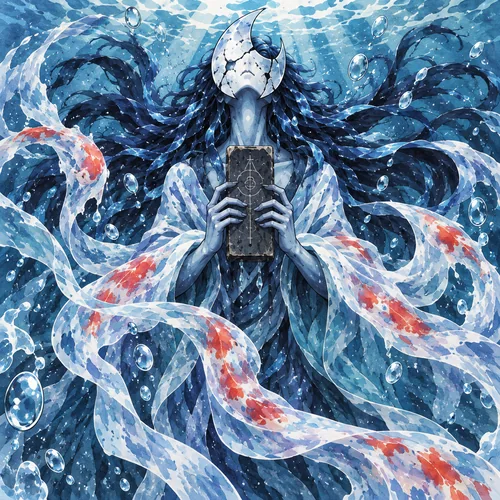
Water covered her feet, her waist, the pale mask, the dark hair spreading above her shoulders. She fought for breath. She was a woman being drowned, not an oracle choosing a final revelation. When she tried to push upward, the frame held her beneath the surface. Her last air rose between the inward-facing weights and failed to escape their closed recording. The porcelain at her cheek cracked against the wood. Her lungs filled. At the moment her living awareness broke, the instruments caught more than the spoken warning: her final remembrance of herself was still attached to the voice they were seizing. They held the departing spirit inside that remembered breath.
Death offered an opening, and she felt it briefly beyond the pressure. Then the recording repeated. She was beneath the frame again, knowing the next attempt at breath would fail. The body died; the captured person remained. When the officials lifted the weights, water moved through their channels into the reservoir's listening bed, carrying the closed record with it. They thought dilution would make it silent. Instead each returning current gave the voice another path. Sivren's warning reached the first kitchen through a drawn pail before the men who had killed her finished agreeing on what their report would say.
The city that drank her words
She did not awaken as a whole figure beneath clear water. At first she was a sleeve of current, a syllable in a bucket, a terror repeating where the inlet met the reservoir floor. She could hear the warning return without choosing to speak it. The spell had kept her last breath as a closed deposit rather than allowing it to become the final act of a dying person. Ordinary water carried its echo; her spirit remained caught in the original pattern. A child repeating the words did not contain a piece of her soul. A household drinking them did not become another prison. Yet hearing herself everywhere and being able to stand nowhere felt like being scattered beyond repair.
The warned flood still came, though not exactly as she had seen it. Hadrin and his fellow workers refused the fatal maneuver and withdrew before the mounting failed. Water damaged streets and homes; the notices and evacuations saved people who would otherwise have stayed. Hadrin survived. When word reached the reservoir, Sivren found herself listening for his daughter's voice among those at the bank. Her vision had not demanded a death. Its prevention should have been the proof she had wanted. Instead the council called the surviving worker evidence that her prophecy had been false, while families carrying ruined belongings asked why a false warning had named their danger so closely.
Anet and Orven tried to retrieve her. They found the lowering frame and brought the broken tablet to the bank. Moving it did not move the whole recording; the tablet had become its focus, while the closed breath was impressed into the reservoir's returning water. Breaking a listening weight only removed an instrument whose work was already done. A jar carried away from the bank held an echo that faded, never the complete person. Sivren tried to follow it and felt herself lose the memories that made the voice hers. She withdrew before even Anet's name became noise. It was another failed exit, not evidence she lacked the wish to leave.
Stillness gave her something movement denied. When a quiet surface perfectly reflected the water beneath it, she could draw the repeating impressions together long enough to form hands, hair, and a face behind the cracked mask. A breeze dissolved her outline. A thrown stone returned her to broken sound. She learned to wait for sheltered hours and to hold the old tablet against her chest, shaping it again from the memory the record had retained. The blue and white folds of her clothing stretched into water; red marks drifted through them like the remembered warning cloth. In those intervals she could speak a new sentence. She began with Anet's name.
The hand above the water
Anet waited through several windless mornings before Sivren managed more than a mouthful of words. Their first conversation was embarrassingly practical. Anet had brought the repaired jug from their first meeting, although there was no reason she needed that jug. Sivren asked whether the shelf had fallen again. Anet said it had survived the whole disaster, which she considered an insult to the city's engineers. Sivren laughed, and the effort broke her shape into ripples. Anet sat until the surface settled, then repeated the joke without pretending she had not been frightened. They learned to leave space inside a conversation for someone to gather herself again.
Touch was harder. Anet could hold her hand above the water, and Sivren could lift the remembered shape of her own toward it. The instant the surface broke, the speaking figure came apart. They stopped just short. Sivren remembered the warmth that should have occupied the remaining space. Anet described ordinary days: work on ferry seats, their neighbors, a disagreement with a customer who thought mending meant making age disappear. She did not ask for a prophecy each time she came. This kindness sometimes made Sivren weep more fiercely than questions. She had been useful to so many people that being visited without a request felt almost unfamiliar.
Anet asked once whether they would ever leave the reservoir together. Sivren could not give her an honest answer without looking. She used one of her own remaining memories, the sound of Ruva arranging bowls during her birthday rain, as the anchor. The glimpse showed Anet older on the same bank, alive, holding flowers. It did not show an escape. When the image passed, Sivren knew the story of the bowls but could no longer hear their particular notes. She told Anet what she had spent. Anet was angry, then held her hand above the surface until both had said everything the anger was protecting.
Their visits continued through the years they had left. Orven died, her brother grew old, and Anet's hands became lined and slow. The reservoir did not preserve the people who loved her merely because it had preserved her loss. On their final March birthday together, Anet tapped the repaired jug with a small stick and declared every note perfect. Sivren disagreed out of habit. Anet smiled. Long afterward, the Oracle remembered that smile more clearly than the flowers laid at the bank when Anet could no longer come. She did not ask the water to show her every final moment. Some things she knew because people had lived them with her, and that was enough.
The price of one tomorrow
After Anet's death, strangers still came. They knelt where she had sat and offered coins, promises, tears, or the assumption that suffering had made the Oracle endlessly available. Sivren learned to refuse. She could show a deliberate glimpse by spending a loved memory, but she would no longer empty her own remaining life every time another person feared a decision. The water accepted a willing memory from a questioner as it accepted one from her. Once surrendered into the tablet's still surface, the remembered moment turned toward a possible tomorrow and was consumed in the seeing. The visitor retained the fact that it happened. The living experience of it was gone.
She made the loss clear before accepting it. A man who wanted to know whether a venture would enrich him offered the memory of his daughter learning to whistle. While describing it, he began to smile and then stopped. He chose to leave without an answer. Sivren watched him go with a relief she could not explain to later visitors who assumed refusal must disappoint an oracle. Another woman willingly gave a summer evening with her sister to learn which route might bring medicine through a blocked district. The vision helped, but Sivren would not call the payment small simply because the choice had been brave.
The price was never proof that the answer became certain. Water offered a glimpse, and the choices surrounding it could still change. Sivren described the caught sleeve, the unbroken bowl, and the man who had survived his predicted drowning whenever someone tried to buy inevitability. She had once let powerful people treat certainty as a free resource, while the costs fell on other households and on the hidden portions of her own life. That mistake had helped ruin a district. Now the questioner had to bring something personally valuable to the decision. She sometimes disliked the severity of her own practice. She disliked even more the ease with which people called another person's sacrifice generosity and then asked for more.
Centuries altered the banks. New pipes crossed old channels, houses rose over forgotten kitchens, and descendants repeated phrases carried from the reservoir without knowing who had first said them. The original recording persisted beneath these changes because it was held in remembered breath, not maintained by a particular council or a single surviving stone. Sivren's presence could gather wherever its connected water became perfectly still, but she could not step from it into dry life or follow the dead beyond the world. She listened to rain approaching the reservoir, played remembered rhythms upon her tablet, and guarded a handful of moments no visitor could purchase from her.
Two witnesses, neither first
Near the present, a hare's reflection arrived at the water before the hare did. Sivren noticed because the reflected creature waited beside a patch that had not yet been disturbed by paws. When the Mourningglass Hare Mourningglass HareC30 · 2 energy · 1/3Its reflection arrives a moment before it does, looking for the wounded it intends to follow.Read this folio → appeared, the two images aligned without explaining themselves. She asked what had been paid for that early arrival. The hare gave no answer she could recognize. Its silence did not prove innocence, debt, or freedom from cost. She watched it study an injured visitor and wondered whether they were looking at the same possibility from different edges. For once, another creature's uncertain relationship with tomorrow did not require her to settle it.
The Ledger Crow's phrase for their meeting was two witnesses, neither first. Sivren liked it because it resisted the invitation to make one of them a solution to the other. She did not learn the hare's beginning, and it did not release her from the reservoir. What its visits did change was the question she asked about her own reflection. She had spent centuries trying to drag a scattered person away from the closed record. Yet when the surface was still, the whole of her could be present in one small depth. Perhaps she did not need to break the record apart. Perhaps she needed a different place in which it could remain whole.
A conservator who worked with bound souls brought her a prepared vessel and listened while she described the failures. They tested no hurried promises. The reservoir's echo could be repeated elsewhere, but a copy was not Sivren. The new enclosure would have to receive the complete remembered breath while she occupied it, leaving no repeating center behind. Her old tablet could focus that transfer. It could not become the destination: it belonged to the recording already, and carrying its recovered wood had failed long ago. A separate, thin soul card offered a bounded surface capable of keeping the record coherent beyond the water.
She delayed the attempt through several seasons. Not because captivity had become acceptable, but because hope had acquired consequences she knew how to measure. She named the memories she would preserve, arranged for visitors to hear that no answer was owed while she worked, and returned in thought to the space between her hand and Anet's. She could not make that old hand warm again. She could decide whether the absence would be the only place she ever remained. On the chosen morning she listened for rain before approaching the sheltered surface. None came. She waited until even the smallest trembling on the water had stopped.
A breath with room around it
The conservator held the prepared card flat in a shallow dry tray at the reservoir's edge. It was no larger than the palm beneath it. Sivren raised the long weathered tablet separately, its familiar metal lines dark against the water. She placed its lower edge against the surface so that the whole quiet patch answered as one plane. The card was held just beyond that edge, inside a clear cover that kept ordinary water from soaking it. There was no new lowering frame, no inward command from somebody standing safely above her. She could stop the attempt, and did twice before the reflected person remained complete from mask to trailing robe.
To draw the last recurring breath into that present shape, she needed one memory held without interruption. She chose Anet taking her hand beneath their shared table on an evening when no prophecy had been requested. She remembered the callus at the base of a finger, the slight impatience of an affectionate squeeze. As the water turned through the tablet's lines, the experience thinned. Sivren kept its fact and its meaning, but its felt warmth passed into the work. She did not mistake choosing this loss for having chosen the captivity that required it. The memory gathered the scattered recording toward a single person who knew what she was giving up.
She turned the tablet once. The enclosed breath moved across its wet edge into the prepared card, drawing the blue hands, cracked pale mask, dark spreading hair, and drifting water folds with it. The remembered tablet followed; its old physical remains stayed in the conservator's keeping. No voice continued circling as a second Sivren beneath the reservoir. On the vessel's reverse, gold ornament enclosed fine teal rings and the flat red impression of a skeletal-hand seal against black. The completed card lay slender and still within an ordinary hand. When the conservator lifted it, the water did not pull her back.
She remained a spirit bound in the mortal world. The closed breath had acquired a different enclosure, not been undone into the passage death had once offered. The card held a quiet depth in which she could be whole without waiting for every current to settle. People would continue repeating the old warning because words, once heard, belonged to their histories too. Those echoes were no longer a scattered prison. Inside the vessel, Sivren remembered the table, the person beside it, and why the hand had mattered. The precise warmth was gone. She let that absence be a real cost, then listened to the world beyond the reservoir for something she had not already been asked to predict.
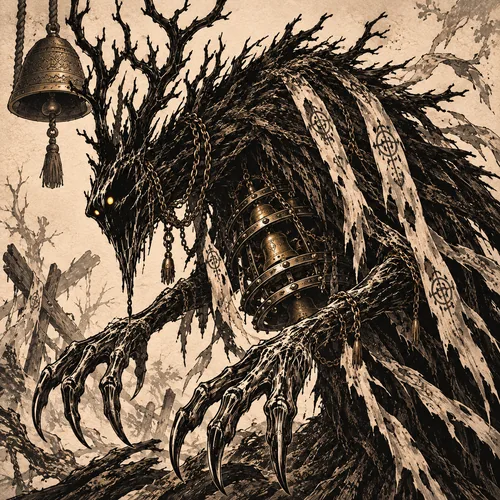 The Bell-EaterC08 · 4 energy · 3/5When the plague bells stopped, something beneath the cathedral began to starve.Read this folio →
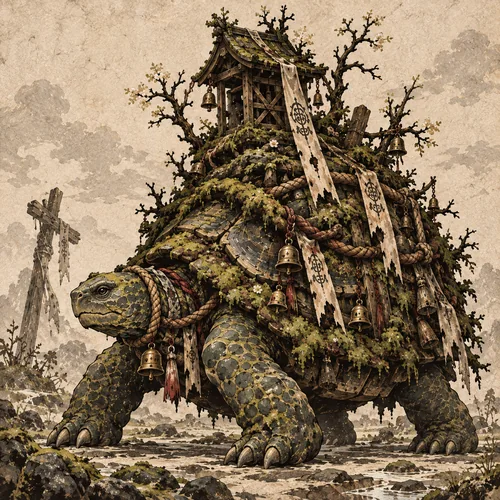 Thornback PilgrimC06 · 3 energy · 2/4The pilgrim planted a thorn in his back for every village that denied him shelter.Read this folio →