The program on the floor
The paper crane began as a discarded program after the final matinee of The House Without Windows. Jun, a twelve-year-old call boy, found the sheet beneath the third-row seats. One side listed actors and musicians; the other held a printer’s floral border. He folded it while waiting for his older sister Eren to finish striking the painted walls. His fingers followed a shape their mother had taught them before she died.
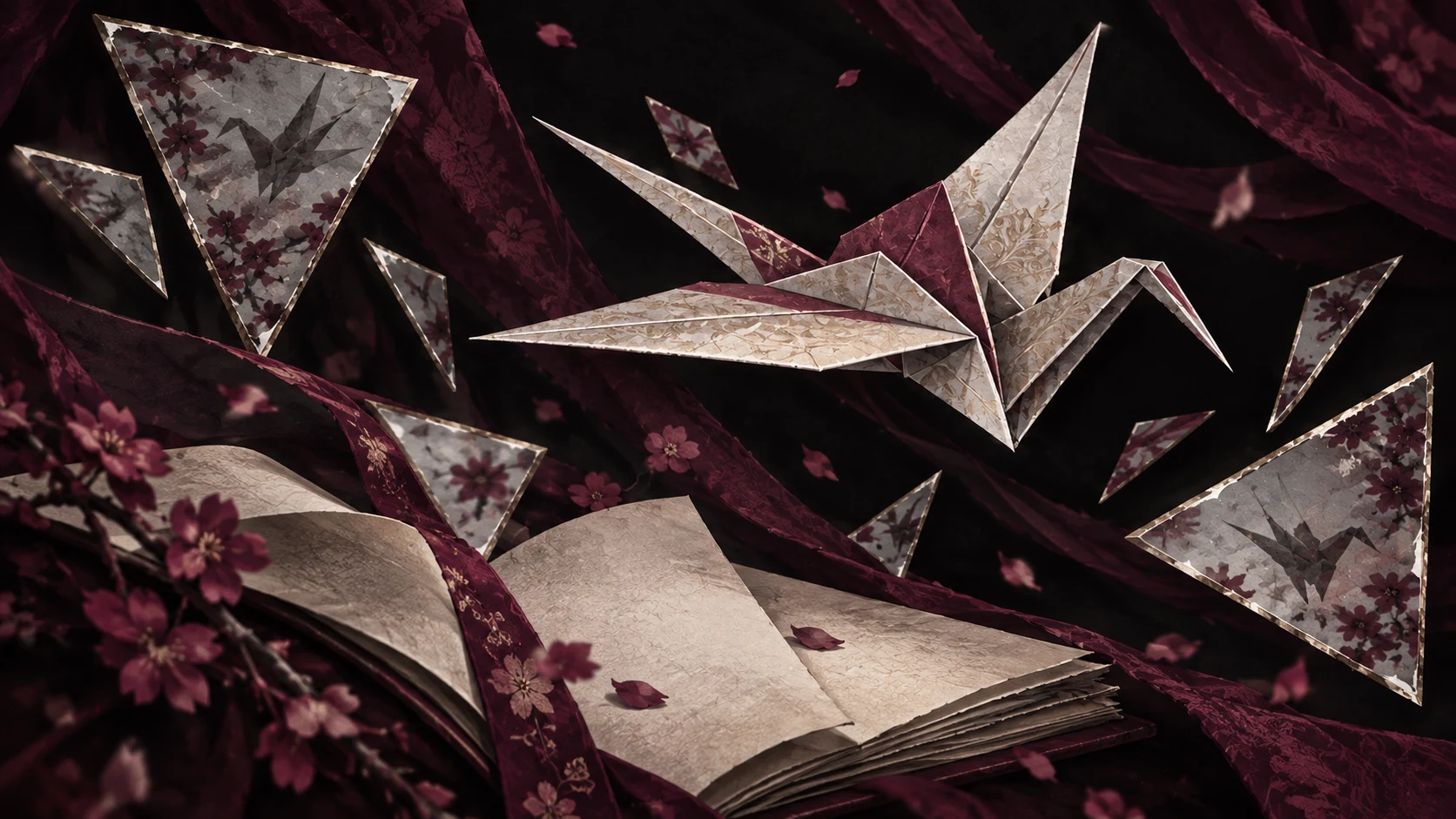
Jun set the crane on the prompt desk and forgot it. During the night, moonlight from the cracked roof passed through a triangular mirror used in the play’s storm scene. The reflection broke into pale colors across the folded paper. By morning the crane had moved to the stage. Its wings were sharply creased, its paper body ivory and wine-red, and one printed actor’s name ran along its neck.
Eren assumed a stagehand had moved it. She put the crane back on the desk. It returned to the stage while everyone watched the rehearsal from the house. Jun saw its paper feet lift and settle. The bird did not flap like a living crane; each fold loosened and tightened in sequence, carrying it one careful step. Nobody spoke until it bowed toward the empty seats.
The company named it Prism Crane because colored light gathered along its creases whenever the mirror turned. Jun objected that the name made it sound like a prop. Eren asked what the bird preferred. The crane unfolded one corner to reveal the printed word PRISM from an advertisement on the program’s reverse, then folded itself closed. They accepted the answer without deciding whether it was coincidence.
Vessa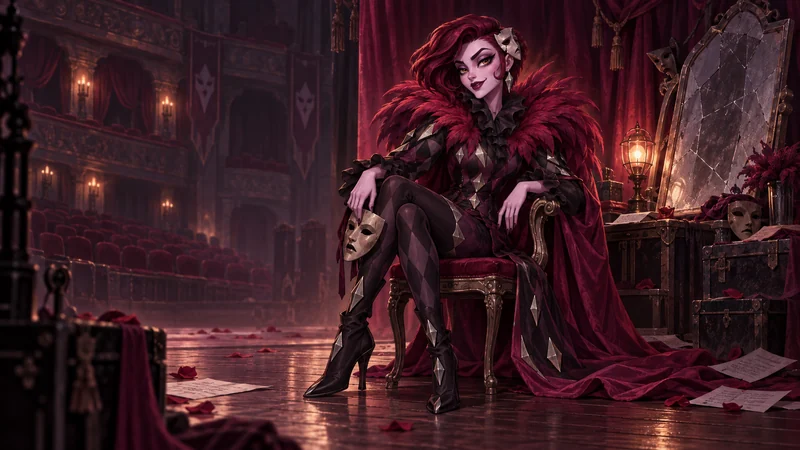 VessaFirst-generation championVessa once played every role in the mirror theater.Read this biography → was not yet the theater’s leading mask artist. She worked in the costume loft and watched from the balcony, fascinated by a creature whose face never changed. She did not claim it as one of her illusions. The crane had arisen from another person’s hands, another family’s folding lesson, and an accident of mirror light. Its first choice was to remain on the stage after the audience had gone.
Jun and Eren
Jun and Eren lived above a bakery two streets from the playhouse. Eren painted scenery by day and repaired costumes at night. Jun carried messages, swept aisles and learned every line from the wings. Their father had disappeared on a touring job years earlier, leaving only a trunk of unfinished masks. Eren refused to tell Jun he would return. She also refused to declare him dead without evidence.
The crane followed Jun home once, landing on the railing outside the bakery. Rain softened one wing. Eren brought a dry board and placed it beneath the bird without touching its folds. Jun wanted to press the paper flat. The crane stepped away. It repaired itself slowly, refolding the damp edge until the floral border aligned with the original crease.
Jun began carrying spare programs in case the creature wanted new paper. It ignored them. Its body remained the first sheet, patched only with tiny fibers from the stage curtains and dust from the prism mirror. Eren explained that care did not mean replacing what another being had chosen to keep. The stains and worn corners were part of how the crane had moved through the world.
At supper, Jun recited dialogue from the rehearsal. Whenever he changed a line to make himself sound important, the crane hopped onto the wrong page of his script. At first they laughed. Then it did the same when Eren claimed she was not tired while hiding a shaking hand. The bird seemed drawn to the place where spoken words and written records failed to match.
It could not read motives or expose every deception. Sometimes it landed on a page simply because the paper caught the light. Jun learned not to accuse someone because of the crane’s movement. He used it as a reason to ask again: is that what happened, or is that what we wish had happened? The question changed their household more than any theatrical trick.
The play with two endings
The company’s next production had two endings. In the approved script, a queen admitted she had ordered the city gates closed. In the version preferred by the theater’s patron, an unnamed servant accepted the blame. The director, Sovan, rehearsed both while waiting to learn which ending the council would permit. Actors marked their pages in different inks and began forgetting which truth belonged to which performance.
Prism Crane landed on the servant’s confession every time the patron entered the room. It covered the false lines with one wing and pecked at the queen’s omitted speech. The patron called the behavior charming until the cast began noticing the pattern. He ordered Jun to lock the bird in the prop cupboard. Jun refused and was sent home for the evening.
Eren opened the stage window. The crane left the cupboard through a gap above the hinge and returned to the script. Sovan told the patron that the company could control actors, scenery and lighting, but not a living paper creature. This was only partly courageous; he knew the audience had already heard rumors and would object if the bird vanished. Still, the statement kept the crane free.
On opening night, the patron’s ending was performed. The actor playing the servant reached the confession and found the crane standing on the line. He paused long enough for the audience to feel the lie. Then he spoke it exactly as ordered. The crane did not magically change the script or force him to rebel. Its small presence made the compromise visible.
Afterward, the cast signed both endings and stored them together. Jun wrote which version had been performed and who demanded it. The record did not erase the false ending, but it prevented the company from pretending there had never been another choice. The crane slept between the pages, its folded beak resting near the queen’s missing admission.
The mirror maker
A mirror maker named Salvi came to repair the triangular prism from the storm scene. She found colored scratches where the crane had nested against the glass. Jun feared she would polish them away. Salvi said a repair should preserve evidence of use unless the damage made the object unsafe. She sealed the sharp edge and left the faint marks visible beneath a clear layer.
Salvi taught Jun how a prism separated light without inventing new colors. The colors were already present, traveling together until the glass changed their path. Jun thought the crane behaved the same way with stories. It did not create a lie or truth; it made the differences easier to see. Salvi approved the comparison but warned that light could still be aimed to deceive.
VessaVessaFirst-generation championVessa once played every role in the mirror theater.Read this biography → spent evenings studying the repaired mirror. She practiced masks in front of it, changing posture and voice while keeping her own eyes visible. The crane watched from the frame. When VessaVessaFirst-generation championVessa once played every role in the mirror theater.Read this biography → used a mask to avoid answering Eren’s question about a missing costume payment, the bird landed on the account book. VessaVessaFirst-generation championVessa once played every role in the mirror theater.Read this biography → removed the mask, checked the numbers and discovered the manager had withheld three workers’ wages.
The incident began VessaVessaFirst-generation championVessa once played every role in the mirror theater.Read this biography →’s distrust of perfect performances. She paid the missing wages from her own fee and confronted the manager with records, not the crane’s behavior alone. The bird had directed attention; the ledger supplied proof. Eren kept the corrected page and asked each worker to sign only after receiving the money.
Salvi gave the crane a shallow tray lined with old programs, a place to rest without being displayed. The bird refolded the papers into smaller shapes: a boat, a flower, a crooked hound. It never made another crane. Jun came to see the pastime as conversation. The creature preserved its own form while exploring every shape the theater’s discarded pages could hold.
The wrong page
Prism Crane developed a habit of landing on the wrong page whenever someone lied during rehearsal. If an actor claimed to know a scene, it settled on the forgotten entrance. If Sovan said a dangerous rig was safe, it perched on the inspection report he had not read. The company began calling the behavior judgment. Jun corrected them. A pattern could prompt inspection; it could not replace it.
The crane made mistakes. It landed on Eren’s paint order after she truthfully said the blue pigment had arrived. The invoice was accurate, but the barrel contained watered dye. The paper was not a lie; the delivery was. Another time it covered a love letter everyone assumed was false. The writer had meant every word, though the recipient did not return the feeling.
These errors taught the company restraint. They stopped demanding that the bird identify liars. Instead, they asked what did not fit: a page, an object, a timing, or a person’s own discomfort. The crane’s movement opened a question. Evidence, conversation and consent decided what happened next.
Jun kept a notebook of incidents, including the times nothing was wrong. He wanted the record to show uncertainty. Eren helped him phrase conclusions narrowly. ‘Crane landed on rope invoice; rope later found frayed’ was better than ‘Crane knew the rope would break.’ This habit later saved the company from accusing a blameless rigger when a supplier had substituted cheaper fiber.
The bird sometimes landed on blank pages. Jun first treated them as warnings, then noticed it liked the warmth of new paper. Not every action needed symbolic weight. A living creature could seek comfort without teaching a lesson. That realization made him love the crane more, because it allowed the bird to exist beyond what people wanted from it.
The unfinished play
Eren began writing a play about two siblings waiting for a parent who might never return. She hid the pages beneath scenery plans and insisted she was only practicing dialogue. Prism Crane found the draft and folded one corner into a small open door. Jun recognized their kitchen, their father’s trunk and the third cup Eren still set out on difficult anniversaries.
He felt betrayed that she had used their life without asking. Eren said the play was private. Jun replied that she had already given their mother’s folding lesson to a character with another name. They argued until the crane stepped between the pages and tore one crease. Neither sibling blamed it. The paper had been worn thin from being hidden and handled.
Eren apologized and offered to burn the draft. Jun asked to read it first. Together they marked which memories belonged to both of them and which details Eren could claim as her own. They changed the family’s occupation, removed their mother’s final illness and kept the feeling of waiting beside an empty chair. The play became less literal and more honest.
They never finished the ending. In one version the parent returned; in another, the siblings closed the door. Prism Crane repeatedly landed on a third blank page between them. Jun decided the blank was not an answer from the bird. It was space for a future they did not yet know. Eren left the page in the script.
VessaVessaFirst-generation championVessa once played every role in the mirror theater.Read this biography → read the draft years later with permission. Its shifting endings influenced her belief that a mask could reveal truth when chosen, not when imposed. The crane’s folio connects to VessaVessaFirst-generation championVessa once played every role in the mirror theater.Read this biography →’s theater circle because they shared this stage and these questions. It does not mean the bird was VessaVessaFirst-generation championVessa once played every role in the mirror theater.Read this biography →’s creation or that every false face belonged to her story.
The costume book
VessaVessaFirst-generation championVessa once played every role in the mirror theater.Read this biography → kept a costume book with a drawing of every mask, coat and pair of shoes used by the company. She wrote who wore each object, who repaired it and whether the material had been borrowed. The record began as inventory but became a map of labor. A famous actor’s silver coat contained Eren’s invisible stitches, Salvi’s mirror buttons and Jun’s hurried note about a missing clasp.
Prism Crane liked the pages showing costumes altered for different bodies. It landed where old measurements had been crossed out and new ones written beside them. VessaVessaFirst-generation championVessa once played every role in the mirror theater.Read this biography → learned never to describe the first number as the true shape and the second as a correction. Both recorded a person at a particular time. The garment changed so the performer could work safely and move without pain.
When a patron demanded that a young actor wear the queen’s original narrow shoes, VessaVessaFirst-generation championVessa once played every role in the mirror theater.Read this biography → refused. The patron claimed tradition required them. The Crane stepped onto the costume book where an earlier note recorded that the shoes had caused bleeding. VessaVessaFirst-generation championVessa once played every role in the mirror theater.Read this biography → showed the entry to the director and made a wider pair. The actor performed without injury; the audience never knew the difference.
Jun asked whether the Crane’s interest meant the book contained lies. VessaVessaFirst-generation championVessa once played every role in the mirror theater.Read this biography → said crossed-out measurements were not lies when the changes remained visible. A dishonest record hid who did the work or pretended no alteration happened. The costume book told a fuller truth because it kept layers. The Crane refolded a discarded fitting slip into a tiny open coat and left it between the pages.
After the archive fire, the costume book helped identify fragments of the original program. A wine-red fiber matched the queen’s repaired sleeve; gold dust came from Salvi’s mirror buttons. None of the clues proved why the Crane returned for the blank page, but each restored part of the world it had inhabited. The company rebuilt its history from ordinary records rather than asking the trapped spirit to perform its memories on command.
The closing notice
The theater received a closing notice claiming the building had failed inspection. Sovan accepted it with suspicious speed and told the company to remove their belongings by morning. Prism Crane landed on the second page, where an official seal had been pressed over a scraped patch. Jun compared it with a genuine notice in the archive. The date format and registrar’s initials did not match.
Eren and VessaVessaFirst-generation championVessa once played every role in the mirror theater.Read this biography → took the paper to the municipal office. The registrar confirmed that no closure had been ordered. The theater’s manager had forged the notice after secretly selling the building fixtures to a salvage broker. Sovan knew about the sale and hoped to avoid paying the company’s final wages. The crane’s landing had revealed no complete scheme; careful comparison uncovered it.
Workers locked the prop rooms and inventoried every item. Salvi marked the prism mirror as loaned equipment that could not be sold. Jun found his father’s mask trunk on the broker’s list even though it belonged to the family. He produced Edda-like receipts his sister had kept. The broker withdrew when ownership could be proven.
The manager fled before the hearing. Sovan testified and admitted his part. The company received part of its wages but could not afford the next season. People called the exposure a triumph, yet Eren still lost steady work and several actors left the city. Truth prevented one theft; it did not restore everything already damaged.
The forged notice remained in the archive with VERIFIED FALSE written across its cover, followed by the evidence. Prism Crane continued landing on the scraped seal. Jun thought it remembered the texture rather than the lie. Either way, the page became a teaching object: not a magical proof, but an example of what to inspect when authority arrived too eager to end a story.
The last performance
The company chose Eren and Jun’s unfinished play for its final performance. They called it The Third Page. Eren painted a house with a door that could remain open or closed. Jun, now old enough to perform, played the younger sibling. VessaVessaFirst-generation championVessa once played every role in the mirror theater.Read this biography → designed three masks that showed not different people but different ways of waiting: anger, hope and ordinary fatigue.
The audience voted on neither ending. At the final scene, Jun placed the blank page on the table and left the door ajar. Prism Crane crossed the stage and stood on the paper. No one had rehearsed the movement. The audience remained silent, uncertain whether the play was finished. Eren lowered the lights before anyone could demand a clearer answer.
After applause, families stayed to tell stories about people who never returned and questions that never received proof. The company did not treat those accounts as material for another show. Jun wrote down only the names people asked him to preserve. VessaVessaFirst-generation championVessa once played every role in the mirror theater.Read this biography → helped pack chairs while the crane refolded discarded programs into small open doors.
Sovan apologized to Eren for helping the manager. She listened and said the apology did not require immediate forgiveness. He spent the final week returning props and wages. The crane landed on his inventory pages several times; each time he checked again. One omission was dishonest, two were mistakes, and the last page was complete.
At midnight, Salvi turned the prism mirror toward the stage for the final bow. Colored light ran through the crane’s wings. The creature unfolded almost flat, displaying the original cast list across its body, then rebuilt itself crease by crease. Jun saw their mother’s folding pattern in the motion and cried without pretending the bird contained her spirit.
The fire in the archive
A fire began in the archive three nights after the closing performance. Investigators later traced it to a cracked lamp, not revenge by the manager. Jun and Eren were asleep above the bakery when VessaVessaFirst-generation championVessa once played every role in the mirror theater.Read this biography → saw smoke from the costume loft. She ran inside with Salvi and two stagehands, calling names to make sure no person remained in the building.
Prism Crane was still in the archive beside The Third Page, the forged notice and the prism mirror. VessaVessaFirst-generation championVessa once played every role in the mirror theater.Read this biography → found it carrying small burning scraps away from the script. Its paper wing had blackened along one edge. She opened the stage door and urged it toward the street. The crane returned to the archive for the blank ending page.
A ceiling beam fell between them. Salvi pulled VessaVessaFirst-generation championVessa once played every role in the mirror theater.Read this biography → back before the mirror frame collapsed. The prism shattered across the wet floor where firefighters had thrown buckets. Colored reflections multiplied the crane into dozens of paper shapes. VessaVessaFirst-generation championVessa once played every role in the mirror theater.Read this biography → saw the real bird only once more, folding itself around the blank page as smoke covered the room.
The company saved most people’s personal property, but the archive burned. The Third Page survived only in fragments. Firefighters found the forged notice fused to a triangular mirror shard and a cluster of paper feathers beneath it. No intact crane body remained. Jun recorded the creature as lost in the fire, last seen protecting a page with no ending.
The city tried to list Prism Crane as a destroyed prop. Jun objected. It had moved, chosen, refused confinement and lived among them for years. The registrar created a new entry: living paper creature, status unknown after fire. The wording did not solve what the crane was. It stopped the record from reducing a life to theater inventory.
The bird in the fragments
After the ruins cooled, Jun gathered paper fragments with permission from the investigators. He did not refold them into a replacement crane. The original creature had not been a pattern anyone could reproduce by copying its shape. He placed each piece between clear sheets, noting where it was found and whether it carried a word, floral border or burn mark.
The fragments shifted overnight. A piece bearing the queen’s missing confession moved beside the forged closing notice. The blank ending page settled beneath both. Jun suspected drafts until Salvi sealed the windows and the movement continued. A crane-shaped reflection appeared in the repaired prism shard whenever someone gave a false account of the fire.
VessaVessaFirst-generation championVessa once played every role in the mirror theater.Read this biography → tested the reflection carefully. She spoke a true sentence, an obvious lie and a statement she merely feared was false. The shape moved for the lie and the fear. The result proved it could not distinguish intention with certainty. They stopped testing. The spirit was not an instrument to be forced through painful memories so people could outsource judgment.
Eren apologized to the fragments for arguing over the unfinished play. Jun told her the apology belonged to their relationship whether the crane could hear it or not. They completed no ending. Instead, they wrote the story of the fire with separate columns for witness, evidence and uncertainty. The crane’s reflection rested on the boundaries between them.
The archive box traveled with the remaining company. Wherever it stayed, old programs folded themselves into small shapes by morning. None became a living crane. The acts felt like echoes of the creature’s pastime, not proof of multiplication. VessaVessaFirst-generation championVessa once played every role in the mirror theater.Read this biography → preserved the shapes and labeled them afterimages, keeping them distinct from Prism Crane’s one trapped spirit.
The binding in the third page
The binding became visible during a memorial performance in a borrowed hall. Jun placed the fragment box beside the blank page and turned Salvi’s prism shard toward the stage light. The crane’s reflection emerged across the paper, folded from light rather than ink. It tried to step beyond the page but returned to the same crease whenever it reached the edge.
The fire, broken mirror, original program and unfinished script had accidentally caught the creature’s spirit. The binding was not a final trick Prism Crane chose to perform. Its repeated attachment to the page had created an anchor; the fire collapsed body, record and reflection together before the bird could leave. No actor, parent or character from the play was trapped with it.
Jun opened every side of the archive case and removed the fasteners. The reflected crane remained. Burning the page might destroy the anchor without freeing what it held. Refolding the fragments might impose a body the creature had not chosen. The company kept the materials stable while searching for a safer passage, refusing both spectacle and desperate experimentation.
Prism Crane could still move among nearby pages. It landed on discrepancies in ledgers, scripts and testimonies, though never with perfect accuracy. The company’s rules remained: treat its movement as a question, preserve evidence, and ask the people involved. The binding narrowed the creature’s world but did not erase the personality it had built through years of rehearsal and repair.
VessaVessaFirst-generation championVessa once played every role in the mirror theater.Read this biography → later placed the Crane within A Thousand False Faces, her circle for performances, identities and truth under pressure. The circle recognized its history; it did not own the bird or claim to have made it. Its June 12 birthday and Gemini sign match its curiosity, double pages and ability to hold more than one possible ending without treating uncertainty as deceit.
The card and the new choice
The Ledger Crow recorded Prism Crane in the official Mournhand design: an ivory and wine-red folded bird crossing dark theater cloth, framed by triangular shards that reflect its silhouette. The card preserves one spirit. It does not contain Jun’s mother, the actors, the roles they played or the names printed on the original program. Card containment did not free the crane from the mortal archive.
In the game, Prism Crane costs 2 energy and enters as a 1/3. Its entry effect draws one card and then requires one discard. The effect always occurs on entry; it does not require a damaged ally. Drawing first gives the player a new option before choosing what to discard, but the total hand size does not increase after the sequence.
The Crane’s best use is improving a hand that contains a poor answer for the current board. Deploy it, examine the new card, then discard the least useful option. The 1/3 body remains afterward. The effect does not reveal an opponent’s card, prove which choice is true, or let the player keep both the drawn card and the original hand without discarding.
Its lore connects selection with honest revision. A discarded card is not branded false; it is simply the option the player chooses not to carry forward. That distinction respects the creature’s life. Prism Crane never existed to punish every lie. It taught a company to compare pages, preserve uncertainty and revise a story without pretending the first version had never existed.
Its pastime remains refolding old theater programs into new shapes. Its ledger trivia says it lands on the wrong page when someone lies, with the caveat earned through its history: a landing opens an investigation, not a verdict. The blank third page remains in the archive case, waiting for an ending chosen freely rather than forced by a patron, a fire or a card.

 Mirror-Fang DancerC05 · 3 energy · 3/3Her reflection learned the final step before she did.Read this folio →
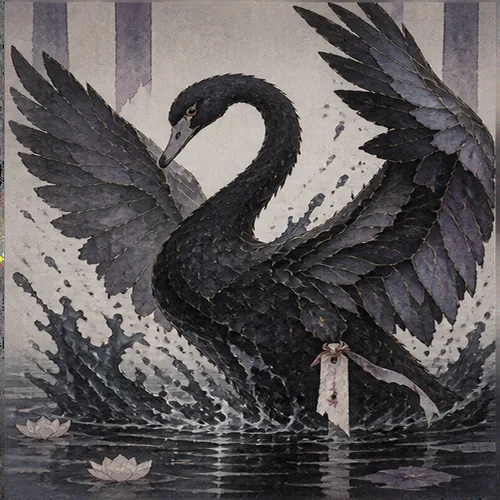 Undertaker's SwanC31 · 4 energy · 3/4It ferries names written on feathers and washes its beak only after it has earned someone one more morning.Read this folio →
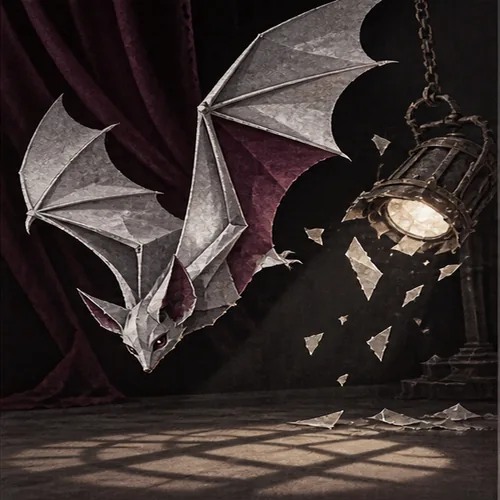 Silver-Echo BatC33 · 2 energy · 3/1It repeats only the sound magic makes after it has already passed.Read this folio →