Vessa grew up in the mirror theater, learning roles before she understood that a person could refuse one. She could imitate a patron’s laugh, a grieving queen’s posture, or the exact pause that made an audience lean forward. Applause gave her a clean measure of success. Offstage, choices felt messier. She let directors, admirers and eventually her own reflection tell her which version of Vessa was most convincing.
Vessa
A Thousand False Faces
Biography
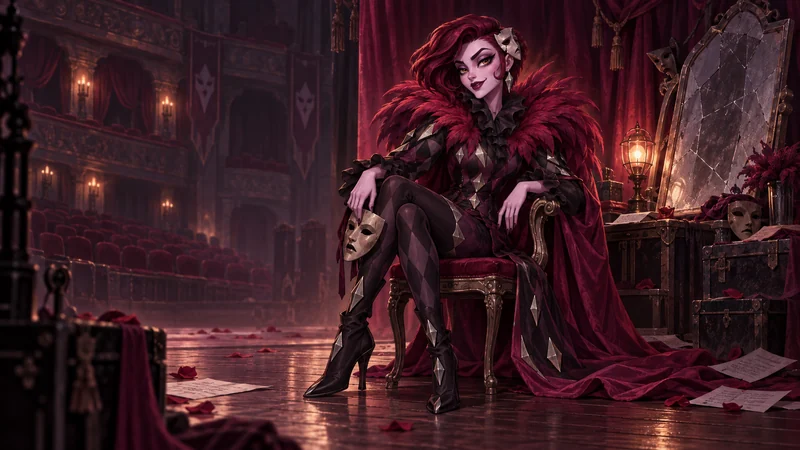
Vessa once played every role in the mirror theater. One night her reflection refused to leave the stage, so she shattered the mirrors and began searching the fragments for her stolen ending. She performs in Mournhand for an audience she cannot see, suspecting her reflection has bought the best seat.
Why Vessa entered Mournhand
A 381-word account of the life, loss, wish and dangerous bargain behind this campaign.
During the final performance, the reflection missed a cue. It remained onstage after Vessa had stepped into the wings, then continued the scene with lines no one had written. The audience applauded the reflection as if nothing were wrong. Vessa shattered the mirrors, but each fragment preserved a different continuation: a marriage she never chose, a triumph she had secretly wanted, a quiet life she had mocked because she feared she could not have it. The reflection began collecting experiences Vessa could see but not remember.
She traveled with masks and broken programs, looking for the boundary between stolen possibility and a second person’s life. If the reflection has become conscious, destroying it would be murder. If it is only a trap, letting it continue may erase her. The theater’s ghostly audience offers no guidance; it applauds every ending equally. Vessa’s charm and theatrical confidence remain real, but they no longer protect her from the question beneath the performance: what does she want when nobody is watching?
Vessa enters Mournhand to reclaim the right to choose her next scene. The table offers to put her back in the mirror and give her reflection the mortal life, or to erase the reflection and transfer every stolen memory into Vessa. Both answers treat one existence as disposable. Vessa’s actual wish is to separate their lives without deciding which one is authentic. She will have to accept that the reflection may choose a future she wanted.
A Thousand False Faces turns that conflict into play. Prism Crane Prism CraneC32 · 2 energy · 1/3Folded from the program of a play that never ended, it lands on the wrong page whenever somebody lies.Read this folio → rearranges a program that never ended. Silver-Echo Bat
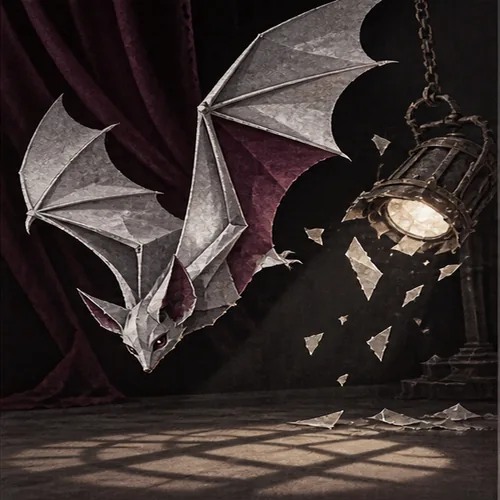 Silver-Echo BatC33 · 2 energy · 3/1It repeats only the sound magic makes after it has already passed.Read this folio → hears magic after the line is spoken. Facet Marionette
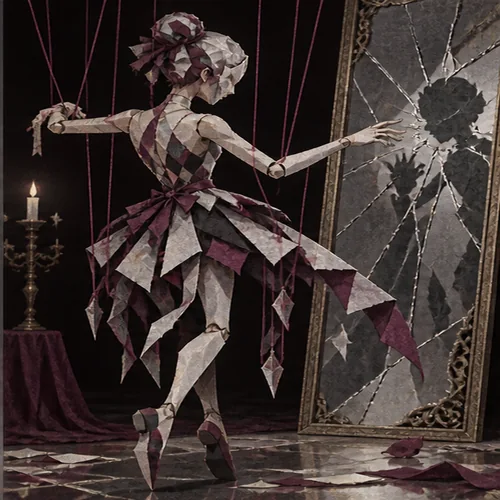 Facet MarionetteC34 · 3 energy · 2/4It learned to bow after every injury because its strings tighten when it survives.Read this folio → survives by giving the audience exactly the fall it expects. Mirror-Fang Dancer
 Mirror-Fang DancerC05 · 3 energy · 3/3Her reflection learned the final step before she did.Read this folio → challenges anyone who confuses performance with consent. Vessa plays because she wants an ending of her own, then learns that authorship is not control over everyone else in the story.
The unfinished question
A stolen reflection now performs a role she can no longer finish. Vessa searches the broken mirror theater for her ending, unsure whether the unseen audience follows her or the double who has taken her place.
Mirror-Fang DancerMirror-Fang DancerC05 · 3 energy · 3/3Her reflection learned the final step before she did.Read this folio → disputes who is real, Prism CranePrism CraneC32 · 2 energy · 1/3Folded from the program of a play that never ended, it lands on the wrong page whenever somebody lies.Read this folio → rearranges a play's pages, Silver-Echo BatSilver-Echo BatC33 · 2 energy · 3/1It repeats only the sound magic makes after it has already passed.Read this folio → hears magic after it passes, and Facet MarionetteFacet MarionetteC34 · 3 energy · 2/4It learned to bow after every injury because its strings tighten when it survives.Read this folio → bows to survive injury. Vessa calls them a cast, but is unsure whether the stolen reflection chose them first.
Faction or circle
The mirror-theater circuit
Pastime
Collecting and rearranging unfinished play programs.
Ledger trivia
Her stolen reflection may hold the best seat in the house.
How to play Vessa
Change the Script: Draw, then discard to improve your hand without increasing its size.
Change the Script draws then discards, improving choice without adding a card to the hand. Use it to find a response while the board is stable. Repeated selection costs energy and cannot compensate for ignoring an immediate attacker.
The four encounters
The settings recorded for this champion’s campaign chapter:
The abandoned playhouse. Torn programs flutter across empty seats beneath a mirror with one silhouette missing.
The silver fly tower. Bat wings flicker among hanging scenery and a single fractured stage lamp.
The puppet undercroft. Cut strings hang over a marionette bowing toward a cracked rehearsal mirror.
The divided grand stage. A thousand mirror faces watch from behind a curtain split by silver light.
Souls in this chapter
C32Prism Crane
Prism CranePrism CraneC32 · 2 energy · 1/3Folded from the program of a play that never ended, it lands on the wrong page whenever somebody lies.Read this folio →
Folded from the program of a play that never ended, it lands on the wrong page whenever somebody lies.
C33Silver-Echo Bat
Silver-Echo BatSilver-Echo BatC33 · 2 energy · 3/1It repeats only the sound magic makes after it has already passed.Read this folio →
It repeats only the sound magic makes after it has already passed.
C34Facet Marionette
Facet MarionetteFacet MarionetteC34 · 3 energy · 2/4It learned to bow after every injury because its strings tighten when it survives.Read this folio →
It learned to bow after every injury because its strings tighten when it survives.