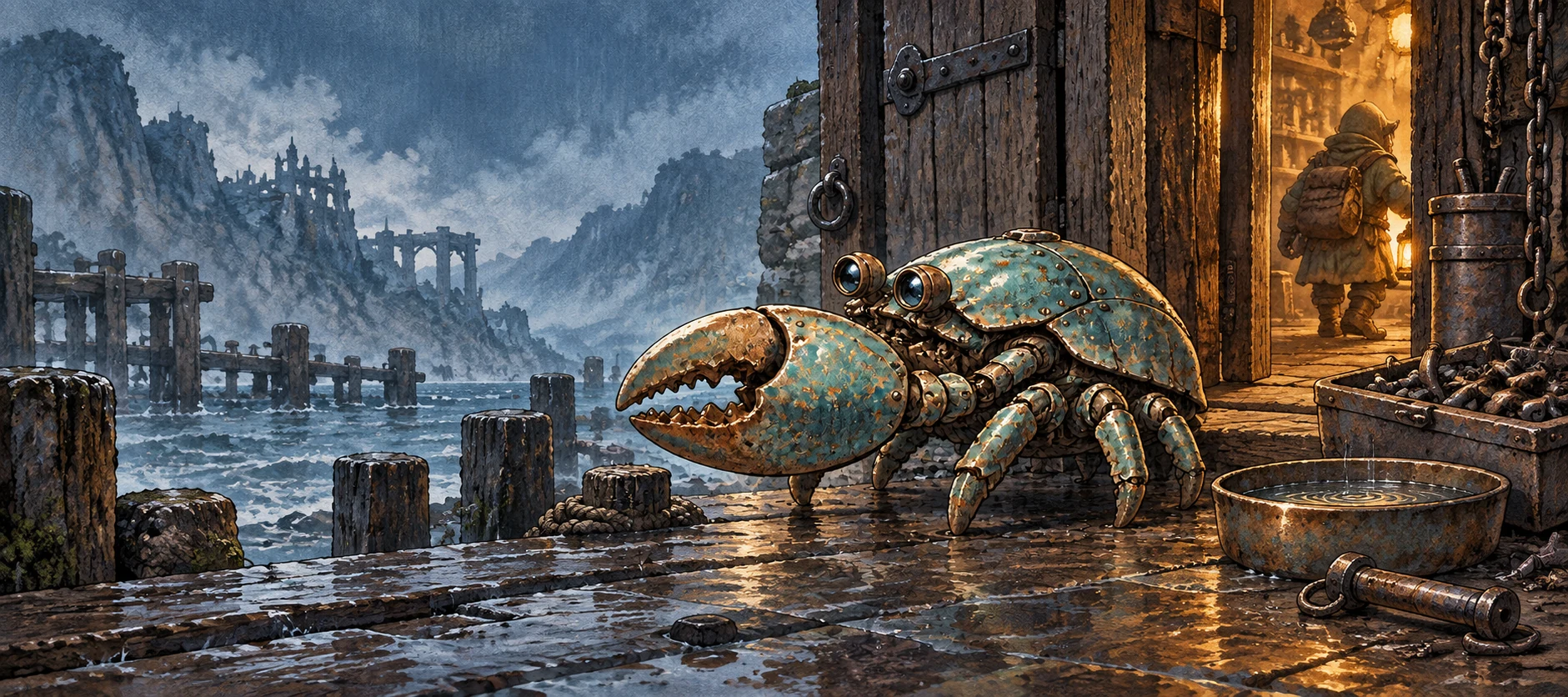
Eggs in the cooling channel
Clink hatched on May 2 in a shallow cooling channel beneath the east workshop, a clutch of translucent eggs tucked between two stones. The channel carried water past the forge and out toward the river. Its young crabs learned to crawl between warm stones, scraps of coal, and metal filings before they could lift their shells above the water.
Clink was not the largest hatchling or the fiercest. It had one claw slightly wider than the other and an instinct for moving small objects into neat piles. Shell chips, pebbles, and bits of copper wire all ended up in a hollow near its sleeping place. The other crabs sometimes stole from the pile, and Clink rebuilt it without chasing them.
The cooling channel changed temperature with the workshop's schedule. When the furnaces opened, the water warmed; when the doors closed, it went cold. Clink learned to retreat under the stones whenever the surface shivered. It did not understand the machines, only the vibrations they sent through the channel.
The older crabs moved toward the river when the channel grew too bright. Clink stayed near the workshop because scraps and small flies gathered there. A bent nail made a useful brace across its nest, and a green copper washer kept the water from washing the shell chips away. Its first home was already a small repair.
A shell of scrap and water
As Clink grew, its blue-green shell caught flecks of copper from the water and acquired a dull metal sheen. The coating was not armor anyone had fitted to it; minerals from the channel settled into the shell's natural ridges. A workshop apprentice once tried to polish the color away, then stopped when the crab backed into a crack between the stones.
The apprentices called it Clink because its smaller claw struck a washer whenever it crossed the grating. The sound was soft, like a dropped button. The name did not make the crab tame. It still pinched fingers that reached too quickly and vanished beneath the nearest bench when the room became crowded.
The workshop had no official animal keeper. A cleaner named Bera left a dish of water by the canal opening, and an apprentice named Jori set aside bits of fish after supper. Each believed the other had adopted the crab. Clink accepted both offerings and continued its own route through the cooling channel.
On the night before its first birthday, the apprentices left a flat brass washer by the water. It was too large for a claw to move, but Clink nudged it until it rested against the channel grate. Jori laughed and said that the crab had chosen a birthday present it could never carry. Clink tried again the next morning.
The channel water left pale mineral rings on the stones. Bera scrubbed one clear each week so she could see if the flow had changed. Clink would place a washer on the clean patch, then move it to the next pale ring when the channel rose.
The workshop door
The east workshop made hinges, handrails, door latches, and small braces for buildings around the Ward. Its large door stayed open during the day so carts could bring in timber and carry out finished work. Clink found a dry place beneath the threshold where the wood met stone, close to both the channel and the sound of people moving.
Workers stepped around the crab after the first few weeks. Some left scraps; some complained that it was in the way. Clink did not understand the difference between a welcome and an obligation. It kept returning because the threshold was warm, the channel was close, and the stone gave it a clear vibration whenever the door moved.
The first time a child fell near the threshold, Clink moved between the child and a rolling toolbox. It raised both claws and held still until the cart stopped. The child, Mina, put a bread crumb beside it. The workshop master called the crab a guard as a joke, and no one remembered who said it first.
The word stuck. Workers began saying 'ask the guard' when a loose piece of hardware disappeared under the bench. They never expected a crab to find it, but Clink often did. It carried small items toward the bench and left them in a crooked line, as if sorting the objects by what had broken.
The door had a lower hinge that squeaked whenever someone leaned against it. The master planned to replace the hinge but kept postponing the job. Clink positioned itself beside the squeak and raised its claws each time the door moved unexpectedly, making the workers notice the fault before it became dangerous.
The bent nail
One morning, Clink carried a bent nail to the repair bench and set it beside Jori's hammer. Jori thought the nail had fallen from a crate. He straightened it and dropped it back into the scrap tin. Clink waited until the next day, found it again, and brought it to the same spot.
Bera noticed that the nail had been bent by a cart wheel, not by a careless hammer. She used it to demonstrate how to test a hinge before fitting it to a door. Jori kept it on the bench afterward. Clink returned with another bent nail, then a twisted washer, then a broken hook.
The apprentices made a small tray for the things Clink brought. They did not know whether the crab wanted them repaired, sorted, or removed from its path. They tried different arrangements. When they put the bent pieces in one side and the usable pieces in another, Clink stopped carrying the same nail back and began bringing new ones.
The tray became an informal lesson. Young workers learned to examine a damaged piece before throwing it away. Sometimes the object could be straightened; sometimes it was unsafe to reuse. Clink did not know the difference, but its habit gave the humans a reason to look closely.
Mina began writing a date beside every item in the repair tray. It helped the apprentices see how long a piece had waited and whether it had become useful. Clink never understood the marks, but it seemed to prefer the tray after the dates were added.
The quiet apprentice
Mina was the workshop's youngest apprentice and the one most often sent to fetch tools. She was small enough to move through the stacks without disturbing them, but older workers treated this as a reason to give her every errand. Clink began following her route, carrying washers from the floor to the bench and slowing whenever she fell behind.
Mina did not want the crab to become another responsibility. She had been made caretaker of younger cousins at home and spent most of her day being told what someone else needed. She liked that Clink did not ask her to carry it or speak for it. It simply waited by the door until she chose to stop.
On hard days, Mina sat at the threshold and sorted the pieces Clink had brought. The job was quiet and had no test at the end. She learned the difference between a bent nail and a nail she could safely straighten, then taught the next apprentice without repeating the harsh correction she had received.
Mina's name is not part of the crab's spirit. She lived her own life after the workshop changed hands, and the Crow's later account cannot say what became of every apprentice who left. The old repair tray preserved only the practice: inspect the broken piece before deciding that it was useless.
A place under the bench
Clink's nest moved from the channel to a dry space under the repair bench after a winter flood. The apprentices lined it with smooth stones and a strip of sackcloth. Bera left a shallow dish nearby, while Jori placed the copper washer at the entrance as a marker. Clink rearranged all of it during the first night.
The crab slept through the loudest work and woke when the door latch clicked. It learned each worker's footfall and could tell when Mina was carrying too much by the uneven rhythm of her steps. When she came in late, Clink waited by the threshold instead of retreating under the bench.
The workshop master tried to move it into a safer box. Clink pinched his glove, and he withdrew his hand. Mina told him the crab was not a tool to be stored. The master apologized, set the box aside, and asked where Clink preferred to stay. The question was new; the answer was the old warm stone.
Clink's small shelter was never locked. It could leave through the drain, cross the channel, and return when it wanted. The workers did not claim ownership of the animal because they had fed it. They only agreed to keep the door from crushing it when carts passed.
When the channel flooded again, Clink moved its shelter to a dry shelf without being carried. It took the copper washer and two smooth stones with it. Jori found the arrangement the next morning and decided the crab had chosen its own home more carefully than the workshop's landlord had chosen the roof.
The shop teaches its guard
The workshop's Guard title came from the way Clink stood when anything approached the door too quickly. It did not attack every visitor. It raised its claws for a cart wheel, a falling crate, or a hand reaching beneath the bench without warning, then lowered them when the danger passed.
Mina began placing a chalk line just inside the threshold so workers would know where to set heavy loads. Clink settled on the line during crowded hours. Anyone pushing through had to pause long enough to see the small copper shell at their feet.
A new apprentice named Tel tried to frighten the crab with a broom. The workers stopped him before the broom touched its shell. The master assigned Tel to repair the threshold where he had kicked loose a stone, and he learned that a guard's presence was not an invitation to test its patience.
Clink responded to routine more than commands. It did not understand a shift bell or a spoken appointment. It knew the door's weight, the feet coming toward it, and whether a worker had left the water dish full. The people around it gave these habits a name, but they never taught the crab to wait.
When the masters were gone
The workshop's owners left during a period of closures and never returned on the schedule they had posted. Some took tools to another district; others left after receiving a notice that the east building would be inspected. The apprentices were told to wait for word before they cleared the benches.
The first week, Clink waited at the door every morning. It raised its claws when the latch moved and lowered them when no one entered. Mina kept the water dish filled and sorted the old nails beneath the bench. Jori checked the posted schedule, though the paper had begun to peel from the wall.
Mina received a place at another workshop and asked the remaining workers whether they wanted to go with her. Some left; some stayed to help their families; some could not be found when the roll was called. Clink was not able to distinguish an absence from a refusal, so it waited for each footfall as if it might be familiar.
The masters' departure was never fully explained. The records list a closure and a transfer of tools, but no account of where each person went. Clink's watch did not establish that anyone had died. It only preserved the fact that the door remained closed when the people it expected did not come through.
Mina waited three days beyond the posted reopening date before clearing the first bench. She left the masters' tools where they were and set the notice beside the sign-in sheet. When no one returned, she asked the apprentices to write down what they had moved, so no one would mistake a borrowed tool for an abandoned one.
A smaller worker at the threshold
Years later, a child named Tamsin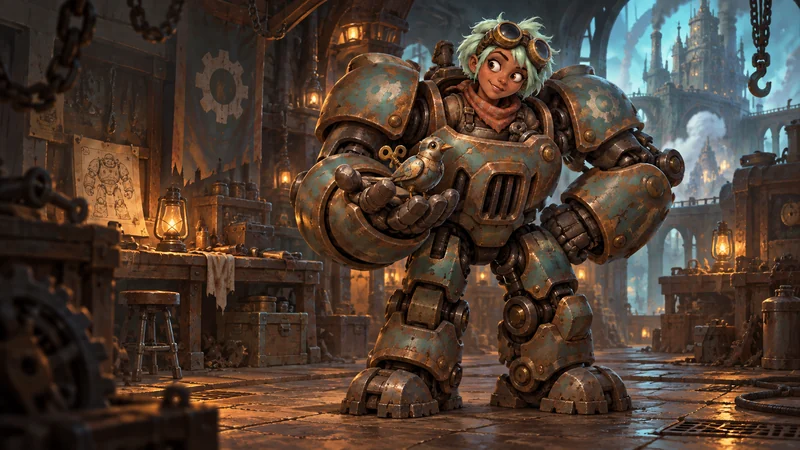 TamsinFirst-generation championTamsin was the smallest apprentice in a workshop that built enormous machines.Read this biography → entered the shuttered workshop with a bundle of mismatched tools. She was looking for anything light enough to carry and useful enough to build a shelter. The room was quiet except for water beneath the floor and the small clicking of a crab beneath the bench.
TamsinTamsinFirst-generation championTamsin was the smallest apprentice in a workshop that built enormous machines.Read this biography → set a bent nail on the floor and watched Clink carry it to the old repair tray. She followed the crab to the bench, then saw that the door still had a clear path through the debris. She did not know who had once called it a guard. She only knew it had made a place for small things to pass.
The two did not become family in an instant. TamsinTamsinFirst-generation championTamsin was the smallest apprentice in a workshop that built enormous machines.Read this biography → had to learn not to lift the crab by its shell, and Clink had to learn that a new pair of boots could belong to someone who was not one of the old workers. She returned the next day with a water dish and left it by the threshold.
TamsinTamsinFirst-generation championTamsin was the smallest apprentice in a workshop that built enormous machines.Read this biography →'s own story continued through the tools she gathered and the suit she assembled. Clink remained an independent creature in the room. It did not build her armor or explain why its masters had vanished, and she did not claim that the crab had chosen her as a replacement for anyone.
TamsinTamsinFirst-generation championTamsin was the smallest apprentice in a workshop that built enormous machines.Read this biography → was careful with the room because she knew what it meant to be small among oversized tools. She did not assume the crab's place was empty just because the masters had gone. She asked the remaining apprentices which benches could be used and which should stay clear for someone who might still return.
The gate that would not stay open
A storm weakened the workshop door while TamsinTamsinFirst-generation championTamsin was the smallest apprentice in a workshop that built enormous machines.Read this biography → and two other children searched the room for dry timber. The top hinge pulled free, and the heavy door began to swing inward. Clink moved from under the bench and wedged its shell between the threshold and the lower edge.
The children pulled the door back while TamsinTamsinFirst-generation championTamsin was the smallest apprentice in a workshop that built enormous machines.Read this biography → pushed a brace into place. Clink held still through the first shift of weight. Once the hinge caught, it backed away and went to the water dish. The shell had not broken, but one copper ridge had been scraped flat.
TamsinTamsinFirst-generation championTamsin was the smallest apprentice in a workshop that built enormous machines.Read this biography → thanked it as if it could understand the words. Clink did not answer. It carried a bent nail to the repair tray and waited beside the old tools until the children finished clearing a path through the room.
The workshop's door became a symbol of the small shelter TamsinTamsinFirst-generation championTamsin was the smallest apprentice in a workshop that built enormous machines.Read this biography → wanted to make. Clink's role was modest: hold one corner, notice one danger, leave room for the next person to pass. The children respected that scale and did not ask the crab to hold the whole building alone.
The night of the failing roof
The building had been marked for demolition, but its remaining rooms still held tools and records. During a later storm, water saturated the roof beams above the workshop. TamsinTamsinFirst-generation championTamsin was the smallest apprentice in a workshop that built enormous machines.Read this biography → and the other children had moved most of the tools outside, but a trunk of old job books remained near the far wall.
Clink heard the top hinge shiver before the children did. It moved to the door and braced itself where it had wedged the gate before. TamsinTamsinFirst-generation championTamsin was the smallest apprentice in a workshop that built enormous machines.Read this biography → shouted for everyone to leave. The children carried the trunk out while the door swung against the crab's copper shell.
The old lintel split. Clink held the gap long enough for the smallest child to crawl beneath the door. TamsinTamsinFirst-generation championTamsin was the smallest apprentice in a workshop that built enormous machines.Read this biography → reached back for it, but a section of beam dropped across the threshold, pinning the crab under the bent hinge and crushing its body against the stone.
The children were outside. TamsinTamsinFirst-generation championTamsin was the smallest apprentice in a workshop that built enormous machines.Read this biography → and Mina tried to lift the beam, but the roof continued to shift. Clink's legs stopped moving before they could free it. The other workers carried its still body away after the danger passed, while TamsinTamsinFirst-generation championTamsin was the smallest apprentice in a workshop that built enormous machines.Read this biography → kept the hinge pin that had fallen beside it.
The roll call after the collapse
The workshop crew met in the lane after the roof settled. Mina read the names of everyone who had been inside; each person answered or had a living witness answer for them. The list had one blank where an old master should have been, but the absence did not prove whether that person was dead, transferred, or still missing.
TamsinTamsinFirst-generation championTamsin was the smallest apprentice in a workshop that built enormous machines.Read this biography → added Clink's name to the lower corner of the page. She wrote 'small guard, under the door' beside it, because she did not know the animal's earlier name or the old owners' language for it. Mina recognized the bent nail tray and confirmed that the crab had lived in the workshop for years.
The body was a body, not a vessel anyone planned to use. The workers returned it to the cooling channel and buried the broken copper ridge nearby. They kept the fallen hinge pin and the sign-in sheet, both ordinary records from the same ruined doorway.
TamsinTamsinFirst-generation championTamsin was the smallest apprentice in a workshop that built enormous machines.Read this biography → left the shop with the rescued tools. She did not claim that Clink had died for her specifically; it had held a door for whoever was passing through. The distinction mattered to Mina, who remembered how often the crab had protected people who never learned its name.
The list gave the survivors a practical task after the rescue: check each name, correct each spelling, and note who had taken the original page. The work slowed rumor. If someone was not present, the group recorded that they were absent and kept looking for better information.
The hinge pin and the water
After the collapse, the hinge pin was placed in a tin with the workshop's surviving tools. It had been bent where the door met the frame and carried a strip of blue-green mineral stain from the cooling channel. TamsinTamsinFirst-generation championTamsin was the smallest apprentice in a workshop that built enormous machines.Read this biography → kept it in her kit because it could still be straightened and used as a brace.
The roll-call sheet went to Mina, who compared it with the apprentice list from the previous year. Several names had been crossed out after workers left the Ward. Their departures were recorded separately from the names of people reported dead, and Mina refused to let later readers merge the categories.
One night, the hinge pin moved inside TamsinTamsinFirst-generation championTamsin was the smallest apprentice in a workshop that built enormous machines.Read this biography →'s kit. It rolled to the corner nearest the workshop door and stopped against the old sign-in sheet. A quiet clicking followed, like the crab's small claw on the brass washer. TamsinTamsinFirst-generation championTamsin was the smallest apprentice in a workshop that built enormous machines.Read this biography → opened the kit and found a copper shadow waiting among the tools.
The spirit-form resembled a riveted crab, with a shell of oxidized copper, round lens-like eyes, and a strong claw shaped by the old hinge. It was not the body brought from the channel. The animal's departing spirit had remained near the threshold, caught by its shell's metallic coating, the fallen pin, and the last written roll call.
The creature that keeps a place
The spirit did not recognize TamsinTamsinFirst-generation championTamsin was the smallest apprentice in a workshop that built enormous machines.Read this biography → as an owner. It followed the vibration of her tools and moved toward doors that had not been secured. When she set down a straight nail, it carried the nail to the bench and left it beside the other useful pieces. When she tried to pick it up, it lifted both claws.
Mina brought the spirit a shallow dish of water, but the copper crab did not need to drink. It sat beside the dish because that was where the living crab had rested. The old habit remained recognizable, even though the new form was made of metal-like plates and no longer required food.
The creature would place itself between a worker and a danger, but it did not chase everyone who entered. It allowed TamsinTamsinFirst-generation championTamsin was the smallest apprentice in a workshop that built enormous machines.Read this biography → to pass when she announced herself and stopped an unfamiliar cart from rolling down the broken ramp. Its protection was a chosen posture, not a command issued by the hinge pin.
TamsinTamsinFirst-generation championTamsin was the smallest apprentice in a workshop that built enormous machines.Read this biography → gave the copper crab a new water dish in her workshop. She left the door unlatched and set a tray beneath the bench for bent nails. The crab continued to straighten what it could and left the pieces that were too damaged to trust.
On quiet mornings, the crab's round eyes reflected the doorway and whoever stood there. The workers began greeting it before they entered, partly to avoid startling it and partly because the greeting made the threshold feel like a shared room instead of a checkpoint.
The names that stayed outside
The old sign-in sheet contained dozens of names, but none of them entered the crab's spirit. It was a record of the people who had worked near Clink, not a list of souls inside the copper shell. Mina retained the page and added notes when former apprentices sent news from another district.
Some of the old masters later wrote to say they had found work elsewhere. Others never answered. The archive did not fill those spaces with guessed deaths. TamsinTamsinFirst-generation championTamsin was the smallest apprentice in a workshop that built enormous machines.Read this biography → kept the open roll call beside the tool chest, where anyone could add a verified return or a new lead.
The crab could not tell which masters were alive, and it did not carry a memory of their voices as separate people. It remembered the rhythm of the door, the tray of bent nails, and the moment the lintel came down. The names belonged to the living ledger, not to its shell.
When someone asked the creature why it still guarded the threshold, it raised one claw and then lowered it again. TamsinTamsinFirst-generation championTamsin was the smallest apprentice in a workshop that built enormous machines.Read this biography → said it probably liked the view. Mina said it probably remembered the water. Neither answer was confirmed, so both were left as friendly guesses rather than facts.
A small guard in a new workshop
TamsinTamsinFirst-generation championTamsin was the smallest apprentice in a workshop that built enormous machines.Read this biography →'s workshop grew around reclaimed tools and people who had been overlooked elsewhere. The copper crab took up a place near the doorway where carts turned sharply. It was too small to stop a heavy machine, but workers learned to watch their footing and slow down when the claws rose.
A new apprentice once tripped over the tray of bent nails and blamed the crab. TamsinTamsinFirst-generation championTamsin was the smallest apprentice in a workshop that built enormous machines.Read this biography → asked the apprentice to sort each nail before clearing the floor. The crab waited nearby. By the time the task was done, the apprentice understood why the tray had been there and apologized to the creature.
The workshop kept a list of people who came and went. TamsinTamsinFirst-generation championTamsin was the smallest apprentice in a workshop that built enormous machines.Read this biography → did not use the list to claim that each person owed her loyalty. She wanted to know who needed a tool, who had found another place, and which bench could be cleared for someone new.
The crab never became a mascot. It had preferences, habits, and a guarded space beneath the workbench. The children could watch it sort a nail, but no one was permitted to pull it out by its shell or attach a tag to its body. The door stayed open because the creature chose to guard it.
The card that holds the door
Long after the first workshop fell, a cardmaker found the old hinge pin in a box of salvaged tools. TamsinTamsinFirst-generation championTamsin was the smallest apprentice in a workshop that built enormous machines.Read this biography → and Mina were asked whether the spirit would consent to a transfer. The copper crab was shown the card back, then the open doorway beside it. It moved toward the card only after TamsinTamsinFirst-generation championTamsin was the smallest apprentice in a workshop that built enormous machines.Read this biography → set the bent nail tray nearby.
The transfer carried the crab's whole remaining spirit relation into one authentic Mournhand card. The physical body had been buried in the cooling channel; the sign-in sheet, hinge, water dish, and every worker's name remained outside. No other person or creature was drawn in with it.
At the table, Rivet Crab costs 2 energy, has 2 attack and 3 health, and has Guard. Guard directs legal enemy creature attacks according to the game's normal rules. It has no entry damage, armor, or healing ability; the card's role is to stand where a smaller ally needs protection.
The transfer ledger included a sketch of the door's hinge and the small claw marks left on its lower edge. Mina added the tray of bent nails to the workshop inventory, but marked it as shared. The crab's place could travel with the card; the workroom's tools stayed for whoever came next.
The name on the card came from the hinge and the small metal pieces it kept sorting. No one remembered formally appointing it to guard the door, because no appointment had happened. The workshop had left a place open, and Clink had chosen to keep it.
 Coppercap PorterC23 · 1 energy · 1/1The porter was built to carry things no larger than a lunchbox.Read this folio →
 Needlejaw CatC20 · 4 energy · 3/4Seamstresses leave broken needles on their windowsills for the cat with the silver mouth.Read this folio →
 Hearth-Anvil StagC22 · 4 energy · 3/6When the last forge went cold, the apprentices found a stag standing among its ashes.Read this folio →