
Cloth sold by length
Rhea Sorn was born on November 9 in a room above a costume-mending shop, while rain found three different ways through the roof. Her mother, Mara, remembered the date because an actor downstairs was demanding the return of a borrowed mourning coat. The midwife sent him away wearing a curtain. For years afterward, Mara told that story whenever Rhea mistook a customer's urgency for an emergency. The household owned little, but its small collection of jokes was treated with the care other families gave their silver. Rhea grew up knowing exactly which floorboards complained and how to carry a basin without spilling it on the cloth below.
The shop supplied the mirror-theater circuit: cuffs for players, hems for dancers, false velvet for noble characters whose performers could not afford real velvet. Mara worked from the inside of garments. She taught Rhea to turn a beautiful sleeve over and inspect the knots. A handsome seam could hide a hurried repair; an ugly one might hold through twenty seasons. Rhea sorted buttons, unpicked rented lace, and delivered costumes in a covered basket. She saw how often a hero's splendid cloak arrived at their counter with soup on it. This did not diminish her love of the stage. It made the people who walked it seem reachable.
Her first sword was a broken wooden curtain rod. She practiced in the strip between the worktable and the wall, where a careless swing would cost the family a pane of glass. Mara forbade thrusts toward the window, so Rhea learned to turn her wrist and curve a cut around things she could not afford to damage. She was a watchful child with abrupt enthusiasms. An insult might trouble her for days, while a single invitation to join a game could make her recklessly loyal. She disliked being pitied more than being corrected, and would quietly redo a bad seam after insisting there was nothing wrong with it.
On her birthdays, Mara gave her the longest silk offcut left in the basket. One year it was barely enough to tie around a finger; another, it reached from Rhea's wrist to her elbow. She treasured both. In November, the household marked Scorpio beside her name on an old almanac, and Mara joked that her daughter could remember a kindness or a slight through any winter. Rhea remembered the kindnesses more carefully than people later supposed. Her first red ribbon was a gift, not a prize. When she eventually won finer silk, she kept that narrow, uneven scrap wrapped around the wooden sword's grip.
The distance between points
At thirteen, Rhea delivered a repaired fencing coat to Tel Orris, an aging duelist whose right knee stiffened before rain. She found him rehearsing alone, moving a curved practice blade through an exchange meant for two. When she unconsciously stepped into the absent partner's position, he stopped. Her balance was poor and her elbow too high, but she had noticed where another person belonged. He offered to teach her if she would sweep the rehearsal floor and count aloud when he practiced. Mara agreed after inspecting the room, the weapons, and the man. She asked where the exits were before she asked what he charged.
Tel's first lessons were mostly walking. Rhea learned the distance at which a blade looked dangerous, the shorter distance at which it became dangerous, and the importance of not confusing them because an audience cheered. She learned to fall without striking her head and to hear a partner's breathing under music. A ribbon tied to each practice weapon showed whether a cut finished cleanly. When hers tangled around her wrist, she wanted a sharper blade. Tel gave her a broom and had her repeat the movement until the handle stopped catching her sleeve. He was sparing with praise and exact about the reason for every correction.
There were no formal ranks in the little rehearsal room. Pupils arrived between other jobs. A cooper's daughter had powerful shoulders; a courier could cross the floor in three steps; Rhea learned quickest when she could watch an exchange from the gallery and take it apart afterward. She filled the margins of discarded costume invoices with foot positions. Her first serious injury was a sprained ankle caused by trying to finish a spectacular turn after her partner had called a stop. Tel made her sit through a week of rehearsals and record every time someone trusted someone else. The resulting list was longer than her notes on cuts.
Her first public bout was held on a rented platform behind a supper house. The audience could hear plates being washed through the wall. Halfway through, a fastening broke on her partner's guard. Rhea saw it and turned the exchange into a comic stumble that ended with both weapons on the floor. They received scattered laughter and almost no money. Tel gave her a blue ribbon afterward. She protested that she had not won. He answered that her partner still had all his fingers. Rhea tied the ribbon above her worktable. Years later, when silk prizes crowded the wall, that plain strip remained the only one she never lent to a costume department.
The house that employed them
The Larkglass Theater hired Rhea first to mend costumes and perform small exchanges between acts. Its painted ceiling showed a summer sky, though buckets stood beneath it whenever actual weather arrived. Mirrors along the side passages let spectators admire themselves and allowed stagehands to see a door opening around a corner. Rhea loved the place almost at once. She liked its smell of rosin, wet wool, and dust warmed by lamps. She liked the absurd solemnity with which everyone discussed a missing wooden crown. Most of all, she liked the hour before a performance, when dozens of small tasks briefly agreed on a single purpose.
Her closest friend there was Iven, a stagehand who could repair a pulley while carrying on an argument below it. He showed her the narrow passage behind the scenery and which stair would take a whole company outside fastest. Their affection grew through practical favors: he set aside undamaged ribbon, she strengthened the knees of his work trousers, and each saved supper when the other finished late. On quiet evenings they played a counting game with buttons and stale bread crusts. Rhea was a poor loser and an excellent maker of the next pot of tea. Iven eventually learned to wait for the tea before discussing her mistakes.
Senn, the theater's prompt keeper, became their third companion. She copied cues in a precise hand and distrusted any instruction that could mean two things. A former accounts apprentice, she kept household totals for performers who could barely read their contracts. Rhea initially found her caution dull. Then Senn discovered a fee being charged twice and recovered enough money to pay Mara's winter coal bill. After that, Rhea brought every contract to the prompt desk. In return, she taught Senn how to stand without being easily pushed aside. Their lessons usually ended in laughter, with Senn demanding a written explanation for the position of each foot.
Life in the company was not an uninterrupted rehearsal for tragedy. There were excellent pears bought cheaply at closing time, terrible songs invented while washing paintbrushes, and mornings when Rhea slept past noon without guilt. She collected unusual knots and taught neighborhood children how to untangle them. She liked braiding silk because the work occupied her hands while leaving room to listen. She also liked applause, expensive soap when she could afford it, and the sight of her name printed larger than the previous week. The people who loved her knew her vanity alongside her generosity. Neither was a disguise for the other.
Ribbons from the gallery
Rhea's reputation grew through ribbon duels, staged contests in which the winner cut a silk token from the other's costume. The weapons had real edges; the movements had agreed limits. A good performance made skill visible without making injury necessary. Rhea favored a curved blade because its line carried clearly to the highest seats. She cut her crimson hair short after it caught in a collar during rehearsal, then kept it that way because she liked the uncovered weight of her own head. Her black fitted fencing clothes, practical leather guards, and long red ribbons became familiar across the circuit. Audiences began asking for the girl who turned a missed stroke into a second beginning.
Success arrived in increments. First she could pay Mara on time for costume work. Then she bought a blade that belonged to her alone. Eventually patrons sent silk in sealed boxes and expected a dedication in return. Rhea enjoyed choosing which ribbon to wear. She told herself a name spoken from the stage cost nothing, although Senn pointed out that people rarely paid so much for nothing. When a warehouse owner asked her to humiliate a rival's favored performer, Rhea refused the requested injury but accepted a rearranged victory. Her opponent consented. Everyone was paid. She let those facts settle the matter more comfortably than they should have.
Tel attended that performance and waited until the dressing room emptied. He did not object to an arranged result; they had performed hundreds. He asked whether her partner had been free to decline. Rhea said adults could speak for themselves, then remembered the man's rent overdue and his sponsor sitting in the front row. She argued anyway. For several weeks she avoided Tel's rehearsal room, embarrassed that he had seen something she preferred to call complicated. When she finally returned, he had her practice the same old walking exercise. It irritated her, then steadied her. She began asking different questions before accepting a patron's silk.
She could still be seduced by a room paying attention. At a benefit performance, a raised gallery applauded until she attempted an unrehearsed flourish and frightened Iven half to death above the scenery. Afterward she apologized without offering the crowd as an excuse. They made a rule: anyone working the show could call a halt, regardless of how expensive the spectators' seats were. Rhea insisted the rule be written into the company book. The manager called it unnecessary. She signed beneath it anyway and pressed so hard that her name marked the next page. For a while, she believed writing a decent rule meant the house would keep it.
The price of an open door
The first locked exit was explained as a precaution against unpaid admission. Iven found its bolt fastened during a crowded matinee and opened it without asking. The manager deducted a fine from his wages. Rhea paid it, then received a private warning about interfering with the theater's security arrangements. She had begun earning enough to absorb such costs, which made the arrangement feel solvable. Senn showed her the larger account. Other doors, other fines, and fees charged to families collecting an injured worker appeared in the same careful columns. Rhea's money was restoring a small piece of what the house repeatedly took away.
A group of patrons controlled the Larkglass through loans made to its previous owner. Their agreements reached further than seats and receipts. Performers owed costume hire, musicians owed instrument storage, and stagehands were charged for tools damaged through ordinary use. Leaving before a contract ended could make an entire season's wages repayable. Senn found these terms attached to people who had never signed them. She also found names disappearing from the current company roll after they complained. The names remained on old invoices, where nobody powerful expected anyone to look. Rhea knew several of the missing people. She had accepted their absence as the ordinary movement of a difficult trade.
For the first time, she took a ribbon from her wall because she could not bear its giver's name. Mara found her unpicking the embroidered initials late at night. Her mother did not congratulate her. She asked what removing the thread would change for the person who had stitched it. That question annoyed Rhea enough to make her answer honestly. She had no plan beyond wanting to stop feeling implicated. Together they sorted her gifts, separating those bought by fellow performers from those sent to purchase favor. Rhea sold the latter silk without its dedications and put the money into a fund the company could use without the manager's signature.
The fund helped two workers leave. It could not protect everyone. The patrons' agents began attending rehearsals, and a supplier withdrew credit after Senn requested copies of old accounts. Iven urged them to carry the evidence to a magistrate. They did; the returned petition bore an official stamp and no appointment. One evening Rhea caught herself practicing cuts at an imaginary patron while ignoring a pupil waiting beside her. She put down the blade and apologized. Anger had made the problem vivid, but it had not made her attentive. She asked Senn what proof strangers could understand in a single sitting. Senn laid a theater program across the account book.
A play with witnesses
Their answer was a performance built around a familiar comedy about a house whose owner charged its tenants for the privilege of using the stairs. The company replaced invented sums with sums from its own accounts. Senn copied the supporting entries into an appendix that could be distributed after the curtain. The actors would never need to accuse anyone by a spoken name; the documents could do that afterward. Rhea disliked the caution until Senn explained that a convincing performance and a usable record were different things. They needed people to remember figures accurately when the laughter ended.
Participation was discussed in the rehearsal room, with the doors open and no manager present. Some workers wanted no part in it. Rhea's first impulse was to persuade them, but Tel asked whether she was giving them another decision they could not afford to refuse. She stopped. They arranged ordinary paid substitutes for those who withdrew and found beds elsewhere for two families afraid to remain on theater property. The plan became smaller and less spectacular. It also became something Rhea could look her friends in the face about. She surrendered the grand final duel she had imagined and wrote a quieter exchange in which both performers put their weapons down.
The programs were printed on inexpensive pale stock. A child waiting for her mother folded a spoiled copy into a bird and balanced it on the ticket ledge; Rhea straightened one crumpled wing before hurrying back to rehearsal. It was an ordinary small kindness, barely noticed at the time. She kept a clean program in her sleeve because its final leaf held the cue for distributing the appendix. Years afterward, descriptions of the Prism Crane Prism CraneC32 · 2 energy · 1/3Folded from the program of a play that never ended, it lands on the wrong page whenever somebody lies.Read this folio → would make that paper bird difficult to forget. But the fold was common, and many theaters printed on the same stock. Memory would never give her permission to pretend she had seen where it flew.
On the evening of the performance, around the year the Crow would later place at 2860 A.B., Rhea checked the stage exits with Iven. They opened. Tel tested the practice weapons. Senn laid the packets of copied accounts beneath her desk. Mara sat near an aisle, wearing a coat her daughter had bought without accepting a patron's dedication. The house filled with workers, regular spectators, and several men whose names appeared in the documents. Rhea felt the old pleasure of a full room and then felt ashamed of it. Tel touched her shoulder before the first bell. She could care about the audience and still enjoy being seen. She went onstage carrying both feelings.
The night the doors held
At first, everything worked. The audience recognized a ridiculous fee and laughed; someone called out another. A scene about a broken banister drew an angry murmur from the upper rows. During the interval, a patron's agent asked the manager to prevent the company leaving before certain papers had been recovered. Money changed hands. Guards took the keys, slid outside bolts into place, and stationed themselves along the alleys. The performance resumed inside a building whose actors believed its doors were still open. Rhea would spend much of her later existence separating the people who ordered those bolts from the people who merely stood nearby. On that night, she knew none of their names.
The first smell of smoke reached her during an exchange she had practiced until she could speak through it. A strip of scenery glowed at its lower edge. Accounts would disagree about the first flame: a spilled lamp, a deliberate distraction, a light left too close to dry canvas. The cause vanished with the section of stage where it began. Rhea called the halt. Music stumbled to silence. She told the audience to use the aisles, projecting her voice as Tel had taught her, and pointed toward the side doors. The people nearest one pushed, stopped, and pushed again. The next sound was not applause.
Iven came out of the passage carrying an iron bar. Together they attacked a side-door fastening while smoke lowered beneath the painted summer sky. Rhea's curved blade was a poor lever, but its point found room beside a plate. She bent it, cursed, and kept working. Tel and two spectators cleared space behind them. When the timber finally split, the opening was too narrow for the crowd trying to reach it. Rhea knotted a strip from her sleeve around the damaged latch, holding it back. She stood in the gap and sent people through one at a time. She recognized Mara and shoved the copied program into her mother's coat, then lost sight of her as another person fell against the door.
A strip of burning scenery dropped across Iven's path. Rhea cut its hanging ropes and helped him drag it aside. She could have followed the last group out through the broken door. Instead, she heard Senn calling from the prompt desk, where fallen wood had trapped her foot. Rhea was frightened, coughing, and furious that she had to choose. She reached Senn, forced the obstruction upward, and half-carried her toward the gap. At the door, wood cracked overhead. Rhea shoved her friend outside as the frame fell. Her last living thought was that someone must keep the narrow opening clear.
What the ashes kept
She first returned as the sensation of a hand against a door that no longer existed. Rain passed through the ruined Larkglass. Men lifted beams and set anything recognizable in rows. Rhea tried to speak to them, then tried to stop them moving the patch of floor where she believed Senn still lay. Time arrived in fragments: a morning repeated, a bell heard without its hour, smoke where water had already washed the stones. She did not understand that she was dead until Mara entered the ruins, called her daughter's name once, and waited through an answer she could not hear.
Between the falling roof and her return, she had reached a pale threshold. Tel stood beyond it, his injured knee straight. Rhea stepped toward him. Something tightened around her wrist and dragged her backward: the red sleeve she had knotted around the broken door's latch. Her dying breath had caught in that strip while the fallen frame crushed her body. The cloth burned into the theater's stones before her soul could follow him. She tried again whenever the threshold appeared in rainwater or dark glass. Every attempt ended at the same door. Wanting to leave did nothing. Her tether survived even after its original cloth became ash.
Her mother carried Rhea's blue practice ribbon. She tied it around a surviving rail because there was no body she could confidently call her child's. Rhea followed every movement of those familiar fingers. When Mara finished the knot, the loose end stirred against the wind. For the first time since the fire, Rhea felt herself gathered into a shape with an edge. She reached for the ribbon and found that ash from her burned costume gathered with her. Her crimson hair, her leather guards, the blade she had bent at the door: each returned imperfectly, held by recollection and stubborn attachment. The long silk at her sleeves carried the theater's gray dust.
Senn survived. She came with Iven, whose damaged hand could no longer close properly around a hammer. Tel did not return. Neither did several people Rhea had sent toward the main entrance before anyone knew it was barred. The survivors read their names aloud at the rail. Rhea tried to answer each one. Some evenings a word made it through as the scrape of cloth on stone, but she could not summon the dead by wanting them. She learned to braid ash into the strips at her arms because separating and crossing the strands gave the broken hours an order. The work felt enough like the old workshop to keep her present.
Mara lived long enough to see a gray ribbon appear in her locked sewing drawer. She left a needle beside it the following night. Their exchanges remained small: a moved spool, a familiar knot, a length of cloth neatly folded where grief had left a heap. Rhea could not recover the life she wanted to give her mother, and Mara could not follow her daughter into the ruins. They found a way to stop asking every meeting to accomplish the impossible. When Mara eventually died, Rhea sat unseen beside the bed until morning. She kept no grand trophy of that farewell. She took the old almanac and the wooden practice sword.
The names beside the payments
Senn brought the first proof of payment to the ruins folded inside a mending invoice. She had spent months recovering copies from suppliers, doorkeepers, and a frightened clerk. Several patrons had paid specifically to hold the exits until the performers surrendered their papers. None of the entries instructed anyone to start a fire. Rhea read that distinction until she hated the page for preserving it, then read it again. Whoever had lit the first flame remained unknown. The people who had purchased locked doors were already named. She would not make uncertainty about one crime into an excuse to forget the other.
She discovered she could travel farther by carrying cloth someone living had brought from outside. Beyond its reach, the city thinned and the burned stage rose beneath her feet again. Senn supplied plain silk and addresses. Rhea first confronted a patron in the courtyard of his new house, with a payment copied onto a ribbon and an offer to answer publicly. He called guards. She disarmed one and wounded another before the patron drew his own sword. The challenge ended quickly and without the clarity she had imagined. He died insisting he had meant to frighten people, not kill them. Rhea believed he might be telling the truth about that last, insufficient intention.
The next morning, his entry in the current city ledger had gone blank. A gray ribbon lay across the space. Rhea had left it in his courtyard, but the register now held it, the copied payment still legible on the cloth. She could not explain the passage between them. The disappearance terrified Senn, who refused to let an erased name become an erased responsibility. Together they began a second book containing testimony, dates, and the names the official ledger lost. Rhea left ribbons beside later vanished entries, but kept their words in Senn's book. She would not allow the city to call an empty line an absence of evidence.
Not every challenge ended in death. One patron surrendered his keys and accounts; another named the agents who had carried the money. Rhea accepted those answers when witnesses could check them, though people who had come to watch vengeance jeered. She was tempted to despise them as a single crowd, then remembered the strangers who had lifted debris alongside Tel. Her anger needed practice as surely as her footwork once had. She learned to ask whether a name belonged to the payer, the paid guard, or someone whose seal had been borrowed. The gray ribbons multiplied slowly. Each was a person she had chosen to confront, never a score she could honestly call victory.
The page without an ending
Years carried the people she knew beyond the reach of visits. Iven became a patient teacher of apprentices who needed tools adapted to their hands. Senn kept copying the testimony until her letters grew larger and she needed help sharpening a pen. Rhea remained as they remembered her on the night of the fire, which became its own cruelty. She could hear age changing their voices without lending them any of her unwanted continuance. They argued about this only once. Senn told her friendship was not a debt to be balanced by suffering equally. Rhea spent the next visit listening to an ordinary complaint about the price of lamp oil.
The Larkglass site changed owners. Walls rose across old passages, and her excursions began ending inside locked storerooms built over the stage. The dead patrons' agreements passed to new custodians, while witnesses' children inherited bundles they did not always know how to read. Rhea still had the surviving program. Mara had saved it, and Senn had returned it to the rail years later. The printed scenes ended at the cue before the appendix; its final leaf was smoke-darkened and almost blank. Rhea kept it inside her sleeve. She would reveal that leaf only to someone offering real knowledge of the order to close the doors, protecting the few impressions on it from useful invention.
Stories of the Prism CranePrism CraneC32 · 2 energy · 1/3Folded from the program of a play that never ended, it lands on the wrong page whenever somebody lies.Read this folio → reached her through a collector of unusual papers. A living folded bird, he said, carried part of a play that had never ended. Rhea remembered the ticket ledge so vividly that she nearly declared it hers. Instead, she asked which words survived beneath its wings. The collector could not say. She sent him away with a description of the Larkglass printing mark and no claim of kinship. If the Crane did come from that night, it might remember something she could not. If it did not, its own unfinished story deserved better than being folded into hers because the shape was convenient.
She finally understood that her existence was narrowing around an address. She could punish another name and still leave the testimony vulnerable to a leaking roof. She could guard the ruins forever and never find what had happened beyond their walls. When a paper conservator named Dessa offered to examine the damaged program, Rhea almost refused. The page was all that remained of an ending she had expected to perform alive. But Dessa spoke to her as a person making a difficult decision, rather than a haunting to be cleared away. She asked whether Rhea wanted to preserve the building's last night, or carry her whole life somewhere the building could not hold it.
The binding she chose
Dessa knew of souls that persisted in cards, though she claimed no single method worked for every remnant. She prepared a small piece of sturdy card from clean fibers and left its face unmarked. Rhea brought the things she had chosen to keep: Mara's almanac, Tel's blue ribbon, the testimony book, and the scorched program. Nothing was burned as an offering. Dessa insisted they first name what must survive the attempt, then placed the book well away from the lamp. Rhea was accustomed to people reaching for her blade or her ashes when they tried to understand her. Someone protecting the accounts before attempting a wonder steadied her more than any promise could have.
They worked at a plain table beside the broken side door. Rhea loosened one gray braid from her sleeve and laid it across the blank card. Beneath it she placed the program's last leaf, preserving the surviving print and impressions rather than scraping them away. Dessa pressed the card against the paper through a clean cloth. The marks that appeared were not an illustration of the fire. Rhea saw the shop window, a rehearsal floor, Iven holding a teapot, Mara's hands opening a knot. Every memory she had spent years reducing to evidence crowded the little surface. She nearly pulled away when she understood the card would contain the girl who had wanted applause as well as the soul who wanted answers.
She stayed. She spoke her name, Rhea Sorn, and then the name people now used when they saw the gray ribbons: Ash-Ribbon Duelist. One did not cancel the other. The braid sank into the fibers, and the image gathered around a crimson-haired woman holding a curved blade, her sleeves carrying silk and ash together. Rhea felt the distant pull of the burned stage loosen. The door beside the table became an ordinary ruined door. Her weight, her anger, the remembered angle of her mother's needle all drew inward at once. Dessa lifted a card from the clean cloth. Its reverse had darkened beneath gold and silver thorns, teal circles, and a red seal bearing a skeletal hand. The same pattern marked other bound souls in the Crow's ledger. Its surface was cool. Inside its depth, Rhea opened her eyes.
That was her binding: a chosen passage from a soul tethered to a theater into a soul remaining in the mortal world as a card. It moved the tether into a vessel; it could not reopen the pale threshold. She could travel now, but still could not follow her dead. The program remained tucked against her image; the testimony stayed outside, where other hands could read it. Before Dessa closed the protective case, a gray ribbon slipped across the table toward the open doorway. Rhea had once believed a perfect final bow would settle what a performance meant. Her first act in card form was to leave room for someone else to pass.

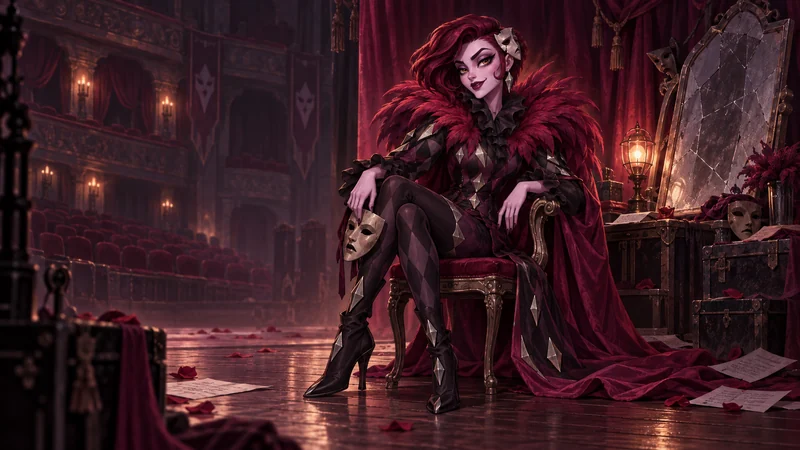 VessaFirst-generation championVessa once played every role in the mirror theater.Read this biography →
 Thimble KnightC02 · 2 energy · 1/4A seamstress fashioned his armor from her last thimble and asked him to guard the nursery door.Read this folio →
 Grave Lantern KeeperC04 · 2 energy · 2/3The keeper lights a lantern for every grave the city refuses to mark.Read this folio →