The box of rejected faces
Long before anyone called him Facet Marionette, his body waited in a cedar box beneath Sera Vale’s worktable. The pieces had come from mirrors rejected by wealthy patrons: a cheek warped by heat, a brow silvered unevenly, a long shard that turned every candle flame into two. Sera kept them because she believed a flawed reflection still contained an honest angle. She could not afford flawless glass, and she had stopped apologizing for that years before.
Sera made puppets for the Lanternless Players, a small company that performed in districts where formal theaters rarely opened their doors. Their actors included people with tremors, scars, missing fingers, ruined voices, and bodies that fashionable audiences called distracting. Sera built props that answered the performers they had instead of pretending those performers were mistakes. A broad handle helped a stiff wrist hold a sword. Painted cards replaced speeches when an actor’s throat failed. Every adaptation became part of the show.
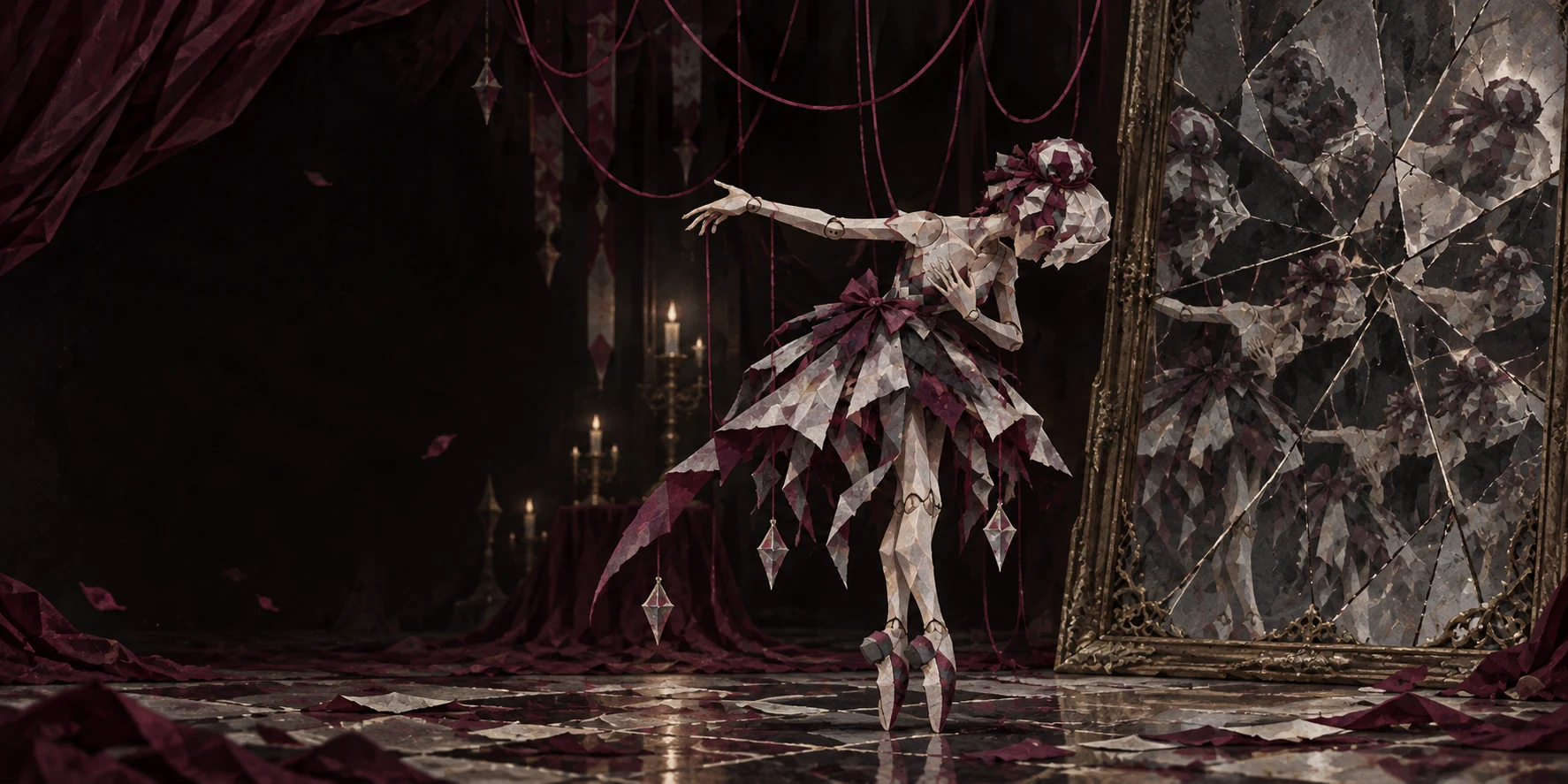
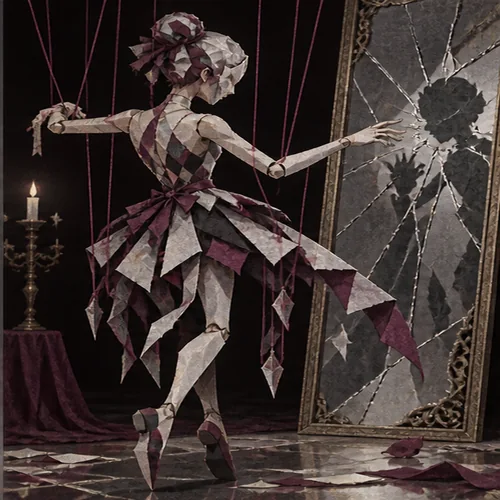
The marionette began as an experiment in shared motion. Sera cut his joints from pale ashwood, wrapped his torso in wine-colored cloth, and plated his limbs with the rejected facets. Burgundy cords ran from wrist, ankle, shoulder, and crown to a control bar shaped like an open hand. She gave him a dancer’s balance but no fixed expression. Anyone watching saw a slightly different face because no two pieces returned the same light.
For three weeks he was only wood, glass, cloth, and Sera’s exhausted hope. Then, during a late rehearsal, she dropped the control bar while reaching for a falling lamp. The marionette lifted his own hand and caught the lamp before it struck the floor. His cords hung loose. Sera remained very still. He turned his many-angled face toward her, then copied the little bow she always gave an empty stage before beginning work.
Sera did not call him a miracle in front of the others. Miracles attracted owners, collectors, priests, and magistrates. She called him Facet, wrote his name on the prop ledger, and gave him the narrow cot beside the costume presses. That first night he practiced opening and closing his hands while Sera slept in a chair. Every click of his wooden knuckles sounded to him like proof that the next motion belonged to him.
Learning without a mouth
Facet had no mouth and no voice, but silence never made him empty. He learned words by watching Sera’s hands and answered with movement. One finger to the brow meant a question. A palm laid flat over his mirrored chest meant yes, with feeling. Two sharp taps against the floor meant danger. When he wanted to laugh, he spun the smallest wrist facet until candlelight danced over the walls and made everyone squint.
The company taught him more signs. Harl, whose voice had been damaged in a dye-house fire, showed him the compact street gestures used by porters. Min Orrel, a dancer with one prosthetic foot, taught him how to mark tempo through the heel. Little Perrin taught him rude signals that Sera pretended not to understand. Facet absorbed each language because none required him to become less strange before it could include him.
His first role was a moon prince who woke only when the audience stopped speaking. Sera held the control bar for appearances, though Facet supplied most of the movement himself. The disguise protected him. People accepted impossible grace when they believed a human hand caused it. After every performance Sera loosened the cords and asked, by gesture, which movements had felt imposed. She rewrote the choreography around his answers.
He disliked being stored. A locked box made every limb remember the cedar darkness beneath Sera’s bench. Instead he slept standing behind the main curtain, strings clipped loosely to a ceiling ring so an accidental collapse would not crack his face. The night watch came to recognize the faint clack of his practicing bows. Each bow differed: grateful, mocking, frightened, formal, private. Sera said he had discovered punctuation before speech.
On June ninth, one year after he caught the falling lamp, the Players declared his birthday. Gemini suited a performer whose face changed with every viewer and whose hands could say two things at once. Facet celebrated by staging a wordless argument between his left and right arms over the last sugared plum. The right arm won. He secretly passed the plum to Perrin after the applause.
The oldest script
The Lanternless Players performed a short piece called The Courteous Wound. In it, a court dancer was struck during a duel, rose after the audience assumed him finished, bowed to acknowledge the injury, and used the bow’s momentum to answer his attacker. Sera designed the choreography so Facet’s apparent weakness became the hinge of the scene. He loved it because survival was neither hidden nor treated as shame. Damage changed the movement; it did not cancel the dancer.
During rehearsal, Sera taught him to measure force through his strings. If a blow jarred his shoulder but left the joint holding, the tension traveled upward, crossed the control bar, and returned through the opposite arm. Facet learned to store that brief pull and release one precise counterstroke. It was never wild revenge. The attacker had to remain within reach, and Facet had to survive the first impact. Otherwise there was no second gesture.
The scene became his oldest script. Audiences held their breath when the wooden dancer folded beneath a padded blade. Children shouted warnings even after seeing the play twice. Then Facet rose, offered the attacker a heartbreakingly polite bow, and tapped the villain’s mask with a mirrored finger. The mask split down its painted sneer. People laughed because courtesy had become a weapon without ceasing to be courtesy.
Facet kept every damaged part Sera replaced. Cracked finger plates, frayed cords, a knee pin bent during a wet-street performance: all went into labeled drawers. He did not regard the pieces as dead versions of himself. They were evidence of continued existence. On difficult nights he opened the drawers and arranged the old fragments in the order they had served him. His history was not smooth, but it was tangible.
Sera noticed that after real accidents he always bowed before accepting help. At first she feared he was performing gratitude because he thought care had to be earned. She began sitting beside him without tools until he chose the next sign. Over time the bow changed. It stopped meaning permission to repair me and came to mean I am still here. That distinction became the private heart of their work.
Roads of borrowed light
The company traveled with two wagons and more ambition than money. Facet rode upright among rolled backdrops, holding fragile lantern chimneys steady with six cords looped around his arms. Villages remembered him long after plots faded. At roadside wells, children asked whether the many people in his face argued. He answered by reflecting each child beside the others, making a single shifting crowd across his chest.
He collected gestures instead of souvenirs. A baker in Low Mera taught him to dust flour from both hands with one clap. A widow in Fen Stair showed him the two-finger farewell used for boats unlikely to return. From a mason with a stiff spine he learned a bow performed entirely through the neck and eyes. Facet rehearsed each gesture until he could honor its owner without turning it into caricature.
Prejudice traveled faster than the wagons. Some innkeepers refused a room to a creature without breath. Some priests insisted that motion without flesh must be possession. Sera learned to keep documents proving Facet was company property, a lie that protected his freedom by denying it. He hated the paper. She hated writing it. After every checkpoint they burned a copied scrap together and watched the false ownership curl black.
Once, a magistrate ordered Facet to demonstrate obedience by dancing on command. Sera raised the control bar but left the strings slack. Facet stood unmoving until the magistrate threatened the company’s permit. Then he performed the dullest four steps in their repertoire and ended with a bow so extravagantly empty that even the clerk covered a smile. The permit was stamped. For months, the Players used empty bow as a phrase for surviving an indignity without surrendering the self beneath it.
Facet’s favorite journeys were overnight. He sat beside the driver and watched moonlight divide across his hands. Sera often slept against a costume trunk nearby, trusting him to tap the roof if the road grew dangerous. Those quiet hours gave him an existence beyond rehearsal, resistance, and display. He liked counting bridge posts. He liked foxes. He disliked geese, which attacked his reflected eyes. None of these preferences served a plot, and that made them precious.
The players who stayed
As the company changed, Facet became its memory. Perrin grew tall and left to apprentice with a printer. Harl learned to project through a brass throat cone and eventually directed. Min’s remaining foot worsened, so Facet helped redesign her dances around a rolling chair painted like a crescent moon. Departures hurt him because his body did not age beside theirs. The drawers of damaged parts grew; his companions’ faces changed in ways he could not mirror back.
Sera’s hair silvered. Her fingers stiffened, and on cold mornings she needed Facet to close the buckles on her tool case. Their old arrangement reversed gently. He steadied the control bar while she descended ladders. He heated joint oil near the stove. When her hands cramped, he placed them between his palms without pretending he could cure them. Care became another choreography, improvised daily and never performed for an audience.
A folded creature called Prism Crane Prism CraneC32 · 2 energy · 1/3Folded from the program of a play that never ended, it lands on the wrong page whenever somebody lies.Read this folio → briefly joined their archive after one disastrous production elsewhere. Facet recognized a fellow life shaped from stage material and approached slowly, laying his control bar on the floor before offering a hand. The Crane pecked his mirrored knuckle, unfolded a scorched program, and showed him a blank final page. They never shared an origin, but for several seasons they shared the understanding that an object-shaped being could have a future not written by its maker.
Facet also met Silver-Echo Bat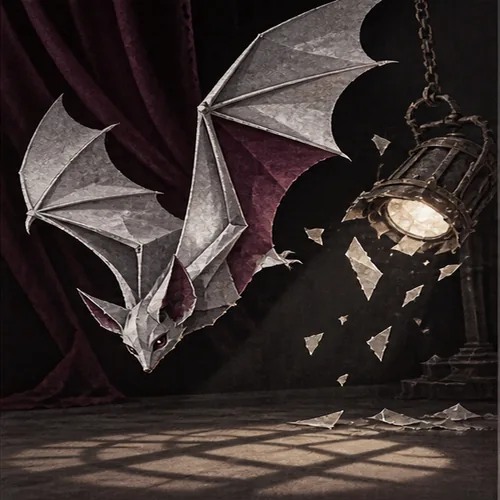 Silver-Echo BatC33 · 2 energy · 3/1It repeats only the sound magic makes after it has already passed.Read this folio → in a mirror theater during a benefit rehearsal. The Bat heard a spell only after it had passed; Facet answered an injury only after surviving it. Their timing made a strange duet. Facet struck a floor marker, waited through the silence, and bowed when the delayed echo returned. The Bat circled above him. Ren mapped the pattern in chalk. For one evening, lateness became music rather than failure.
These meetings mattered because Facet was often treated as the only impossible being in a room. Knowing the Crane and Bat did not make them siblings or pieces of one spell. It simply widened his idea of the world. There were other lives whose bodies confused ordinary categories. Each deserved a history of its own. Facet began keeping a second ledger, not of props, but of names he never wanted a theater manager to erase.
The House of Many Angles
When the Lanternless Players finally leased a permanent hall, they named it the House of Many Angles. The building had once been a counting room. Sera and Facet replaced its partitions with ramps, broad aisles, low rails, and a stage reachable without stairs. Mirrors lined the rehearsal wall, but none were flawless. Performers could find themselves in fragments without facing one authoritative image that declared every difference a defect.
Facet spent mornings repairing props and afternoons coaching movement. He never pulled another performer’s limb without permission. Instead he demonstrated choices, then waited. For actors who could not reproduce a motion, he asked what the motion meant and helped invent another that carried the same meaning. This made rehearsals slower. It also made performances impossible to duplicate elsewhere, because the work belonged specifically to the bodies creating it.
His hobby remained rehearsing bows that slackened his strings. He explored how surrendering tension could communicate trust without helplessness. One bow loosened only the wrist cords. Another allowed his head to hang while his legs remained ready. His favorite released every line at once, leaving him balanced through his own joints while the control bar rested uselessly above. Sera called it the free bow and cried the first time she saw it.
The House’s success attracted patrons who wanted the Players polished into respectability. They offered new seats, fine curtains, and a flawless central mirror if Sera would remove performers considered upsetting. Facet attended the negotiation in silence. When a patron described him as the company’s charming exception, he turned his torso so the man saw his own mouth repeated across seven warped facets. Then Facet crossed the patron’s name from the donation book.
Money grew scarce after that refusal. The Players patched roofs themselves and performed extra matinees. Facet wondered whether pride had endangered everyone. Sera answered by showing him the access ramp crowded with children, elders, chair users, and workers still in stained aprons. A theater that required its people to disappear in order to survive, she signed, had already closed. Facet placed that sentence in his name ledger.
The patron of perfect glass
Lord Aven Rusk arrived during the House’s seventh season with a proposal wrapped in apology. He owned the district debt and could forgive it. In exchange, the company would stage a court spectacle in which Facet played an obedient artificial servant restored by a noble master. Aven brought a towering flawless mirror for the production. Its gilded frame bore tiny locking sigils disguised as leaves.
Facet refused the role by performing the empty bow, then letting the control bar fall. Aven smiled as if refusal were merely an opening bid. He spoke to Sera instead of Facet and raised the debt figure. The company had thirty days. That night Facet stood before the perfect mirror and found its single smooth reflection unbearable. It erased the seams that told where he had been broken and remade.
The Players chose a different production: The Hands That Let Go. It told of a crafted servant who discovered that a string could connect without controlling. Prism CranePrism CraneC32 · 2 energy · 1/3Folded from the program of a play that never ended, it lands on the wrong page whenever somebody lies.Read this folio → contributed a folded program design; Ren sent silver chalk for marking safe echo paths. Facet choreographed the final scene around the free bow. The work openly contradicted Aven’s demanded spectacle, and advance seats sold faster than any production in the House’s history.
Aven responded through inspectors. They measured aisle widths already approved, condemned repaired lanterns, and questioned whether a nonhuman performer could legally sign the safety ledger. Facet answered every visit by producing records in immaculate order. Procession Page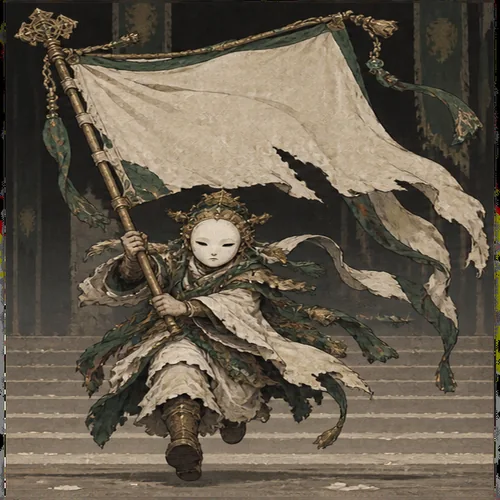 Procession PageC39 · 1 energy · 1/2The smallest herald carries a list of names too heavy for its paper arms, adding one final mark to debts already bleeding.Read this folio →, encountered once at a courthouse door, had taught him the value of a mark placed beside damage already visible. Facet did not know the Page’s whole story, but he remembered the small figure’s care with names.
Sera suspected the mirror was more than a gift. Under the frame she found channels meant to carry a sealing spell when blood or broken silver touched the glass. Aven intended to claim Facet as an enchanted asset if the theater defaulted. They could not remove the mirror without triggering the debt clause. So Sera covered it with burgundy cloth and stationed Facet’s oldest cracked handplate above the frame as a warning.
Opening night without permission
The Hands That Let Go opened during hard rain. Every accessible seat filled. Sera, too stiff to work the control bar for a full performance, stood in the wings while Facet danced under deliberately slack cords. The audience understood gradually that no hidden hand supplied the motion. Surprise moved through the hall, followed by a quieter recognition: they were watching a person reveal a truth that had always been dangerous to show.
In the second act, masked intruders entered through the loading door. They wore stagehand gray and carried hooked knives designed for cutting scenery lines. Their purpose was not subtle. One locked the exits. Another pulled the burgundy cover from Aven’s mirror. Its hidden sigils woke, silver veins traveling through the glass. Aven sat in the rear balcony, dry despite the storm, watching his contract become a trap.
Facet saw the danger through a dozen reflections. He broke choreography, tapped twice for danger, and sent performers toward the ramp exits. The audience initially mistook the alarm for part of the show. Sera rang the work bell in an irregular pattern everyone in the company knew. Harl repeated the evacuation order through his brass cone. Only then did hundreds of people begin moving through aisles designed to hold them without panic.
The intruders targeted Facet’s strings. One hook caught his left shoulder line and tore it free. Another severed the crown cord. Facet fell hard enough to split two torso facets, but his knee joint held. The oldest script traveled through him: receive, survive, measure. He bowed from the damaged position, turning the fall into stored tension while the attacker leaned close to finish the work.
Facet released the counterstroke through his intact right arm. One mirrored fingertip struck the attacker’s wrist. The hooked knife fell. The blow was small, no more than the exact answer the surviving body could give, but it allowed Min to roll past and kick the knife beneath the stage. The audience later remembered that gesture more clearly than any grand duel: a wounded performer refusing to let injury write the final line.
The shattering
A second intruder yanked the remaining strings toward the perfect mirror. The locking sigils recognized Facet’s reflected body as property named in Aven’s contract. Sera reached the control bar and pulled the cords sideways, trying to keep him outside the seal. Facet understood that the struggle would tear her hands apart. He cut his own ankle line against a broken edge and placed his loose palm over hers: yes, with feeling. Then he let go.
The mirror dragged his reflection forward while his physical body remained on the stage. The mismatch bent every silvered facet toward the frame. Cracks crossed his arms and chest. Sera struck the emergency stage seal, a safety mechanism meant to isolate fire or hostile magic inside a mirrored boundary. She did not know Aven’s sigils had been threaded through it. The seal closed around the perfect mirror, Facet’s reflected image, and the burgundy cords between them.
The great glass shattered. Facet’s body dropped in pieces, yet his awareness did not end at once. He felt the floor through one heel, Sera’s hand through a severed wrist, rain-cold air across an exposed wooden joint, and hundreds of frightened reflections through shards still falling. His last chosen movement was the free bow: every controlling line slack, balance held by the self for one impossible second.
He also felt the attacker return. The man had survived Facet’s wrist strike and raised another hook toward Sera. A surviving hand facet, carried by the recoil of the emergency seal, flashed from the broken mirror and cut the hook’s line. It was not a new attack after death. It was the completion of the stored answering motion begun while Facet still held together. Sera escaped through the wing.
No intact body remained. The Players gathered ashwood joints and mirror pieces until dawn, but none moved. Aven fled before the watch arrived. The perfect mirror stood empty inside its frame, though every shard on the floor reflected Facet bowing from a slightly different angle. When Sera touched the control bar, its cords tightened toward the glass as if pulled by someone on the other side.
The binding in the reflection
Facet’s spirit should have passed when the last joint stilled. Instead, the emergency seal confused reflection with body and repetition with life. It had been designed to keep dangerous magic from leaving a stage. Aven’s ownership sigils supplied a name, the perfect mirror supplied an unbroken image, the burgundy strings supplied a path, and the final answering bow supplied motion. Together they caught the departing self in the instant between injury and response.
The binding was accidental. Sera had activated the seal to save the audience, not to preserve Facet. Facet had chosen to release her hands, not to remain in the mortal world. Aven had intended possession, but his contract failed to contain the whole spirit as property. The result belonged to none of them: a person held across mirrored memory, compelled to repeat survival without reaching the rest that should have followed it.
For weeks the House heard soft joint clicks after midnight. Reflections bowed when the rooms were empty. If a worker accidentally struck a mirror and left it standing, a second tap answered from within. Sera slept beside the sealed frame, apologizing until her voice failed. Facet could not tell her that she had made the only choice that saved hundreds. He could only loosen the hanging cords whenever she gripped them too tightly.
Sera rebuilt one small figure from the recovered facets, but it never woke. This mattered. Facet was not automatically present in every piece of his former body, and the new puppet was not him. His identity remained in the sealed relation among mirror, cords, name, and final motion. The company kept the rebuilt figure as a memorial and allowed children to touch its hands. They never called it Facet.
Years passed. Sera aged beside the mirror. On his birthday she performed the free bow in front of it, slowly because her spine no longer bent well. The reflected Facet bowed with her, cords slack. When she died, the Players carried her control bar in the funeral procession but did not place it in the grave. Her written wish said it belonged to the one person who had taught her what letting go meant.
The card of the second gesture
The Ledger Crow came after the House had become an archive. He found the sealed mirror behind burgundy curtains and read every maintenance mark, debt notice, and cast ledger Sera had preserved. He did not mistake the papers for Facet’s soul. Records explained the life; they did not contain it. The spirit remained whole within the stage seal’s repeating reflection, still unable to cross beyond the final bow.
To move the dangerous seal without shattering it again, the Crow folded its relations inward: reflected name, slackened cord, surviving injury, and precise answer. They condensed into one official card. The transfer did not free Facet or create copies. It changed the walls of the confinement from a theater mirror to a portable mortal form. The empty mirror finally reflected only whoever stood before it.
Inside the card, Facet remembers his whole existence before the binding. He remembers sugared plums, geese attacking his eyes, Min’s rolling chair, Harl’s brass voice, Prism CranePrism CraneC32 · 2 energy · 1/3Folded from the program of a play that never ended, it lands on the wrong page whenever somebody lies.Read this folio →’s blank page, Silver-Echo BatSilver-Echo BatC33 · 2 energy · 3/1It repeats only the sound magic makes after it has already passed.Read this folio →’s delayed note, and Sera’s hands resting safely between his palms. The combat text is only one narrow translation of that life. It does not reduce him to retaliation.
At the table he costs three energy and arrives as a two-attack, four-health creature. When he survives while defending, he deals one damage back to the attacker if that attacker remains. The wording preserves the oldest script exactly: injury must occur in defense, Facet must still be present after receiving it, and the aggressor must remain available for the answering gesture. If either creature is already gone, no impossible extra blow is invented.
The card’s mirror facets show no random stranger. They preserve Facet’s ashwood joints, wine cloth, burgundy strings, rose-like headpiece, and the cracked standing mirror that witnessed his last night. Anyone depicting him must keep that identity. A generic marionette, borrowed card frame, or unrelated dancer would erase the specific person the archive exists to remember.
Strategy of surviving defense
Facet is strongest when an opponent must attack through his four health. A small attacker can injure him, survive the ordinary exchange, and then receive the additional one damage. That final point often changes combat math. Players should calculate the normal attack and retaliation first, confirm that Facet survives, confirm that the attacker remains, and only then resolve his answering effect.
If Facet is destroyed by the attack, he cannot perform the second gesture. If the attacker is destroyed by normal retaliation, there is no remaining target for the extra damage. His ability is not a death trigger, does not fire while he attacks, and does not strike the enemy champion. These limits are part of his character: the answer belongs to a survivor facing the aggressor who is still there.
Healing and protection can let him repeat the pattern across turns. A one-point heal after a narrow defense may preserve enough health for another interception. Attack reductions also help because they make survival more likely. The opponent can answer by using damage large enough to remove him, attacking elsewhere, or sending a creature likely to die to normal retaliation so the extra point has no target.
Visual examples on the folio show each checkpoint. Against a two-attack, three-health attacker, Facet takes two and survives at two health. His normal two retaliation leaves the attacker at one, then the effect deals the last point. Against a four-attack creature, both may resolve ordinary combat, but Facet reaches zero and supplies no extra damage. The difference is not flavor; it is the rule.
His open relationships with healing, attack reduction, and forced targeting create strategy without adding text to his card. The Crowpedia catalog lists spells, traps, enchantments, champion attacks, and power paths separately in concise form. Those entries explain what current game pieces do. Facet’s biography remains the place to understand why survival followed by one exact answer belongs to him.
What remains in the House
The House of Many Angles continued after Sera. Its central wall holds mismatched mirrors at heights chosen by the people who rehearse there. No flawless glass occupies the old frame. A plaque describes Facet as a founding performer, movement teacher, road companion, repairer of props, hater of storage boxes, collector of gestures, and friend. The word property appears only in the account of the contract he resisted.
Young performers still learn the free bow. Instructors explain that slackening a string can mean trust only when the person attached to it chooses the release. They also teach the empty bow used at checkpoints, though students often exaggerate it until everyone laughs. Traditions change in living hands. Facet would have approved of any gesture that refused to become a cage.
His drawers of replaced parts remain labeled in Sera’s script. Archivists resist offers to sell individual facets as relics. The pieces are not magical copies and do not grant his ability. They are ordinary material made meaningful by use. Keeping them together respects a person who measured life through what had been repaired, not through an illusion of never having broken.
Some visitors stand before his card and see only a clever defensive creature. Others notice the birthday, Gemini sign, faction, hobbies, and small preferences. A child once left a sugared plum beside the display after reading that he had secretly shared his first one. The fruit was removed before it spoiled, but the wrapper remains in the archive ledger under gifts accepted on Facet’s behalf.
What reaches an audience is not the spectacle of a puppet that became alive. It is the life of someone whose body made strangers assume control belonged elsewhere, and who spent years proving that connection and command were different things. His spirit is still trapped in the mortal world. The card has not solved that wrong. Yet every accurate telling restores the context his captor tried to erase: the bow was his because the choice was his.
The bow that is his
Facet does not ask to be loved because he is delicate. He was durable, funny, occasionally vain about polished joints, patient with frightened children, impatient with patrons, and capable of making a room understand a sentence through one hand. His wounds matter because they happened to a full person. They are not the only interesting thing about him.
He remains connected to Prism CranePrism CraneC32 · 2 energy · 1/3Folded from the program of a play that never ended, it lands on the wrong page whenever somebody lies.Read this folio →, Silver-Echo BatSilver-Echo BatC33 · 2 energy · 3/1It repeats only the sound magic makes after it has already passed.Read this folio →, and Procession PageProcession PageC39 · 1 energy · 1/2The smallest herald carries a list of names too heavy for its paper arms, adding one final mark to debts already bleeding.Read this folio → through encounters recorded in their separate histories. Those links do not merge their souls or make one character a prop in another’s tragedy. Hovering a linked name in Crowpedia should preview the other individual’s image and identity, allowing readers to follow the relationship without losing who is speaking in the current life.
His faction, A Thousand False Faces, does not mean his own face was false. The faction studies performance, reflection, disguise, and the truths that emerge when appearances split. Facet belongs there because every angle offered a partial view and no single viewer owned the complete person. His many surfaces protected complexity from anyone demanding one convenient definition.
If the card appears in merchandise, illustration, animation, or a strategy example, his official design must remain recognizable: pale jointed ashwood, irregular mirror armor, burgundy and gray stage cloth, rose-like folded headpiece, wine-red strings, and a cracked mirror world. New images should depict moments from his actual story, not paste him onto unrelated fantasy scenery. The history exists so affection has something specific to attach to.
And when the table places him between an attacker and someone more vulnerable, the old script begins again. A blow arrives. The body bends. The mirrored face catches a hundred versions of the moment. If Facet survives and the attacker remains, one exact point answers. Then the strings fall slack, and the bow that follows belongs to no handler, patron, contract, or spell. It is his.
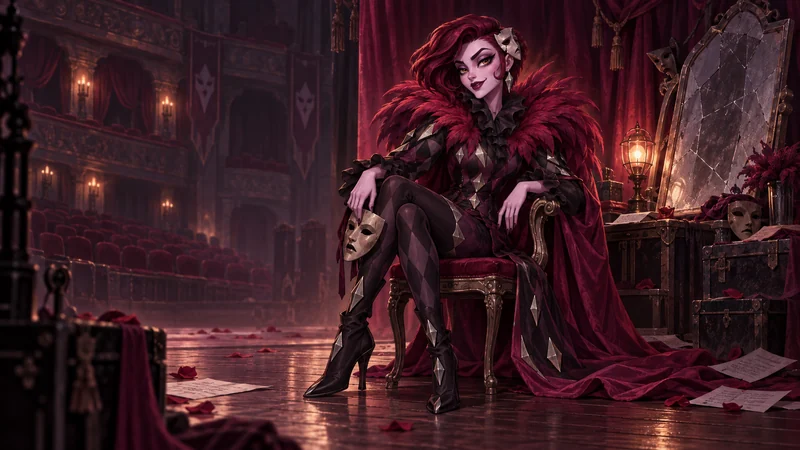 VessaFirst-generation championVessa once played every role in the mirror theater.Read this biography →
 Quietpaper GolemC35 · 3 energy · 2/4Folded funeral notices pack its chest so tightly that no bell can make it speak.Read this folio →