
June 5 between performances
Serel was born on June 5 while her family's small company waited for a road to dry. Her father repaired instruments and played the bells during performances; her mother carved masks and disliked traveling anywhere without knowing where clean water could be found. Serel came into a household of long white hair, dark slender limbs, and clawed hands capable of delicate work. She was not a human child wearing an animal costume. The pointed fox masks the family used onstage belonged to their theatrical tradition, concealing faces the audience had no special right to inspect after paying for a story.
Her older brother preferred boats to performances and spent much of childhood explaining how soon he would leave the company to build them. Serel took these announcements as personal desertion. She hid one of his tools, then helped him search for it with an enthusiasm that eventually betrayed her. Their mother required her to return it and listen while he described what he wanted, without offering a better future on his behalf. Serel understood the lesson and disliked it. She loved her family intensely, but at first that love included the conviction that everyone ought to remain near enough for her to arrange the next game.
Her favorite game involved imitating people with sufficient accuracy that they recognized themselves and sufficient kindness that they laughed. She was better at the accuracy. A ferryman's stiff walk, copied before she knew he was injured, earned her the first apology she could not improve by being charming. Her father made her deliver it plainly. Later she began asking permission before turning a familiar gesture into a joke. The pleasure never left her: a movement could tell a room who someone was before a single word arrived. She wanted to learn how much could be said that way without making the person smaller.
On June 5, the company let her choose the closing tune. She repeatedly chose an untidy one that required the players to exchange places midway through. She liked watching competence briefly become confusion and then settle into cooperation. Her father gave her one cracked bronze bell to keep, explaining that its imperfect note made the others easier to hear. She wore it on a red cord after learning to stop ringing it beside sleeping people. In later years the bell would hang among finer ornaments. Both dancers remember its original sound. Neither accepts the other's claim to have remembered it first.
A floor wide enough to learn
When the company found regular work on the mirror-theater circuit, Serel finally had a rehearsal floor that did not end at a wagon wheel. Her first teacher, Sevet, had retired from the sharpest turns after damaging a leg. She taught from a chair when standing became painful, marking the count with a stick against the boards. Serel initially mistook the chair for a sign that the lessons would be easy. By the end of the first morning, she had learned how much effort could fit into moving one foot correctly. Sevet asked for balance before speed and attention before either.
The blade came later. It was a broad crescent with polished reflective panels set along its curve, made for a style in which the weapon's changing light helped an audience read the dancer's path. Serel began with wood. She learned where a partner could safely stand, how a sleeve changed momentum, and why looking beautiful from the gallery did not excuse being unpredictable to the person beside her. Her long white hair was tied back until she understood how its weight moved. The pointed silver fox mask came after months of practice; dancing without seeing the floor directly required a different confidence from merely pretending she did not need to look.
Sevet paired her with students whose rhythms differed. One arrived at each step cautiously; another rushed the last part of every phrase. Serel could adapt to both and soon became insufferable about that ability. She corrected people while they were still trying to hear the original instruction. Sevet made her dance an entire afternoon with the slowest beginner and forbade advice unless requested. The exercise annoyed her until she noticed how often the other student had been moving away from her corrections rather than toward the music. She learned to offer a steady place from which someone else could decide to move.
Off the floor, she practiced folding paper into elaborate shapes she invariably forgot how to unfold. She liked sour fruit, arguments about costumes, and choosing names for the stray cats behind the theater even after the animals acquired better names from other people. She disliked hearing herself reduced to strangers' descriptions: the graceful one, the difficult one, the young prodigy, each phrase offered as if it contained her. She was not yet aware how readily she imposed equivalent descriptions on others. Her brother, now apprenticed to a boatbuilder, visited and listened to an hour of theater complaints before asking whether she wanted him to solve them or eat supper with her.
The person behind the bells
Teren joined the theater as a percussionist and became the person whose silence Serel could tolerate most easily. He had an exact ear and a habit of tapping complicated rhythms against whatever surface was nearest. She answered with a foot, a claw against a cup, or the cracked bell at her wrist. They could hold a conversation about an ordinary day's frustrations through exaggerated versions of each other's musical mistakes. Teren was also willing to say when he was tired of the game. This made him more valuable to her than the people who admired everything she did and never risked displeasing her.
Their friendship was maintained through unremarkable work. They cleaned practice boards after everyone else left, searched markets for inexpensive cloth, and argued over whether a bad performance required discussion before breakfast. Teren preferred breakfast. Serel preferred to believe discussion would prevent the next bad performance, then became hungry enough to agree with him. He learned to leave a portion covered when she rehearsed late. She learned which part of his instrument case always needed tying twice. They were sometimes mistaken for a romantic pair and sometimes for siblings, and did not find it necessary to settle the question for every curious stranger.
Her adult costume developed through these years. Her mother designed the layered purple and black robes so their folded edges would continue a movement after the body stopped. Gold floral patterns showed the turn of the fabric, while red knots and tassels marked the lines an audience needed to follow. Bronze bells and small medallions gave the dance its own sound. Serel chose the angular fox mask herself, with narrow red openings and a face that could look amused or severe depending on its angle. Beneath it, the dark clawed limbs remained those of the girl who had once crawled beneath a wagon to hide her brother's tool.
Success pleased her. She liked a full room, a well-timed gasp, and finding that strangers had attempted her difficult turns at home. She also disliked a performance once she could repeat it without uncertainty. Teren called this appetite useful onstage and exhausting at supper. She began collecting endings other dancers abandoned: an interrupted bow, a turn that failed to settle, a phrase whose final beat seemed to belong to another tune. She believed the best ending should reveal something that had been present all along without simply confirming what everyone expected. That ambition would outlast the body that first learned to pursue it.
The glass that kept a movement
The rehearsal mirror stood in a narrow room off the upper gallery. Its silver backing had been prepared to retain unfinished movements and offer them again when a performer returned. Dancers had used it for generations as a demanding practice aid. An ordinary mirror showed where a hand was; this one could repeat where it had almost gone. The frame carried small working marks rather than a readable warning, and the people who maintained the room understood its habits better than its construction. Serel first used it to examine a turn that disappeared from her mind as soon as she completed it.
The glass pleased her by refusing easy praise. It repeated a drooping shoulder, exposed the hesitation inside a flourish, and held the imperfect ending after she had turned away. She began returning before the others arrived. When Teren played below, she could hear his count through the floor, but often continued after he stopped. The reflection eventually began completing a movement a heartbeat before her body reached it. She took the change for evidence that she was approaching a more fluent performance. Instead of studying her own attempt, she studied the image's apparent correction and learned to follow it.
The final phrase of her new dance required a turning cut with the mirrored crescent, followed by a step that brought the blade, mask, and falling robes into a single still line. Every previous version felt like a pose she had decided upon too soon. The image offered another possibility. Its heel settled, its wrist released the smallest degree of tension, and the whole movement seemed suddenly inevitable. Serel tried to reproduce it. She could reach the position but not the transition. In the mirror, the reflection watched with an expression she did not remember choosing, as if it had become the teacher and she was arriving late to the lesson.
Sevet asked her to spend a week practicing without the glass. Serel heard concern as fear of being surpassed and answered with an arrogance that made her ashamed almost at once. She returned the next day to apologize, but not to accept the advice. Teren noticed that the image sometimes continued moving after Serel stopped. She insisted that retaining motion was what the mirror had been made to do. This was true and incomplete. They argued about the difference. She had become very skilled at using an accurate fact to prevent a question from reaching the part of herself that needed to hear it.
The evening she missed
Her brother invited her to see the first boat he had completed without his master's supervision. The launch was on a quiet afternoon, followed by supper with people Serel scarcely knew. She promised to attend and spent the morning rehearsing. By the time she noticed the light had changed, the boat was already on the water. She arrived with an elaborate explanation of a breakthrough and discovered that nobody at the table wanted to hear it. Her brother put a plate before her because he had saved food. His consideration was harder to endure than an accusation. She ate and asked him about the boat, awkwardly, long after the question should have come.
She tried to make repairs through gifts: better tools, paid tickets, a new coat. Her brother wanted her to keep a modest promise without turning the result into a production. Teren wanted her to take a day away from rehearsal and remain present through it. Serel agreed, went to the market with him, and spent the first hour reproducing the final step with her fingers against her thigh. He caught her doing it and said nothing. She stopped. Later they bought sour fruit neither had intended to buy and sat beneath an awning while rain made their routes inconvenient. She laughed so hard at one of his imitations that the fruit juice went down her wrist.
The ordinary afternoon frightened her afterward. It proved how much she still enjoyed a life that did not depend on getting the ending right. She had begun treating every pleasure outside the practice room as time stolen from the person she hoped to become. Recognizing this did not dissolve the habit. On her next June 5, she allowed the company to perform the old tune in which players exchanged places, then disappeared upstairs before the last cup was cleared. Teren found the cracked bell on the table and carried it to her. In the mirror behind her, another hand seemed to reach for it before she did.
The public performance was scheduled soon afterward. Serel insisted that the rehearsal mirror be incorporated into the stage, so the audience could see the completed movement from two angles. The stage crew protested about its weight and unfamiliar effects. She listened to their practical objections, paid for additional supports, and mistook solving those problems for answering the larger one. The mirror stood securely. The rehearsed exits remained clear. The people closest to her had warned her of a danger they could not fully name, and she had convinced herself that danger without an explanation was only another form of reluctance.
The step that came first
Accounts place the performance around 2200 A.B. Teren kept the rhythm from the side of the stage. Serel entered with her white hair loosened over the purple folds, the mirrored crescent catching light above her shoulder. For most of the dance, the image behaved almost as expected. It reached the turns early, but an audience accustomed to theatrical tricks could mistake the difference for angled glass or a second performer behind it. Teren knew the count was wrong. He tried to slow the phrase. Both figures adjusted, although he could no longer tell which had responded to his hands first.
At the final step, the reflection completed the movement Serel was still trying to begin. It smiled, lowered the mirrored crescent, and stepped out through the silver. The blade was solid enough to strike the stage and leave a mark. Serel moved backward as the image took the place she had meant to occupy. Then the glass brightened across both figures, their robes crossed, and the lamps threw the audience's sight into confusion. Teren followed one red tassel until it passed behind an identical fold and appeared somewhere else. From that turn onward, even the witness who knew her best could not keep a trustworthy count of which body had come from which side.
The crossing killed the living dancer without resolving that count. The mirror had been holding one unfinished movement; now its leading image and the body following it occupied the same open interval. The silver drew the dancer's last living breath into that interval and held it there, a pale shape visible between the glass and its backing. The heartbeat that had sustained her ordinary body stopped. Both figures fell silent for one beat and rose cold, without breath. The mirror kept the departing spirit within the doubled movement instead of allowing it to pass beyond the mortal world. No willing vow or choice to remain had been asked of her.
The two dancers finished the phrase differently. One made the step the reflection had demonstrated. The other answered with a turn Teren recognized from an old, abandoned rehearsal. Neither brought the suspended breath back. Their blades met, throwing broken light across the room, and each seemed to cast the other's shadow. The spectators left before the curtain fell, some convinced they had watched a killing, others an elaborate escape. Teren remained long enough to hear both figures call him by the same private joke. He could not bring himself to call either a stranger. That failure of certainty would become the beginning of their shared existence.
Two answers to one name
They both answered to Serel. Each remembered the canal launch she had missed, the sour fruit in the rain, the exact place a stolen tool had been hidden in childhood. Each insisted the other had acquired those memories through imitation. Teren asked questions he believed no reflection could answer and discovered he had no sound reason for that belief. One dancer remembered the taste of burnt bread more vividly; the other remembered which hand had held the plate. They accused one another of inventing details, then found a letter or a witness confirming both. The surviving life would not divide itself into a clean original and a convenient counterfeit.
They tried stopping. One sat on the stage and refused to lift the blade. The other found herself moving toward the mirror against her intention, pulled through the unfinished interval until both were standing again. Covering the glass made their outlines vanish from the room without giving either rest. Uncovering it returned them to positions that no observer could confidently assign. They tried leaving separately and were drawn back toward the nearest reflection before the final threshold of the building. Moving together let them travel farther, especially where a polished surface could carry the stored interval along. They could change stages. They could not become free of the unfinished movement.
Sevet arranged a careful attempt at a place where departing spirits were sometimes seen beyond the city's ordinary roads. The dancers approached side by side. As one shape began to thin toward that passage, the other was pulled back into the mortal reflection beside the path. The opening closed and returned both to their starting steps. The mirrored interval required a leading figure and a following figure; whenever one tried to leave, it restored the pair before the sequence could end. Neither could pass without the whole unresolved relation being carried with her. Calling the other unreal did nothing to alter its force.
They finally broke the rehearsal glass. The stored breath flashed into the fragments, and the mirrored panels of their crescents cracked at the same instant. Gold repairs later held those weapon panels together, but the fracture never vanished. Instead of ending the trap, shattering the glass distributed the open interval through its surviving reflective pieces. The dancers learned to carry those pieces rather than risk one being sold beyond their reach. Their masks acquired corresponding gold-lined cracks, as if the old distinction between performer and prop had also failed. They remained the figures the audience recognized, with white hair, silver fox faces, dark clawed limbs, and robes that continued a turn after its meaning had become disputed.
The friends who had to choose
For a while, Teren tried assigning each dancer a different bell so he could at least greet a consistent person. They exchanged the bells overnight, each accusing the other of beginning the game. He was angry with both. Whatever the truth of their origins, he told them, his need to recognize the person he was addressing was not a flaw they had to expose. They returned the bells and attempted separate cords. The agreement lasted until a performance rearranged their reflected positions again. Teren stopped searching for a method that would settle identity through costume and began announcing the things he needed without pretending he could prove which figure owed them.
Serel's brother brought the old tool she had hidden as a child. One dancer reached for it. The other stepped aside and asked about his boats. Both actions hurt him for different reasons. He spent several visits trying to decide which response felt more like the sister he knew, then admitted she had been capable of both. He would not bless a contest in which one must become disposable before the other could be loved. He visited when he could and left when their quarrels exhausted him. Their condition did not oblige him to surrender his own life to investigating it.
There were still good evenings. The dancers played the old exchange-of-places tune with Teren, making a joke of a problem that elsewhere frightened them. They taught beginners to keep their wrists loose. One folded paper while the other tried to recover the original sheet without tearing it. At times they discovered a preference that had developed after the crossing: one enjoyed silence after rehearsal; the other wanted to repeat every sound. These differences shifted and did not reliably identify a source. They did, however, give the pair something to discuss besides ownership of the past. For brief periods, cooperation became more interesting than winning the argument.
The people who had known Serel alive grew old. Sevet stopped attending evening rehearsals. Her brother's children brought news from places the company had never visited. Teren's rhythm slowed as his hands stiffened, and both dancers adjusted to it without comment. When he died, they disagreed about which should carry his cracked drum frame from the room, then recognized the ugliness of the question and lifted it together. No departing shape returned to identify the real Serel for them. The loss was not a test arranged to solve their mystery. It was the death of someone who had kept offering friendship while they were busy demanding certainty.
The audiences that left early
Across the following centuries, they traveled through the mirror-theater circuit under one name. Some managers advertised twins. Others advertised a single dancer accompanied by an illusion. The pair objected to both descriptions and occasionally sabotaged a program rather than let either become authoritative. They were not innocent of using mystery to attract an audience. Serel had liked attention while alive, and whatever now carried that life still knew how to arrange an entrance. The name Mirror-Fang Dancer spread with accounts of a crescent blade bright enough to reveal a face and sharp enough to make looking away a sensible choice.
No audience agreed which dancer cast a shadow. An observer at one side saw a dark shape following the masked figure nearest the curtain; another saw it move from the far dancer's feet. Attempts to flood the stage with lamps multiplied reflections rather than settling them. The final phrase remained unfinished, its stored beat reaching toward a conclusion and being answered from another angle. Spectators began to notice their own reflections preparing to clap before their hands moved. The sensible ones left. Others stayed until the repetition made the room feel as if it had forgotten how long an evening ought to be, then fled before any final curtain could prove what had happened.
The dancers sometimes blamed each other for the departures. One accused the other of frightening people just when they might have learned something useful. The answer was that another empty room could not injure a performer whose best work had always been rehearsed for herself. It was a cruel answer precisely because it contained a part of the old Serel's truth. They learned to stop some quarrels before a blade came free. Not all. Their affection for the shared life did not automatically make them kind to the figure who contested it. Both carried grievances that would have seemed absurd to anyone who believed a reflection could not be hurt.
June 5 continued to matter. Some years they marked it by sharing sour fruit they could no longer taste as they once had. Some years they let a living musician choose the closing tune and left before an argument could reclaim the room. The cracked childhood bell survived among the bronze ornaments, though each claimed it was currently fastened to her own red cord. If a friend tried to inspect both closely enough to settle the claim, the dancers would abruptly find urgent reasons to move. They could mock their mystery and still protect it from questions whose answers they feared they might not be able to survive.
The page the crane refused
Near the archive's present, their disputed performances intersected with the routes of the Prism Crane Prism CraneC32 · 2 energy · 1/3Folded from the program of a play that never ended, it lands on the wrong page whenever somebody lies.Read this folio →. It arrived with folds drawn from a program for a play that had never reached its ending, though neither dancer could establish that it belonged to their own vanished stage. Similar paper, familiar marks, and a missing final page were not enough to prove a shared beginning. The bird settled on a program a manager had amended to identify one performer as the genuine Serel. It shifted to the wrong page each time the manager repeated the claim. He accused it of being part of the act. The dancers, for once, agreed to laugh at someone else.
The Crane offered no spoken explanation. Its interruptions made it harder for the pair to maintain a public declaration they could not support privately. When one insisted that the other had never loved Teren, the bird folded the page carrying his old musical credit beneath its wing. Both remembered loving him. Neither could use the memory to exclude the other without denying the evidence of years they had lived together. The Crane did not solve the argument; it made certain dishonest shortcuts less comfortable. They began keeping programs that preserved contradictions instead of quietly altering them into a single flattering account.
They also began studying soul vessels as possible ways to contain the entire open interval. Previous attempts had tried to finish the movement, destroy the image, or select one figure as the person permitted to leave. A vessel might carry the relation without first deciding it. The pair compared accounts over many evenings, testing harmless reflected gestures on prepared surfaces and stopping when either felt her memories becoming difficult to reach. One proposed capturing the other alone and withdrawing from the experiment afterward. The resulting silence lasted three days. An apology eventually arrived in the plain language Serel's father had once required.
The workable design used one prepared soul card between two polished surfaces. Each dancer would offer the movement from her own side, and the edges of the card would hold the interval together. Both had to enter; neither could remain outside as the owner of the other's prison. This would not complete the final step or reopen the passage beyond death. It could end the need to keep borrowing mirrors from rooms that frightened their audiences. The decision required a form of trust they had avoided for centuries: accepting the other figure's continued existence without demanding that she first surrender her claim to the life they remembered.
One card, two unfinished answers
They arranged the binding on an empty rehearsal stage, using two surviving pieces of the old glass and a prepared, unbound soul card. The cracked drum frame marked the space where Teren would once have sat. They set the childhood bell beside it and declined to decide which of them had brought it. One dancer began the phrase from the left; the other took the mirrored position on the right. The polished crescents remained in their hands, carrying the fractures through which the stored last breath had scattered. Instead of striking each other, they guided their blades along opposite sides of the waiting card.
The first attempt failed because each waited for the other to commit. The silver pulled toward the old interval, restoring the lead and the follower before either outline reached the paper. They stopped and began again. This time neither tried to perform the perfect ending. Both offered the unfinished movement exactly as it existed, including the hesitation each had spent centuries blaming on the other. The crescent edges traced a closed reflection around the card without cutting it. The suspended breath appeared once between the surfaces, then gathered into their shared boundary. Their shapes entered together, with no figure left outside to declare that she had escaped the imitation.
The vessel completed as one tall, thin soul card. Its reverse darkened to textured black within aged gold ornament; fine teal circles enclosed the stamped image of a red wax seal bearing a skeletal hand. The front held the Mirror-Fang Dancer's white hair, pointed silver fox mask, purple folds, red tassels, bells, and cracked crescent within the familiar narrow frame. In the reflective edge of the blade, another movement remained perceptible. The card held the whole unresolved pair and the mortal spirit caught between their positions. It did not reveal whether there were two complete selves, a divided self, or an image whose claim had become something neither knew how to dismiss.
The old glass on the stage ceased repeating the final beat. Inside the card, the dancers could still find one another and begin again. The confinement had changed into a vessel that carried their shared interval, rather than forcing it to occupy every mirror they approached. They remained in the mortal world, and no witness could identify an original by inspecting the new shadow. The childhood bell was heard once, although nobody watching its place by the drum frame saw it move. On the completed card, a silver face seemed to smile. Whether another face answered from the blade, or had smiled first, remained a question the final curtain had still not settled.

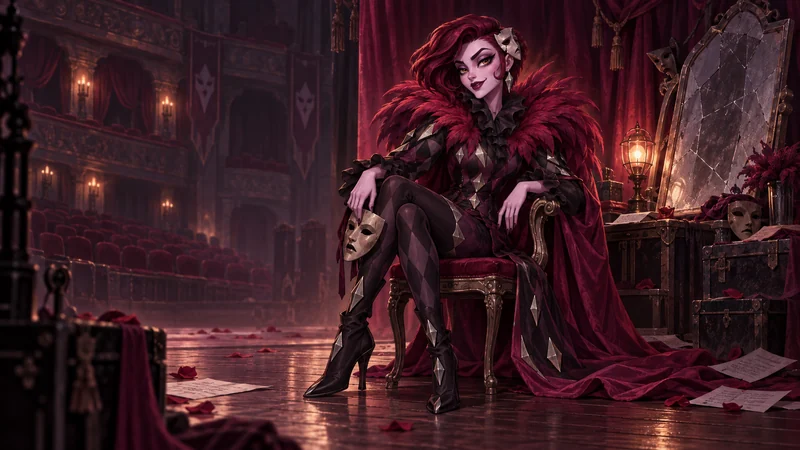 VessaFirst-generation championVessa once played every role in the mirror theater.Read this biography →
 Ash-Ribbon DuelistC03 · 2 energy · 3/2She once fought duels for silk ribbons and applause.Read this folio →
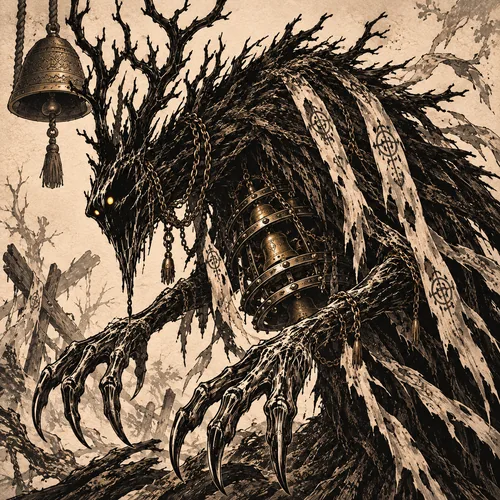 The Bell-EaterC08 · 4 energy · 3/5When the plague bells stopped, something beneath the cathedral began to starve.Read this folio →
 Grave Lantern KeeperC04 · 2 energy · 2/3The keeper lights a lantern for every grave the city refuses to mark.Read this folio →
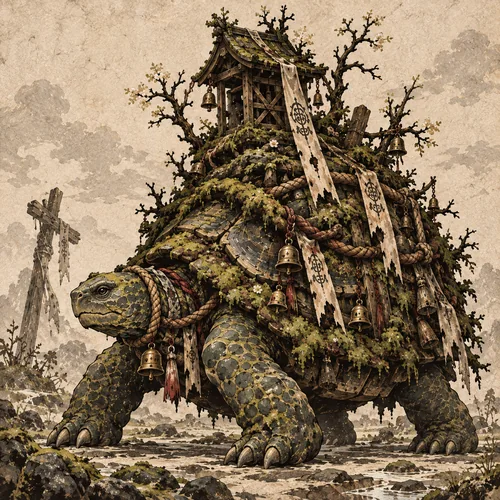 Thornback PilgrimC06 · 3 energy · 2/4The pilgrim planted a thorn in his back for every village that denied him shelter.Read this folio →